Key Takeaways
Genuine premium reduction on combined policies
Most major carriers offer multi-policy discounts of 5–25%, applied to one or both policies. Even at the low end, that's real money returned annually without sacrificing coverage.
Single insurer for coordinated claims handling
When an event — like a hailstorm — damages both your car and home, having one insurer handle both claims eliminates adjuster disputes about damage attribution and simplifies the entire process.
Simplified policy management and billing
One carrier, one customer service number, often one renewal date, and consolidated billing reduces administrative overhead for busy households.
Loyalty benefits accumulate over time
Long-term multi-policy customers tend to receive better service escalation, claim flexibility, and in some cases additional loyalty discounts that solo policyholders don't access.
Can stack with other discounts
Bundle discounts can often be combined with multi-car discounts, good driver discounts, or safety device discounts, compounding the total savings meaningfully.
Lower risk of coverage gaps at renewal
A single carrier managing both policies is more likely to flag mismatches in liability limits or coverage structures that could leave you exposed.
Discount may not beat best separate market rates
A 15% discount on a carrier's inflated base rate can still cost more than the best independent quotes for each policy type from competing carriers. The math doesn't always favor bundling.
Creates switching inertia at renewal
Once bundled, the friction of switching one policy without disrupting the other discourages comparison shopping. Insurers rely on this behavioral dynamic to retain customers who might otherwise find better rates.
Home insurer may be weak on auto — and vice versa
Not every carrier is equally competitive across both product lines. Choosing based on bundle availability rather than per-product strength can mean mediocre coverage or pricing in one or both areas.
High-risk homes may have limited carrier options
In wildfire-prone, coastal, or high-flood-risk areas, homeowners often have few or no bundle-eligible insurers available, forcing them to shop each policy line separately regardless of preference.
Specialty vehicle needs may require a dedicated insurer
Classic cars, exotic vehicles, or heavily modified vehicles are often better served by specialty auto insurers that don't offer home policies, making bundling impractical or financially disadvantageous.
Bundle savings erode if left unreviewed
Insurance pricing shifts regularly. A bundle that saved meaningfully at inception may no longer be competitive three years later, especially if local claims data or carrier pricing strategies have shifted.
Our Verdict
Bundling home and auto insurance delivers real savings for most mainstream buyers who insure standard homes and vehicles with a carrier that is competitive in both lines. The discount is genuine, the convenience is real, and the simplified claims process is an underrated benefit. However, bundling stops making sense when one policy line has a significantly better standalone option elsewhere, when your home sits in a high-risk area that limits your insurer choices, or when the bundle locks you into coverage limits that don't match your actual needs.
Bundling works best for homeowners with standard coverage needs who want simplified policy management and are willing to run the numbers to confirm the combined premium beats separate competitive quotes.
What Bundling Actually Means (and What It Doesn't)
Bundling home and auto insurance means purchasing both policies from the same carrier, typically in exchange for a multi-policy discount applied to one or both premiums. Most major insurers — State Farm, Allstate, Nationwide, Liberty Mutual, Farmers — promote bundling prominently because it increases customer retention and reduces their acquisition costs. That mutual benefit is exactly why it's worth scrutinizing rather than taking on faith.
What bundling is not: a guarantee of the lowest total premium. The discount is real, but it's applied to that carrier's base rate, which may be higher than a competitor's base rate in your area. A 15% discount on an inflated starting number can still leave you paying more than two separate best-in-class policies from different carriers.
It also doesn't mean your policies are combined into one document. You still carry two separate contracts — one for home, one for auto — with their own coverage terms, deductibles, and renewal dates. Some carriers will align renewal dates for convenience, but the policies remain legally distinct.
Bundle vs. Discount: Not the Same Thing
Homeownership alone — without a formal bundle — can lower your auto insurance premium at many carriers. Insurers view homeowners as statistically lower-risk customers, and some apply a homeowner discount to auto policies even when the home is insured elsewhere. If you own a home but can't find a competitive bundle, you may still qualify for this standalone discount. See our article on how homeownership status affects your auto rate for details.
High-Risk Home Markets Change the Equation
In states where the admitted homeowners insurance market has contracted — California, Florida, Louisiana, and parts of Texas — your home policy options may be limited to state residual market programs that don't participate in bundle arrangements. In these markets, the bundle discount is effectively off the table for home coverage, and your auto policy must be evaluated entirely on its own merits. This situation affects more households every year as carriers pull back from high-catastrophe-risk ZIP codes.
When to Revisit Your Bundle Decision
The right time to re-shop your bundle is at every renewal — or whenever you experience a major life change: buying a home, selling a home, adding a driver, buying a new vehicle, or moving to a new state. Insurance pricing is dynamic, and a bundle that was clearly the best deal two years ago may not be today. Set a calendar reminder to run the comparison at least once every 24 months even if nothing major has changed.
See our in-depth guide on when the bundle discount is actually worth it for a deeper look at how to evaluate multi-policy offers from specific carriers.
How Much Can You Actually Save?
Industry data consistently puts the average bundle discount somewhere between 5% and 25%, depending on the carrier, your location, your claims history, and the coverage amounts you're purchasing. That's a wide range — and the spread matters enormously when you're making a financial decision.
5–25%
Typical multi-policy bundle discount range
Industry data from major carriers and consumer research groups consistently places the home-auto bundle discount in this range, with the average around 10–15% depending on state and carrier.
~$646
Average annual bundle savings (homeowners)
According to insurance comparison data from PolicyGenius and similar platforms, homeowners who bundle and confirm competitive pricing save an average of several hundred dollars per year.
87%
Major insurers offering bundle discounts
The vast majority of large U.S. personal lines carriers offer multi-policy discounts, making it a near-universal feature — though the discount size and eligibility criteria vary significantly.
3 in 10
Bundled customers who last shopped competitors
Consumer surveys suggest a significant share of bundled policyholders haven't compared rates against separate-policy alternatives in the past two years, leaving potential savings on the table.
2x
Retention rate advantage for bundled customers
Insurance industry research shows that multi-policy customers are roughly twice as likely to renew with the same carrier as single-policy customers, reflecting the switching friction bundling creates.
The discount is typically applied to the auto policy, the home policy, or both, depending on the insurer's structure. Some carriers front-load the savings on auto (because that's where customers shop most aggressively), while others apply a flat percentage to each line.
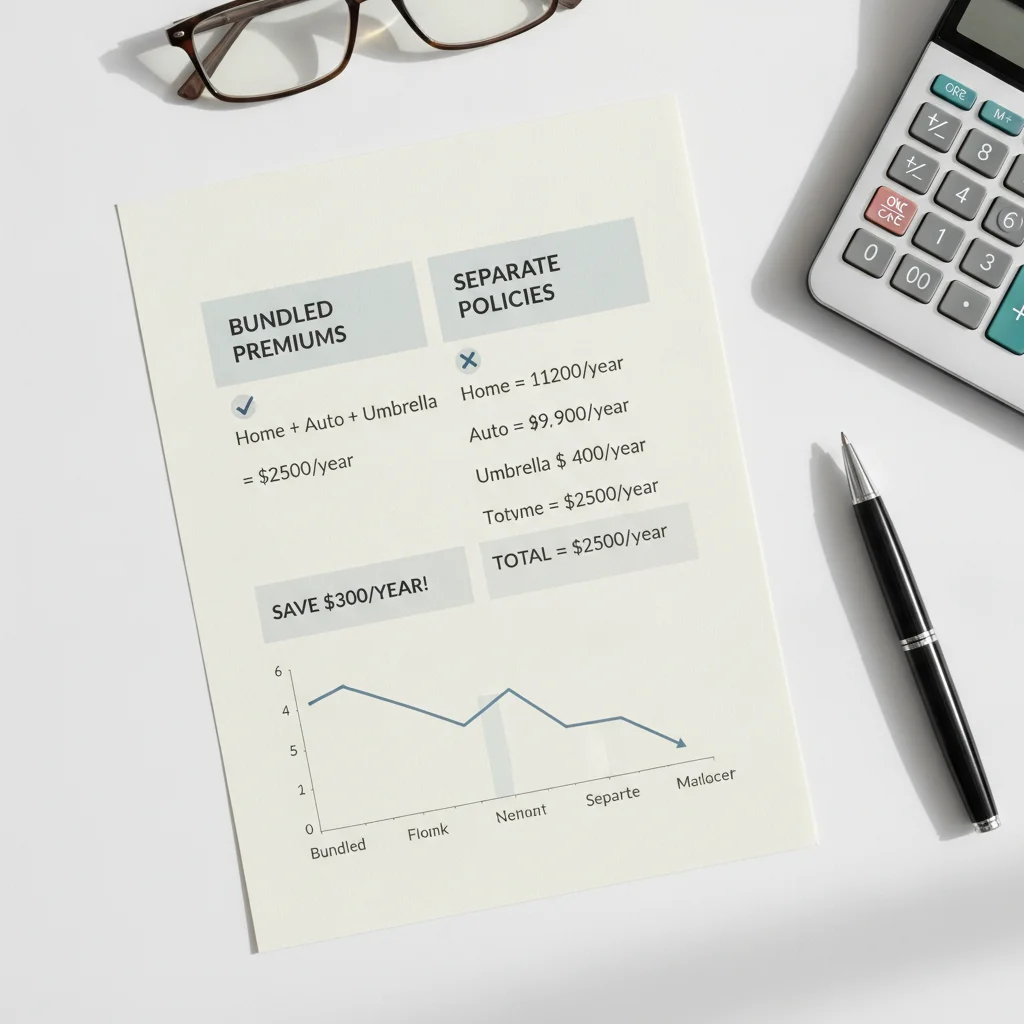
Here's the practical test: take your current or quoted bundled premium and compare it to the best individual quotes you can find for each policy type separately. Comparing policies side by side across multiple carriers is the only way to know whether bundling with any given insurer actually pencils out.
One real-world complication: the home insurance market has tightened significantly in states like Florida, California, and Louisiana due to wildfire and hurricane exposure. In those markets, homeowners may have limited carrier options for the home policy regardless of bundling interest, which constrains the comparison set and can reduce the bundle's financial advantage.
The Pros of Bundling Home and Auto
The case for bundling is stronger than just the dollar figure on the discount. Here's a full accounting of what you're actually getting.
Genuine premium reduction on combined policies
Most major carriers offer multi-policy discounts of 5–25%, applied to one or both policies. Even at the low end, that's real money returned annually without sacrificing coverage.
Single insurer for coordinated claims handling
When an event — like a hailstorm — damages both your car and home, having one insurer handle both claims eliminates adjuster disputes about damage attribution and simplifies the entire process.
Simplified policy management and billing
One carrier, one customer service number, often one renewal date, and consolidated billing reduces administrative overhead for busy households.
Loyalty benefits accumulate over time
Long-term multi-policy customers tend to receive better service escalation, claim flexibility, and in some cases additional loyalty discounts that solo policyholders don't access.
Can stack with other discounts
Bundle discounts can often be combined with multi-car discounts, good driver discounts, or safety device discounts, compounding the total savings meaningfully.
Lower risk of coverage gaps at renewal
A single carrier managing both policies is more likely to flag mismatches in liability limits or coverage structures that could leave you exposed.
One often-overlooked benefit is the claims experience. If a hailstorm damages both your car and your roof simultaneously — a scenario that happens far more often than people expect — having a single insurer handle both claims streamlines the process considerably. You deal with one adjuster, one point of contact, and one liability determination rather than two separate insurers potentially disagreeing about damage attribution.
The loyalty factor also has a compounding effect. Long-term customers with multiple policies tend to receive better service escalation, faster claims processing, and more flexibility during disputes. That's difficult to quantify upfront but has real value over the lifetime of a policy relationship.
The Cons of Bundling Home and Auto
The disadvantages of bundling are less obvious but equally important. The core problem is that bundling optimizes for convenience and vendor loyalty rather than for price competition — and price competition is what keeps insurance costs down for consumers.
Discount may not beat best separate market rates
A 15% discount on a carrier's inflated base rate can still cost more than the best independent quotes for each policy type from competing carriers. The math doesn't always favor bundling.
Creates switching inertia at renewal
Once bundled, the friction of switching one policy without disrupting the other discourages comparison shopping. Insurers rely on this behavioral dynamic to retain customers who might otherwise find better rates.
Home insurer may be weak on auto — and vice versa
Not every carrier is equally competitive across both product lines. Choosing based on bundle availability rather than per-product strength can mean mediocre coverage or pricing in one or both areas.
High-risk homes may have limited carrier options
In wildfire-prone, coastal, or high-flood-risk areas, homeowners often have few or no bundle-eligible insurers available, forcing them to shop each policy line separately regardless of preference.
Specialty vehicle needs may require a dedicated insurer
Classic cars, exotic vehicles, or heavily modified vehicles are often better served by specialty auto insurers that don't offer home policies, making bundling impractical or financially disadvantageous.
Bundle savings erode if left unreviewed
Insurance pricing shifts regularly. A bundle that saved meaningfully at inception may no longer be competitive three years later, especially if local claims data or carrier pricing strategies have shifted.
There's also a behavioral inertia risk. Once you've bundled, the friction of switching one policy without disrupting the other creates a psychological barrier to shopping around at renewal. Insurers know this, which is why bundle discounts are partly a retention tool. Policyholders who bundled and never shopped again may be paying well above market rate within three to five years.
For drivers with specialty vehicles — classic cars, modified vehicles, high-value exotics — the auto policy offered by a general-market home insurer may have coverage gaps or valuation methods that don't serve them well. In those cases, using a specialist insurer for the auto policy and a separate carrier for home may produce better protection and better pricing. Our guide on add-ons that rarely pay off versus ones that do is worth reading alongside any coverage decision.

When Bundling Makes Sense
Bundling works best under a specific set of conditions. If all of these apply to you, the discount is probably real and worth taking.
- Your carrier is competitive in both lines. Some insurers are strong on auto but weak on home pricing, or vice versa. Research carrier ratings and quotes in your ZIP code for each product independently before assuming the bundle is a deal.
- Your home doesn't require specialty coverage. Standard single-family homes in low-to-moderate-risk areas are exactly what the major bundle carriers price well. Coastal homes, older homes needing replacement cost adjustments, or homes in wildfire zones often require specialist underwriters who don't offer competitive auto policies.
- You value simplified management. One carrier, one renewal cycle, one customer service relationship — for busy households, that's worth something tangible.
- You're adding a multi-car discount on top. Pairing a bundle with a multi-car discount for multiple vehicles can compound the savings meaningfully, often producing the best overall premium across the household.
Life changes can also create natural bundling opportunities. If you're buying a home for the first time, you're already shopping for homeowners insurance — that's the ideal moment to run a bundle comparison without additional switching friction. Similarly, getting married and combining auto policies is a natural trigger to evaluate whether bundling all household coverage makes sense.
When to Skip the Bundle and Shop Separately
There are clear scenarios where separate policies from different carriers will beat a bundle. Knowing them saves you from leaving money on the table.
Bundle vs. Discount: Not the Same Thing
Homeownership alone — without a formal bundle — can lower your auto insurance premium at many carriers. Insurers view homeowners as statistically lower-risk customers, and some apply a homeowner discount to auto policies even when the home is insured elsewhere. If you own a home but can't find a competitive bundle, you may still qualify for this standalone discount. See our article on how homeownership status affects your auto rate for details.
High-Risk Home Markets Change the Equation
In states where the admitted homeowners insurance market has contracted — California, Florida, Louisiana, and parts of Texas — your home policy options may be limited to state residual market programs that don't participate in bundle arrangements. In these markets, the bundle discount is effectively off the table for home coverage, and your auto policy must be evaluated entirely on its own merits. This situation affects more households every year as carriers pull back from high-catastrophe-risk ZIP codes.
When to Revisit Your Bundle Decision
The right time to re-shop your bundle is at every renewal — or whenever you experience a major life change: buying a home, selling a home, adding a driver, buying a new vehicle, or moving to a new state. Insurance pricing is dynamic, and a bundle that was clearly the best deal two years ago may not be today. Set a calendar reminder to run the comparison at least once every 24 months even if nothing major has changed.
- Your home is in a high-risk area. If your state's admitted market has pulled back from your county — common in parts of Florida, California, and Texas — you may be buying homeowners coverage through the state insurer of last resort (like Citizens in Florida or FAIR plans elsewhere). Those programs don't offer bundle discounts and don't partner with auto carriers. Your auto policy needs to be shopped independently.
- You have a significant at-fault accident or DUI on record. Nonstandard auto carriers (those specializing in high-risk drivers) typically don't offer competitive homeowners products. Keeping policies separate lets you use a specialist where you need one.
- You rent rather than own. Bundling renters insurance with auto is available from several carriers, but the discounts tend to be thinner — often 5% or less — because renters policies carry lower premiums to start. Run the comparison; don't assume it's a deal.
- You found a materially better standalone rate. If your best auto quote is 20% cheaper than the bundled carrier's auto rate even after the bundle discount, separate policies win on price. The math is simple: run it every renewal cycle.
For a systematic look at the scenarios where the bundle backfires, see our article on when bundling backfires and separate policies cost less.
How to Shop a Bundle Correctly
Most people evaluate bundling backwards — they start with a carrier they already use, ask for the bundle discount, and assume the resulting number is good. A more rigorous approach:
- Get your current total premium. Add home and auto costs together. This is your baseline.
- Get standalone quotes from at least three carriers for each policy type separately. This tells you the competitive market rate for each line.
- Add the best standalone auto quote to the best standalone home quote. This is your independent-shopping baseline.
- Get bundle quotes from at least three carriers that are competitive in both lines in your area. Compare the bundled total to both baselines from steps 1 and 3.
- Factor in non-price considerations. Claims satisfaction ratings (J.D. Power publishes annual data), financial strength ratings (AM Best), and customer service track records all matter — especially for homeowners, where claim disputes over roof damage or total losses can be financially significant.
Note that homeownership itself can affect your auto rate even without a formal bundle. How homeownership status affects your auto insurance rate explains the underlying logic — some carriers discount auto premiums for homeowners regardless of whether the home policy is with them.

Repeat this comparison at every renewal — or at minimum every two years. Insurance pricing shifts meaningfully with local claims data, reinsurance costs, and carrier appetite for specific risk profiles. A bundle that was a clear winner three years ago may not be today.
The Bottom Line on Bundle Discounts
Bundling home and auto insurance is one of the more reliable discounts in consumer insurance — reliable in the sense that it almost always produces some savings relative to buying two policies from the same carrier at full price. The more important question is whether that discounted price beats the alternative: best-in-class policies from two different carriers, each chosen for strength in its own product line.
For most households with standard homes and standard vehicles, the bundle is worth taking — but only after verifying it with actual competitive quotes. For households with specialty coverage needs, high-risk locations, or poor driving records, the bundle often isn't the best financial outcome.
The discipline required is simple: compare both scenarios numerically at every renewal, don't let inertia make the decision for you, and remember that the discount percentage means nothing if the base rate is inflated. The savings are real when you find a carrier that's genuinely competitive in both lines. Your job is to verify that's actually the case.
Bundle vs. Discount: Not the Same Thing
Homeownership alone — without a formal bundle — can lower your auto insurance premium at many carriers. Insurers view homeowners as statistically lower-risk customers, and some apply a homeowner discount to auto policies even when the home is insured elsewhere. If you own a home but can't find a competitive bundle, you may still qualify for this standalone discount. See our article on how homeownership status affects your auto rate for details.
High-Risk Home Markets Change the Equation
In states where the admitted homeowners insurance market has contracted — California, Florida, Louisiana, and parts of Texas — your home policy options may be limited to state residual market programs that don't participate in bundle arrangements. In these markets, the bundle discount is effectively off the table for home coverage, and your auto policy must be evaluated entirely on its own merits. This situation affects more households every year as carriers pull back from high-catastrophe-risk ZIP codes.
When to Revisit Your Bundle Decision
The right time to re-shop your bundle is at every renewal — or whenever you experience a major life change: buying a home, selling a home, adding a driver, buying a new vehicle, or moving to a new state. Insurance pricing is dynamic, and a bundle that was clearly the best deal two years ago may not be today. Set a calendar reminder to run the comparison at least once every 24 months even if nothing major has changed.

All claims are backed by peer-reviewed research. Sources on request.