
Key Takeaways
Why the Add-On Menu Is Designed Against You
Whether you're sitting in a dealership finance office or reviewing an insurance quote online, the add-on presentation is engineered for the same outcome: maximum spend with minimum scrutiny. Prices are quoted per month, not per year. The benefits sound indispensable. And there's always a sense of urgency—as if declining is somehow reckless.
I spent years on the dealer side of that table. Most optional products exist on a spectrum: some deliver genuine financial protection, others are high-margin upsells structured so that payout rates remain low enough to be profitable for the seller. The hard part is that they don't look different from the outside. A valuable add-on and a nearly worthless one can sit side by side on the same menu.
This article cuts through that. What follows is an honest breakdown of which optional coverages—both on the insurance and dealer side—tend to pay off for real drivers, and which ones you can almost always decline without regret. For a broader overview of the full optional coverage landscape, see the complete optional add-ons guide.
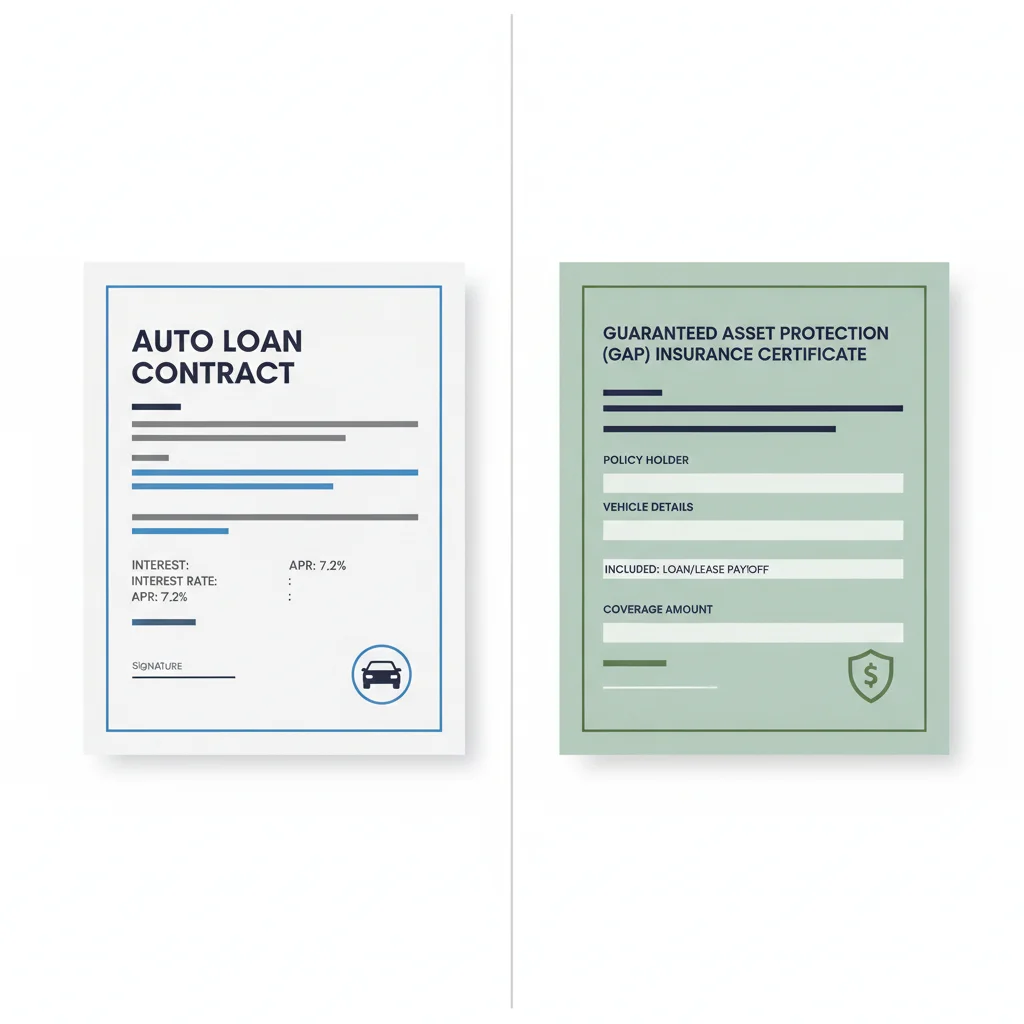
Gap Insurance — Worth It When You Owe More Than the Car Is Worth
Gap insurance (Guaranteed Asset Protection) covers the difference between what your car is worth at the time of a total loss and what you still owe on the loan or lease. The moment you drive a new car off the lot, depreciation can outpace your loan payoff balance—sometimes by several thousand dollars.
This add-on earns its cost in very specific circumstances: low or no down payment, a loan term of 60 months or longer, high depreciation rate (common with luxury and domestic trucks), or a lease. If any of those apply to you, gap insurance is one of the few add-ons that genuinely earns its premium. The average annual cost through an insurer runs $20–$40 per year—a fraction of what dealers charge for the same product.
The catch: Skip the dealer version. Finance offices regularly mark up gap insurance to $500–$900 as a lump sum rolled into the loan—you pay interest on it for years. Buy it directly from your auto insurer instead. For drivers leasing, this is essentially non-negotiable protection. See why gap coverage matters for leased vehicles.
Buy gap insurance from your insurer, not the dealer—you'll pay a fraction of the price.
Rental Reimbursement — Cheap Coverage That Earns Its Keep
Rental reimbursement covers the cost of a rental car while your vehicle is in the shop for a covered insurance claim. At roughly $5–$15 per month, this is one of the most straightforwardly useful optional coverages available—not because accidents are frequent, but because repair timelines have gotten dramatically longer.
Supply chain disruptions and parts delays mean a rear-end collision that once took a week to repair can now strand you for three to five weeks. A $30/day rental cap suddenly covers $600–$1,500 in expenses you'd otherwise absorb out of pocket. Unlike many add-ons, the premium-to-benefit ratio here is genuinely favorable for most drivers.
Who can skip it: If you have a second household vehicle you can use freely, or your employer provides a company car, the coverage may be redundant. Otherwise, this one is usually worth adding. The policy features drivers most often overlook guide notes that rental reimbursement is one of the most commonly undervalued line items in a policy comparison.
Extended repair timelines make rental reimbursement worth far more than its modest monthly cost.
Roadside Assistance Through Your Insurer — Often Redundant
Roadside assistance sounds like a must-have until you realize how many sources already provide it at no extra cost. Many major credit cards include roadside services. Manufacturer new-car warranties typically include it for three to five years. AAA and similar auto clubs bundle it into membership. And some health or home insurers include limited versions as well.
Adding roadside assistance through your auto insurer—usually $5–$15/month—when you already have it from two other sources is pure overlap. Before you add it, spend five minutes checking your credit card benefits portal and your vehicle's warranty documentation.
[in_content_images:2]When it does make sense: If you drive an older vehicle with no manufacturer warranty, don't carry a premium credit card, and aren't an auto club member, insurer roadside assistance fills a real gap. But this is the exception, not the rule. For a full breakdown of how to identify duplicate protections you're already paying for, see our guide on avoiding redundant optional coverages.
Most drivers are already covered for roadside emergencies through credit cards or manufacturer warranties.
Accident Forgiveness — Valuable Once, Then Diminishing Returns
Accident forgiveness prevents your rate from increasing after your first at-fault accident. For drivers with clean records, this has real financial value—a single at-fault collision can raise premiums by 30–50% for three years. The math on accident forgiveness works well in this scenario.
The problems start when the add-on is misrepresented. Many carriers only forgive one accident; a second at-fault incident triggers the full rate increase regardless. Some policies require a long claim-free period before the benefit activates—meaning a newer customer can't use it when they need it most. And if you've already had one recent at-fault claim, there's nothing left to forgive.
The real question: Is it priced proportionally to the benefit? If accident forgiveness adds $10–$15/month to a clean-record policy, and a single at-fault accident would cost you $600–$900/year in added premiums over three years, the protection is worth buying. If you're being charged $30–$40/month, the math reverses. Always price it against your actual rate-increase exposure. Year-round policy management habits can also help you stay in the best possible position before any claim arises.
Accident forgiveness earns its premium for drivers with spotless records—but only if the price is proportional.
New Car Replacement — Time-Limited and Easy to Overpay For
New car replacement coverage guarantees that if your vehicle is totaled in the first year or two of ownership, you'll receive the value of a new equivalent model rather than the actual cash value at the time of loss. Given how aggressively new cars depreciate in the first 12–18 months, this sounds compelling.
And it can be—but the window is narrow. Most policies cap the benefit at one to two years, and some carriers have strict mileage limits. If you're carrying this coverage on a car that's already 30 months old, you're paying for a benefit that no longer applies. The add-on frequently auto-renews without a reminder that the coverage window has closed.
What to do: If you bought new within the last 18 months and have a long loan term, it's worth evaluating. After that window, cancel it and consider whether gap insurance still makes sense given your remaining payoff balance. Compare this add-on against the comprehensive coverage picture in the real cost of skipping comprehensive coverage.
New car replacement coverage has a short useful window—check whether yours has already expired.
Uninsured/Underinsured Motorist Coverage — Chronically Undervalued
Uninsured motorist (UM) and underinsured motorist (UIM) coverage protects you when the other driver either has no insurance or carries limits too low to cover your medical bills and damages. In many states it's mandatory, but where it's optional, drivers frequently cut it to trim their premium—which is almost always a mistake.
The data is stark: roughly 1 in 8 drivers on the road carries no insurance at all, and a significant additional share carries the state minimum—which might be $25,000 in liability coverage on a policy in a state where a moderate injury claim easily clears $100,000. Your own health insurance may cover medical bills, but it won't cover lost wages, pain and suffering, or vehicle repair costs.
UM/UIM is typically priced modestly—often $30–$60/year for meaningful limits—which makes it one of the highest-value add-ons available. It's also one of the easiest to overlook during a quote comparison. Our detailed breakdown on why UM/UIM is easy to undervalue walks through real claim scenarios where this coverage made a decisive difference.
One in eight drivers has no insurance—UM/UIM is cheap protection against a very real risk.
Credit Life and Disability Insurance — One of the Worst Deals in Finance
Credit life insurance pays off your auto loan balance if you die before the loan is repaid. Credit disability insurance makes your loan payments if you become disabled. Both are pitched in the F&I office as peace-of-mind essentials. Both are, almost without exception, very poor value compared to alternatives.
The premium on credit life insurance is typically rolled into your loan—meaning you pay interest on an insurance product for its entire term. The benefit (loan payoff) declines as you pay down the balance, but the premium doesn't decrease proportionally. A standalone term life insurance policy for the same coverage period costs a fraction of what dealers charge, and unlike credit life, it isn't tied to a single creditor.
Credit disability coverage has similarly poor terms—waiting periods, exclusions, and benefit caps that limit real-world payouts. If disability protection matters to you (it should), buy a standalone disability policy from a licensed insurer, not a bundled add-on from a finance office. These are exactly the kinds of add-ons that sound essential but rarely are—decline them at the dealer and address the underlying need separately.
Credit life insurance on auto loans is overpriced, declining-benefit coverage—term life is almost always superior.
Mechanical Breakdown Insurance — Selectively Useful, Often Redundant
Mechanical breakdown insurance (MBI), offered by some auto insurers (notably GEICO), covers the cost of mechanical and electrical failures beyond normal wear and tear—essentially what an extended warranty covers, but often at lower cost. This is one of the more nuanced add-ons because its value depends heavily on vehicle age, mileage, and what else you're already carrying.
For a new vehicle still under manufacturer warranty, MBI is redundant. For a vehicle just out of warranty with low miles and a reliable reliability record, MBI may offer a cost-effective bridge before expensive repairs become likely. For a high-mileage older vehicle, the insurer may decline to offer it at all—or if they do, the exclusions may swallow most of the benefit.
[in_content_images:3]The honest assessment: MBI from an insurer tends to be cheaper than dealer-sold extended warranties, which carry significant markup. If you want this type of protection, MBI is the better version—but still compare it against self-insuring by banking what you would have paid in premiums. For high-mileage drivers specifically, the risk-reward calculus on multiple add-ons shifts—see how mileage changes the value of optional add-ons.
Insurer MBI is cheaper than dealer extended warranties—but only consider it if you're outside manufacturer coverage.
Paint Protection, VIN Etching, and Fabric Guard — Almost Always a Decline
These three are the dealer finance office classics. Paint protection films and sealants can be valuable—but not the spray-on version applied at the dealership for $300–$900. Real paint protection film (PPF) applied by a qualified shop runs more and covers more, or ceramic coating from a reputable detailer delivers lasting protection that dealer spray-ons don't approach.
VIN etching—etching your vehicle identification number onto the windows as a theft deterrent—costs $100–$300 at a dealership. You can buy a DIY kit for under $25 and do it yourself in fifteen minutes. Some insurers do offer a small discount for VIN etching, but it won't offset dealer-level pricing.
Fabric guard (or interior protection packages) is perhaps the easiest decline. The product is essentially Scotchgard, applied by a dealership technician, marked up 400–600%. A can of the consumer product costs $10 and takes ten minutes to apply yourself. None of these products are inherently useless—the dealership pricing is the problem. For a full breakdown, see dealer add-ons that inflate your final bill.
VIN etching kits cost $25 retail—paying $300 at the dealership is a pure margin play.
Custom Parts and Equipment Coverage — A Genuine Gap for Modified Vehicles
Standard auto insurance policies cover factory equipment. If you've added aftermarket wheels, a lift kit, custom stereo, running boards, or other modifications, those additions typically aren't covered under a standard collision or comprehensive policy unless you've specifically added custom parts and equipment (CPE) coverage.
For drivers who haven't modified their vehicle, this coverage is unnecessary. For drivers who have put $3,000–$10,000 in modifications into a truck or enthusiast vehicle, it fills a real and often overlooked gap. The annual cost is typically low—$30–$100/year depending on the declared value of modifications.
The key step is accurate documentation. Keep receipts and photos of all aftermarket additions. When you add CPE coverage, declare the actual installed value—not an inflated number, which can create claim disputes, and not an underestimate, which leaves you underinsured. This is also an area worth reviewing with the same attention you'd bring to understanding what a policy endorsement does.
If you've added $3,000+ in aftermarket parts, CPE coverage is a real gap in your standard policy.
How to Use This Framework for Your Own Situation
No add-on is universally good or universally bad. The value of any optional coverage is a function of three things: your financial exposure, the probability of a covered event, and whether you already have that protection somewhere else. Before accepting or declining anything, run that quick filter.
Run a Benefits Audit Before Buying Any Add-On
Before adding any optional coverage, spend ten minutes checking three sources: your credit card benefits (many include roadside assistance, rental coverage, and purchase protection), your vehicle's current warranty documentation, and any membership programs you carry. Paying for coverage you already have is one of the most common—and avoidable—ways drivers overpay for insurance.
Always Price Add-Ons Annually, Not Monthly
Finance offices and insurance agents almost always quote add-on costs per month because the number looks small. Always convert to annual and total-loan-term cost before deciding. A $15/month add-on on a 72-month loan costs $1,080 over the life of the loan—plus interest if it's rolled in. That framing changes the decision considerably.
Shop Add-Ons Separately From the Source Selling Them
For every add-on a dealer or insurer sells, there's usually a competing source offering the same protection at lower cost. Gap insurance through your auto insurer beats the dealer version. MBI through an insurer beats a dealer extended warranty. Term life beats credit life. Getting a second quote on any product offered as part of a package is almost always worth the ten minutes it takes.
Drivers who are leasing face a different risk profile than those who own outright—optional coverages for leased vehicles deserve their own analysis. Similarly, if premium budget is tight, prioritizing add-ons on a budget can help you make the highest-impact choices first.
The goal isn't to carry zero optional coverage—it's to carry the right coverage for your actual situation, not for the situation the seller is implying you might be in. Check your existing protections (credit card benefits, health insurance, manufacturer warranties, auto club memberships) before buying any add-on. Overlap is one of the most common ways drivers overpay. See how to identify redundant protection in our guide on stacking optional coverages and avoiding duplicates.
State Requirements Vary Significantly
Some coverages that appear 'optional' in one state are mandatory in another. Uninsured motorist coverage, personal injury protection (PIP), and medical payments coverage all vary by jurisdiction. Always verify your state's minimum requirements before declining any coverage—what's optional where you live may not be optional at all where you're driving.
Policy Endorsements Work Differently Than Add-Ons
Some optional protections are sold as separate add-ons with their own premium line items; others are added as endorsements that modify your base policy language. The distinction matters because endorsements can also restrict coverage, not just expand it. Before signing any policy change, confirm whether the modification adds to your protection or introduces new exclusions.
Revisit Add-Ons At Every Renewal
Your coverage needs change as your vehicle ages, your loan balance decreases, and your financial situation shifts. Gap insurance may be essential in year one and irrelevant in year four. New car replacement coverage expires by contract. Reviewing every optional line item at renewal—not just the total premium—is one of the highest-value habits a policyholder can build.
Finally, remember that some add-ons are hidden in the paperwork rather than pitched verbally. If you're buying a car, read every line of the contract before signing. Our guide on add-ons hidden in car contracts shows exactly what to look for and how to remove what you didn't request.


All claims are backed by peer-reviewed research. Sources on request.