

Key Takeaways
Liability Coverage Limits
Liability coverage limits are the maximum dollar amounts your auto insurance will pay when you cause an accident. They're expressed as a series of numbers — such as 50/100/50 — that cap how much your insurer will pay per injured person, per accident for all injuries combined, and for property damage. Once your insurer pays up to those caps, any remaining costs fall to you personally.
These limits apply only to damages you cause to others — they do not cover your own injuries or vehicle damage. Bodily injury and property damage limits are treated as separate coverage pools and cannot be combined or reallocated mid-claim.
Breaking Down the Three-Number Format
When you pull up your auto insurance declarations page, liability coverage looks like this: 50/100/50 or 100/300/100. Three numbers, two slashes, and a lot of financial consequence packed into a small space. Each number represents a distinct cap — and understanding what each one does (and doesn't) cover is the foundation of comparing policies intelligently.
Here's what the three positions mean:
- First number — Bodily Injury Per Person: The maximum your insurer will pay for a single injured person's medical bills, lost wages, pain and suffering, and related costs. In a 50/100/50 policy, this is $50,000.
- Second number — Bodily Injury Per Accident: The total your insurer will pay for all bodily injury claims arising from one accident, regardless of how many people are hurt. In a 50/100/50 policy, this is $100,000.
- Third number — Property Damage Per Accident: The maximum your insurer will pay for damage you cause to other people's vehicles, structures, or property. In a 50/100/50 policy, this is $50,000.
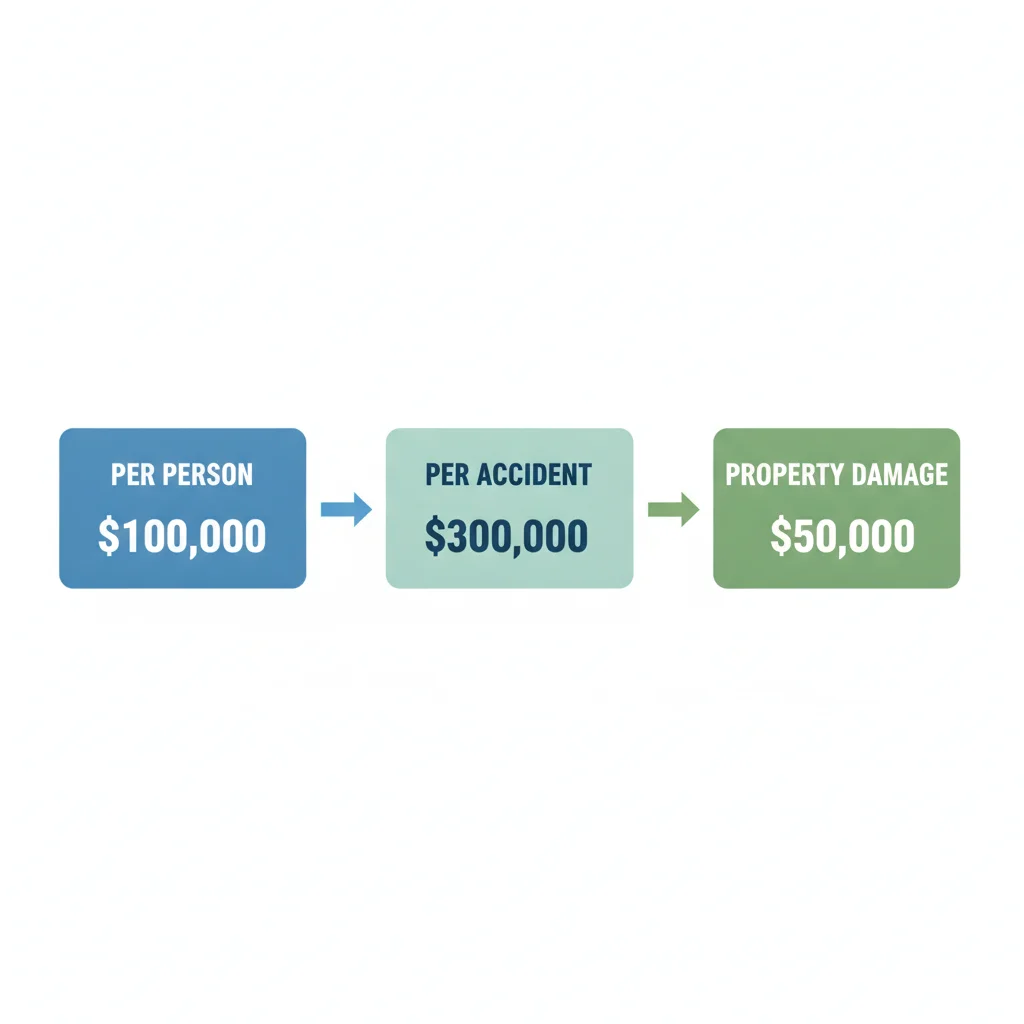
The numbers are always expressed in thousands of dollars, even though insurance cards and policy documents sometimes drop the trailing zeros. A policy listed as "100/300/100" means $100,000/$300,000/$100,000 — not $100.
For a deeper look at what each digit on your declarations page is actually capping, see Reading Your Liability Limits: What 25/50/25 Actually Means.
Why the Per-Person Cap Creates Real Gaps
Most drivers focus on the middle number — the per-accident total — and feel reassured by its size. But the per-person cap is where coverage gaps actually bite.
Here's a straightforward example: You have a 50/100/50 policy. You cause an accident that injures two people. Person A has $80,000 in medical bills. Person B has $30,000 in medical bills. The per-accident pool is $100,000 — which technically covers both.
But Person A's claim is capped at $50,000 — the per-person limit. So your insurer pays $50,000 for Person A and $30,000 for Person B, totaling $80,000 from the $100,000 pool. Person A can now sue you personally for the remaining $30,000. The per-accident limit never gets fully used, but you're still on the hook.
“Buying the minimum required liability coverage is like wearing a seatbelt only when you think you might crash. The point of insurance is to protect against the accidents you didn't see coming — and those are often the most expensive ones.”
— J. Robert Hunter, Former Insurance Commissioner and Director of Insurance, Consumer Federation of America
This is the structural quirk of split-limit policies: the per-person cap constrains what any individual receives, even when the per-accident bucket has room left. The two caps operate independently — the smaller one always wins for individual claimants.
To understand exactly how per-person and per-accident limits interact in practice, The Difference Between Per-Person and Per-Accident Bodily Injury Limits walks through the mechanics in detail.
Per-Person Cap Applies Even With Room in the Pool
The per-person bodily injury cap restricts what any individual claimant can receive — even if the per-accident total hasn't been reached. These two limits operate as separate ceilings. Understanding this prevents a common misreading where drivers assume unused per-accident funds can flow to any individual claimant.
Liability Limits Don't Cover Your Own Damages
Liability coverage only pays for damages you cause to others — other people's injuries, other people's property. It does not pay for your own medical bills, your own vehicle repairs, or any damage to your property. Separate coverages like collision, comprehensive, MedPay, or PIP handle those situations.
State Minimums: The Floor, Not the Target
Every state sets minimum liability limits that drivers must carry to legally operate a vehicle. These are the lowest legally permissible numbers — they are not recommendations, and they are not adequate protection for most drivers.
$48,000+
Average new car transaction price in the US
According to Kelley Blue Book's 2024 market data, the average new vehicle transaction price regularly exceeds common property damage minimums.
25/50/25
Most common state minimum liability requirement
Many US states still require only 25/50/25 as a baseline, limits set decades ago that haven't kept pace with modern vehicle and medical costs.
~$150–$200
Typical annual premium difference: minimum vs. 100/300/100
Industry surveys consistently show the premium gap between state-minimum and robust 100/300/100 coverage is smaller than most drivers expect.
1 in 6
US drivers currently uninsured or underinsured
The Insurance Research Council estimates roughly one in six drivers lacks adequate coverage, increasing risk for everyone on the road.
Consider what a common minimum like 25/50/25 actually covers in today's environment:
- $25,000 per person — A single overnight hospital stay after a serious accident can approach or exceed this.
- $50,000 per accident — In a two-car collision with multiple injuries, this evaporates quickly.
- $25,000 property damage — The average new car transaction price now exceeds $48,000. One totaled vehicle and you're already over your limit.
When a claim exceeds your limits, your insurer closes the file. What remains becomes a personal judgment against you. Your savings accounts, home equity, and even a portion of future wages can be garnished in many states.
Set Limits to Match Your Net Worth
Add up your liquid savings, home equity, and investment accounts. That total is roughly what a civil judgment could reach. Carry liability limits that at least equal that number. For many homeowners, 100/300/100 is a practical minimum — and adding an umbrella policy is worth serious consideration.
Ask for Identical Quotes When Shopping
When getting competing quotes, specify the same liability limits across all of them. Many comparison tools default to different limit levels, making the cheapest quote look attractive when it's actually offering materially less coverage. Standardize limits first, then compare premiums.
The liability coverage hub covers what liability insurance pays for and explains exactly why these minimums exist — and why regulators haven't updated them to match modern costs in many states.
Split Limits vs. Combined Single Limit: A Structural Difference
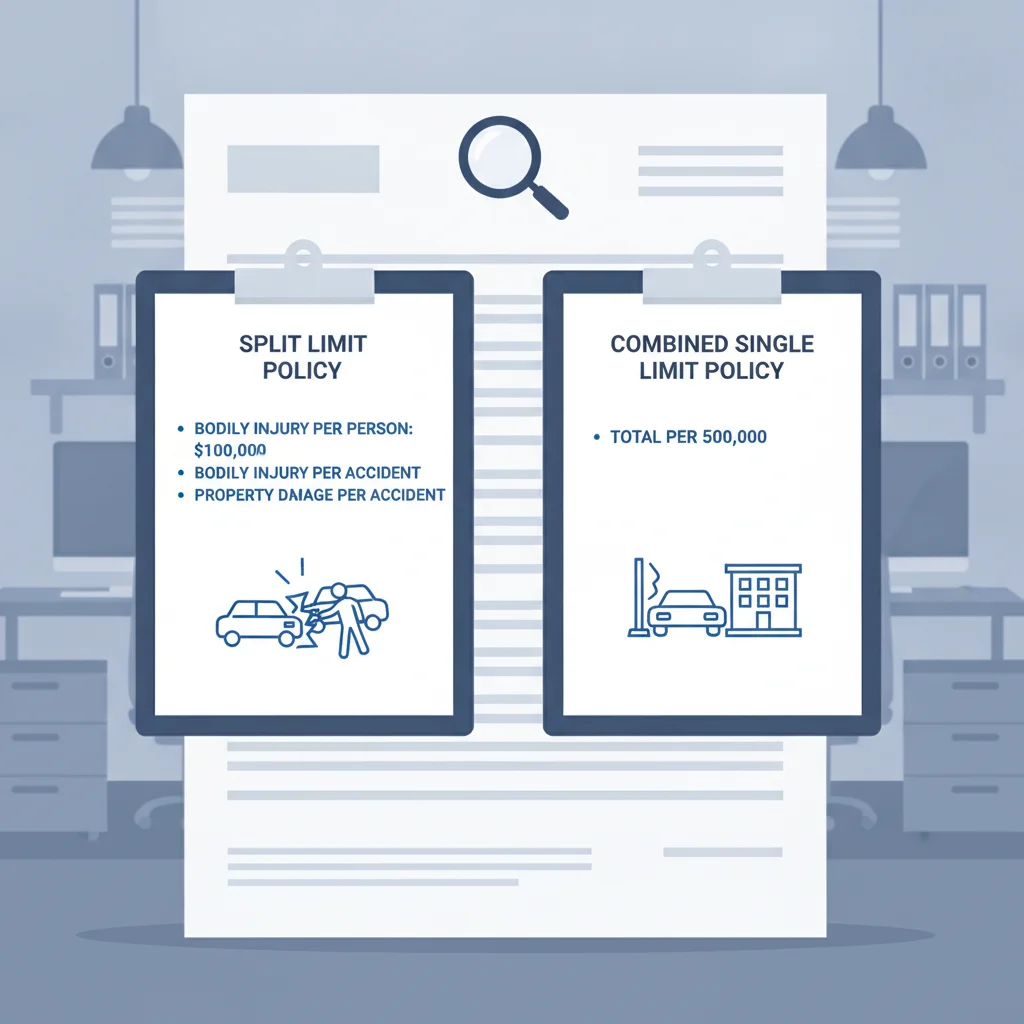
The three-number format described above is called a split-limit policy. It's the most common structure in personal auto insurance. But there's an alternative: a combined single limit (CSL) policy, which provides one pooled amount covering both bodily injury and property damage.
A CSL policy of $300,000 means your insurer can pay up to $300,000 in any combination across bodily injury and property damage claims from a single accident. There's no per-person ceiling restricting individual payouts — the entire pool is available based on actual claim needs.
| Feature | Split Limits (e.g. 100/300/100) | Combined Single Limit (e.g. $300,000 CSL) |
|---|---|---|
| Per-person bodily injury cap | Yes — $100,000 | No separate cap |
| Per-accident bodily injury cap | Yes — $300,000 | Covered by single pool |
| Property damage cap | Yes — separate $100,000 | Drawn from same pool |
| Flexibility in multi-injury accidents | Limited by per-person cap | Higher — funds flow where needed |
| Availability | Universal for personal auto | More common in commercial policies |
For a full comparison of when each structure works in your favor, see Split Limits vs. Combined Single Limit Liability Coverage.
How Multi-Car Accidents Expose Your Limits
A two-car accident with one injured party is straightforward — your per-person limit either covers the claim or it doesn't. But real-world accidents rarely stay that clean. Pile-ups, intersection collisions, and chain-reaction crashes routinely involve three or more injured parties, and that's when split-limit math becomes uncomfortable fast.
With a 100/300/100 policy and four injured people, your per-accident cap of $300,000 is divided among all claimants — but no individual can receive more than the $100,000 per-person cap. If each person has $90,000 in damages, your insurer pays the full $360,000 equivalent... except the per-accident cap cuts total payment to $300,000. The math doesn't add up in your favor, and you're liable for the difference.
The dynamics get worse at lower limits. A 25/50/25 policy facing three seriously injured claimants leaves each person fighting over a $50,000 pie, with none of them able to claim more than $25,000 individually — regardless of actual injury costs.
For a detailed breakdown of how limits erode in multi-vehicle situations, Liability Coverage and Multi-Car Accidents: How Limits Get Stretched is worth reading before you choose your coverage level.
Set Limits to Match Your Net Worth
Add up your liquid savings, home equity, and investment accounts. That total is roughly what a civil judgment could reach. Carry liability limits that at least equal that number. For many homeowners, 100/300/100 is a practical minimum — and adding an umbrella policy is worth serious consideration.
Ask for Identical Quotes When Shopping
When getting competing quotes, specify the same liability limits across all of them. Many comparison tools default to different limit levels, making the cheapest quote look attractive when it's actually offering materially less coverage. Standardize limits first, then compare premiums.
Choosing Limits That Actually Protect You
Insurance is a transfer of financial risk. The limits you choose determine how much risk stays with the insurer and how much stays with you. Choosing limits based purely on monthly premium cost is backwards — you're optimizing for the wrong variable.
A useful starting point: your liability limits should at minimum equal your net worth. That means totaling your savings, investment accounts, home equity, and any other assets that could be targeted by a civil judgment. If someone can sue you for $200,000 and win, you want at least $200,000 in coverage.
For most drivers with any assets at all, 100/300/100 is a reasonable baseline. The premium difference between state-minimum coverage and 100/300/100 is often surprisingly small — frequently under $200 per year — because the most expensive accidents are far less frequent than minor ones.
If you have significant assets — a home, retirement accounts, business interests — consider an umbrella policy layered on top of your auto limits. Umbrella policies typically provide $1 million or more in additional liability coverage and are priced efficiently relative to the protection they add.
When weighing coverage levels, Liability Limits vs. Full Coverage: Choosing the Right Protection Level helps frame the broader decision around what protection level matches your specific situation.
Per-Person Cap Applies Even With Room in the Pool
The per-person bodily injury cap restricts what any individual claimant can receive — even if the per-accident total hasn't been reached. These two limits operate as separate ceilings. Understanding this prevents a common misreading where drivers assume unused per-accident funds can flow to any individual claimant.
Liability Limits Don't Cover Your Own Damages
Liability coverage only pays for damages you cause to others — other people's injuries, other people's property. It does not pay for your own medical bills, your own vehicle repairs, or any damage to your property. Separate coverages like collision, comprehensive, MedPay, or PIP handle those situations.
Comparing Policies: Beyond the Price Tag
When you shop for car insurance, quotes arrive with premiums front and center. The limits buried in the fine print determine whether those premiums are actually comparable. A quote for $800 per year at 25/50/25 and a quote for $950 per year at 100/300/100 are not the same product at different prices — they're fundamentally different risk transfers.
Before comparing premiums, verify that all quotes reflect identical limits. Insurers and comparison platforms don't always default to the same numbers. Some start at state minimums; others suggest higher limits. If you're comparing apples to oranges, the cheaper quote may be cheap for a reason.

Also pay attention to how property damage limits are set. With average new vehicle prices well above $40,000, a $25,000 property damage limit is inadequate if you total someone else's vehicle. Newer vehicles, luxury cars, and commercial vehicles push that number higher still.
The liability coverage hub and the Collision & Comprehensive coverage hub together help frame the full picture of what different policy structures actually cover — useful context when you're deciding where to set each limit.
The bottom line: three numbers on your declarations page determine your exposure in the worst moments of your driving life. Read them carefully, model the scenarios in which they'd be tested, and set them based on your asset exposure — not just this month's premium budget.

All claims are backed by peer-reviewed research. Sources on request.