Key Takeaways
Option A
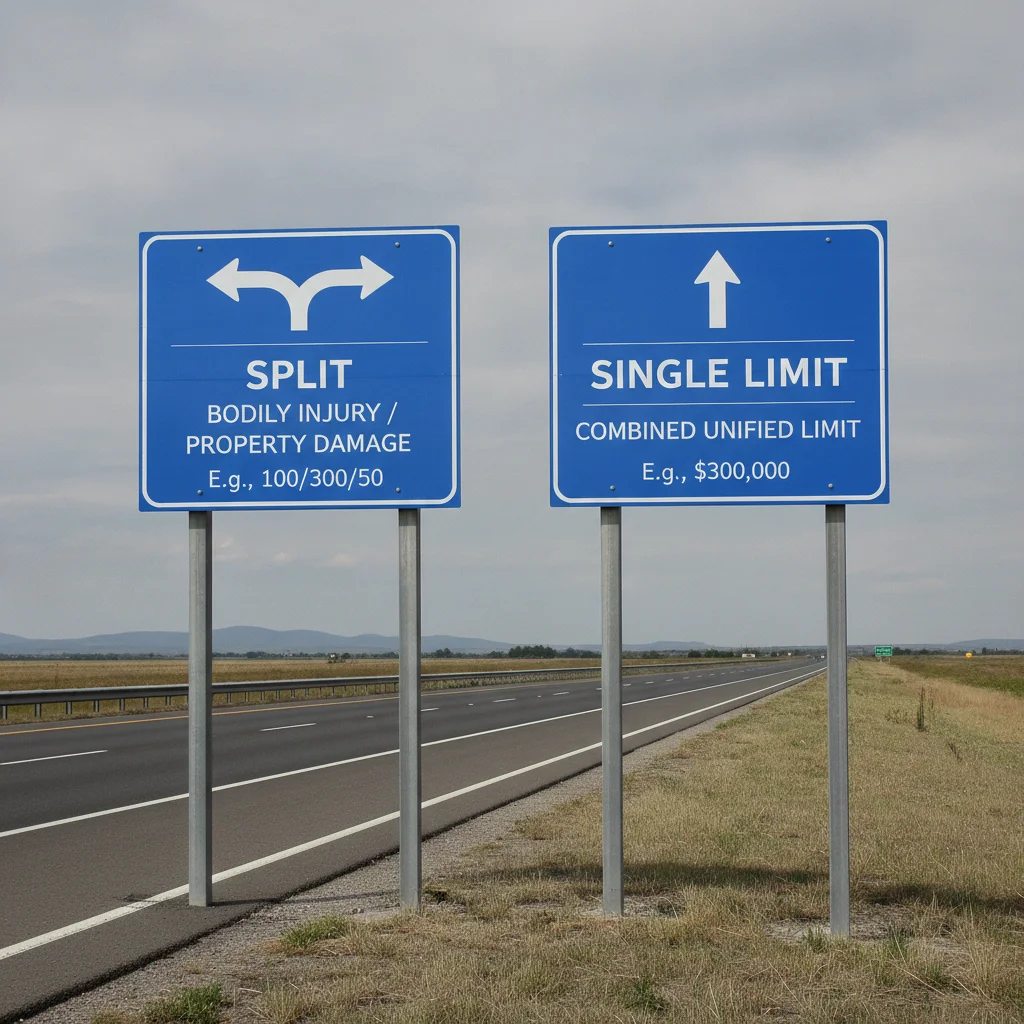
Split Limits
The structured, compartmentalized approach to liability protection.
Best for: Drivers who want predictable, separately capped coverage for bodily injury per person, bodily injury per accident, and property damage.
Option B
Combined Single Limit (CSL)
The flexible, pooled alternative that adapts to the shape of a claim.
Best for: Drivers and commercial policyholders who want one unified dollar amount that can be applied however a claim demands — no internal sub-caps.
If you want the most affordable personal auto policy with straightforward coverage
Split Limits
Split-limit policies are standard, widely available, and generally less expensive. For drivers with modest assets and typical risk exposure, the structured format covers most everyday accident scenarios effectively.
If you frequently carry passengers or drive in dense, multi-car environments
Combined Single Limit (CSL)
When multiple people are injured in one accident, a CSL policy's pooled amount can be distributed where it's needed most, rather than bumping against a rigid per-person cap.
If you own a small business with a commercial vehicle fleet
Combined Single Limit (CSL)
Commercial auto policies commonly use CSL because business accidents often have unpredictable claim mixes. One flexible limit simplifies coverage management across diverse loss scenarios.
If you are shopping on a tight budget and want to meet state minimums
Split Limits
State minimum requirements are almost universally expressed in split-limit format. Meeting those minimums with a split-limit policy is the lowest-cost path to legal compliance.
If you have significant personal assets and want the most adaptable protection above minimums
Combined Single Limit (CSL)
A high CSL limit gives your insurer maximum flexibility to settle complex multi-claimant cases quickly, reducing the risk that sub-limits leave any portion of a valid claim exposed.
How Each Structure Works
When you buy liability car insurance, you are purchasing a promise: if you cause an accident, your insurer will pay the other party's bills up to your limit. But the word limit is not a single number for everyone. Insurers express liability limits in two fundamentally different ways, and the format shapes exactly what gets paid — and what doesn't — when a real claim lands.
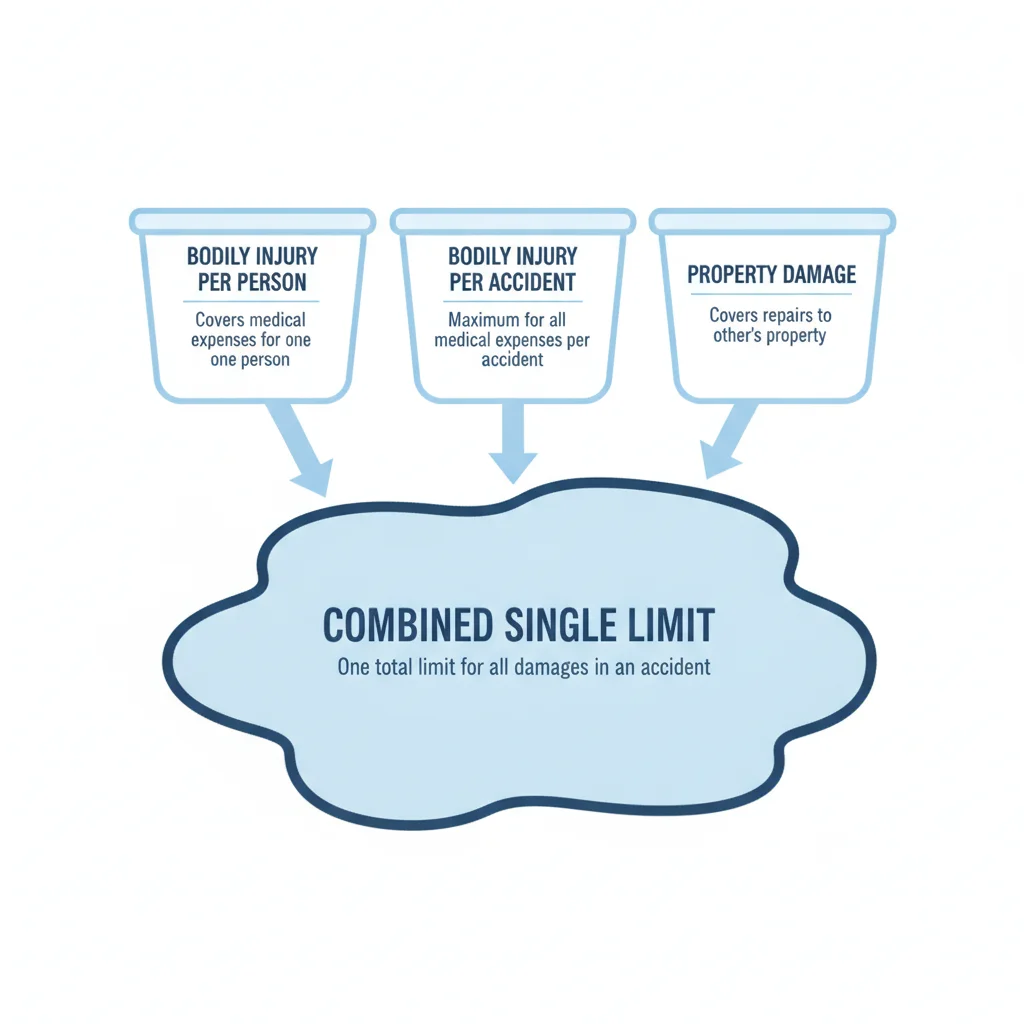
Split limits divide your liability coverage into three separate buckets, each with its own ceiling. The most common way you will see them written is as a trio of numbers — for example, 100/300/100. If you have ever wondered what those figures actually mean, decoding split-limit notation breaks down exactly how each number applies to a real-world accident.
- Per-person bodily injury (BI): The maximum your insurer will pay for any single injured person's medical bills, lost wages, and pain-and-suffering claims.
- Per-accident bodily injury (BI): The total your insurer will pay for all injured people in one accident combined — regardless of how many individuals are involved.
- Property damage (PD): The ceiling for damage to the other party's vehicle, fence, building, or any other property.
A combined single limit (CSL) replaces all three buckets with one pool. If your CSL is $300,000, that entire amount is available to cover bodily injury claims, property damage claims, or any combination of the two — in whatever proportions the accident requires. There are no internal sub-caps to worry about.
Understanding the mechanical difference between these two formats is the foundation for everything else in this comparison. The structure determines flexibility, cost, and where gaps can appear.
Where Split Limits Can Fall Short
Split limits work well when an accident fits neatly inside each bucket. A single injured driver with moderate medical bills and a damaged bumper? Your three caps likely cover it without friction. The problem emerges when reality doesn't fit the buckets.
Consider a common scenario: you cause an accident that injures three people. Your policy is 100/300/100 — $100,000 per person, $300,000 per accident. One of those three people suffers a serious spinal injury with $210,000 in verified medical costs. Your per-person cap stops at $100,000. The remaining $110,000 of that person's claim is yours to cover out of pocket, even though your per-accident limit still has room to spare.
This is the central tension in split-limit coverage: the per-person cap can be exhausted before the per-accident cap is reached. understanding how per-person and per-accident limits interact is essential for anyone evaluating whether their current limits are truly adequate.
| Criterion | Split Limits | Combined Single Limit (CSL) |
|---|---|---|
| Structure | Three separate sub-limits (BI per person / BI per accident / PD) | One unified pool for all liability losses |
| Flexibility | Fixed — unused funds in one bucket can't shift to another | High — funds flow to wherever the claim requires |
| Typical cost | Lower for equivalent per-accident BI ceiling | Higher — 15–25% premium for flexibility |
| Availability (personal auto) | Universal — standard in personal policies | Limited — more common in commercial auto |
| State minimum format | Yes — all state minimums use split-limit notation | No — CSL equivalents must be confirmed with insurer |
| Best for single severely injured claimant | Vulnerable — per-person cap can be reached quickly | Strong — full pool can be directed to one claimant |
| Best for multi-person accidents | Adequate if per-accident limit is high enough | Strong — pool distributes across all claimants without sub-caps |
| Ease of comparison shopping | Easy — standardized notation across all insurers | Harder — CSL options vary by insurer and state |
A second gap appears in multi-vehicle accidents. When one collision involves several cars, the property damage limit can be stretched across multiple owners' vehicles simultaneously. If your property damage cap is $50,000 and you damage three cars worth $22,000 each, you are $16,000 short. The split format does not allow any unused bodily injury budget to fill the property damage gap — each bucket is sealed.
For a deeper look at how per-accident caps behave when multiple claimants compete for the same pool, see how liability limits get stretched in pile-ups.
Where Combined Single Limit Has the Edge
A CSL policy eliminates the bucket problem. That same spinal injury scenario plays out differently: with a $300,000 CSL, your insurer can direct the full $210,000 toward the most severely injured claimant without hitting an internal wall. Whatever remains in the pool then covers the other two claimants and any property damage. The money follows the claim, not a predetermined compartment.
This flexibility is especially valuable in two situations:
- Accidents with one catastrophically injured person: All $300,000 (or whatever your CSL is) can go to that one claimant if the injury warrants it.
- Accidents with unusually high property damage and modest bodily injury: If you total an expensive vehicle but the occupants walk away, the CSL pool can shift heavily toward property damage without leaving bodily injury money sitting idle and inaccessible.
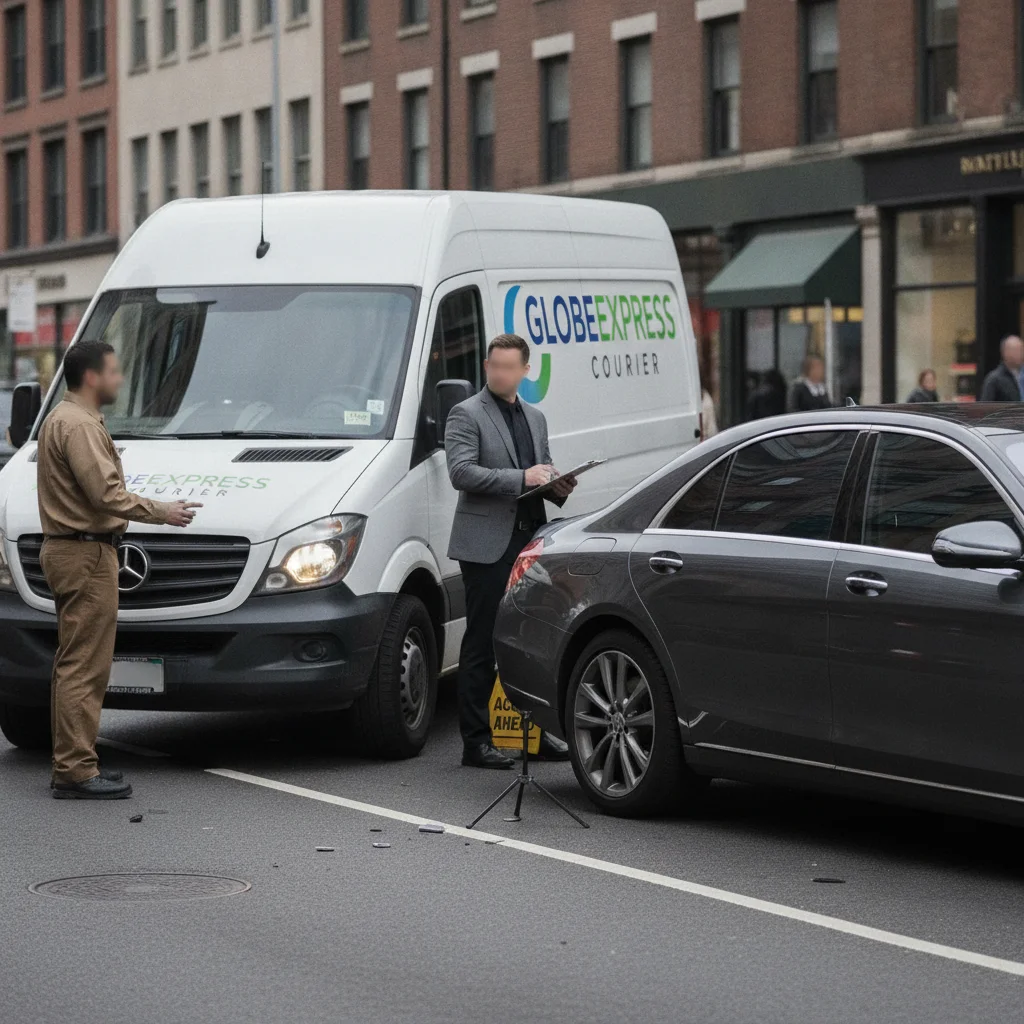
Commercial auto policies have used CSL as their standard format for decades, precisely because business-related accidents tend to be harder to predict. A delivery driver might rear-end a luxury sedan carrying one severely injured passenger and cause $80,000 in vehicle damage — a scenario where split limits would likely leave gaps that a CSL policy handles cleanly.
CSL on Commercial vs. Personal Policies
Combined single limit coverage is the norm in commercial auto insurance because business-related accidents often involve unpredictable combinations of property damage and multiple injured parties. On personal auto policies, CSL is offered by fewer insurers and may require specifically requesting it. If your insurer doesn't offer it, shopping independently for a CSL policy is worth the effort if your risk profile warrants it.
Converting Split Limits to a CSL Equivalent
If you want to compare a split-limit quote to a CSL quote, a rough rule of thumb is to use the per-accident bodily injury limit as the CSL benchmark — for example, 100/300/100 compares loosely to a $300,000 CSL. However, the CSL will generally provide more protection in extreme scenarios, so the comparison isn't perfectly one-to-one. Always ask your insurer to walk through a specific claim scenario if you are uncertain.
The trade-off is cost. A $300,000 CSL is not the same price as a 100/300/100 split-limit policy, even though the per-accident bodily injury number looks identical. You are paying for the flexibility to reallocate funds across loss types, and insurers price that option accordingly.
Cost, Availability, and State Requirements
For most personal auto shoppers, split limits are the default — and often the only option offered without asking. Nearly every state sets its minimum liability requirement in split-limit terms. You will see floor requirements expressed as figures like 25/50/25 or 15/30/15, depending on where you live. Meeting those minimums with a CSL equivalent requires finding an insurer that offers CSL on personal policies, which is less common outside the commercial market.
49
U.S. states with mandatory liability insurance
All 49 states that require liability insurance express their minimum thresholds in split-limit format, per the Insurance Information Institute.
15–25%
Typical CSL premium increase over split limits
Industry estimates suggest CSL policies cost roughly 15–25% more than split-limit policies with a comparable per-accident bodily injury ceiling.
$22,734
Average bodily injury liability claim
According to the Insurance Research Council, the average bodily injury liability claim in recent years has exceeded $22,000, underscoring why per-person sub-limits matter.
38%
Multi-vehicle accident share of all crashes
The National Highway Traffic Safety Administration estimates that multi-vehicle crashes account for approximately 38% of all reported accidents, making per-accident cap behavior highly relevant.
When CSL is available for personal auto policies, it typically comes at a premium — sometimes 15% to 25% higher than a split-limit policy with a comparable per-accident bodily injury ceiling. Whether that premium is worth it depends on how likely you think a worst-case, cross-compartment claim is for your specific driving situation.
If you already carry high split limits and are wondering whether the flexibility of CSL justifies the cost increase, it is worth considering two additional paths to broader protection: raising your existing split limits or adding an umbrella policy. comparing umbrella insurance against high liability limits walks through both options in detail.
One practical note: if you are comparing quotes across insurers, do not assume a split-limit 100/300/100 policy and a $300,000 CSL policy offer identical protection. The CSL may be meaningfully more protective in certain accidents — and meaningfully more expensive. how liability coverage limits are expressed and what the numbers really mean gives context for reading both formats side by side without confusion.
Practical Guidance: Which Format to Prioritize
The honest answer is that most personal auto policyholders will be shopping for split-limit coverage — it's what the market offers, it's what state minimums reference, and for the majority of everyday drivers, high split limits protect adequately. The goal is choosing sufficient limits within that format, not chasing CSL for its own sake.
That said, a few situations make it worth asking your insurer whether a CSL option exists:
- You regularly carry multiple passengers and worry about a single serious accident spreading thin across several per-person caps.
- You drive a commercial or business-use vehicle where loss scenarios are harder to predict.
- You have substantial personal assets that could be exposed if split-limit sub-caps leave a portion of a large claim unpaid.
For drivers weighing the broader question of how much coverage is enough — not just the format, but the actual dollar amounts — liability vs. full coverage is a useful next step, covering how liability-only protection compares to more comprehensive policy structures.
Similarly, if you are thinking about your overall coverage strategy and whether liability limits alone are the right foundation, understanding when liability-only coverage is sufficient helps frame that decision around your vehicle's value, your budget, and your real risk exposure.
The bottom line: split limits are the practical default for personal drivers. CSL is a powerful upgrade if it is available to you, if you can absorb the cost, and if your driving situation increases the odds of a complex, multi-type claim. When in doubt, prioritize high limits in whatever format is available over low limits in either format.

All claims are backed by peer-reviewed research. Sources on request.