
Key Takeaways
Bodily Injury Liability Limits
Bodily injury liability coverage pays for injuries you cause to other people in an accident. It comes with two separate caps: a per-person limit, which is the maximum your insurer will pay for any single injured person, and a per-accident limit, which is the most your insurer will pay in total across all injured people in one accident. Both limits apply simultaneously whenever a claim is filed.
These paired limits are known as split limits and are typically expressed as a ratio — for example, 25/50 means $25,000 per person and $50,000 per accident. Even if one person's damages exceed $25,000, the policy will not pay more than that per-person cap for that individual.
How Split Limits Actually Work
When you look at your car insurance declarations page, you'll likely see your bodily injury liability coverage expressed as two numbers separated by a slash — something like 50/100 or 100/300. These paired numbers are called split limits, and each number does a very different job.
The first number is the per-person limit. It's the ceiling on what your insurer will pay toward one individual's injury-related losses — medical bills, lost wages, pain and suffering — from a single accident you caused. No matter how severe that person's injuries are, the insurer won't pay beyond this cap for them alone.
The second number is the per-accident limit. It's the total pool of money your insurer will pay across all injured parties combined in one accident. Once that pool is exhausted, your insurer's obligation ends — regardless of how many people were hurt or how serious their injuries are.
Both limits work at the same time. Think of it as a two-door system: every claimant must pass through the per-person door first, and then the collective group must stay within the per-accident door. If either door is too narrow, someone gets left out.
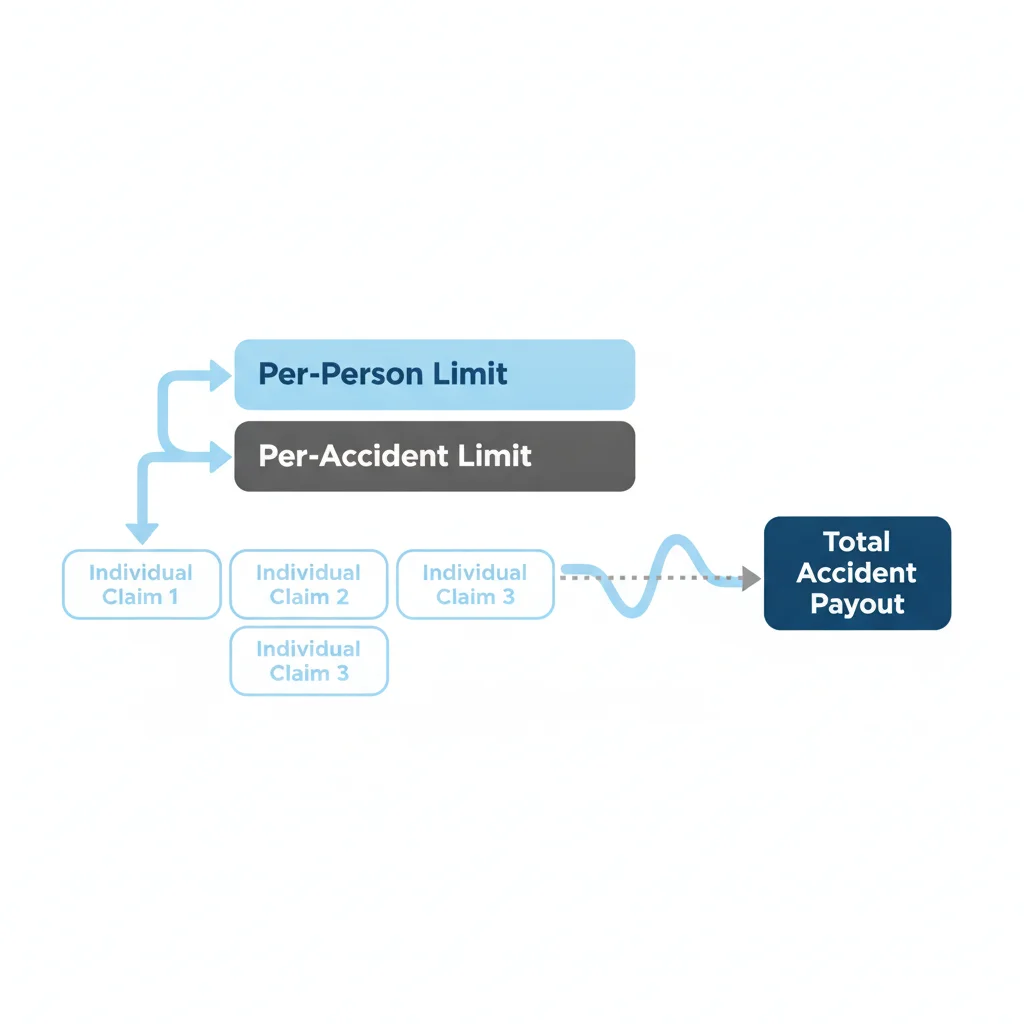
This structure is different from a combined single limit (CSL) policy, which merges both caps into one flexible pool. To understand the trade-offs between those two formats, see our comparison of split limits vs. combined single limit coverage.
A Concrete Example: When Both Limits Come Into Play
Abstract numbers are easier to understand with a real scenario, so let's walk through one.
Suppose you carry 50/100 bodily injury liability — $50,000 per person and $100,000 per accident. You run a red light and collide with another car. Three people in that car are injured:
- Driver A — fractures an arm, totaling $35,000 in medical costs and lost wages
- Passenger B — suffers a concussion and soft tissue injuries, totaling $20,000
- Passenger C — severe spinal injury with $80,000 in documented losses
Here's how the limits apply:
| Claimant | Actual Damages | Per-Person Cap | Insurer Pays | Your Gap |
|---|---|---|---|---|
| Driver A | $35,000 | $50,000 | $35,000 | $0 |
| Passenger B | $20,000 | $50,000 | $20,000 | $0 |
| Passenger C | $80,000 | $50,000 | $45,000* | $35,000 |
*The per-accident limit of $100,000 has already paid out $55,000 for A and B, leaving only $45,000 in the accident pool for C — even though C's per-person cap would allow $50,000.
Notice what happened: Passenger C hit both limits. Her individual damages exceeded her per-person cap, and the remaining per-accident pool further reduced what the insurer would pay. She could sue you personally for the $35,000 shortfall.
“Minimum limits are set to protect accident victims from uninsured drivers — not to protect the at-fault driver from financial ruin. The gap between what the law requires and what a serious accident costs can be enormous.”
— J. Robert Hunter, Former Insurance Commissioner and Director of Insurance at the Consumer Federation of America
This kind of scenario is exactly why multi-car and multi-person accidents stretch your liability limits so quickly.
Why the Per-Person Cap Is the Binding Constraint Most Drivers Miss
Most people focus on the per-accident number because it looks bigger. But in practice, the per-person cap is often the first limit hit — and it can leave a seriously injured person dramatically undercompensated even when the overall accident pool isn't exhausted.
Consider a two-car accident where only one person is injured but their medical bills run to $75,000. If you carry 50/100 limits, the per-accident pool of $100,000 is untouched — but the per-person cap of $50,000 is binding. Your insurer pays $50,000 and stops. The victim is $25,000 short, and your per-accident limit was never the issue.
Per-Person Limits Can Bind Before the Accident Pool Is Full
A common misconception is that the per-accident limit is the primary constraint. In reality, the per-person cap frequently exhausts coverage for an individual claimant while the overall accident pool still has funds remaining. This matters especially in single-victim accidents, where the per-accident number is never the relevant figure.
Umbrella Policies Extend Both Limits
A personal umbrella policy typically adds a single large limit — commonly $1 million or more — on top of your existing auto liability coverage. When your per-person or per-accident limits are exhausted, the umbrella kicks in. It applies to both caps, not just the per-accident total, which is why umbrella policies are particularly valuable for drivers with significant assets.
Bodily Injury Liability Does Not Cover Your Own Injuries
It's easy to assume your bodily injury coverage protects everyone involved in an accident, but it only pays for injuries to others. Your own medical expenses after an at-fault accident must be covered by separate first-party coverages like PIP or MedPay — which operate under entirely different rules and limits.
This is one reason insurance professionals often recommend evaluating the per-person limit just as carefully as — or even more carefully than — the per-accident figure. A high per-accident limit with a low per-person limit still leaves individual claimants exposed.
It's also worth understanding that bodily injury liability only covers other people's injuries. Your own medical costs after an at-fault accident are handled separately — typically through MedPay or Personal Injury Protection (PIP), which operate differently from liability coverage.
$60,000+
Average cost of a serious car accident injury
According to the National Safety Council, the average economic cost of a medically consulted injury from a motor vehicle crash exceeds $60,000 when including medical costs, lost wages, and administrative expenses.
15/30
Lowest state minimum bodily injury limits
Several U.S. states still allow drivers to satisfy the legal minimum with just $15,000 per person and $30,000 per accident — limits easily exhausted by a single serious injury.
38%
Drivers carrying only minimum liability limits
Industry estimates suggest roughly 38% of insured drivers carry only their state's minimum required liability limits, leaving them financially exposed in serious multi-person accidents.
$1M+
Umbrella policy coverage for as little as $150–$300/year
Many major insurers offer personal umbrella policies providing $1 million in additional liability coverage above your auto limits for an annual premium that typically ranges from $150 to $300.
How State Minimums Compare to Real-World Medical Costs
Every state requires drivers to carry at least some bodily injury liability, but the minimums are often strikingly low compared to the actual cost of medical care after a serious accident.
Many states set minimums as low as 15/30 — $15,000 per person and $30,000 per accident. A single emergency room visit, ambulance ride, and overnight hospital stay can easily exceed $15,000. Add surgery, physical therapy, or long-term care, and the gap between what your insurer pays and what the victim is owed can become enormous.
For a full breakdown of what each state requires, our state minimum liability requirements reference covers every state's current mandated limits in one place.
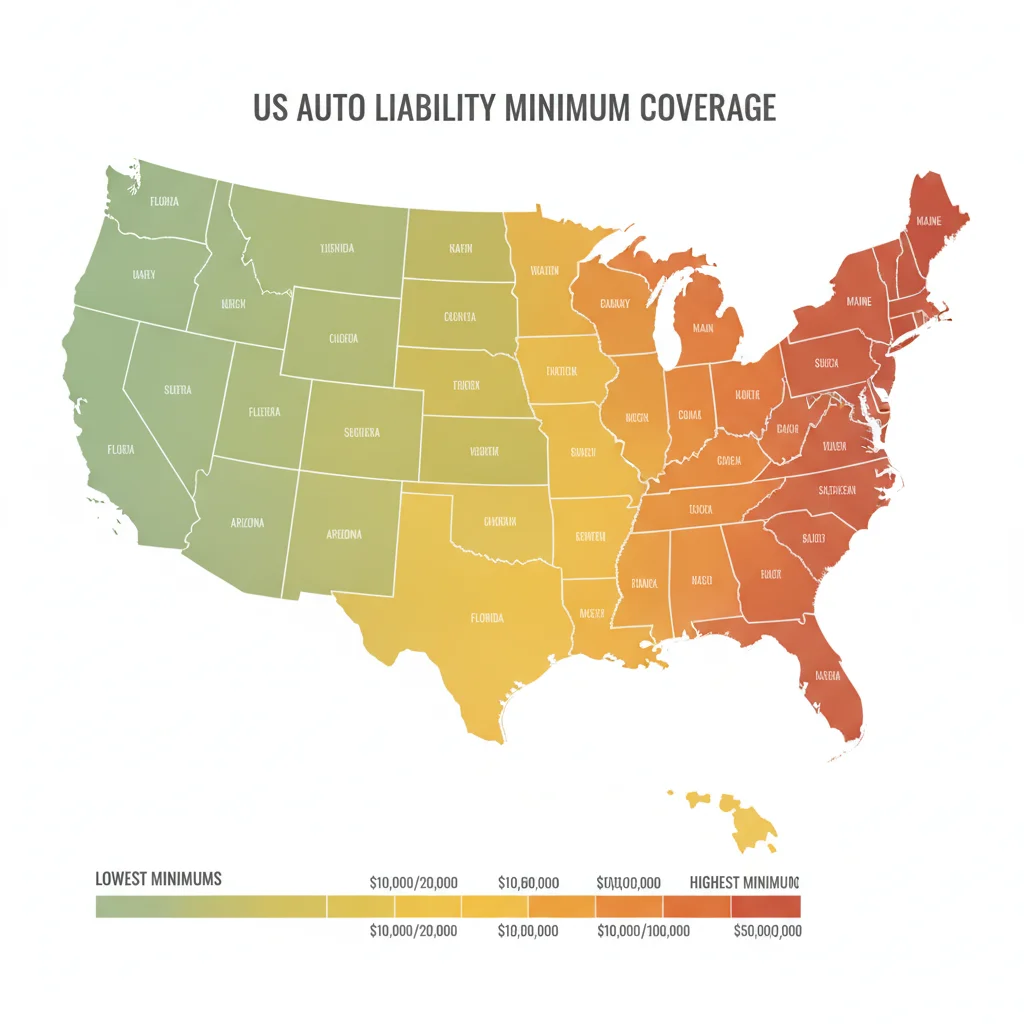
Carrying state-minimum coverage keeps you legal. It does not keep you financially safe. If your limits are exhausted and a court judgment goes against you, the injured party can pursue your personal assets — savings, home equity, even future wages in some states.
Get a Quote for Higher Limits Before Assuming It's Unaffordable
Many drivers assume that doubling their bodily injury limits will double their premium — but that's rarely how it works. Because the additional risk to the insurer is incremental, the premium increase for moving from 25/50 to 100/300 is often surprisingly modest. Ask your insurer or agent to quote higher limits so you can see the actual cost difference before deciding.
Review Your Limits After Major Financial Milestones
Buying a home, receiving an inheritance, or significantly growing your savings all increase what you stand to lose in a lawsuit. Make reviewing your bodily injury liability limits part of your annual insurance checkup — especially any time your net worth increases meaningfully.
Bodily Injury Liability in the Broader Coverage Picture
Bodily injury liability is one component of a two-part liability system. The other is property damage liability, which covers repairs or replacement of vehicles and other property you damage. These two coverages are bundled into your liability policy but serve distinct purposes. Understanding how bodily injury and property damage liability differ gives you a clearer picture of what each one is — and isn't — designed to do.
For drivers who want protection beyond standard liability limits — particularly those with significant assets — an umbrella policy is worth considering. Umbrella coverage sits on top of your auto liability limits and kicks in once those limits are exhausted, typically adding $1 million or more in additional protection for relatively modest annual premiums.
Per-Person Limits Can Bind Before the Accident Pool Is Full
A common misconception is that the per-accident limit is the primary constraint. In reality, the per-person cap frequently exhausts coverage for an individual claimant while the overall accident pool still has funds remaining. This matters especially in single-victim accidents, where the per-accident number is never the relevant figure.
Umbrella Policies Extend Both Limits
A personal umbrella policy typically adds a single large limit — commonly $1 million or more — on top of your existing auto liability coverage. When your per-person or per-accident limits are exhausted, the umbrella kicks in. It applies to both caps, not just the per-accident total, which is why umbrella policies are particularly valuable for drivers with significant assets.
Bodily Injury Liability Does Not Cover Your Own Injuries
It's easy to assume your bodily injury coverage protects everyone involved in an accident, but it only pays for injuries to others. Your own medical expenses after an at-fault accident must be covered by separate first-party coverages like PIP or MedPay — which operate under entirely different rules and limits.
If you're weighing your coverage options and also thinking about how your own injuries would be handled after an accident, it helps to understand the difference between first-party medical coverages. PIP and MedPay both cover medical costs but work differently — knowing which one your policy offers can close another gap you might not realize is there.
Choosing Limits That Actually Protect You
Raising your bodily injury limits is usually less expensive than drivers expect. The jump from state minimums to a 100/300 policy often costs surprisingly little in additional premium — typically a few dollars per month — because the insurer's expected payout risk increases incrementally, not proportionally.
Here's a practical framework for thinking about how much coverage to carry:
- Estimate your net worth. Add up your savings, investment accounts, home equity, and any other assets. This is roughly what you stand to lose if a judgment exceeds your policy limits.
- Match your limits to your exposure. If your net worth is $150,000, carrying 50/100 limits may leave you vulnerable. A 100/300 policy — or higher — closes that gap considerably.
- Consider an umbrella policy for additional protection. If your assets significantly exceed even 100/300 limits, an umbrella policy provides a substantial additional buffer at a reasonable cost.
- Review your limits when major life changes occur. Getting married, buying a home, or growing your savings are all moments to revisit your coverage.
Get a Quote for Higher Limits Before Assuming It's Unaffordable
Many drivers assume that doubling their bodily injury limits will double their premium — but that's rarely how it works. Because the additional risk to the insurer is incremental, the premium increase for moving from 25/50 to 100/300 is often surprisingly modest. Ask your insurer or agent to quote higher limits so you can see the actual cost difference before deciding.
Review Your Limits After Major Financial Milestones
Buying a home, receiving an inheritance, or significantly growing your savings all increase what you stand to lose in a lawsuit. Make reviewing your bodily injury liability limits part of your annual insurance checkup — especially any time your net worth increases meaningfully.
The goal isn't to carry the maximum possible coverage regardless of cost — it's to carry limits that are proportionate to your financial exposure. Taking a few minutes to understand your current limits and compare them against your actual assets is one of the most valuable things you can do as a policyholder.

All claims are backed by peer-reviewed research. Sources on request.