
| Typical tow distance limit (basic plan) | 15–25 miles per incident (Insurance industry standard, 2024) |
| Emergency fuel delivery amount | Up to 2 gallons (service covered, fuel cost usually not) |
| Lockout service dollar cap (common range) | $50–$100 per incident |
| Annual incidents covered (standard plan) | 3–4 per vehicle per year |
| Typical annual premium per vehicle | $5–$15/year as an insurance add-on (National average estimate, 2024) |
| Key replacement coverage | Not included in standard roadside policies |
| Spare tire required for flat service | Yes — no spare means tow instead |
The Gap Between What You Expect and What Shows Up
Most drivers picture roadside assistance as a simple safety net: you break down, you call, help arrives. What actually happens is more conditional. Your insurer dispatches a contracted provider — not a dedicated fleet — and that provider operates within limits your policy quietly defines. Tow the car 100 miles to your trusted mechanic? Likely not covered in full. Need a gallon of gas delivered on a rural highway? Covered, but probably not the cost of the fuel itself. Locked out of your car after hours? Service available, but response time guarantees are rarely part of the deal.
Understanding those limits before you're stranded is the entire point of this reference. The sections below break down each service type, what a standard insurance-based roadside policy typically includes, and where the coverage quietly ends. For a broader comparison of where to get roadside assistance — your insurer, AAA, or your automaker — see our full provider comparison.
| Typical tow distance limit (basic plan) | 15–25 miles per incident (Insurance industry standard, 2024) |
| Emergency fuel delivery amount | Up to 2 gallons (service covered, fuel cost usually not) |
| Lockout service dollar cap (common range) | $50–$100 per incident |
| Annual incidents covered (standard plan) | 3–4 per vehicle per year |
| Typical annual premium per vehicle | $5–$15/year as an insurance add-on (National average estimate, 2024) |
| Key replacement coverage | Not included in standard roadside policies |
| Spare tire required for flat service | Yes — no spare means tow instead |
Towing: Miles Matter More Than You Think
Towing is the most-used roadside benefit and also the most misunderstood. A standard insurance add-on typically covers towing to the nearest qualified repair facility — not your preferred shop, not a dealer across town, and definitely not your driveway. The mileage cap on most basic policies sits between 15 and 25 miles. Go beyond that and you're paying per mile, usually $3–$7 per mile out of pocket.
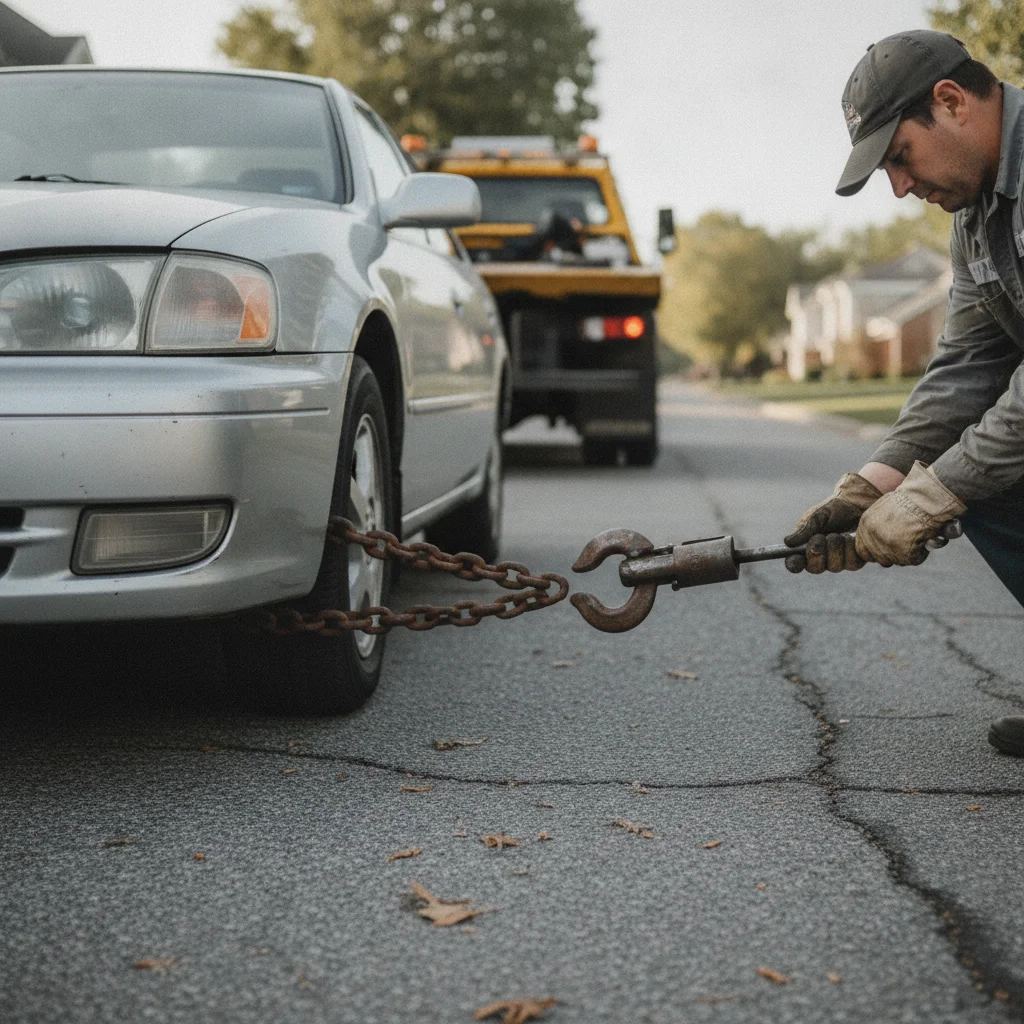
Here's the dealership finance perspective on why this matters: if you're financing a newer vehicle and break down 40 miles from your dealer's certified service center, a 15-mile tow cap means you're covering $75–$175 in overage fees on top of whatever repair is coming. That adds up fast, especially if you're already managing a tight monthly payment.
Some mid-tier and premium roadside plans extend towing to 100 miles or offer unlimited towing to any facility. If you drive long distances regularly, that upgrade is worth pricing out. See what a single tow actually costs without coverage to run the math on whether the premium bump makes sense for your situation.
Key Towing Policy Terms to Check
- Maximum tow distance per incident (not per year — some policies cap total annual towing distance separately)
- Destination restrictions — nearest facility vs. facility of your choice
- Per-mile overage rate once the cap is exceeded
- Number of towing events covered per year (commonly 3–4)
Fuel Delivery, Battery Jump, and Flat Tire: The Smaller Services
Beyond towing, standard roadside policies cover several smaller services. Each sounds simple. Each has its own fine print.

Fuel Delivery
Most policies will send a technician with emergency fuel — typically up to 2 gallons. The service call itself is covered; the fuel usually isn't. You'll pay the cost of the gas at retail or a markup. On some policies, even the service fee has a dollar cap ($50–$75 is common), and anything beyond that comes out of your pocket. Rural areas and highways with limited contractor networks can also mean longer wait times, with no guaranteed response window.
Battery Jump-Start
Jump-starts are the most straightforward service: a technician arrives, connects a jump box, and gets you moving. Covered under virtually every roadside plan with no meaningful dollar cap. The catch is repeated use — call for a jump more than 2–3 times in a year and some insurers flag the pattern, and a few will explicitly cap jump-start calls at 3–4 per policy period.
Flat Tire Change
Flat tire service means the technician swaps your flat for your spare — they don't provide a new tire, patch the flat, or take any further action. If you don't have a spare (increasingly common on newer vehicles with run-flat tires or no spare at all), the service defaults to a tow. That distinction catches a lot of drivers off guard. Check whether your current vehicle even has a spare before you assume tire service means you're rolling again.
Reimbursement vs. Direct Dispatch: Know Which You Have
Some insurers — particularly budget carriers — operate roadside assistance on a reimbursement model. You call a tow truck yourself, pay upfront, and submit a receipt for reimbursement up to your policy limit. This is a critical difference if you're stranded without access to a credit card or significant cash. Check your policy documents now, not during a breakdown, to confirm which model applies to you.
No Spare Tire? Read Your Flat Tire Coverage Carefully
An increasing number of new vehicles — particularly smaller sedans and EVs — are sold without a spare tire, relying instead on run-flat tires or a tire inflation kit. If your car has no spare, flat tire service under a standard roadside policy automatically converts to a tow. Make sure your tow distance cap is adequate before assuming you'll be back on the road quickly after a flat.
Annual Service Limits Reset With Your Policy Period
Your 3–4 annual service calls reset when your policy renews, not on a calendar-year basis. If your policy renews in March, calls made in January and February count against the previous year's limit. Knowing your renewal date helps you track how many incidents you have remaining at any given time.
EV drivers should note that fuel delivery and conventional jump-starts don't apply to their situation. The coverage requirements are fundamentally different. See what EV roadside assistance actually needs to include for a full breakdown.
Lockout Service: What the Policy Sends vs. What You Might Need
Lockout service is one of the most frequently used roadside benefits. A technician arrives and uses a slim jim, wedge, or programming tool to unlock your vehicle. Simple in theory; more variable in practice.
Modern vehicles — especially those with advanced key fob systems, push-button ignitions, or smart locks — require technicians with specialized equipment. A standard contracted roadside technician may not have that equipment. In those cases, the service escalates to a locksmith call, which may exceed the policy's dollar cap (typically $50–$100 for lockout service). You pay the difference.
Also worth knowing: lockout service does not cover key replacement. If you've lost your key or it's damaged, that's a separate expense. Replacement key fobs for newer vehicles routinely run $200–$500 through a dealer, and roadside assistance won't touch that cost.
$75–$175
Out-of-pocket tow overage beyond 25-mile cap
Based on typical per-mile overage rates of $3–$7 charged by roadside contractors when distance limits are exceeded.
$200–$500
Dealer cost to replace a key fob
Key fob replacement for newer vehicles often requires dealer programming and is not covered by standard roadside assistance policies.
35%
Drivers who don't know their tow distance limit
According to a 2023 J.D. Power roadside satisfaction study, more than a third of policyholders were unaware of mileage caps before their first claim.
3–4x
Annual cost of one tow vs. one year of roadside coverage
A single 30-mile tow averages $100–$200 out of pocket; most insurance roadside add-ons cost $5–$15 per year per vehicle.
What Lockout Coverage Typically Includes
- Unlocking a vehicle when keys are locked inside
- Service fee up to a policy-defined dollar limit
- One lockout call per incident
What It Doesn't Cover
- Key cutting or replacement
- Key fob programming
- Costs exceeding the service cap
- Lockouts resulting from mechanical failure of the lock mechanism
How to Actually Read Your Roadside Policy Before You Need It
The coverage details that matter most are buried in the declarations page and the endorsement language — not the summary brochure your insurer emailed you. Here's how to find them efficiently.
- Pull your declarations page. Look for the "Emergency Road Service" or "Roadside Assistance" line item. The premium is usually $5–$15 per vehicle per year. If it's not there, you don't have it.
- Find the endorsement form number. It'll be listed on the declarations page. Request or download that specific form — it contains the actual service limits, dollar caps, and exclusions.
- Check the call process. Most insurers now use an app or a toll-free dispatch number. Some have switched to reimbursement models where you pay out of pocket and submit receipts — a critical difference if you're stranded with limited cash or credit access.
- Note the annual service limits. Three to four incidents per year is standard. If you've already used two tows this year, that context matters.
If you're in the middle of comparing policies and want to avoid overlooking this and other add-ons, this rundown of commonly overlooked policy features covers what to scrutinize across the board. And for the full landscape of optional coverages — where roadside fits relative to gap insurance, rental reimbursement, and more — see the complete optional coverage guide.

One more thing worth flagging: if you're involved in an accident rather than a mechanical breakdown, roadside assistance and your collision/comprehensive coverage operate separately. Dispatching a tow after an accident involves different procedures. The accident procedures hub walks through exactly what to do in that scenario so you're not making those decisions under pressure.
Emergency Road Service (ERS)
The formal policy term used by most insurers for roadside assistance coverage. It typically appears as a line item on your declarations page and governs dispatch, service types, and dollar limits.
Tow distance cap
The maximum number of miles your policy will cover for a single tow event. Distance beyond the cap is billed at a per-mile overage rate paid by the policyholder.
Reimbursement model
A roadside assistance structure where you pay a service provider directly at the time of the incident and then submit receipts to your insurer for repayment, up to your policy's dollar limits.
Contracted network
The third-party towing and service companies your insurer dispatches when you call for roadside assistance. Response times and capabilities vary by contractor, not by your insurer directly.
Service incident limit
The maximum number of times per policy period (usually annually) you can call for roadside assistance. Standard plans allow 3–4 incidents per vehicle.
Dollar cap
The maximum dollar amount your policy will pay toward a specific service type per incident. Costs above the cap — for lockouts, fuel, or towing overages — are the policyholder's responsibility.
Roadside Assistance Provider Comparison Guide
A side-by-side breakdown of insurance add-ons, AAA, and automaker plans — including service limits, response times, and cost — to help you choose the right source of coverage for your driving habits.
Optional Coverage Cost Calculator
Estimate how much optional add-ons like roadside assistance and rental reimbursement cost annually versus the out-of-pocket expense of a single incident, so you can decide if the premium is worth it.
Insurance Declarations Page Decoder
A plain-English walkthrough of every line item on a standard auto insurance declarations page, including how to find your roadside assistance endorsement and service limits.
AAA Membership Benefits Overview
Official AAA membership tiers with service limits, towing distances, and pricing — useful for comparing against your current insurer's roadside add-on to identify gaps.
EV Roadside Assistance Checklist
A downloadable checklist of EV-specific roadside requirements — including charging assistance, flatbed towing needs, and dealer-only service restrictions — to evaluate before your next policy renewal.

All claims are backed by peer-reviewed research. Sources on request.