Key Takeaways
Liability Limits and Net Worth
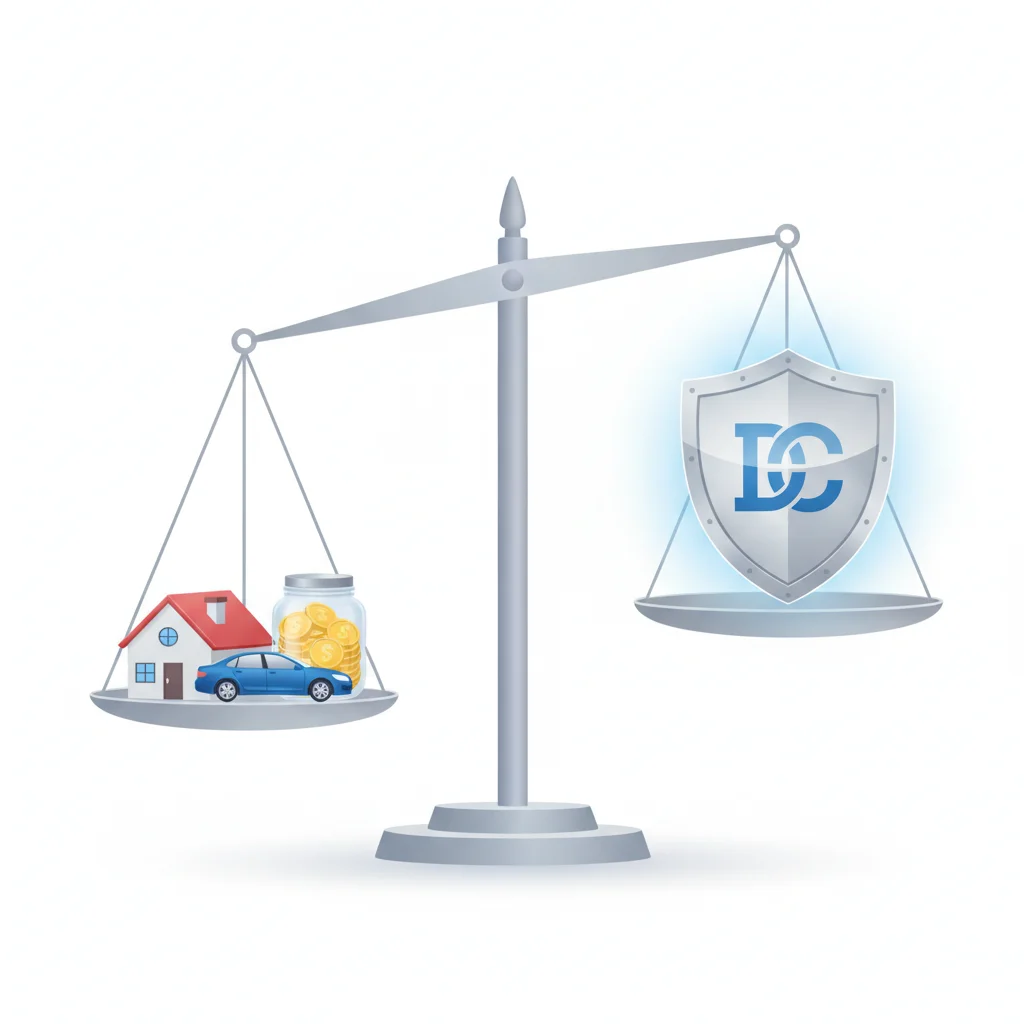
Liability limits are the maximum dollar amounts your auto insurance will pay if you cause an accident that injures someone or damages their property. Your net worth — what you own minus what you owe — is exactly what's at risk when those limits aren't enough. If a court judgment exceeds your coverage, creditors can pursue your savings, investments, and even your home to cover the difference. That's why matching your liability limits to your net worth is one of the most important financial decisions you'll make as a driver.
In most states, a judgment creditor can garnish wages, place liens on real property, and seize non-exempt financial assets to satisfy a court award that exceeds your policy limits. Exempt assets vary by state.
The Hidden Gap in Most Auto Insurance Policies
Most drivers pick their liability limits the same way they pick a cable package — they go with whatever seems standard and move on. And for a long time, that approach doesn't cause any problems. Then one day it does, and the consequences can follow them for years.
Here's what's actually happening when you choose liability limits: you're deciding how much financial protection stands between a bad day on the road and your personal finances. If you cause an accident and the costs exceed your policy's limits, those excess costs don't disappear. They become a debt attached to you — your savings, your home equity, your paycheck.
That's the hidden gap. State minimums and "standard" policy options are designed to meet legal requirements, not to protect what you've worked to build. Understanding the relationship between your net worth and your liability limits is one of the most practical financial conversations you can have, and most people never have it.

Before going further, it helps to understand what liability coverage actually does. If you haven't yet decoded what those three numbers on your declarations page mean, our guide on reading your liability limits walks through each figure clearly.
What "Net Worth" Means in This Context
Net worth isn't just for the wealthy. Anyone who owns a home, has a savings account, contributes to a 401(k), or holds any investment — even a modest one — has a net worth that can be targeted by a creditor following a lawsuit.
To understand your exposure, consider these asset categories:
- Home equity: The portion of your home's value you actually own, after subtracting your mortgage balance.
- Liquid savings: Checking and savings accounts, money market funds, CDs.
- Investment accounts: Brokerage accounts, stocks, bonds, mutual funds.
- Retirement accounts: 401(k), IRA, and pension assets — note that these have varying levels of protection depending on your state.
- Future income: Courts can also consider your earning potential when determining how to satisfy a judgment through wage garnishment.
State Exemptions Vary Widely
Some states offer generous homestead exemptions that protect your primary residence from most creditors. Others offer minimal protection. Retirement accounts like 401(k)s generally receive strong federal protection under ERISA, but IRAs and other accounts vary by state. Don't assume your assets are protected without confirming the specific rules in your state — a brief conversation with a local attorney can clarify your actual exposure.
Liability Limits Are Per-Accident, Not Lifetime
Your liability limits reset each policy period, but they're capped per accident — meaning a single serious collision can exhaust your entire coverage. If you're involved in a multi-vehicle accident or one involving severe injuries and multiple claimants, the per-occurrence limit is the ceiling your insurer will pay out in total. Understanding this makes the case for higher limits even more concrete.
Not all assets are equally vulnerable. Every state has exemption laws that protect certain assets from creditors — a homestead exemption for primary residences is common, for example. But these protections vary enormously, and many people overestimate how much of their wealth is actually shielded. A local attorney or financial advisor can tell you what's specifically protected where you live.
The practical takeaway: add up what you own. That number — whatever it is — is what's at risk when your liability limits fall short. And it should serve as the starting point for choosing how much coverage to carry.
How Liability Judgments Can Reach Your Personal Assets
Let's walk through what actually happens when a serious accident results in a lawsuit that exceeds your coverage limits. Understanding this sequence makes it easier to see why the numbers matter so much.
Suppose you cause a collision that results in significant injuries to another driver. Their medical bills, lost wages, pain and suffering, and ongoing rehabilitation costs are determined by a court to total $450,000. Your policy has a per-person bodily injury limit of $100,000.
Your insurer pays the $100,000. That's what they're obligated to do. The remaining $350,000 is a judgment against you personally. The injured party — or their attorney — can now pursue that amount through legal mechanisms including:
- Wage garnishment — a portion of your paycheck is redirected to satisfy the debt.
- Bank levies — funds can be withdrawn directly from your checking or savings accounts.
- Property liens — a lien placed on your home means you can't sell or refinance without satisfying the debt first.
- Seizure of non-exempt assets — investments and property that fall outside your state's exemptions can be sold to satisfy the judgment.

This isn't a theoretical worst case. It happens. And the financial consequences can take years — sometimes decades — to fully resolve. For a deeper look at how your coverage functions as a firewall between a judgment and your personal wealth, see our article on liability insurance and personal asset protection.
“People insure their cars, their homes, their health — but they often forget that the biggest financial risk they face is the liability exposure from an at-fault accident. The gap between what their policy covers and what a court can award them is where financial lives unravel.”
— J. Robert Hunter, Former Director of Insurance, Consumer Federation of America
The Real Cost of Higher Limits (It's Less Than You Think)
One reason drivers stick with low liability limits is a belief that better coverage costs significantly more. The actual premium difference is often a surprise.
$150–$300
Typical annual cost of a $1M umbrella policy
According to the Insurance Information Institute, personal umbrella policies are among the most cost-effective forms of liability protection available to individual drivers.
62%
Drivers carrying only minimum or low liability limits
A 2023 analysis by the Insurance Research Council found that a majority of U.S. drivers carry liability limits at or near state-required minimums, leaving significant personal assets exposed.
$30,000+
Average cost of auto accident bodily injury claim
The Insurance Information Institute reports the average bodily injury liability claim now exceeds $30,000 — well above many drivers' per-person policy limits.
~$15/mo
Typical premium increase to double bodily injury limits
Industry rate data suggests that moving from 50/100 to 100/300 bodily injury limits adds as little as $10–$20 per month for many drivers, depending on location and driving record.
Raising your bodily injury limits from the common 25/50 (25,000 per person, 50,000 per occurrence) to 100/300 might add somewhere between $10 and $30 per month to your premium, depending on your insurer, driving record, and location. That's a meaningful increase in protection for a very modest change in what you pay.
Property damage limits follow a similar pattern. Going from a $25,000 property damage limit to $100,000 is often just a few dollars more per month — yet the gap in protection is enormous when you consider that a newer vehicle, fence, building, or multiple cars can easily exceed the lower limit.
Start With a Simple Asset Inventory
Before your next policy renewal, spend 15 minutes estimating your net worth: add up home equity, savings, and investments, then subtract debts. That total is your benchmark for liability limits. If your coverage falls well short of that number, ask your agent what it would cost to close the gap — the answer is often a pleasant surprise.
Ask About Umbrella Policies at Renewal
Every time you renew your auto policy is a good moment to ask your insurer about umbrella coverage. Many insurers offer discounts when you bundle umbrella policies with your existing auto and home coverage, making the overall cost even more manageable. A million dollars of extra protection for a few hundred dollars per year is hard to beat.
The math becomes even more favorable when you add an umbrella policy. Umbrella coverage extends your liability limits — typically by $1 million or more — and kicks in after your auto policy limits are exhausted. These policies are available for roughly $150 to $300 per year for the first million in coverage. For anyone with a home, retirement savings, or meaningful income, that's a remarkably cost-effective layer of protection.
Setting Limits That Actually Reflect What You Own
Here's a practical framework for thinking about where your liability limits should sit:
Step 1: Estimate Your Total Net Worth
Roughly tally your assets — home equity, savings, investments, retirement accounts — and subtract your debts. Even a rough number gives you a useful reference point. If you own a home with $200,000 in equity and have $80,000 in savings and investments, your exposed net worth is in the neighborhood of $280,000.
Step 2: Aim to Meet or Exceed That Number
Your liability limits should at minimum cover your net worth. In the example above, that means carrying at least $300,000 in bodily injury coverage per occurrence — not $50,000 or $100,000. Anything less leaves a gap that creditors can reach through.
Step 3: Consider an Umbrella for Larger Estates
If your combined assets exceed what standard auto policy limits can cover — typically capped at $500,000 or so depending on the insurer — an umbrella policy is the right next step. It provides an additional $1 million to $5 million in coverage for a fraction of what you might expect.
Step 4: Account for Income as Well
Even if your current net worth is modest, high earning potential makes you an attractive target for wage garnishment following a judgment. If your income is likely to grow significantly in the coming years, factor that into your coverage decisions today.
State Exemptions Vary Widely
Some states offer generous homestead exemptions that protect your primary residence from most creditors. Others offer minimal protection. Retirement accounts like 401(k)s generally receive strong federal protection under ERISA, but IRAs and other accounts vary by state. Don't assume your assets are protected without confirming the specific rules in your state — a brief conversation with a local attorney can clarify your actual exposure.
Liability Limits Are Per-Accident, Not Lifetime
Your liability limits reset each policy period, but they're capped per accident — meaning a single serious collision can exhaust your entire coverage. If you're involved in a multi-vehicle accident or one involving severe injuries and multiple claimants, the per-occurrence limit is the ceiling your insurer will pay out in total. Understanding this makes the case for higher limits even more concrete.
For a more detailed framework that factors in driving habits and risk exposure alongside assets, our article on how much liability coverage you actually need walks through the decision more fully.
When to Reassess: Life Changes That Shift Your Risk
Liability limits aren't a one-time decision. As your financial life evolves, the gap between what you have to lose and what your policy covers can widen without you even noticing.
Some of the most common triggers for a coverage review include:
- Buying a home: Home equity is one of the most significant and vulnerable assets most people own.
- Marriage: A spouse's assets may now be jointly held — and jointly exposed.
- A significant salary increase or promotion: Higher income means more attractive wage garnishment for creditors.
- Inheriting money or property: A sudden increase in assets demands an immediate look at whether your coverage still keeps pace.
- Opening investment accounts: Brokerage and taxable investment accounts are generally not protected from creditors the way some retirement accounts may be.
- Adding a young driver to your policy: Newer drivers statistically increase your accident risk, which makes adequate limits even more important.
If any of these situations sound familiar, it's worth scheduling time to review your declarations page and speak with your agent. Our guide on reviewing your liability coverage after a major life change offers a practical checklist for exactly these moments.
Start With a Simple Asset Inventory
Before your next policy renewal, spend 15 minutes estimating your net worth: add up home equity, savings, and investments, then subtract debts. That total is your benchmark for liability limits. If your coverage falls well short of that number, ask your agent what it would cost to close the gap — the answer is often a pleasant surprise.
Ask About Umbrella Policies at Renewal
Every time you renew your auto policy is a good moment to ask your insurer about umbrella coverage. Many insurers offer discounts when you bundle umbrella policies with your existing auto and home coverage, making the overall cost even more manageable. A million dollars of extra protection for a few hundred dollars per year is hard to beat.
Liability-Only vs. Full Coverage: A Separate But Related Question
It's worth pausing to distinguish between two conversations that sometimes get conflated. This article is specifically about how much liability coverage you carry. A separate decision is whether to add collision and comprehensive coverage — what's commonly called "full coverage" — to protect your own vehicle.
Those are two different questions with different answers depending on your situation. But they're related: carrying high liability limits while skimping on collision coverage (or vice versa) can leave different parts of your financial picture exposed.
If you're weighing those decisions together, our comparison of liability limits vs. full coverage can help you think through the right mix for your situation.
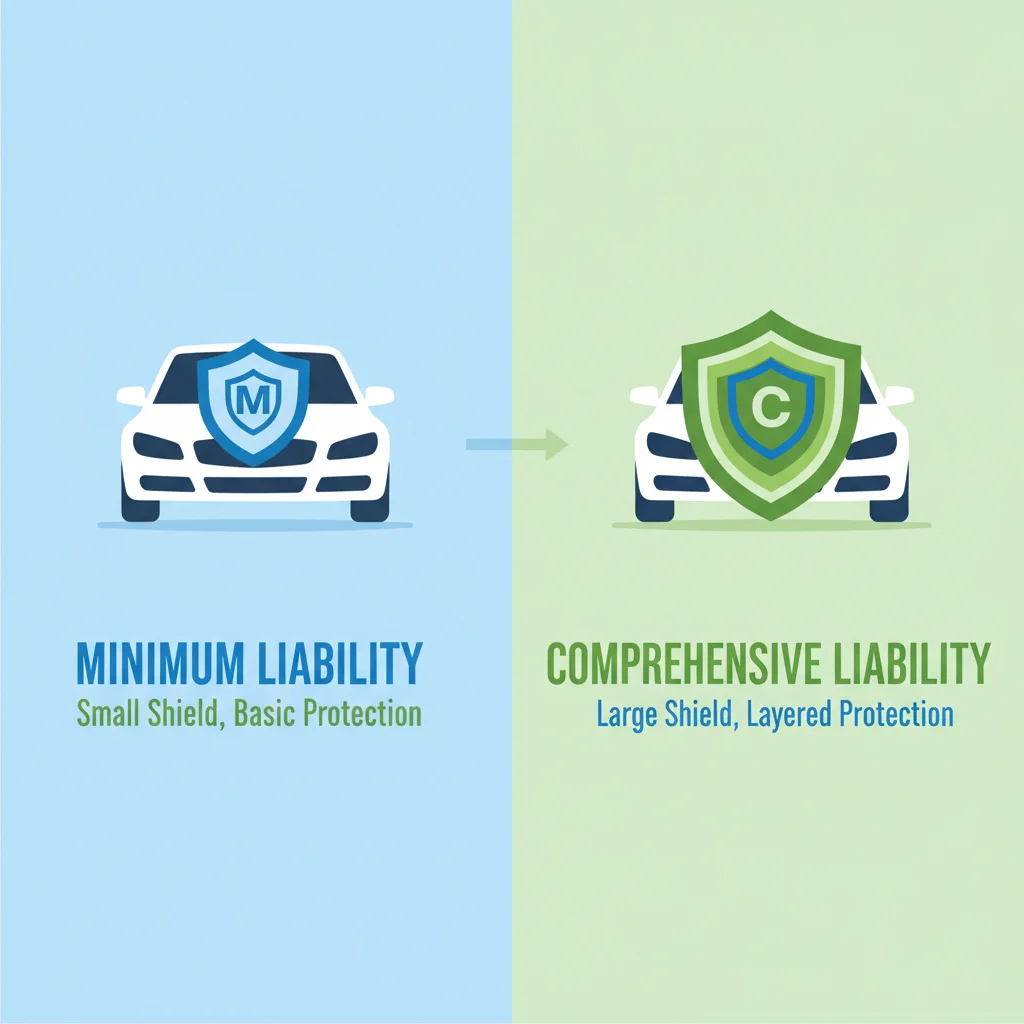
The short version: high liability limits protect your net worth from being taken to satisfy someone else's damages. Collision and comprehensive protect the vehicle you're driving. Both matter — but for different reasons and in different situations.
A Calm Case for Taking This Seriously
There's nothing alarming about this conversation — it's actually a fairly simple and empowering one once you understand the mechanics. You've worked to build financial stability, and your insurance should be designed to protect it.
The good news is that meaningful protection doesn't require a dramatic increase in what you pay each month. Raising your limits to genuinely reflect your net worth — and possibly adding an umbrella policy on top — is one of the highest-value moves you can make in your overall financial plan.
If you're not sure where your current limits stand, pull out your declarations page and look at those three numbers. Then compare them to a rough estimate of what you own. If there's a significant gap, a conversation with your insurance agent is worth having sooner rather than later. Small adjustments made now can prevent enormous complications later — and that peace of mind is worth every dollar.

All claims are backed by peer-reviewed research. Sources on request.