| Most common minimum (bodily injury) | 25/50 ($25,000 per person / $50,000 per accident) (Applies to the majority of U.S. states) |
| Lowest property damage minimum | $5,000 (California, Massachusetts, Pennsylvania) |
| Highest bodily injury minimums | $50,000 / $100,000 (Alaska, Maine, Michigan) |
| States without mandatory auto insurance | 1 — New Hampshire (financial responsibility still required) |
| No-fault states requiring PIP | 12 states including Florida, Michigan, New York, and New Jersey (Requirements vary by state) |
| States where BI liability is not mandated | Florida (for most drivers) (Florida Statutes, Chapter 324) |
What State Minimums Actually Mean
Every state (with the exception of New Hampshire, which has alternative financial responsibility options) requires drivers to carry at least a baseline level of liability insurance. These minimums are the floor — the least coverage you can legally drive with. They are not a recommendation.
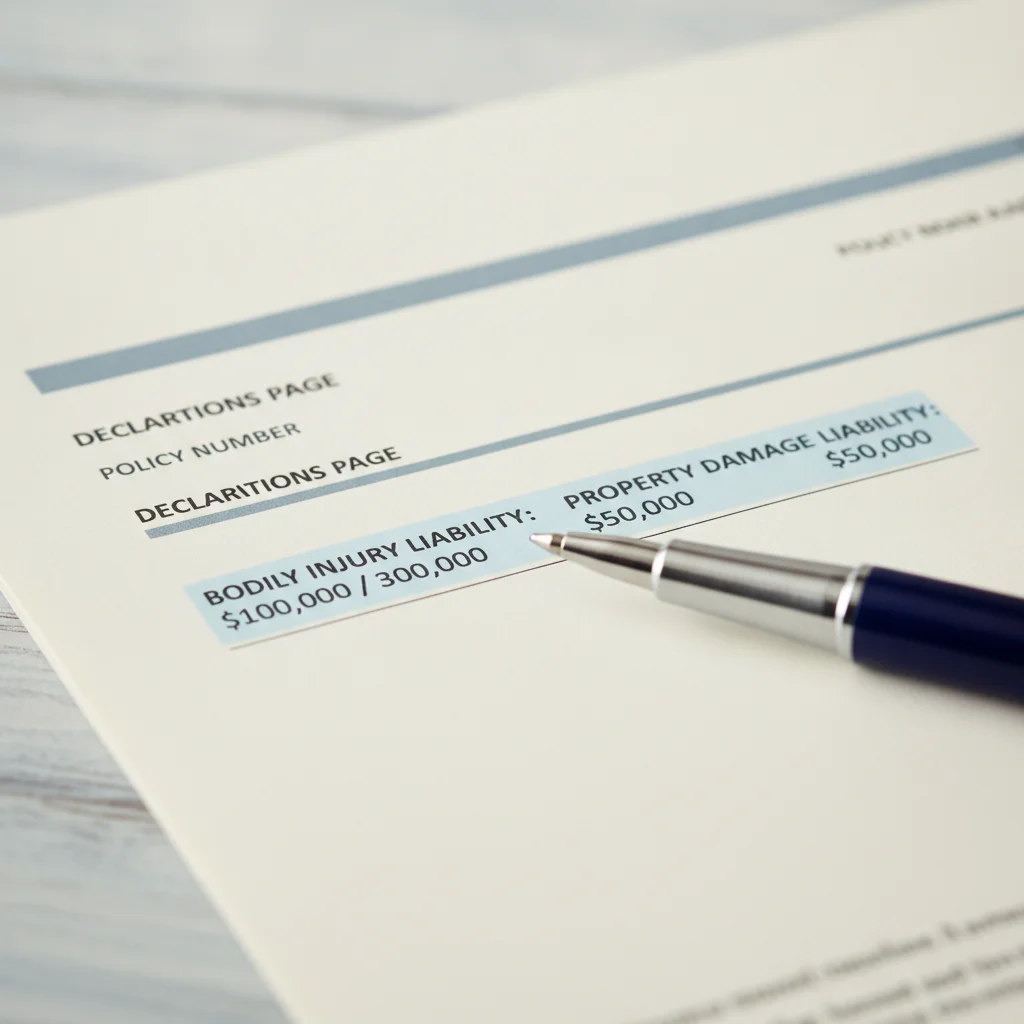
Liability limits are expressed as three numbers separated by slashes, such as 25/50/25. Here's what those numbers mean:
- First number: Maximum payout per injured person (bodily injury, per-person limit) — in thousands of dollars
- Second number: Maximum payout per accident for all injured people combined (bodily injury, per-accident limit) — in thousands of dollars
- Third number: Maximum payout for property damage caused to others — in thousands of dollars
For a deeper explanation of how those first two numbers interact in practice, see how per-person and per-accident limits work together. It's a distinction that trips up a lot of drivers.
Liability Coverage
Car insurance that pays for injuries and property damage you cause to others in an at-fault accident. It does not cover your own injuries or vehicle.
Bodily Injury Liability (BI)
The portion of liability coverage that pays for medical expenses, lost wages, and legal costs for people you injure in an accident. Expressed as two limits: per-person and per-accident.
Property Damage Liability (PD)
The portion of liability coverage that pays for damage you cause to another person's vehicle or property, such as a fence or building.
Per-Person Limit
The maximum your insurer will pay toward any single injured person's bodily injury claims in one accident, regardless of total damages.
Per-Accident Limit
The total cap your insurer will pay across all injured parties in one accident. No matter how many people are hurt, payouts stop at this ceiling.
No-Fault State
A state where each driver's own insurance pays their medical bills after an accident, regardless of who was at fault. No-fault states typically require Personal Injury Protection (PIP) coverage.
Financial Responsibility
A legal requirement to demonstrate you can cover the costs of accidents you cause. Usually met by carrying liability insurance, but some states accept bonds or cash deposits as alternatives.
Split Limit
A liability structure that sets separate maximums for per-person bodily injury, per-accident bodily injury, and property damage — written as three numbers (e.g., 25/50/25).
One more thing worth knowing before you look up your state: these minimums apply to your liability to others. They do not cover your own injuries or vehicle damage. If you want coverage for yourself, you'll need additional policy types such as collision, comprehensive, medical payments, or uninsured motorist coverage.
State-by-State Minimum Liability Requirements
Use the table below as a quick reference. Limits are shown in thousands of dollars (e.g., 25/50/25 means $25,000/$50,000/$25,000). States marked with a note have specific rules or alternatives worth reading carefully.
| Most common minimum (bodily injury) | 25/50 ($25,000 per person / $50,000 per accident) (Applies to the majority of U.S. states) |
| Lowest property damage minimum | $5,000 (California, Massachusetts, Pennsylvania) |
| Highest bodily injury minimums | $50,000 / $100,000 (Alaska, Maine, Michigan) |
| States without mandatory auto insurance | 1 — New Hampshire (financial responsibility still required) |
| No-fault states requiring PIP | 12 states including Florida, Michigan, New York, and New Jersey (Requirements vary by state) |
| States where BI liability is not mandated | Florida (for most drivers) (Florida Statutes, Chapter 324) |
| State | Bodily Injury (Per Person / Per Accident) | Property Damage |
|---|---|---|
| Alabama | $25,000 / $50,000 | $25,000 |
| Alaska | $50,000 / $100,000 | $25,000 |
| Arizona | $25,000 / $50,000 | $15,000 |
| Arkansas | $25,000 / $50,000 | $25,000 |
| California | $15,000 / $30,000 | $5,000 |
| Colorado | $25,000 / $50,000 | $15,000 |
| Connecticut | $25,000 / $50,000 | $25,000 |
| Delaware | $25,000 / $50,000 | $10,000 |
| Florida | No BI minimum required* | $10,000 |
| Georgia | $25,000 / $50,000 | $25,000 |
| Hawaii | $20,000 / $40,000 | $10,000 |
| Idaho | $25,000 / $50,000 | $15,000 |
| Illinois | $25,000 / $50,000 | $20,000 |
| Indiana | $25,000 / $50,000 | $25,000 |
| Iowa | $20,000 / $40,000 | $15,000 |
| Kansas | $25,000 / $50,000 | $25,000 |
| Kentucky | $25,000 / $50,000 | $25,000 |
| Louisiana | $15,000 / $30,000 | $25,000 |
| Maine | $50,000 / $100,000 | $25,000 |
| Maryland | $30,000 / $60,000 | $15,000 |
| Massachusetts | $20,000 / $40,000 | $5,000 |
| Michigan | $50,000 / $100,000 | $10,000 |
| Minnesota | $30,000 / $60,000 | $10,000 |
| Mississippi | $25,000 / $50,000 | $25,000 |
| Missouri | $25,000 / $50,000 | $25,000 |
| Montana | $25,000 / $50,000 | $20,000 |
| Nebraska | $25,000 / $50,000 | $25,000 |
| Nevada | $25,000 / $50,000 | $20,000 |
| New Hampshire | $25,000 / $50,000** | $25,000** |
| New Jersey | $25,000 / $50,000 | $25,000 |
| New Mexico | $25,000 / $50,000 | $10,000 |
| New York | $25,000 / $50,000 | $10,000 |
| North Carolina | $30,000 / $60,000 | $25,000 |
| North Dakota | $25,000 / $50,000 | $25,000 |
| Ohio | $25,000 / $50,000 | $25,000 |
| Oklahoma | $25,000 / $50,000 | $25,000 |
| Oregon | $25,000 / $50,000 | $20,000 |
| Pennsylvania | $15,000 / $30,000 | $5,000 |
| Rhode Island | $25,000 / $50,000 | $25,000 |
| South Carolina | $25,000 / $50,000 | $25,000 |
| South Dakota | $25,000 / $50,000 | $25,000 |
| Tennessee | $25,000 / $50,000 | $15,000 |
| Texas | $30,000 / $60,000 | $25,000 |
| Utah | $25,000 / $50,000 | $15,000 |
| Vermont | $25,000 / $50,000 | $10,000 |
| Virginia | $30,000 / $60,000 | $20,000 |
| Washington | $25,000 / $50,000 | $10,000 |
| West Virginia | $25,000 / $50,000 | $25,000 |
| Wisconsin | $25,000 / $50,000 | $10,000 |
| Wyoming | $25,000 / $50,000 | $20,000 |
| Washington D.C. | $25,000 / $50,000 | $10,000 |
*Florida is a no-fault state that requires $10,000 in Personal Injury Protection (PIP) but does not mandate bodily injury liability for most drivers, though it is required for certain situations including accidents causing serious injury.
**New Hampshire does not mandate insurance by default but sets these minimums for drivers who do carry a policy or need to demonstrate financial responsibility after an incident.
States with Notable Rules or Exceptions
A few states stand out for rules that can genuinely catch drivers off guard. Here's what to know:

Florida — No-Fault and No Mandatory Bodily Injury
Florida operates as a no-fault state, which means each driver's own insurer pays for their medical bills regardless of who caused the accident — up to their Personal Injury Protection (PIP) limit. Florida requires $10,000 in PIP and $10,000 in property damage liability. However, most Florida drivers are not required to carry bodily injury liability. That changes if you've been convicted of certain violations or involved in specific types of accidents. Given how low those property damage limits are, many Florida drivers are seriously underinsured.
New Hampshire — Insurance Is Optional (Sort Of)
New Hampshire doesn't mandate auto insurance for most drivers — but that doesn't mean you're off the hook if you cause an accident. The state requires you to demonstrate financial responsibility, meaning you could be on the hook personally for damages if you're uninsured and at fault. If you do carry insurance, those 25/50/25 minimums apply. For most drivers, carrying coverage is the far safer choice. You can learn more about what happens if you skip coverage in why states require liability insurance.
California — Lowest Property Damage Limit in the Country
California's $5,000 property damage minimum hasn't kept pace with the cost of modern vehicles. A minor fender-bender in a parking lot can easily exceed that figure today. Drivers who carry only the state minimum in California are taking on substantial personal financial exposure.
Michigan — High Bodily Injury Minimums with Complex PIP Rules
Michigan requires $50,000/$100,000 in bodily injury liability — among the highest state minimums in the country — and has a uniquely complex no-fault system with tiered PIP options. Michigan drivers should pay careful attention to how their PIP selection interacts with their bodily injury coverage.
Minimum Requirements Can Change
State legislatures periodically update minimum liability requirements, and some states have recently increased their floors after decades without change. Always verify your state's current minimums directly with your state's Department of Motor Vehicles or Department of Insurance, especially if you've been with the same policy for several years and haven't reviewed your coverage.
Leased or Financed Vehicles Often Require More
If you're leasing a car or carrying an auto loan, your lender or lessor typically requires higher liability limits than the state minimum — along with comprehensive and collision coverage. Check your loan or lease agreement for the required minimums before choosing a policy limit.
Why State Minimums Are Rarely Enough
If you're reading this as a reference tool, the table above gives you the legal minimum for your state. But here's the honest takeaway: state minimums are almost never sufficient financial protection for the average driver.
$20,000+
Average cost of an injury accident
According to the National Safety Council, the average economic cost per injury accident exceeds $20,000 when including medical, lost wages, and property costs.
25/50/25
Most common state minimum limit
This split limit is the standard minimum in the largest number of U.S. states, though costs have made it increasingly inadequate.
$5,000
Lowest state property damage minimum
California, Massachusetts, and Pennsylvania set the national floor for property damage liability — a figure far below the average vehicle repair cost today.
13%
Estimated uninsured drivers on U.S. roads
The Insurance Research Council estimates roughly 1 in 8 drivers carries no insurance, underscoring why uninsured motorist coverage matters alongside meeting minimums.
Consider the math. The average cost of a car accident resulting in injury tops $20,000 — and serious accidents can reach six figures in medical bills alone. If your state minimum is 25/50/25 and you seriously injure someone whose bills reach $80,000, your insurance pays $25,000. The other $55,000? That can come out of your savings, your home equity, and your future wages through a lawsuit.
This isn't meant to alarm you — it's meant to prompt a question worth asking: Is the minimum actually enough for your situation? The answer depends on what assets you have to protect, how much you drive, and the type of roads and traffic conditions you're in regularly. For a practical framework for thinking through that question, see how much liability coverage you actually need.
If you're newer to insurance and want to understand how liability coverage works from the beginning, liability coverage from the ground up is a thorough starting point that walks through costs, limits, and what happens when you file a claim.
The bottom line: use state minimums to know your legal obligation, then consider your personal circumstances to decide how much more protection actually makes sense for you.

All claims are backed by peer-reviewed research. Sources on request.