Key Takeaways
Our Verdict
MedPay and PIP solve the same core problem — getting your medical bills paid quickly after a crash — but PIP does significantly more heavy lifting. If you live in a no-fault state, PIP is your primary injury coverage and you need to understand it well. If you're in a fault state with MedPay, it's a useful, low-friction supplement to health insurance. Neither is universally better; the right answer depends on where you live, what other coverage you carry, and how much financial cushion you need.
| Best for | Recommended |
|---|---|
| Drivers in no-fault states who need broad injury coverage | Personal Injury Protection (PIP) |
| Drivers in fault states who want simple, fast medical bill reimbursement | Medical Payments Coverage (MedPay) |
| Self-employed drivers who cannot afford lost income after an accident | Personal Injury Protection (PIP) |
| Drivers with strong health insurance who want minimal supplemental coverage | Medical Payments Coverage (MedPay) |
Why This Comparison Matters at Claim Time
After a car accident, the last thing you want is to dig through your policy trying to figure out which coverage handles your emergency room bill. Medical Payments coverage (MedPay) and Personal Injury Protection (PIP) are both designed to pay injury costs without waiting to determine fault — but the moment you file a claim, the differences between them become very real.
Understanding those differences now, before an accident, is one of the most practical things you can do for yourself. It's not complicated once you see it laid out clearly. This article walks through how each coverage actually works during the claims process, so you know what to expect and what documentation to gather.
It's also worth noting upfront: these coverages sit alongside — not instead of — bodily injury and property damage liability. Liability pays others when you're at fault; MedPay and PIP pay you (and your passengers) regardless of fault.
What MedPay and PIP Actually Cover
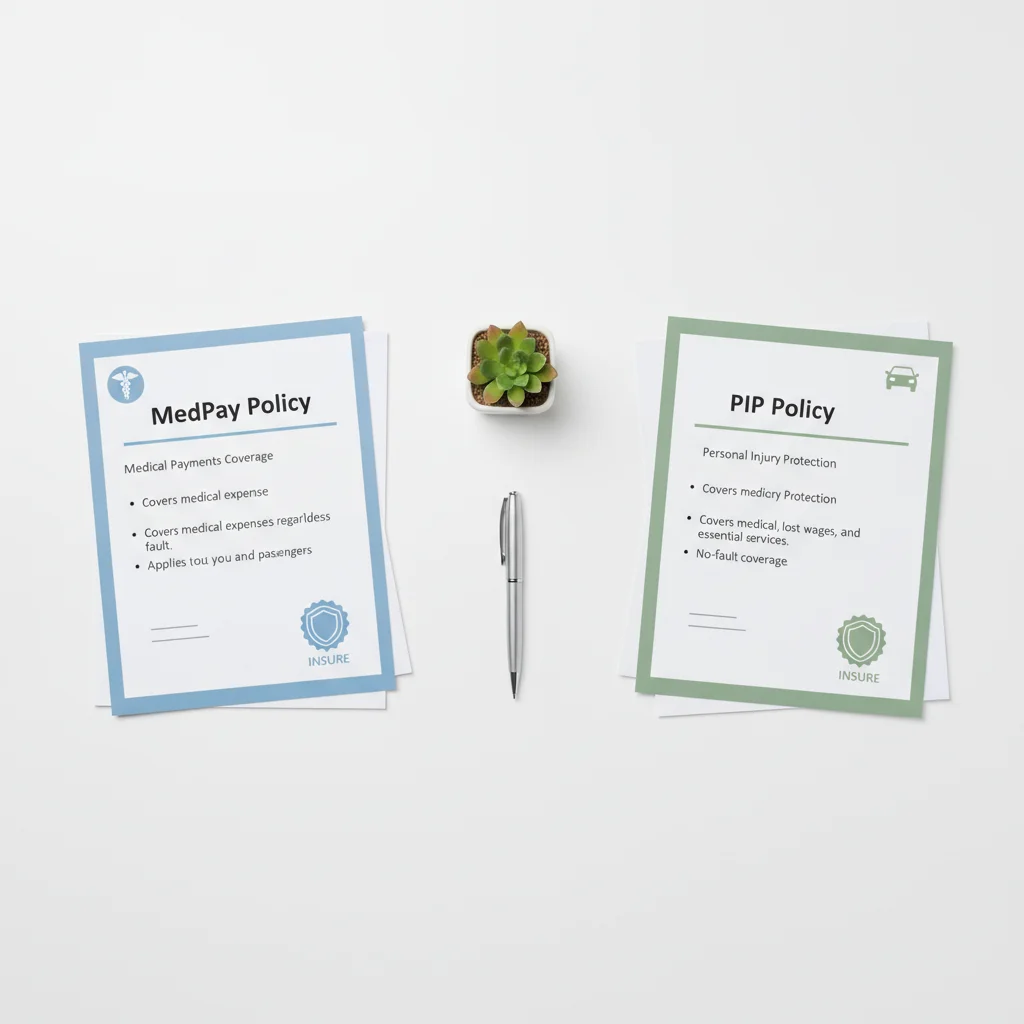
Before comparing the claims process, it helps to be clear on the scope of each coverage. The core overlap is real: both MedPay and PIP pay medical expenses for you and your passengers after an accident, and neither requires a fault determination to kick in. That's where the similarity largely ends.
Medical Payments Coverage (MedPay)
MedPay is a straightforward coverage. It reimburses reasonable and necessary medical and funeral expenses that result from an auto accident. Covered costs typically include:
- Emergency room visits and ambulance fees
- Hospital stays and surgery
- Doctor and specialist visits
- X-rays, MRIs, and diagnostic tests
- Dental treatment caused by the accident
- Funeral expenses (in the event of a fatality)
MedPay does not cover lost wages, child care, or household services. It also does not cover non-medical costs like transportation to appointments in most policies. Think of it as a clean, narrowly focused medical reimbursement tool.
Personal Injury Protection (PIP)
PIP covers everything MedPay does, but the scope extends further. Depending on your state and policy, PIP can also pay for:
- Lost wages if injuries prevent you from working
- Household services you can no longer perform (cleaning, childcare, yard work)
- Rehabilitation and therapy costs
- Survivor benefits and death benefits for dependents
- Essential services and caregiver costs
This broader net is why PIP is the required primary injury coverage in no-fault states. The philosophy behind no-fault insurance is that everyone's own insurer handles their own injuries first — so the coverage needs to address the full financial disruption an accident can cause, not just the hospital bill.
For a deeper dive into how PIP and MedPay differ outside of the claims process, see how to tell which one your policy offers.
| Medical Payments (MedPay) | Personal Injury Protection (PIP) | |
|---|---|---|
| Covers medical bills | Yes | Yes |
| Covers lost wages | No | Yes |
| Covers household services | No | Yes (in most states) |
| Fault requirement to pay | None — pays regardless of fault | None — pays regardless of fault |
| State availability | Optional in most fault states | Mandatory in 12 no-fault states |
| Typical coverage limits | $1,000–$10,000 | $10,000–$100,000+ |
| Filing deadline strictness | Moderate — follow policy terms | Strict — often 14–30 days by law |
| Documentation required | Medical bills and records | Bills, records, wage proof, receipts |
| Claims process complexity | Relatively simple | More involved, multiple components |
| IME (independent exam) required | Rare | Common in PIP states |
How the Claims Process Works for Each
This is where things get practical. Filing a MedPay or PIP claim is different from filing a liability or collision claim, and understanding the steps reduces a lot of anxiety.

Filing a MedPay Claim
MedPay claims are typically the simpler of the two. Here's the general flow:
- Notify your insurer: Contact your insurance company as soon as possible after the accident. You don't need to wait for a police report or fault determination.
- Submit medical bills: As you receive bills from providers, submit them to your insurer. Many insurers will pay providers directly if you authorize it.
- Provide medical records: Your insurer will likely request records showing the injuries are accident-related. Keep everything organized from day one.
- Receive reimbursement: Once the insurer reviews the bills against your policy limit, they issue payment — either to you or directly to the provider.
One important detail: MedPay limits are usually modest (often $1,000–$10,000), and once your limit is exhausted, you're responsible for the remainder. If your bills exceed your MedPay limit, your health insurance becomes the next line of coverage.
Keep a Simple Expense Log From Day One
As soon as you receive any medical bill after an accident, start a dedicated folder — physical or digital — just for accident-related documents. Include every receipt, every explanation of benefits from your health insurer, and any correspondence from your auto insurer. This habit takes five minutes to set up and can save hours of confusion when your claims representative asks for documentation.
Confirm Coverage Details Before You Need Them
The best time to understand your MedPay or PIP coverage is before an accident happens. Pull up your declarations page and note your limit, your deductible if any, and how the coverage coordinates with your health insurance. If anything is unclear, call your insurer — most will walk you through it in under 10 minutes. That small effort now can eliminate significant stress later.
Filing a PIP Claim
PIP claims follow a similar initial path but typically involve more documentation, especially for the non-medical components:
- Notify your insurer promptly: In no-fault states, there are often strict deadlines for filing a PIP claim — sometimes as short as 14 to 30 days. Missing this window can jeopardize your claim entirely.
- Submit medical bills and records: Same as MedPay — keep every bill, explanation of benefits, and treatment record.
- Document lost wages: If you're claiming lost income, you'll need a statement from your employer confirming missed work and your rate of pay. Self-employed individuals typically need tax returns or financial records.
- Document essential services: If you're claiming household service costs, keep receipts and a log of what you couldn't do and what you paid someone else to do.
- Attend required medical exams: Many PIP policies require you to attend an independent medical examination (IME) if your insurer requests it. Declining can result in claim denial.
- Receive reimbursement: PIP payments may come in multiple phases as different expense types are processed separately.
Don't Miss PIP's Filing Deadline
In no-fault states, PIP claims are subject to strict statutory deadlines — often just 14 to 30 days from the accident date. Missing this window gives your insurer legal grounds to deny the claim entirely, regardless of how legitimate your injuries are. If you're injured and unsure whether to file, err on the side of notifying your insurer immediately. You can always provide additional documentation later, but you cannot undo a missed deadline.
Because PIP claims involve more components, they can take longer to fully resolve — particularly when lost wages or rehabilitation costs continue accruing over time. That doesn't mean the process is difficult, but it does mean staying organized and responsive to your insurer's requests pays off significantly.
Key Differences That Affect Your Claim Experience
Beyond the scope of coverage, several procedural differences will shape your experience when you actually file a claim.
State Availability and Requirements
MedPay is optional in most states that aren't no-fault. You may have to actively add it to your policy. PIP, by contrast, is mandatory in the following no-fault states: Florida, Michigan, New Jersey, New York, Pennsylvania, Hawaii, Kansas, Kentucky, Massachusetts, Minnesota, North Dakota, and Utah. In these states, you cannot opt out of PIP (in most cases), and it functions as your primary injury coverage.
If you're uncertain which system your state uses, your declarations page will show whether you have PIP, MedPay, or both.
Filing Deadlines
MedPay doesn't always have a rigid filing deadline beyond the standard policy terms, though filing promptly is always wise. PIP claims in no-fault states are often subject to strict statutory deadlines. Miss the window and your insurer can legally deny the claim — even if your injuries are legitimate and well-documented.
Coordination With Health Insurance
Some MedPay policies are structured as primary coverage, meaning MedPay pays first and your health insurance covers the remainder. Others are excess coverage, meaning health insurance pays first and MedPay covers the gap. Your policy's coordination of benefits language determines this, and it matters for how you submit claims to each insurer.
PIP coordination rules vary by state. Some states require PIP to pay first regardless; others allow coordination with health insurance to reduce premiums.
12
U.S. no-fault states requiring PIP
As of 2024, twelve states mandate Personal Injury Protection as the primary injury coverage under no-fault auto insurance laws.
~30 days
Typical PIP claim filing window
Many no-fault states impose statutory deadlines of 14 to 30 days for filing a PIP claim, after which insurers can legally deny coverage.
$1,000–$10,000
Typical MedPay coverage limit
Most MedPay policies offer limits in this range, which can be quickly exhausted in a serious accident requiring hospitalization.
~60%
Accident injury claimants with delayed symptoms
According to injury research, a significant share of accident-related soft tissue injuries — including whiplash — are not immediately apparent, underscoring the value of early medical evaluation.
Subrogation Rights
Both MedPay and PIP policies often include subrogation rights — meaning if another driver was at fault and their liability insurance pays you a settlement, your insurer may be entitled to recover what they already paid you for medical bills. This can affect how you negotiate with the at-fault driver's insurer, so it's worth asking your claims representative about your policy's subrogation terms before you accept any settlement offer.
Speaking of fault-based settlements — for larger injuries that exceed your PIP or MedPay limits, the at-fault driver's per-person and per-accident bodily injury limits become very relevant. Understanding how those limits work helps you gauge whether a settlement offer is reasonable.
When You Have Both MedPay and PIP
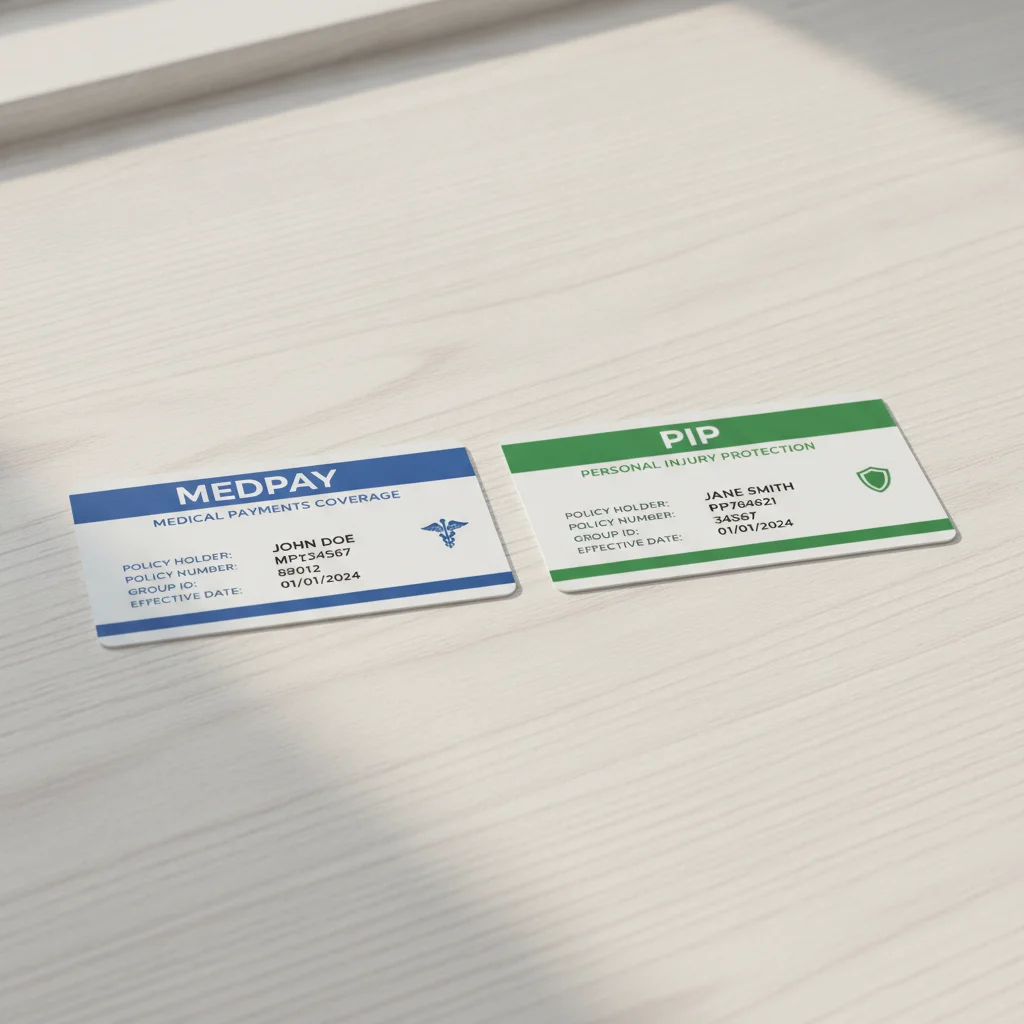
In some states, you can carry both PIP and MedPay. While this might seem redundant, there are situations where it provides meaningful extra protection — particularly if your PIP limit is modest and your potential medical costs are high.
When both coverages apply, the claims process usually works like this: PIP pays first up to its limit, then MedPay steps in to cover remaining eligible expenses up to its own limit. This stacking effect can provide a meaningful cushion if you're in a serious accident.
However, check your policy carefully. Some states restrict stacking, and some insurers write policies that specifically exclude duplicate payments for the same expense. Your insurer's claims department can clarify exactly how the two coverages interact under your specific policy.
Whether you're dealing with a minor fender-bender or a more serious injury claim, it's also worth thinking about how your decision to file through insurance (versus handling matters privately) affects these coverages. Settling privately vs. going through insurance is a real choice some drivers consider, but bypassing your insurer can complicate or forfeit your MedPay and PIP benefits entirely.
Practical Steps to Take Right After an Accident
Regardless of whether you have MedPay or PIP, the steps you take immediately after an accident can significantly affect how smoothly your claim goes.
- Seek medical attention promptly. Even if you feel fine, some injuries — like whiplash or concussions — don't show symptoms immediately. A delayed medical visit can also give an insurer grounds to question whether your injury was accident-related.
- Document everything at the scene. Photos of the vehicles, the road, any visible injuries, and the other driver's insurance card all become part of your claims file.
- Contact your insurer the same day. Most policies require prompt notification. This is especially critical for PIP in no-fault states with tight filing windows.
- Keep a running log of expenses and missed work. This doesn't need to be elaborate — a simple notes file on your phone works. Record every doctor visit, every bill, every day you missed work, and every task you paid someone else to do.
- Ask your claims representative which coverage applies first. Don't assume. Confirm whether MedPay or PIP is primary, and ask how it coordinates with your health insurance to avoid billing errors.
Keep a Simple Expense Log From Day One
As soon as you receive any medical bill after an accident, start a dedicated folder — physical or digital — just for accident-related documents. Include every receipt, every explanation of benefits from your health insurer, and any correspondence from your auto insurer. This habit takes five minutes to set up and can save hours of confusion when your claims representative asks for documentation.
Confirm Coverage Details Before You Need Them
The best time to understand your MedPay or PIP coverage is before an accident happens. Pull up your declarations page and note your limit, your deductible if any, and how the coverage coordinates with your health insurance. If anything is unclear, call your insurer — most will walk you through it in under 10 minutes. That small effort now can eliminate significant stress later.
One final note: if your accident involves a commercial vehicle, a rideshare driver, or any other situation with complex liability, consider consulting an attorney before accepting any settlement. MedPay and PIP can cover your immediate costs while that process unfolds — that's exactly what they're designed to do.

All claims are backed by peer-reviewed research. Sources on request.