Key Takeaways
Covers the full spectrum of physical damage risks
Collision handles crash scenarios; comprehensive covers theft, weather events, fire, and animal strikes. Together, they eliminate nearly every uninsured vehicle loss scenario short of mechanical failure.
Protects your investment against total loss
If your car is totaled or stolen, the payout reflects the vehicle's actual cash value. Without coverage, that loss comes directly out of your pocket or forces a loan under pressure.
Provides coverage regardless of fault
Collision coverage pays even when you caused the accident, which liability coverage does not. You aren't left without a vehicle while pursuing an at-fault claim against yourself.
Satisfies lender and lessor requirements
Financed or leased vehicles contractually require both coverages. Maintaining them keeps you in compliance and avoids force-placed insurance at punishing premium rates.
Fills gaps left by uninsured motorists
If an uninsured driver damages your vehicle, collision coverage steps in where the at-fault driver's liability policy does not. This is critical in states with high uninsured driver rates.
Peace of mind in high-risk environments
Drivers in hail corridors, flood zones, or high-theft urban areas face statistically elevated comprehensive risks. Coverage there isn't overcaution — it's actuarially justified.
Added annual premium cost can be substantial
Combined collision and comprehensive typically adds $500–$900 or more per year depending on location, vehicle, and driver profile. On an older car, this may exceed the coverage's realistic value.
Payout is capped at actual cash value, not replacement cost
Insurers pay ACV, which accounts for depreciation. A car that cost $25,000 new may be worth $9,000 at payout time — a gap that surprises many policyholders.
Deductibles reduce the effective benefit
A $1,000 deductible on a $5,000 car means your maximum net payout is $4,000. On minor damage that doesn't reach the deductible threshold, the coverage pays nothing.
Claims can raise your future premiums
Filing a collision claim — especially if you're at fault — can trigger a rate increase at renewal. In some cases, the long-term premium impact exceeds the initial claim payout.
Poor value on low-ACV older vehicles
When your car's market value drops below roughly $5,000–$6,000, the financial math of carrying both coverages often inverts. Annual premiums can approach the total potential payout.
Overlaps uncomfortably with other financial assets
Drivers with substantial emergency savings or a secondary vehicle may be paying for coverage that replicates a financial cushion they already have — effectively double-paying for the same protection.
Our Verdict
Carrying both collision and comprehensive is the right call for anyone who finances or leases their vehicle, owns a car worth more than $10,000, or lacks the savings to self-insure a total loss. The combined protection is comprehensive in the truest sense — it closes the gap that liability-only policies leave wide open. For older vehicles with low market value, the math often shifts in favor of dropping one or both, but that decision requires an honest reckoning with your local risk environment and emergency fund.
Best for drivers with newer or higher-value vehicles, financed or leased cars, limited emergency savings, or anyone who lives in areas prone to severe weather, high theft rates, or frequent animal collisions.
What You're Actually Buying With Each Coverage
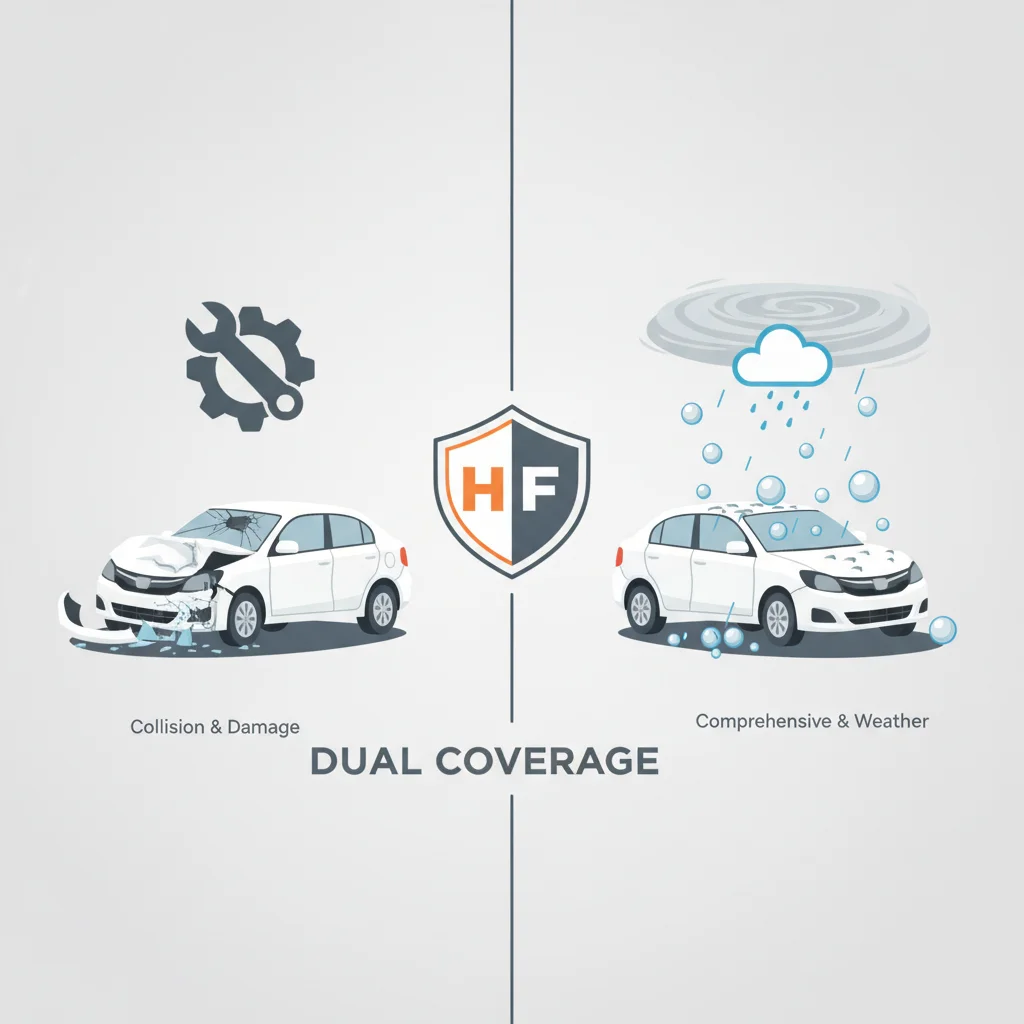
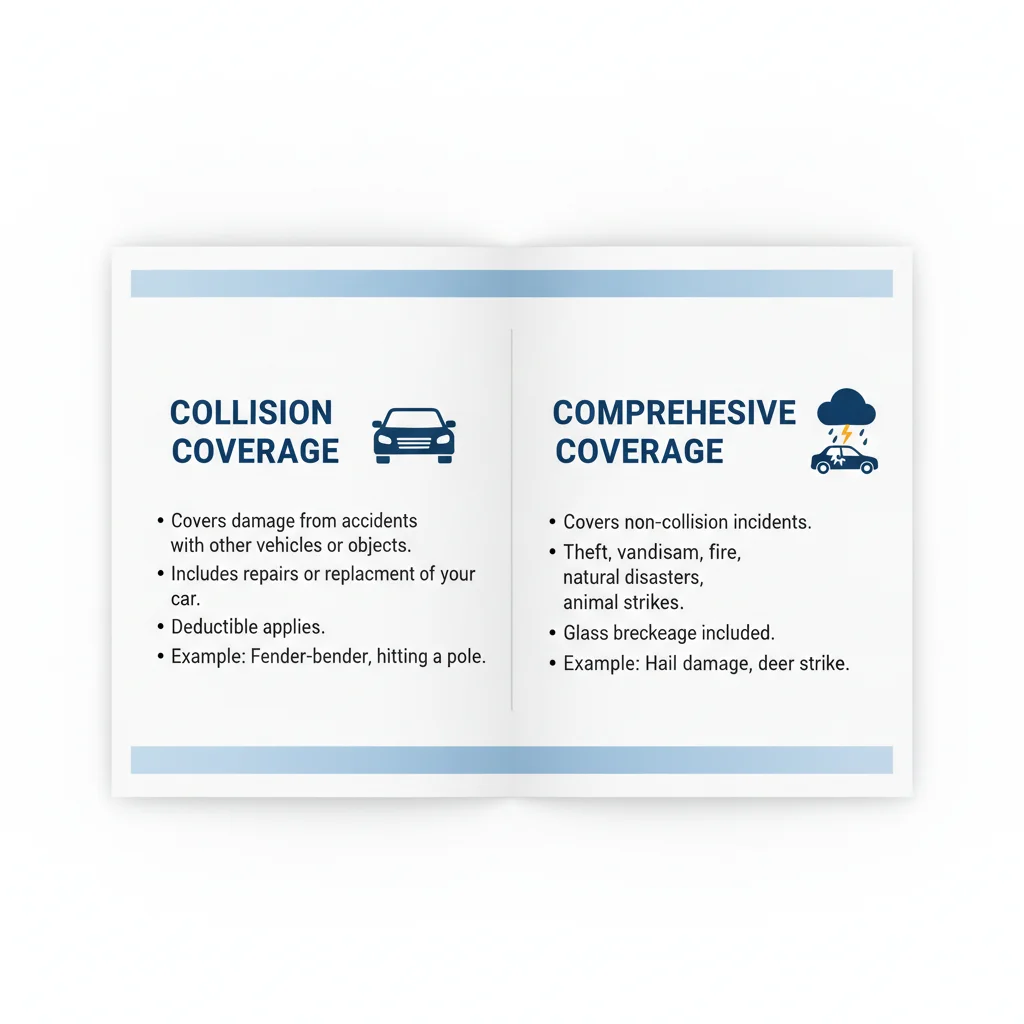
Before weighing the cost, it helps to be precise about what you're paying for. Collision and comprehensive are both physical damage coverages — they pay to repair or replace your vehicle — but they respond to entirely different scenarios.
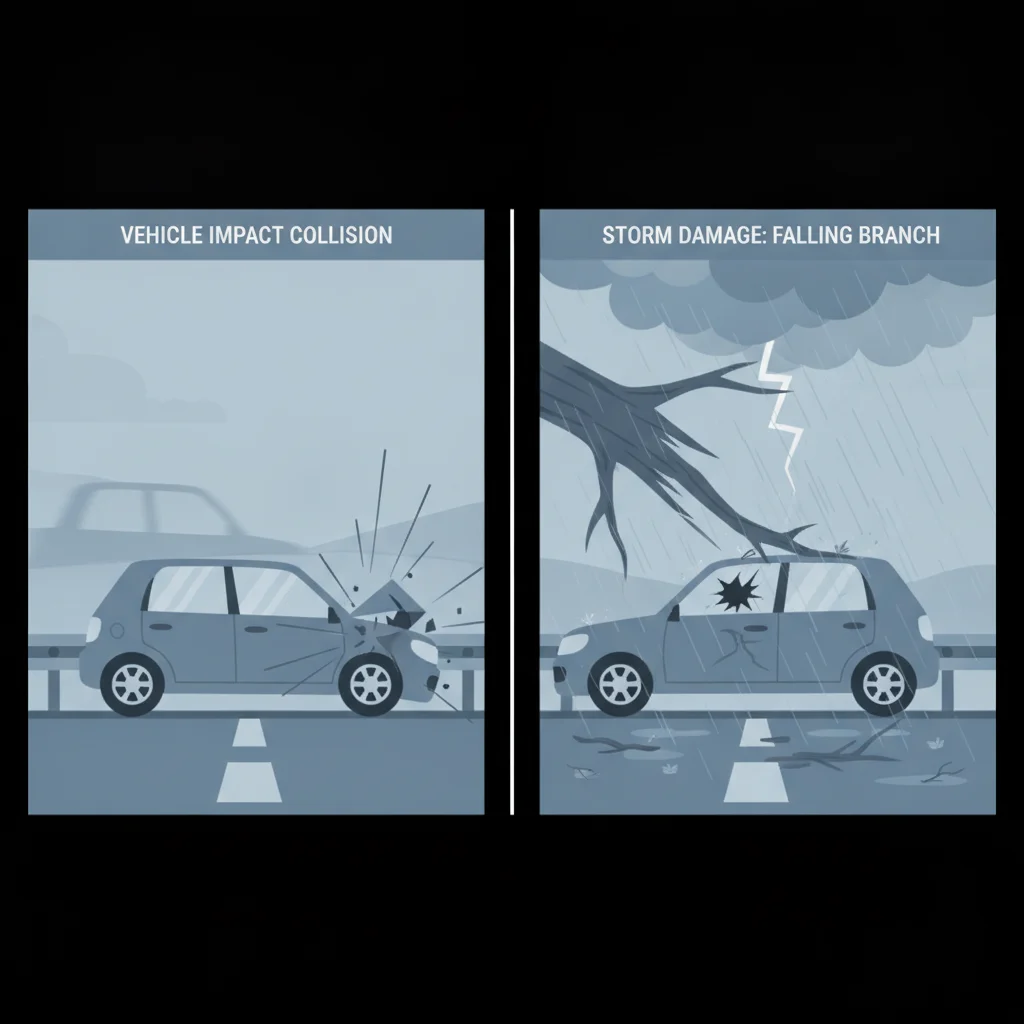
Collision coverage activates when your car makes unwanted contact with another vehicle or object. That includes rear-ending another car, getting sideswiped in a parking lot, rolling your vehicle, or hitting a guardrail. At fault or not, collision is your financial safety net for the crash itself.
Comprehensive coverage handles everything else that can destroy a car without involving a collision. Fire, theft, vandalism, hail, flooding, falling trees, windshield cracks from road debris, and striking an animal all fall under comprehensive. It's sometimes marketed as "other than collision" coverage, which captures its scope accurately.
For a deeper breakdown of exactly what each policy pays for and when it kicks in, see our detailed coverage comparison.
Neither coverage is legally mandated by any state — that's the domain of liability insurance, which covers damage you cause to others. But if your lender or lessor is in the picture, carrying both isn't optional; it's a contractual obligation. More on that below.
The Case For Carrying Both
The argument for maintaining both coverages simultaneously comes down to a single premise: physical damage to your vehicle is likely the largest uninsured financial risk most households carry. A total loss on a $35,000 sedan without coverage isn't an inconvenience — it's a crisis.
Covers the full spectrum of physical damage risks
Collision handles crash scenarios; comprehensive covers theft, weather events, fire, and animal strikes. Together, they eliminate nearly every uninsured vehicle loss scenario short of mechanical failure.
Protects your investment against total loss
If your car is totaled or stolen, the payout reflects the vehicle's actual cash value. Without coverage, that loss comes directly out of your pocket or forces a loan under pressure.
Provides coverage regardless of fault
Collision coverage pays even when you caused the accident, which liability coverage does not. You aren't left without a vehicle while pursuing an at-fault claim against yourself.
Satisfies lender and lessor requirements
Financed or leased vehicles contractually require both coverages. Maintaining them keeps you in compliance and avoids force-placed insurance at punishing premium rates.
Fills gaps left by uninsured motorists
If an uninsured driver damages your vehicle, collision coverage steps in where the at-fault driver's liability policy does not. This is critical in states with high uninsured driver rates.
Peace of mind in high-risk environments
Drivers in hail corridors, flood zones, or high-theft urban areas face statistically elevated comprehensive risks. Coverage there isn't overcaution — it's actuarially justified.
Consider the geography of risk. A driver in Oklahoma faces a genuine threat from hail — the state regularly ranks among the top five for hail claims — while also navigating high-traffic highways that raise collision exposure. Dropping either coverage in that environment means knowingly accepting a risk that insurers have priced as quite real.
$522
Average annual collision coverage premium
According to the Insurance Information Institute's most recent benchmark data, collision averages around $522 annually, making it the costlier of the two physical damage coverages for most drivers.
$172
Average annual comprehensive coverage premium
The Insurance Information Institute reports comprehensive coverage averages approximately $172 per year nationally, though rates vary sharply by state and local risk factors.
1 in 8
U.S. drivers currently uninsured
The Insurance Research Council estimates roughly one in eight drivers on American roads carries no liability insurance, elevating the practical value of collision coverage for everyone else.
$4,711
Average collision claim payout
The Insurance Information Institute's data shows the average collision claim payout exceeds $4,700, a figure that underscores the financial exposure of driving without coverage.
1.8M
Annual deer-strike claims (State Farm alone)
State Farm, the largest U.S. auto insurer, processes approximately 1.8 million deer-collision claims annually — all of which fall under comprehensive, not collision coverage.
There's also the question of what collision and comprehensive protect that liability coverage doesn't. If an uninsured driver totals your car, your liability policy pays nothing toward your own vehicle. Without collision, you'd be pursuing the at-fault driver directly — a process that can take months and frequently yields less than the full loss. Comprehensive closes a completely separate gap: no other standard auto policy covers you if your car is stolen or crushed by a falling oak tree.
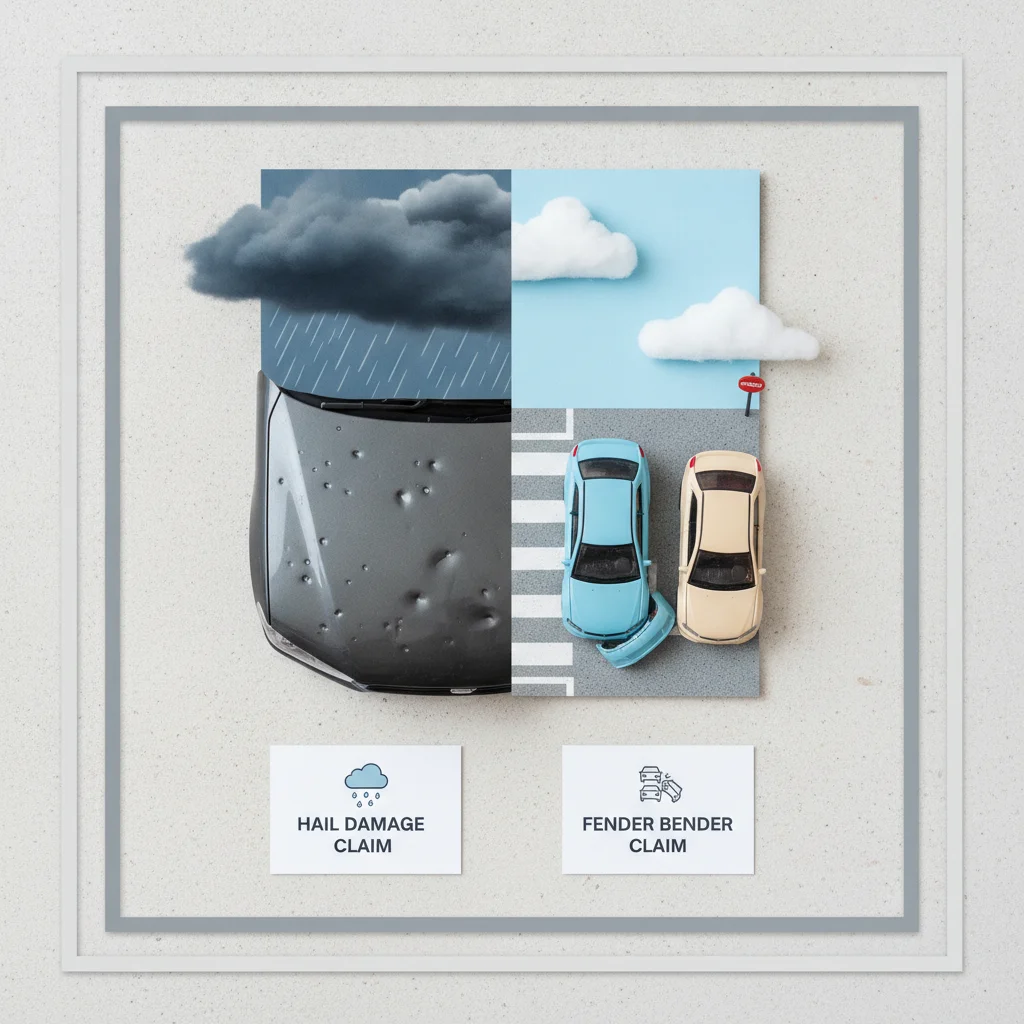
For drivers wondering which coverage applies to a specific incident, the claim-by-claim coverage guide walks through common scenarios from hail damage to fender benders.
The Case Against — When the Math Turns
Insurance is a financial product, and like any financial product, there's a point at which the cost exceeds the benefit. For physical damage coverage, that inflection point is almost always tied to your car's actual cash value (ACV).
Added annual premium cost can be substantial
Combined collision and comprehensive typically adds $500–$900 or more per year depending on location, vehicle, and driver profile. On an older car, this may exceed the coverage's realistic value.
Payout is capped at actual cash value, not replacement cost
Insurers pay ACV, which accounts for depreciation. A car that cost $25,000 new may be worth $9,000 at payout time — a gap that surprises many policyholders.
Deductibles reduce the effective benefit
A $1,000 deductible on a $5,000 car means your maximum net payout is $4,000. On minor damage that doesn't reach the deductible threshold, the coverage pays nothing.
Claims can raise your future premiums
Filing a collision claim — especially if you're at fault — can trigger a rate increase at renewal. In some cases, the long-term premium impact exceeds the initial claim payout.
Poor value on low-ACV older vehicles
When your car's market value drops below roughly $5,000–$6,000, the financial math of carrying both coverages often inverts. Annual premiums can approach the total potential payout.
Overlaps uncomfortably with other financial assets
Drivers with substantial emergency savings or a secondary vehicle may be paying for coverage that replicates a financial cushion they already have — effectively double-paying for the same protection.
Here's the arithmetic that matters: if your car is worth $4,000 and you carry a $1,000 deductible on each coverage, the maximum payout after a total loss is $3,000 — minus any depreciation the insurer applies. If you're paying $900 a year for both coverages, you recover that $3,000 payout ceiling in just over three years of premiums. In that scenario, self-insuring — meaning you absorb the loss from savings — often makes more financial sense.
A commonly cited rule of thumb holds that when your annual premium for collision and comprehensive exceeds 10% of your car's value, it's time to reconsider. A $4,000 car paying $500 a year in combined premiums already sits at that boundary. A $3,000 car crosses it easily.
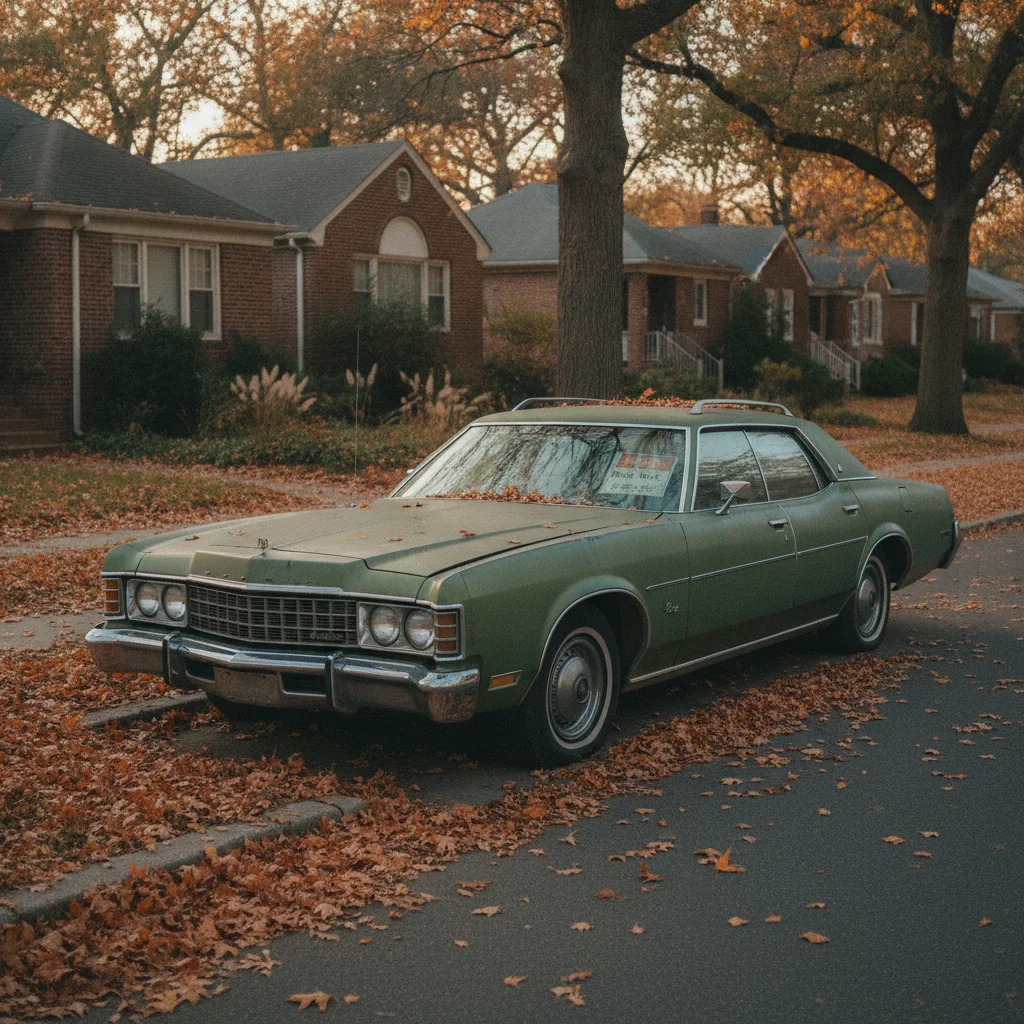
The decision to drop coverage isn't always binary, either. You might retain comprehensive but drop collision on a paid-off older vehicle if your neighborhood has high theft rates but you park in a low-traffic area. That selective approach is explored in our guide to dropping collision or comprehensive.
Gap Insurance: A Related but Separate Need
Carrying both collision and comprehensive doesn't mean you're fully protected if you owe more on your loan than your car is worth. If you financed a new vehicle with little down, your ACV payout after a total loss could be thousands less than your remaining loan balance. Gap insurance covers that difference and is worth considering alongside physical damage coverage for recent model purchases.
Force-Placed Insurance: An Expensive Warning
If you let your collision or comprehensive lapse while still carrying a car loan, your lender can purchase a policy on your behalf and bill you for it — often at rates two to three times higher than market price. Force-placed policies also protect only the lender's interest, not yours. Maintaining your own coverage is almost always the cheaper and better-protected option.
The 10% Rule Is a Starting Point, Not a Hard Cutoff
The common guideline that you should drop physical damage coverage when the annual premium exceeds 10% of your car's value is useful but imprecise. It doesn't account for your deductible, local risk environment, driving frequency, or financial reserves. Treat it as a prompt to run your own numbers rather than a definitive threshold.
Mandatory Coverage: When You Don't Have a Choice
For a significant portion of American drivers, the pros-and-cons debate is somewhat academic: if you're financing or leasing your vehicle, your lender almost certainly requires you to carry both collision and comprehensive for the life of the loan or lease term.
Lenders hold a financial interest in the vehicle — it's collateral for the loan — and they're not willing to accept the risk that their collateral gets destroyed without a payout mechanism. The coverage protects their asset, not just yours. If you drop coverage and the lender discovers it (typically through a policy lapse notification), they can force-place insurance on your behalf at rates that are substantially higher than anything you'd find on the open market.
The details of why lenders demand this coverage — and what the consequences of non-compliance look like — are covered thoroughly in our article on lenders and mandatory physical damage coverage.
Even for owners who've paid off their loans, the lender logic is instructive: they require the coverage because they've assessed the risk of vehicle loss as too large to leave uninsured. The same reasoning applies to your personal finances. The question is whether your specific vehicle's value justifies the premium.
How Your Deductibles Shape the Real Cost Equation
The premium you pay for carrying both coverages isn't fixed — it's heavily influenced by the deductibles you set. Raising your deductibles lowers your annual premium, sometimes substantially, but shifts more of the financial burden onto you when you file a claim.
The key insight is that you don't have to set the same deductible for both coverages. Many insurers allow you to mix and match — say, a $500 comprehensive deductible and a $1,000 collision deductible — if your risk profile for each type of event differs. A driver in a rural area with minimal traffic but high deer activity might logically carry a lower comprehensive deductible while raising the collision threshold.
Our guide to mismatching deductibles walks through when that strategy actually makes financial sense and how to calculate the right combination for your situation.
A practical framework: choose the highest deductible you could genuinely pay out of pocket without financial strain, on either coverage independently. If a $1,500 bill would force you to carry a credit card balance, that deductible is too high regardless of the premium savings.

Risk Factors That Tip the Balance
Beyond the vehicle's value and your deductibles, several external risk factors should weigh into your decision. The calculus looks different in Phoenix than it does in rural Wyoming or coastal Florida.
Geographic and Environmental Risks
- Hail exposure: States in Tornado Alley — Texas, Kansas, Oklahoma, Nebraska, Colorado — see disproportionate hail claim volumes. Comprehensive is genuinely worth more in those ZIP codes.
- Flooding: Flood damage falls under comprehensive, not collision. If you live in a low-lying flood zone, dropping comprehensive is a significant gamble.
- Theft rates: Urban areas with high vehicle theft rates tilt the value of comprehensive upward. The NICB (National Insurance Crime Bureau) publishes annual hot-spot data worth consulting.
- Animal collisions: Deer strikes are the most common large-animal collision in the U.S. — State Farm alone processes roughly 1.8 million deer-strike claims per year. Comprehensive is the only coverage that responds to this.
Personal Financial Factors
- Your emergency fund: If you have $15,000 liquid and a $6,000 car, you could self-insure a total loss. If you have $1,000 saved, you cannot.
- Car dependency: If losing your vehicle would disrupt your income — you commute long distances or use it for work — the financial case for full coverage strengthens significantly.
- Replacement timeline: If you'd need to immediately replace the vehicle, insurance coverage shortens that timeline and removes the financing scramble.
For drivers exploring optional add-ons that complement physical damage coverage — such as gap insurance, which pays the difference between your car's ACV and your remaining loan balance — see the optional add-ons coverage hub.
Gap Insurance: A Related but Separate Need
Carrying both collision and comprehensive doesn't mean you're fully protected if you owe more on your loan than your car is worth. If you financed a new vehicle with little down, your ACV payout after a total loss could be thousands less than your remaining loan balance. Gap insurance covers that difference and is worth considering alongside physical damage coverage for recent model purchases.
Force-Placed Insurance: An Expensive Warning
If you let your collision or comprehensive lapse while still carrying a car loan, your lender can purchase a policy on your behalf and bill you for it — often at rates two to three times higher than market price. Force-placed policies also protect only the lender's interest, not yours. Maintaining your own coverage is almost always the cheaper and better-protected option.
The 10% Rule Is a Starting Point, Not a Hard Cutoff
The common guideline that you should drop physical damage coverage when the annual premium exceeds 10% of your car's value is useful but imprecise. It doesn't account for your deductible, local risk environment, driving frequency, or financial reserves. Treat it as a prompt to run your own numbers rather than a definitive threshold.
Running the Numbers: A Quick Framework
Deciding whether to carry both coverages doesn't require a spreadsheet, but it does require honest answers to a few specific questions. Work through these in order:
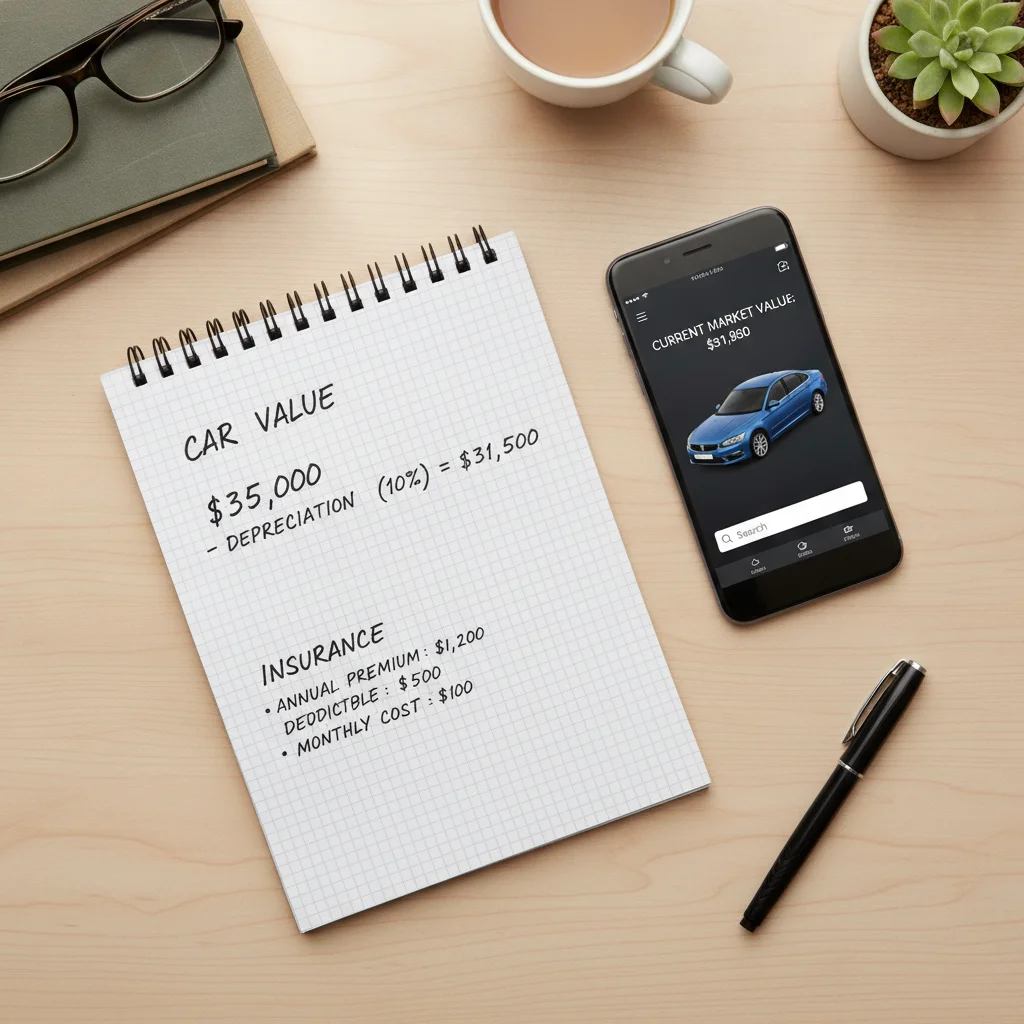
- What is your car's current actual cash value? Use Kelley Blue Book, Edmunds, or NADA Guides for a realistic estimate — not what you paid, not what you'd like it to be worth.
- What are you paying annually for collision and comprehensive combined? Pull your declarations page or ask your insurer to itemize the premium.
- What deductibles are you carrying on each? Subtract your deductible from your car's ACV to find your maximum net payout.
- Is your maximum net payout significantly higher than one year's combined premium? If yes, coverage likely makes sense. If the ratio is approaching 3:1 or lower, the value diminishes.
- Could you replace or repair your vehicle from savings without financial hardship? If yes, self-insuring becomes a legitimate option.
One additional data point worth calculating: your break-even horizon. Divide your car's ACV (minus deductible) by your annual combined premium. That's how many years of paying premiums equals one total-loss payout. If that number is under five years and your car is aging, coverage is likely earning its cost. If it stretches to eight or ten years, reconsider.
For a parallel look at how comprehensive and collision interact at the claims level — and which specific incidents trigger each coverage type — the comprehensive vs. collision coverage overview provides useful context before you make any coverage changes.

All claims are backed by peer-reviewed research. Sources on request.