
Key Takeaways
Why Removing a Driver Actually Matters
Auto insurance premiums are calculated based on risk — and every licensed driver in your household is a variable in that equation. When a driver's status in your life changes, leaving them on your policy unchecked isn't neutral. It's quietly costing you money, and in some cases, creating liability exposure you may not be aware of.
The most common scenarios that prompt a driver removal request include:
- A teenager heading off to college and no longer having access to a vehicle
- A spouse or partner moving out after a separation or divorce
- An adult child who has moved out and obtained their own policy
- A roommate or other household member who no longer lives with you
- A family member whose license has been suspended or revoked
Each situation has its own nuances, but the core process is largely the same. What varies is how your insurer verifies the change and whether they'll require documentation.
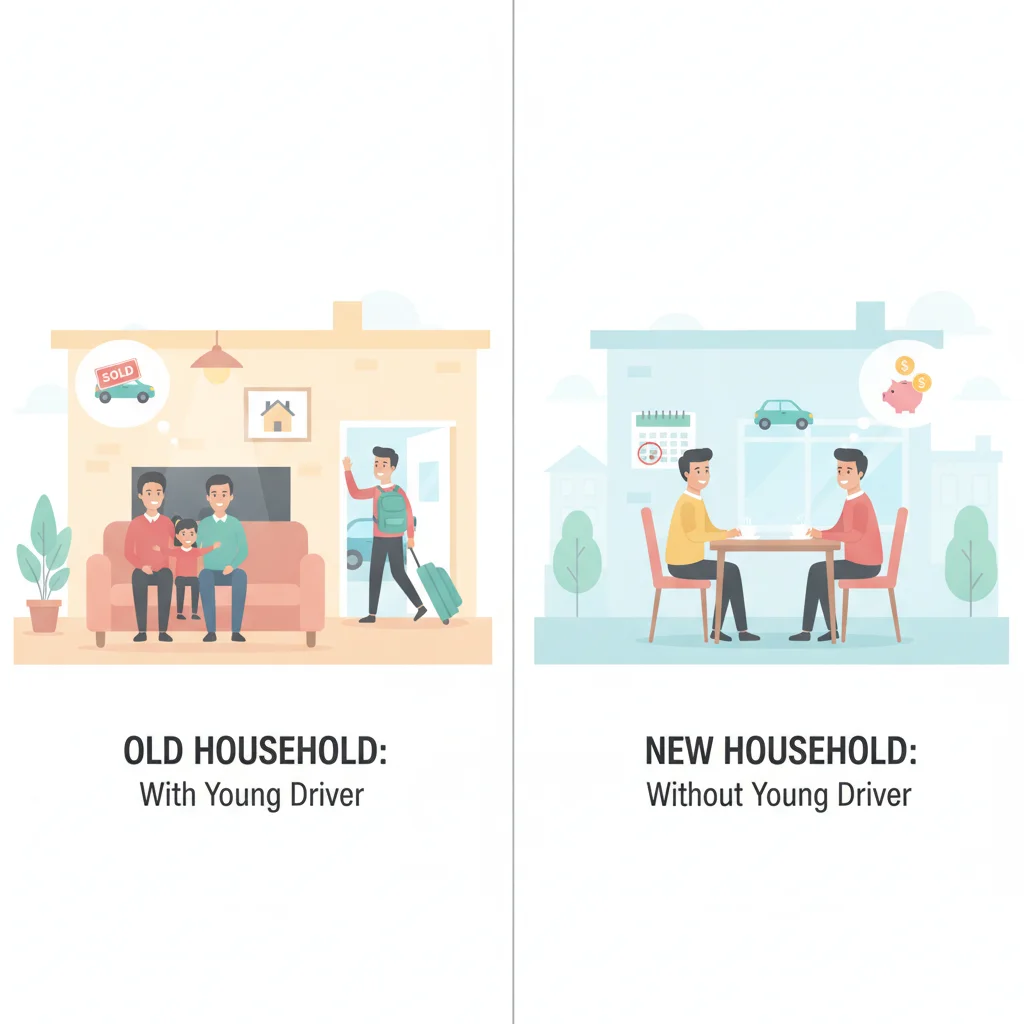
This guide walks you through the process step by step — what to say, what to send, and how to make sure the change actually sticks. For a broader look at managing your coverage through life's transitions, see our complete guide to auto insurance policy management.
What You Need Before You Call Your Insurer
Before you contact your insurance company, gather the information they're likely to request. Walking in prepared shortens the call and reduces the chance you have to follow up with documentation later.
What you will need
One thing worth clarifying up front: there's a difference between removing a driver and excluding a driver. Removing a driver means they're simply taken off the policy because they no longer live with you or no longer use your vehicles. Excluding a driver means they still live in your household but you are formally stating — in writing — that they will never drive your insured vehicles. Exclusions are sometimes used for household members with poor driving records to prevent their risk profile from inflating your premium. Excluded drivers who then operate your vehicle and cause an accident are typically not covered at all.
Auto insurance policy number
Required to pull up your account and identify the specific policy being amended.
Driver's personal details (name, DOB)
Needed to identify which driver is being removed from the policy.
Proof of address change or new policy
Documentation supporting your reason for removal, such as a new lease or the driver's new declarations page.
Insurer's customer service number or online portal login
The channel through which you'll submit and track the driver removal request.
Email or document storage
Used to save and organize the written confirmation and updated declarations page you receive after the change.
If the driver you're removing is staying in your household, your insurer may require an exclusion rather than a simple removal. Be ready for that conversation.
Step-by-Step: How to Remove a Driver from Your Policy
The process is straightforward but has a few checkpoints where things can go sideways. Follow each step carefully to make sure the change is applied correctly and confirmed in writing.
Contact your insurer directly
Call your insurance company's customer service line or log into your online account and navigate to your policy's driver section. Avoid relying on your agent alone for this — while agents can submit requests, calling the insurer directly creates a more direct paper trail. State clearly that you want to remove a specific named driver and have the reason ready (moved out, has their own policy, license surrendered, etc.).
Provide the reason for removal
Insurers treat driver removals differently depending on the reason. Be prepared to explain one of the following: the driver has moved out of your household, the driver has their own separate insurance policy, the driver's license has been surrendered or suspended, or the driver is deceased. Your insurer will note the reason, and some will follow up requesting documentation to support it.
Submit supporting documentation if required
Not all insurers require documentation, but many do — especially for mid-term changes. Common documents that satisfy a removal request include:
- A copy of the driver's new auto insurance policy declarations page (showing they're insured elsewhere)
- A lease or utility bill showing a new address outside your household
- A letter or court document related to a separation or divorce
- A copy of the driver's license surrender confirmation
Ask your insurer specifically what they need before assuming none is required.
Confirm the effective date of the change
Ask your insurer to confirm the exact date the driver removal takes effect. In most cases, it can be made retroactive to a recent date if the change in circumstances happened recently — for example, if your college student moved into a dorm a month ago. Retroactive adjustments can result in a small premium credit. Going forward, the new lower premium applies from the effective date.
Request written confirmation of the change
Before ending the call or closing the online session, explicitly ask for written confirmation that the driver has been removed. This typically comes in the form of a policy endorsement — a formal document that amends your existing policy. Ask whether you'll receive an updated declarations page as well. Most insurers will email or mail this within a few business days. Do not assume the change is final until you have it in writing.
Review your updated premium
Once the change is processed, check your updated premium and billing schedule. If you pay monthly, the new amount should reflect in your next billing cycle. If you pay in six-month or annual installments, ask whether you're owed a prorated credit for the remaining term. Confirm the updated amounts in writing alongside the driver removal confirmation.
After completing these steps, take a few minutes to review the rest of your policy. A driver removal is often a good moment to reassess coverage levels more broadly. If you've recently paid off a vehicle loan, for example, you may also want to revisit your comprehensive and collision deductibles — see our guide on lowering your coverage after paying off a car loan for guidance.

When Insurers Push Back — and What to Do
Insurers don't always make driver removal easy, and it's worth knowing where they tend to resist.
The insurer says they won't remove the driver mid-term
This is rare but happens. Some insurers prefer to make household changes only at renewal. If yours takes this position, ask specifically whether you can add a named-driver exclusion mid-term instead, which effectively prevents that driver's record from affecting your premium while formalizing that they won't operate your vehicles.
The insurer says the driver must be listed because they live in the household
This is actually a legitimate underwriting position. Most insurers require all licensed household members to be either listed as covered drivers or formally excluded. If the driver is staying in your home, removal may not be on the table — exclusion is. This is especially common for teenagers or family members with DUIs on their record.
The driver in question is the primary named insured
If the person you want removed is the policyholder themselves — for example, an ex-spouse whose name is on the policy — simply removing them isn't the right path. You may need to restructure the policy entirely or open a new one in your name only. This is distinct from driver removal and may involve canceling the existing policy without creating a coverage gap.
Don't Remove a Driver Who Still Uses Your Car
If a driver you remove later operates one of your covered vehicles and is involved in an accident, your insurer has grounds to dispute or deny the claim. Misrepresentation — even unintentional — is one of the fastest ways to find yourself uninsured after a loss. If someone still has occasional access to your vehicle, discuss a named-driver exclusion or usage restrictions with your insurer instead.
Mid-Term Removal vs. Renewal: Know the Difference
If your insurer insists the change can only be made at renewal, document that conversation in writing. Operating your vehicle with a driver whose situation has materially changed while the insurer delays the update is a gray area. Push back, escalate to a supervisor, and get the insurer's position in writing so you have a record.
The driver moved to another state
If a driver has relocated out of state and has their own vehicle and policy, your insurer may ask for proof before removing them. A copy of their new policy declarations page or a new state registration typically satisfies this requirement. For the driver who moved, they'll need to address their own coverage changes — our article on updating auto insurance when moving to a new state covers exactly what they should do.

The Premium Impact: What to Realistically Expect
The financial effect of removing a driver depends almost entirely on who they are and what their risk profile looks like. Here's a practical breakdown:
| Driver Type Removed | Likely Premium Impact |
|---|---|
| Teen driver (16–19) | Significant reduction — often 10–25% or more |
| Driver with recent at-fault accident | Moderate to significant reduction |
| Driver with DUI conviction | Significant reduction |
| Clean-record adult driver | Minimal to no reduction |
| Low-mileage or senior driver | Varies; may be minimal |
The reduction applies to the portion of your premium that was inflated by that driver's risk. If you added a 17-year-old to your policy two years ago and your premium jumped 22%, removing them should bring a comparable reduction — though the exact figures depend on your insurer's rating methodology, your state, and your current policy structure.
Shop Around After a Significant Driver Removal
If you're removing a high-risk driver — particularly a teenager or someone with accidents on their record — your premium reduction may be substantial enough to make your current insurer's rate uncompetitive compared to fresh quotes. Before renewal, run a few quotes with other carriers using your updated household driver list. You may find a significantly better rate now that your risk profile has improved.
College Students Away From Home: A Special Case
If your college student lives on campus without a car, many insurers offer a 'student away at school' discount that's better than a full removal — it keeps the student covered when they visit home and drive. Ask your insurer to compare the cost of removal versus applying this discount before making a decision.
Check State Rules on Driver Exclusions
A handful of states restrict or prohibit named-driver exclusions entirely, meaning an insurer cannot require you to exclude a household member to avoid rating their driving record into your premium. California, for example, does not allow named-driver exclusions. Know your state's rules before assuming an exclusion is an available option.
Avoid the common mistake of assuming a driver removal automatically adjusts your bill. Always ask your insurer to confirm when the new premium takes effect and what your updated monthly or six-month cost will be. Skipping this verification step is one of the policy management mistakes that lead to coverage gaps and billing surprises.
Removing a Driver Doesn't Always Mean They're Uninsured
If the driver you remove is a named insured on another policy, they're covered under that policy — not yours. But if they have no coverage of their own and still operate your vehicle, there is a real and unresolved liability gap. Make sure the removed driver has their own insurance before they get behind the wheel of any vehicle, yours or otherwise. An uninsured driver using your car in an accident can expose you to personal liability beyond your policy limits.
After the Removal: Keeping Your Records Straight
Once your insurer processes the change, there are a few follow-through actions that matter more than most people realize.
Verify the updated declarations page
Your declarations page is the document that lists your covered vehicles, drivers, coverages, and premium. After any driver change, request an updated declarations page — either electronically or by mail — and confirm the removed driver no longer appears. This is your official record that the change was made.
Keep the written confirmation on file
Whether it's an email, a PDF, or a mailed endorsement, hold onto the confirmation that the change was processed. If a dispute ever arises — say, the removed driver is involved in an incident and the insurer claims they were still listed — that documentation protects you.
Communicate clearly with the removed driver
If the removed driver is a family member or former household member, make sure they understand they are no longer covered under your policy. If they still regularly drive a vehicle, they need their own coverage. This isn't just a courtesy — if they believe they're covered and they're not, that's a serious gap with real financial consequences.

Revisit your policy at the next renewal
Driver removals often open up a broader conversation about whether your overall coverage structure still makes sense. If your household's driving situation has changed significantly, it may be worth doing a full coverage review at renewal — not just a driver list audit. Your insurer may also be able to identify other adjustments, like updated mileage estimates or usage-based discounts, that lower your premium further. For a comprehensive approach, our auto insurance policy management guide is a useful reference to keep handy.

All claims are backed by peer-reviewed research. Sources on request.