Key Takeaways
Start here
Why Used Cars Make Sense for First-Time Buyers
Next
Setting a Realistic Budget Before You Search
Then
Where to Find Used Cars Worth Buying
Deep dive
How to Research a Specific Vehicle
At the car
Inspecting and Test-Driving a Used Car
Finish line
Negotiating the Price and Closing the Deal
Why Used Cars Make Sense for First-Time Buyers
Buying your first car is one of the largest financial decisions you'll make in your twenties—or thirties, or whenever it happens. The instinct to want something shiny and new is understandable, but the math almost always favors used.
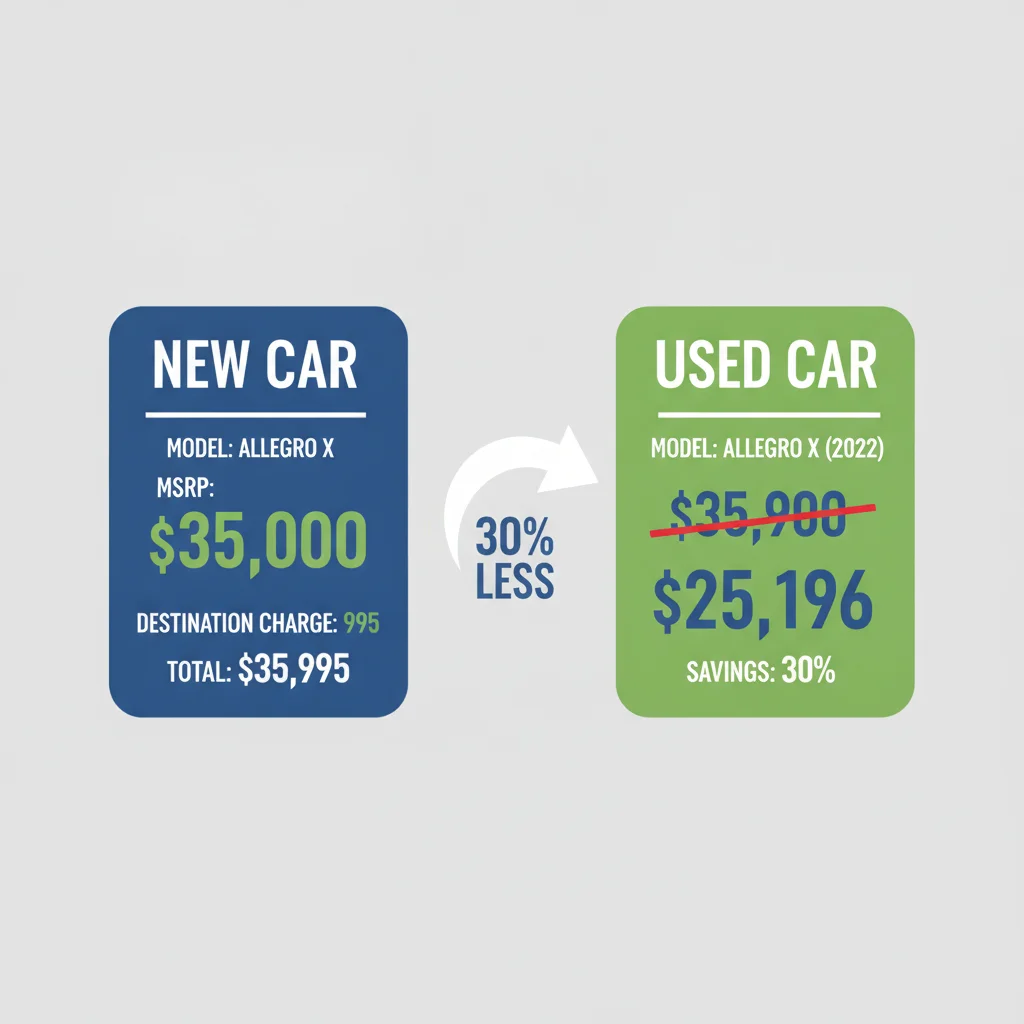
A brand-new car loses roughly 15–20% of its value the moment it leaves the lot and another 10% or so in year one. Buy a car that's two or three years old and you let someone else absorb that hit. For the same monthly payment, a used buyer typically gets a significantly newer or larger vehicle than a new-car buyer. That's a real, tangible advantage, not just a frugality lecture.
If the new-car path still appeals to you, check out what first-timers should know about buying new for a side-by-side comparison. But if you're committed to pre-owned, let's focus on what makes that market different—and how to navigate it without getting burned.
The key risks in the used market are:
- Unknown history. You don't know how the previous owner drove, maintained, or stored the car.
- No manufacturer warranty (unless you buy certified pre-owned).
- Asymmetric information. The seller usually knows more about the car than you do.
None of these risks are dealbreakers. They're manageable with the right process, which is exactly what this guide covers step by step.
Setting a Realistic Budget Before You Search
The single biggest mistake first-time buyers make is confusing "what I can finance" with "what I can actually afford." Lenders will often approve you for more than is healthy for your finances. Your job is to figure out your real number before you set foot on a lot or click a listing.
The Total-Cost Framework
Your true monthly cost of ownership has five components. Add them all up before you commit to a purchase price range:
- Loan payment — if financing, use an online auto loan calculator with realistic interest rates (5–10% for used vehicles depending on credit).
- Insurance — get quotes before you buy. A sports car or luxury SUV can cost $150–$300/month more to insure than a basic sedan.
- Registration and taxes — varies by state, but budget 1–3% of purchase price for the first year.
- Fuel — check the EPA MPG rating and estimate monthly fuel cost based on your driving habits.
- Maintenance and repairs — used cars need more attention. A rule of thumb: set aside $75–$150/month into a dedicated car repair fund.
VIN
Vehicle Identification Number — a unique 17-character code assigned to every vehicle. It's used to pull history reports and check for recalls.
Salvage title
A designation given to a vehicle that an insurance company declared a total loss. The car may have been repaired and put back on the road, but it carries significantly reduced resale value and potential hidden structural damage.
Pre-purchase inspection (PPI)
A mechanical inspection performed by an independent mechanic before you complete a purchase. It's designed to uncover problems that aren't visible to the untrained eye.
Certified Pre-Owned (CPO)
A used car that has been inspected and reconditioned by the manufacturer or a franchise dealer, and typically comes with an extended warranty. CPO cars cost more than standard used cars but offer additional peace of mind.
Lien
A legal claim a lender holds on a vehicle when the owner still owes money on an auto loan. A car with an outstanding lien cannot be cleanly transferred until the loan is paid off.
Fair market value
The price a willing buyer and a willing seller would agree on in an open market. Tools like Kelley Blue Book and Edmunds help estimate this for a specific vehicle based on condition, mileage, and location.
Bill of sale
A written document that records the details of a vehicle transaction—purchase price, date, buyer and seller information, and VIN. It serves as proof of ownership transfer until the title is processed.
Upside down
When you owe more on your auto loan than the vehicle is currently worth. This is also called negative equity and can create financial problems if you need to sell or trade in the car before the loan is paid off.
What Down Payment Do You Need?
Aim for at least 10–20% down on a used car. A larger down payment reduces your monthly payment, lowers your interest paid over time, and keeps you from going "upside down" (owing more than the car is worth). If you're financing a $12,000 car, putting $2,400 down is a reasonable starting point.
Get Pre-Approved Before You Shop
Walking into a negotiation knowing your loan rate and maximum budget puts you in a much stronger position. Apply at your credit union or bank before you start shopping—pre-approval takes 1–2 business days and costs nothing. Dealer financing can be convenient, but it's rarely the cheapest option for used cars.
Always Insist on an Independent Mechanic
A seller who refuses a pre-purchase inspection is almost certainly hiding something. A trustworthy seller will have no objection—they want you to feel confident in the purchase. If you're meeting at a private residence, offer to drive to a mechanic of your choosing, or use a mobile mechanic service that comes to the car.
If you're planning to finance, get pre-approved through a credit union or bank before you shop. Walk into every negotiation knowing your maximum and your rate—not hoping the dealer's finance department will treat you fairly.
Where to Find Used Cars Worth Buying
Not all used car sources are equal. Each comes with its own price range, risk level, and buyer protections. Here's an honest breakdown:
| Source | Typical Price | Buyer Protection | Best For |
|---|---|---|---|
| Franchise dealer (certified pre-owned) | Highest | Strong — warranty, inspections | Buyers who want peace of mind |
| Independent used car dealer | Mid-range | Moderate — varies by dealer | Buyers wanting selection without CPO premium |
| Private seller | Lowest | Minimal — buyer beware | Buyers confident in DIY research |
| Online marketplaces (Carvana, Vroom) | Mid-range | Moderate — return windows vary | Buyers who prefer remote transactions |
| Auctions | Below market | None — sold as-is | Experienced buyers only |
For a first-time buyer, I'd suggest starting your search on private-party platforms like Craigslist, Facebook Marketplace, and CarGurus while also checking local franchise dealer inventories. Private sellers will usually price 10–15% below dealer retail, but you take on more risk. Dealers add a margin, but they've usually at least run the car through a basic inspection.
If you're open to buying online, see how online car buying works for first-timers before you commit to a remote transaction.
Curious about certified pre-owned specifically? The CPO hub breaks down exactly what that label means and whether the premium is worth paying.
CPO vs. Standard Used: A Quick Trade-Off
Certified pre-owned vehicles cost 10–20% more than equivalent non-certified used cars, but they include a manufacturer-backed warranty and a documented inspection. For a first-time buyer who isn't confident evaluating mechanical condition, that premium can be worth it. For a buyer willing to do due diligence and pay for an independent inspection, a standard used car usually offers better value.
Lowball Offers Can Backfire
Opening too low—say, 25–30% below asking price without documented justification—often shuts down the negotiation entirely. Sellers, especially private sellers, can get offended and stop responding. Lead with your research: a specific value from KBB or Edmunds plus any documented repair costs is far more persuasive than an arbitrary number.
How to Research a Specific Vehicle
Found a listing you like? Don't call the seller yet. Do your homework first so you walk into every conversation informed.
Step 1: Run a Vehicle History Report
Pull a Carfax or AutoCheck report using the VIN (Vehicle Identification Number). You'll find the VIN on the dashboard, visible through the windshield on the driver's side, or on the door jamb sticker. A history report costs $20–$50 and tells you:
- Number of previous owners
- Accident and damage history
- Odometer readings over time (flags rollback fraud)
- Title status: clean, salvage, rebuilt, or flood
- Service and recall records
Never buy a car with a salvage or flood title as your first purchase. These vehicles can be road-legal but carry significant hidden structural and electrical risks that are hard to evaluate without professional expertise.
Avoid Salvage and Flood Titles Entirely
A vehicle with a salvage or flood title can look perfectly normal on the surface. Flood damage in particular causes electrical failures and mold problems that may not surface for months. As a first-time buyer, you don't have the experience to accurately assess these risks—skip these listings entirely and move on to a clean-title car.
Don't Drive Uninsured After Purchase
Your existing policy (if you have one) may extend to a newly purchased vehicle for a short grace period—typically 7–30 days depending on your insurer. But don't count on it. Call your insurance company or bind a new policy before you drive the car off. Driving uninsured exposes you to serious financial and legal liability.
Step 2: Look Up Fair Market Value
Before you contact the seller, know what the car is worth. Use at least two of these tools:
- Kelley Blue Book (KBB) — the industry standard for trade-in and private party value.
- Edmunds True Market Value — often more accurate for transaction prices in your local market.
- NADA Guides — useful for lender valuations.
Plug in the exact year, make, model, trim level, mileage, and your zip code. Write down the private-party value in "Good" condition—that's your negotiating anchor.
Step 3: Check for Open Recalls
Visit the NHTSA website (nhtsa.gov) and enter the VIN. Open recalls are repaired free of charge at a dealership, so an outstanding recall isn't necessarily a deal-breaker—but you should know about it before you buy.
Step 4: Review Reliability Data
Check Consumer Reports and J.D. Power reliability ratings for the model year you're considering. Some models are notorious for expensive problems at specific mileage points—knowing that in advance shapes both what you're willing to pay and what your mechanic should focus on during the inspection.

For a deeper dive into the full research-to-purchase process, the complete used car buying roadmap covers every stage in granular detail.
Inspecting and Test-Driving a Used Car
Research gets you to the car. The inspection tells you whether to buy it. This step is where first-time buyers most often skip corners—and pay for it later.
The Visual Walk-Around
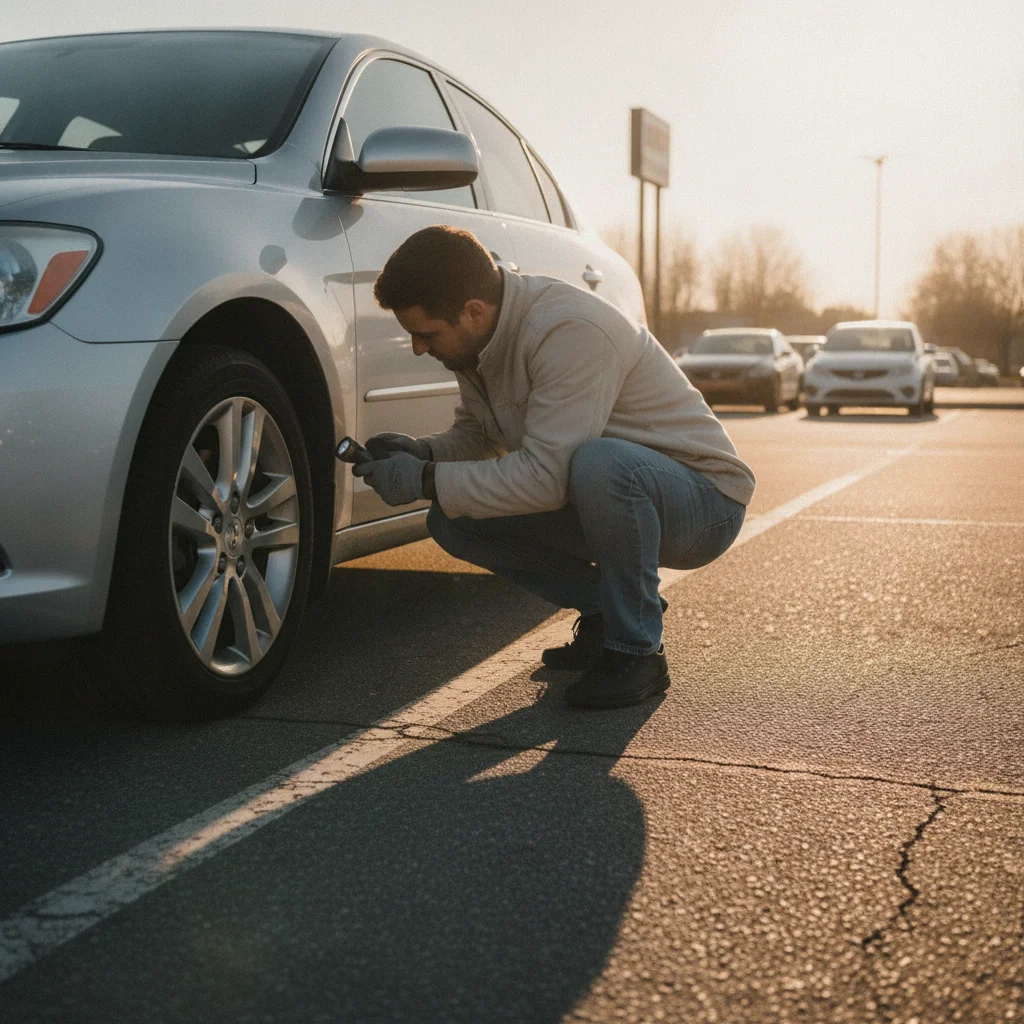
Do this before you even turn the key. Walk around the car in good daylight and look for:
- Panel gaps. Uneven gaps between body panels indicate a collision repair or poor reassembly.
- Paint color matching. Different shades on adjacent panels mean one was repainted—a sign of past damage.
- Rust. Check the wheel wells, rocker panels (the underside of the doors), and the undercarriage if you can get underneath.
- Glass. Chips and cracks in the windshield are negotiating leverage at minimum, safety issues at worst.
- Tires. Uneven wear patterns suggest alignment or suspension problems, not just worn rubber.
Under the Hood
You don't need to be a mechanic to spot red flags. Look for:
- Oil that's black and gritty (rather than amber) — suggests neglected maintenance.
- Coolant reservoir that's low or empty — potential leak or overheating history.
- Any white, milky residue on the oil cap — could indicate a blown head gasket, a serious and expensive failure.
- Visible corrosion on battery terminals or wiring.
The Test Drive
Drive it like you'd actually drive it — highway speeds, hard braking from 45 mph, tight turns. Listen for:
- Vibration or pulling under braking (warped rotors or brake issues)
- Clunking over bumps (worn suspension or ball joints)
- Hesitation or rough idle (engine or fuel system problems)
- Any warning lights that appear once the car warms up
The Pre-Purchase Inspection
After your own walk-around and test drive, pay a licensed independent mechanic $100–$150 to put the car on a lift and give it a full mechanical inspection. This is non-negotiable. A good mechanic will find issues that no visual inspection catches. If the seller refuses to allow an inspection, walk away—that's a major red flag in itself.
Get Pre-Approved Before You Shop
Walking into a negotiation knowing your loan rate and maximum budget puts you in a much stronger position. Apply at your credit union or bank before you start shopping—pre-approval takes 1–2 business days and costs nothing. Dealer financing can be convenient, but it's rarely the cheapest option for used cars.
Always Insist on an Independent Mechanic
A seller who refuses a pre-purchase inspection is almost certainly hiding something. A trustworthy seller will have no objection—they want you to feel confident in the purchase. If you're meeting at a private residence, offer to drive to a mechanic of your choosing, or use a mobile mechanic service that comes to the car.
Negotiating the Price and Closing the Deal
You've done your research, the inspection came back clean (or with only minor issues), and you want the car. Now comes the part most first-timers dread: negotiating. Here's the framework that works.
Start From Value, Not the Asking Price
Never anchor your negotiation to the seller's asking price. Anchor to the fair-market value you looked up—the Edmunds or KBB private-party value in "Good" condition. If the car has issues the inspection flagged, subtract the estimated repair cost from that figure. That's your opening offer.
Example: Asking price is $14,500. KBB private-party value for the condition is $13,200. The mechanic found it needs new rear brakes ($350 to fix). Your opening offer: $12,500. You have $700 of documented room to move if needed.
CPO vs. Standard Used: A Quick Trade-Off
Certified pre-owned vehicles cost 10–20% more than equivalent non-certified used cars, but they include a manufacturer-backed warranty and a documented inspection. For a first-time buyer who isn't confident evaluating mechanical condition, that premium can be worth it. For a buyer willing to do due diligence and pay for an independent inspection, a standard used car usually offers better value.
Lowball Offers Can Backfire
Opening too low—say, 25–30% below asking price without documented justification—often shuts down the negotiation entirely. Sellers, especially private sellers, can get offended and stop responding. Lead with your research: a specific value from KBB or Edmunds plus any documented repair costs is far more persuasive than an arbitrary number.
What to Do With Inspection Findings
Use the mechanic's report as a negotiating tool, not just a pass/fail test. A list of specific, costed repairs gives you objective grounds to ask for a price reduction. If the seller won't budge on price and the repairs are significant, you can either walk away or factor those costs into your total budget decision.
Finalizing Paperwork
This is where people make careless, costly mistakes. Cover these bases:
- Title. Make sure the seller's name on the title matches their ID exactly. The title must be signed over to you with no errors—a single crossed-out letter can cause problems at the DMV. If it's a loan payoff situation, the lender must release the lien before or simultaneously with the sale.
- Bill of Sale. Even if your state doesn't require it, create one. It should include the VIN, purchase price, date, and both parties' names and signatures.
- Odometer disclosure. Required by federal law for vehicles under 10 years old.
- Payment. For private sales, a cashier's check or cash is safest. Never pay by wire transfer to someone you haven't verified in person.
After the sale, take your paperwork to the DMV within your state's required window—typically 10–30 days—to transfer the title and register the vehicle in your name. You'll also need to add the car to your insurance policy before you drive it off.
Avoid Salvage and Flood Titles Entirely
A vehicle with a salvage or flood title can look perfectly normal on the surface. Flood damage in particular causes electrical failures and mold problems that may not surface for months. As a first-time buyer, you don't have the experience to accurately assess these risks—skip these listings entirely and move on to a clean-title car.
Don't Drive Uninsured After Purchase
Your existing policy (if you have one) may extend to a newly purchased vehicle for a short grace period—typically 7–30 days depending on your insurer. But don't count on it. Call your insurance company or bind a new policy before you drive the car off. Driving uninsured exposes you to serious financial and legal liability.
Once you're comfortable with the buying side, you may eventually find yourself on the other end of a transaction. what first-time sellers should expect is a useful read for when that time comes.
Kelley Blue Book (KBB)
The industry-standard tool for estimating the fair market value of any used vehicle by year, make, model, trim, mileage, and condition. Use it to anchor your negotiation before you make an offer.
Carfax Vehicle History Report
Pulls accident history, title records, odometer readings, and service history using a car's VIN. Essential due diligence for any used car purchase — run it before the inspection, not after.
NHTSA Recall Lookup
The official government database for checking open safety recalls by VIN. Free to use and takes under a minute — always check before completing a purchase.
Edmunds True Market Value
Provides local transaction price data for used vehicles, often more accurate than list-price guides for what cars are actually selling for in your area.
Complete Used Car Buying Roadmap
A detailed walkthrough of the entire used car buying process from budgeting through closing. A natural next step once you understand the fundamentals covered in this guide.
Certified Pre-Owned Guide
Breaks down exactly what CPO status means, which manufacturers offer the strongest programs, and whether paying the premium makes sense for your situation.

All claims are backed by peer-reviewed research. Sources on request.