
Key Takeaways
Trade-In Documentation
Trade-in documentation refers to the set of dealership forms, purchase contracts, and disclosure sheets that record the terms of your vehicle trade-in as part of a car deal. These documents specify the trade-in allowance (what the dealer credits you), the payoff amount on any existing loan, and how both figures are applied to the price of your new car. The challenge is that these numbers are often buried within broader contract language, split across multiple forms, or presented in ways that make the real math difficult to see at a glance.
The trade-in allowance and the actual trade-in value are not always the same figure. Dealers may inflate the allowance while also raising the selling price of the new vehicle, a practice sometimes called "trade-in packing."
Why Trade-In Paperwork Is Designed to Confuse
When you agree to trade in your car at a dealership, you're completing two financial transactions simultaneously: selling your old vehicle and buying (or leasing) a new one. Most dealerships present these as a single bundled deal, and the paperwork reflects that bundling—which creates significant room for obfuscation.
The documents you'll encounter aren't necessarily designed to deceive you, but they are optimized for the dealer's workflow, not for your clarity. Trade-in credits, loan payoffs, down payments, and selling prices all interact on the same sheet, making it easy to focus on the monthly payment rather than scrutinize each underlying number.
Understanding which documents matter, what they're supposed to contain, and what they routinely omit is the first step toward signing with confidence. See our guide to reading a dealer's trade-in offer sheet for a line-by-line walkthrough of the appraisal paperwork you receive before you even get to the contract stage.

The Core Documents Involved in a Trade-In Deal
A typical trade-in transaction will generate several distinct pieces of paperwork. Knowing what each one covers—and which ones to request if the dealer doesn't hand them over proactively—gives you a complete picture of the transaction.
1. The Trade-In Appraisal or Offer Sheet
This is the document produced after the dealer inspects your vehicle. It states the dealer's assessed value and the offer they're willing to credit toward your new purchase. Critically, this number may be labeled "trade-in allowance" rather than "trade-in value"—the distinction matters. An inflated allowance can be offset by a higher selling price on the new car.
2. The Buyer's Order (or Purchase Agreement)
This is the primary sales contract and the document where all trade-in figures ultimately land. You'll find a line for the trade-in allowance and, if you have an outstanding auto loan, a line for the payoff. Look for how these are applied: is the trade credit subtracted from the vehicle price before tax, or after? The answer affects your total tax liability.
3. The Four-Square Worksheet
Not every dealer uses this tool, but many do. It's an informal negotiating document that separates the deal into four boxes: vehicle price, trade-in value, down payment, and monthly payment. Finance managers use it to shift numbers between boxes while keeping the monthly payment anchored. If you negotiated using a four-square, compare those numbers to the final buyer's order—discrepancies between the two are common and worth questioning.
4. The Payoff Authorization Form
If your trade-in has an existing loan, the dealer will ask you to sign an authorization allowing them to contact your lender and obtain the exact payoff amount. This form should reference the lender name, account number, and the date through which the payoff is valid. Errors here—especially an outdated or low-balled payoff figure—can leave you personally responsible for the remaining balance.
5. The Finance and Insurance (F&I) Menu
While not specific to the trade-in, the F&I office is where add-ons (extended warranties, GAP insurance, paint protection) are presented. These products increase the loan amount and can partially obscure how the trade-in equity was applied. If your trade-in produced equity, make sure you can see where it reduced the financed amount—don't let it disappear into a bundle of add-ons.
Tax Treatment Varies by State
Most U.S. states allow buyers to pay sales tax only on the difference between the new vehicle price and the trade-in allowance—a significant savings on higher-value trades. However, California, Hawaii, Michigan, and a few others have different rules. Before signing, confirm with the F&I manager how your state calculates the tax base, and verify it on the buyer's order.
Payoff Timing Can Change Your Balance
Auto loan payoffs are calculated to a specific date. If the dealer takes longer than expected to submit the payoff—say, 10 to 15 business days instead of the standard 5 to 7—daily interest may cause your actual payoff to exceed the quoted figure. Most lenders absorb small overages, but it's worth confirming this with your lender in advance.
What the Contract Must Show—and What It Legally Doesn't Have To
Federal and state laws govern certain disclosure requirements in auto sales, but the coverage is uneven. Here's what dealers are generally required to put in writing versus what they can legally omit or obscure.
~44%
New car buyers who had negative equity in their trade-in
According to Edmunds data from 2023, nearly 44% of consumers who traded in a vehicle while buying new were upside down on their loan.
$5,341
Average negative equity rolled into new car deals
Edmunds reported that in Q4 2023, the average amount of negative equity rolled into a new vehicle purchase reached a record high of approximately $5,341.
$1,000+
Typical dealer spread between trade allowance and resale value
Industry estimates suggest dealers routinely mark up trade-in vehicles by $1,000 to $3,000 or more when reselling, which informs how they structure allowance offers.
Required Disclosures
- Trade-in allowance: The credit amount applied to your deal must appear on the buyer's order.
- Payoff amount: If you have a loan, the payoff figure used to calculate your net trade-in equity must be stated.
- Net trade-in equity or negative equity: The difference between your allowance and your payoff—whether positive or negative—must be reflected somewhere in the contract math, though it may not be explicitly labeled.
- Selling price of the new vehicle: Required on the buyer's order. However, this figure can be manipulated relative to the trade-in allowance without violating disclosure rules.
What Dealers Routinely Leave Out or Obscure
- How negative equity is handled: If you owe more on your trade than the dealer credited, that shortfall is typically added to your new loan. This is legal, but it's not always clearly labeled. You may see it buried in a line item called "prior credit or lease balance" or simply folded into the capitalized cost of the new vehicle.
- The wholesale value of your trade: Dealers are not required to tell you what they expect to sell your car for. Understanding what happens to your car after you trade it in helps explain why the offer is often well below retail.
- Market value comparisons: There's no legal requirement to show you third-party valuations alongside their offer. You have to bring those yourself.
- The spread between allowance and actual cash value: In states without specific trade-in transparency laws, dealers can present an inflated allowance tied to a higher vehicle price without disclosing the relationship between the two numbers.
Separate Your Negotiations Before You Combine Them
Dealers prefer to negotiate the entire deal as a package because it lets them adjust one number to offset another. Get your best trade-in offer in writing before discussing the new vehicle price. This forces each part of the transaction to stand on its own merits, making it much easier to verify the final contract numbers match what was agreed.
Take Photos of Every Page Before You Leave
Once the deal is signed, requesting additional copies can become complicated—especially if discrepancies surface later. Before you leave the F&I office, photograph or scan every document you've signed. Many dealers will also provide a complete package via email if you ask at the time of signing.
Negative Equity: The Number That Often Goes Unnamed
Negative equity—owing more on your trade-in than the dealer credits you for it—is one of the most financially significant figures in the entire transaction, and it's routinely the least prominently disclosed.
Here's how it typically flows through the paperwork: suppose you owe $18,000 on your current car and the dealer offers you a $15,000 trade-in allowance. The $3,000 gap (your negative equity) doesn't disappear—it gets added to the purchase price of your new vehicle. On the buyer's order, you may see a line that reads "trade-in payoff" or "net payoff adjustment" that reflects this addition, but it's not always labeled as negative equity, and first-time buyers frequently miss it.
The practical consequence: you're financing $3,000 more than the price of the car you're buying. Over a 60- or 72-month loan at a typical interest rate, that can add hundreds of dollars in total interest costs. And if you trade in again before paying off this loan, the cycle continues—each trade stacking more negative equity onto the next vehicle.
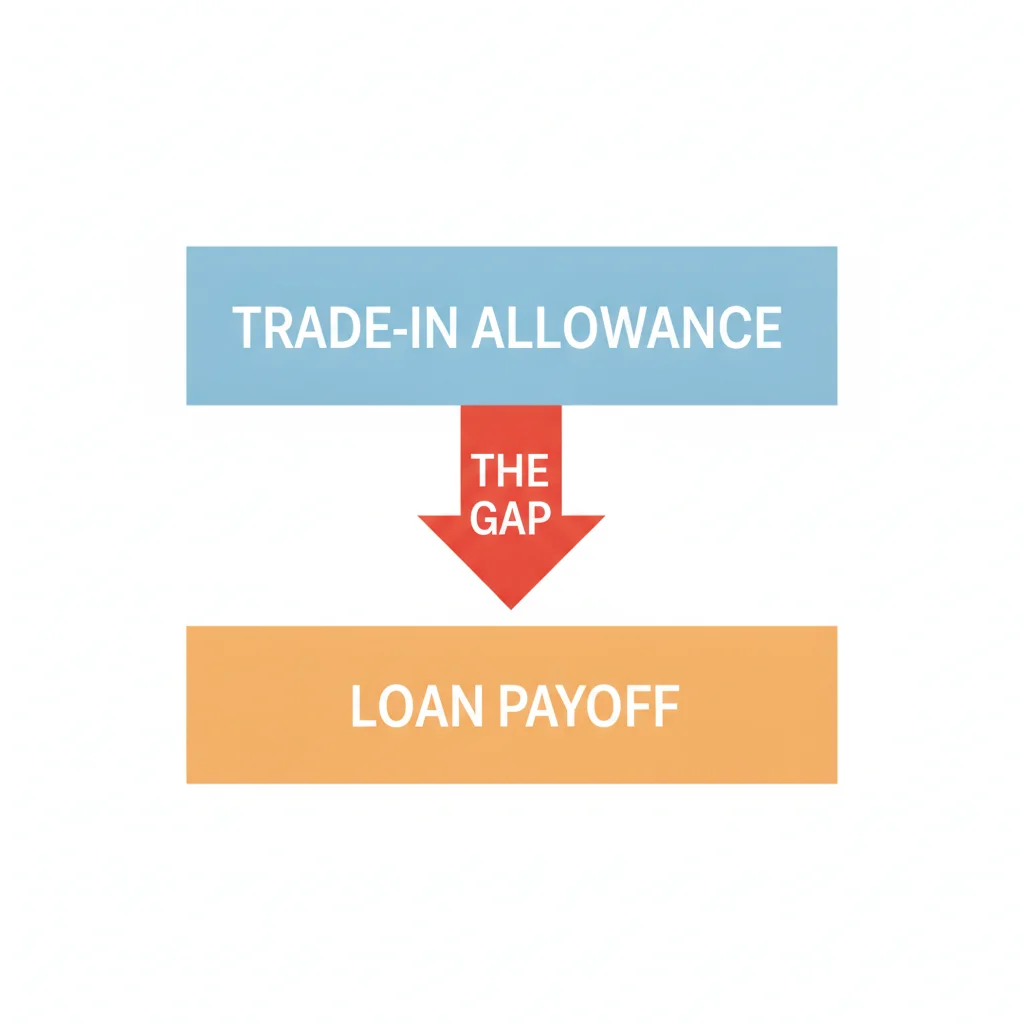
To protect yourself, always arrive at the dealership with a payoff quote obtained directly from your current lender, valid within the last 10 days. Compare that figure to what appears on the payoff line of the buyer's order. If the dealer's number is lower than your lender's quote, ask for an explanation in writing before signing.
“The single biggest mistake buyers make with trade-ins is assuming the dealer's payoff figure is accurate. That number directly affects how much you're financing, and no one in the dealership has a stronger incentive to verify it than you do.”
— Dara Flemming, Consumer Finance Journalist and Auto Loan Specialist
Line by Line: Reading the Buyer's Order for Trade-In Details
The buyer's order is where the full deal math lives. Here's a practical map of the lines that relate directly to your trade-in, and what each one should tell you.
- Trade-In Allowance
- The gross credit the dealer is applying for your vehicle. This should match the figure on your appraisal sheet. If it doesn't—even by a small amount—ask why.
- Trade-In Payoff (or Lien Payoff)
- The amount the dealer is using to pay off your existing loan. This is subtracted from your trade-in allowance to produce your net equity. Verify this matches your own lender payoff quote.
- Net Trade Equity
- Trade-in allowance minus payoff. If this is a positive number, it reduces what you owe on the new car. If it's negative, it adds to what you owe. Not every contract labels this line explicitly—you may need to calculate it yourself.
- Vehicle Selling Price
- The agreed price of the new vehicle before any credits. Compare this to what you negotiated verbally or on the four-square worksheet. This number should not have changed between the sales floor and the F&I office.
- Sales Tax Calculation Base
- In most states, your trade-in reduces the taxable purchase price. For example, if you buy a $30,000 car and trade in a vehicle credited at $10,000, you typically pay tax only on $20,000. Check how this line reads—some dealerships calculate tax on the full purchase price and then credit the trade separately, which may or may not be compliant with your state's rules.
- Amount Financed
- The bottom-line figure you're borrowing. Subtract your down payment and net trade equity from the vehicle price, then add any fees and add-ons. If this number is larger than you expected, something shifted upstream—start working backward through the lines above.
Use our trade-in negotiation checklist to cross-reference each of these lines before you sign anything.
What to Bring and What to Ask For
The best defense against paperwork confusion is preparation. Arriving at the dealership with your own documentation—and knowing which additional forms to request—puts you in a far stronger position than relying on the dealer to surface every relevant number voluntarily.
Bring With You
- Your current loan payoff quote: Call your lender or pull it from your online account within 10 days of your visit. Get it in writing (a screenshot or printout).
- Third-party valuations: KBB Instant Cash Offer, Carmax appraisal, or similar estimates give you a market-anchored baseline for your trade-in discussion. See documentation that strengthens your trade-in position for a full list of supporting materials.
- Your vehicle title or lienholder information: Even if you have a loan, knowing your title status speeds up the process and prevents clerical errors in the payoff authorization form.
Request From the Dealer
- A copy of the appraisal sheet showing how they arrived at your trade-in offer
- The buyer's order before you sit down with the finance manager—review it at your own pace
- A copy of the payoff authorization form with the exact figure they intend to submit to your lender
- Any "we owe" documentation if the dealer promises repairs, accessories, or other items after delivery
Separate Your Negotiations Before You Combine Them
Dealers prefer to negotiate the entire deal as a package because it lets them adjust one number to offset another. Get your best trade-in offer in writing before discussing the new vehicle price. This forces each part of the transaction to stand on its own merits, making it much easier to verify the final contract numbers match what was agreed.
Take Photos of Every Page Before You Leave
Once the deal is signed, requesting additional copies can become complicated—especially if discrepancies surface later. Before you leave the F&I office, photograph or scan every document you've signed. Many dealers will also provide a complete package via email if you ask at the time of signing.
You are legally entitled to copies of every document you sign. If a finance manager tries to rush you through the stack, slow down. Take photos of each page before leaving the dealership if necessary. Once you drive off the lot, recovering unsigned versions of these documents becomes significantly harder.
For a broader look at maximizing what you get from the trade-in process, visit the Trade-In Strategies hub and the Dealer Trade-Ins hub for additional guides.

All claims are backed by peer-reviewed research. Sources on request.