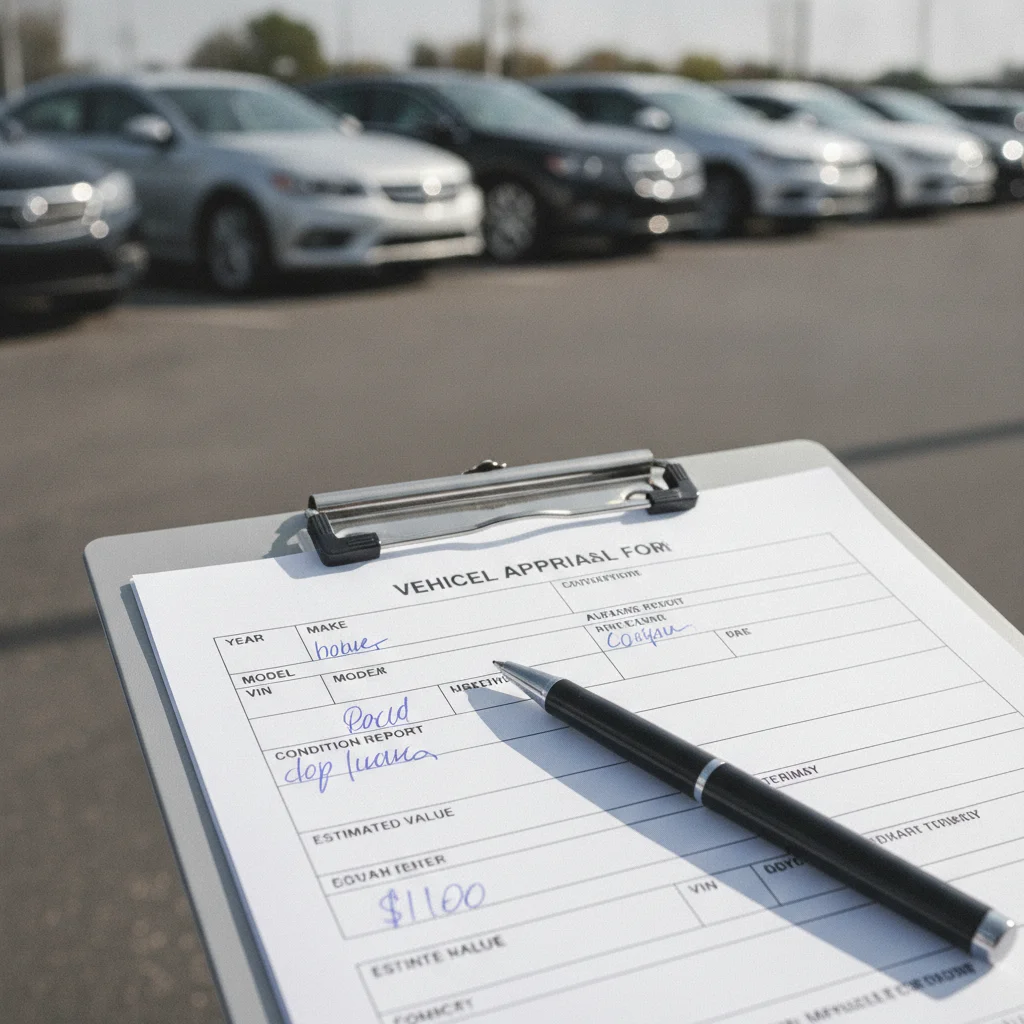
Key Takeaways
Why the Appraisal Sheet Is the Most Important Document You're Not Reading
Every trade-in starts with a number on paper. The problem is that most buyers are handed a single figure — the trade allowance — while the dealer keeps the actual appraisal form internally. That form is where your car's value gets built up, then systematically reduced through a series of deductions that are rarely explained out loud.
I spent years on the finance side of dealerships. The appraisal sheet was never designed for the customer to read — it was designed for the used car manager to justify whatever offer they wanted to make. But if you know what each section means, you can challenge the numbers and recover hundreds, sometimes thousands, of dollars.
This guide walks you through every major section of a standard appraisal form, tells you what dealers are actually calculating, and shows you exactly where the negotiating room lives. For a broader look at how the whole appraisal process unfolds, see what dealers look for during a trade-in inspection.
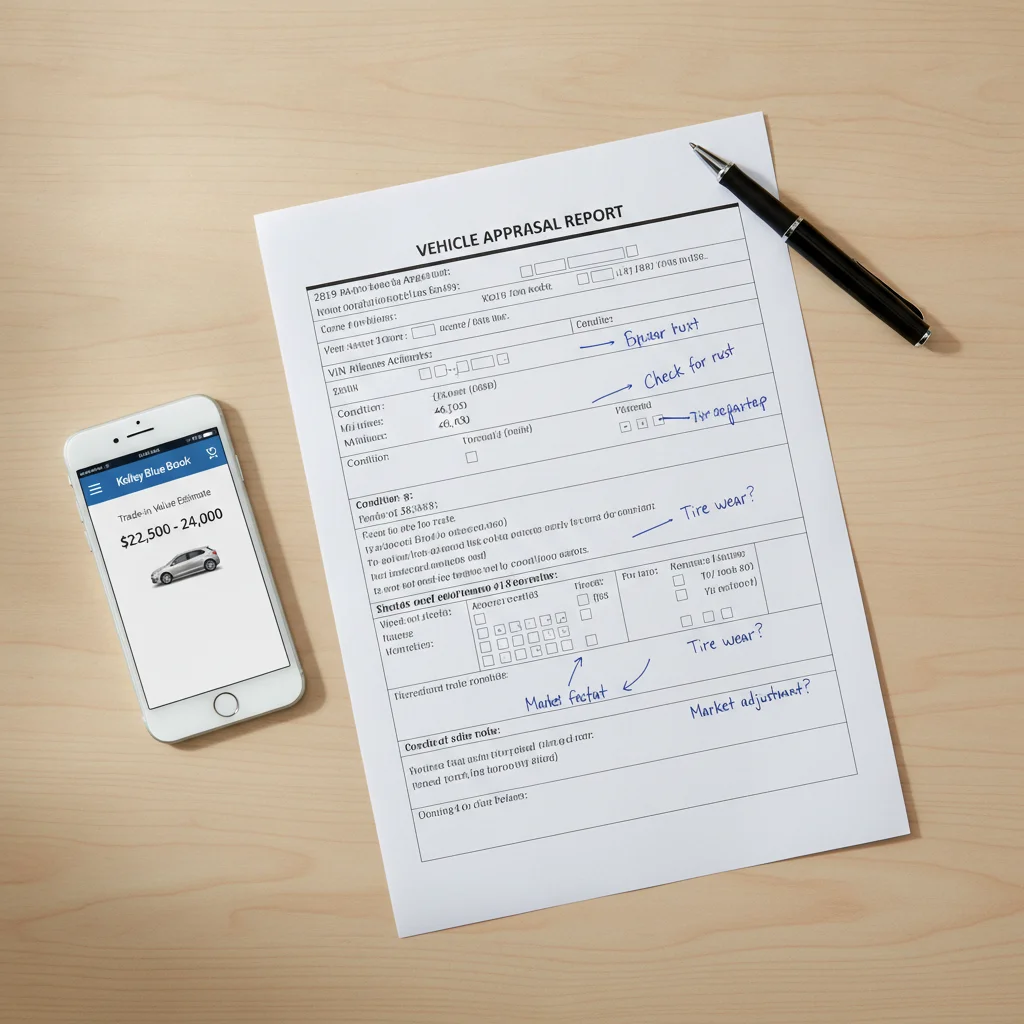
Before you sit down at any dealership, you should already have at least two independent valuations in hand. The valuation tools available from KBB and Edmunds are your baseline — bring printed copies or screenshots. That document discipline alone signals to the used car manager that you're not going to take a lowball offer and smile.
The Anatomy of a Trade-In Appraisal Sheet
Dealer appraisal forms vary by software platform — Reynolds & Reynolds, CDK, and DealerSocket all have their own layouts — but the core line items are consistent across every system. Here's what each section actually represents:
Vehicle Identification Block
At the top you'll see the VIN, year, make, model, trim level, mileage, and color. This block matters more than people realize. If the trim level is wrong — say the appraiser logged a base model when you have the premium package — every value lookup that follows will be understated. Verify this block before the conversation goes any further.
Market-Based Starting Value
The appraiser's software pulls a regional market value — usually from Black Book, Manheim Market Report (MMR), or a proprietary data feed. This is the wholesale anchor, not a retail number. It reflects what the dealer expects to pay at auction for a comparable vehicle. It is almost always lower than KBB Trade-In or Edmunds TMV, which is intentional.
Actual Cash Value (ACV)
ACV is the dealer's internal assessment of what your specific car is worth to them today, after they've applied condition adjustments to the market-based starting value. This is the number the used car desk negotiates around internally. The trade allowance you see on your offer may be higher than ACV — which sounds good — but it often means the profit is simply being shifted elsewhere in the deal. For more on how this works in practice, see how to read a dealer's trade-in offer sheet.
Reconditioning (Recon) Estimate
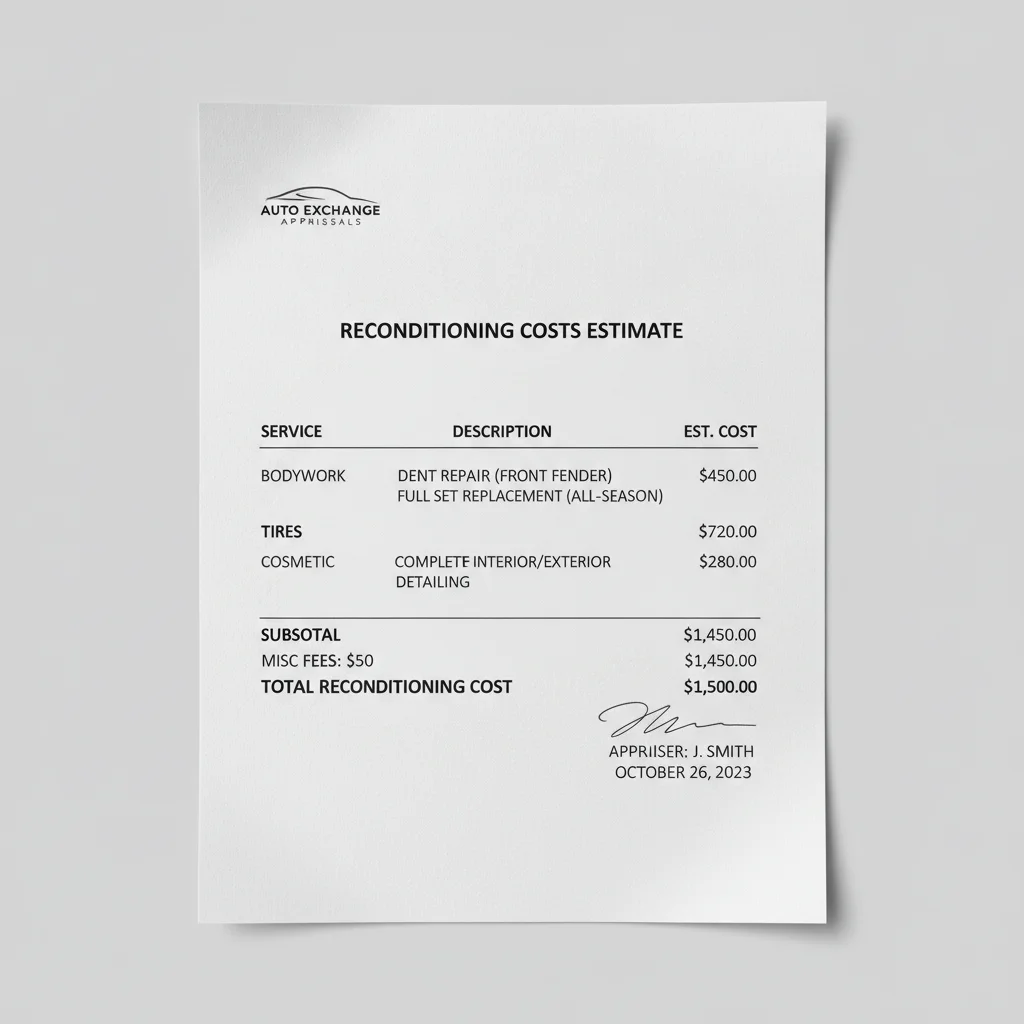
This is the single biggest area of abuse on any appraisal sheet. The appraiser estimates what it will cost the dealer to get your car retail-ready: paint correction, dent repair, tire replacement, detailing, mechanical work. Dealers routinely inflate these numbers — a minor bumper scuff that a body shop would fix for $250 might appear on the sheet as a $600 deduction. Always ask for the recon estimate as a line-by-line breakdown, not a lump sum.
Reconditioning-Adjusted Value
Starting value minus recon deductions. This is what the dealer says your car is worth after they've theoretically priced out all the work. It's a negotiating floor — not a ceiling — and everything above it is where your leverage lives.
Trade Allowance
The number printed on the offer sheet handed to you. It may equal the ACV, exceed it slightly to make the deal look better, or be obscured by manipulation of the new-car selling price. The trade allowance is a marketing number; ACV is the real number. Always ask: "What is the ACV on my vehicle?" If they refuse to answer, that tells you everything.
Days to Sell / Inventory Note
Some appraisal systems include a projected days-to-sell figure based on regional inventory data. If the system shows your vehicle selling in 18 days, it's in high demand — and you should be paid for that. If it shows 60+ days, the dealer will use that to justify a lower offer. Understanding this figure lets you counter with regional demand data you've pulled from online listings yourself.
Payoff Field
If you have an outstanding loan on your trade-in, this field captures the payoff amount. A positive equity position (car worth more than payoff) adds to your down payment. Negative equity (underwater) gets rolled into the new loan — one of the most dangerous moves in auto financing. Make sure the payoff figure is accurate; dealers sometimes use an estimate that's stale by days or weeks, costing you real money at signing. See where trade-in payoff details appear in your contract to know exactly what to verify before you sign.
What You Need Before You Walk In
Reading the appraisal sheet is only valuable if you arrive with competing data. Here's what to gather before your appointment:
What you will need
Kelley Blue Book (KBB) Trade-In Value Tool
Generates a condition-adjusted trade-in range that serves as your retail-side baseline for comparison against the dealer's wholesale anchor.
Edmunds True Market Value (TMV)
Provides an independent trade-in estimate based on regional transaction data, useful as a second data point alongside KBB.
Carvana or CarMax Instant Offer
Generates a written, binding trade-in offer that can be used as direct leverage at a franchised dealership.
Loan Payoff Statement
Confirms the exact amount needed to satisfy your current auto loan, preventing the dealer from using an inflated or stale estimate.
CarGurus or AutoTrader Regional Listings
Shows active retail listings for comparable vehicles in your area, giving you data to challenge a low market-based starting value.
Maintenance and Repair Receipts
Documents completed work that directly reduces legitimate reconditioning deductions on the appraisal sheet.
For a side-by-side comparison of how digital quotes stack up against in-person appraisals, online trade-in offers vs. in-person dealer appraisals breaks down when each approach works best and how to use both in combination.
Step-by-Step: How to Read and Challenge Each Section
Follow these steps in sequence when you receive — or request — an appraisal sheet at the dealership. The goal is to move through each line with discipline, not confrontation. You're verifying data, not arguing.
Request the Appraisal Sheet in Writing Before Any Discussion
When the used car manager returns with an offer, ask directly: "Can I see the appraisal sheet?" Many dealers will say they don't share it. Push back: "I'd like to see the vehicle identification block and the line items that make up this offer before I respond to the number." A dealer unwilling to show you any documentation should raise your suspicion immediately.
At a minimum, you are entitled to see the VIN, the trim and mileage captured, and the trade allowance in writing. In most states, if you request a written appraisal before signing anything, the dealer is obligated to provide one. Know your state's consumer protection rules before your visit.
Verify the Vehicle Identification Block
Cross-check every field in the identification block against your registration and window sticker:
- VIN: Should match your dashboard VIN plate exactly
- Trim level: Critical — EX, EX-L, and Touring trims on the same model can differ by $3,000–$5,000 in wholesale value
- Mileage: Should match your odometer reading at drop-off, not an estimate
- Color: Some colors have meaningful demand premiums — silver and white typically move faster than unpopular colors, which affects days-to-sell projections
If anything is wrong in this block, stop and correct it before proceeding. Every downstream calculation depends on this data being accurate.
Identify the Market-Based Starting Value and Its Source
Ask the appraiser or manager: "What data source is this market value pulling from?" Common answers include Black Book, Manheim Market Report, or the dealer's proprietary feed. Note that these are all wholesale sources — they reflect auction prices, not retail.
Compare this number against your KBB Trade-In Value and Edmunds TMV printouts. If the dealer's market anchor is more than 10% below your research, challenge it with your data. Say: "KBB puts the trade-in range at $X–$Y for my condition. I want to understand the gap before we go further."
Dissect the Reconditioning Estimate Line by Line
This step recovers the most money for the most buyers. Refuse a lump-sum recon figure. Ask: "Can you break that into specific repair items?" A legitimate breakdown looks like this:
- Paint chip repair — left rear quarter panel: $150
- Interior detailing (heavy): $200
- Tire replacement (two fronts): $280
- Windshield chip repair: $75
A lump sum of "$900 in recon" with no breakdown is a negotiating tactic, not an estimate. Counter each line item with market-rate comparisons — you can pull these from any local shop's published price list or a quick Google search.
Locate and Record the Actual Cash Value (ACV)
Once you've verified the identification block and reviewed recon, ask the manager to confirm the ACV — not the trade allowance, the ACV. Write it down. This is the number your vehicle has been assessed at before any deal structure is applied.
The gap between ACV and trade allowance is where dealers hide profit. If trade allowance is $18,500 but ACV is $16,200, the dealer has theoretically "given" you $2,300 in trade allowance — but watch closely whether that $2,300 reappears as a markup somewhere in the new vehicle pricing.
Verify the Payoff Figure Against Your Lender Statement
If you're trading in a financed vehicle, the payoff field on the appraisal sheet is critical. Pull up your lender's website or call them before your appointment to get the exact 10-day payoff figure. Compare it against what the appraiser has entered.
Dealers sometimes estimate payoffs from data in your credit pull rather than from a live lender quote. An estimate that's $400 too high inflates your apparent negative equity and may prompt you to accept a worse deal than you need to. A live payoff statement costs you nothing and takes five minutes to obtain.
Compare Against Your Independent Offers and Decide
Now lay your written offers from Carvana, CarMax, or a competing dealer side-by-side with the ACV you've extracted from the appraisal sheet. If those independent offers exceed the ACV by more than $500, present them directly: "I have a written offer from [source] for $X. Can you match or beat that number?"
Dealers will often improve their offer rather than lose the deal. If they cannot or will not come within $300–$500 of your best independent offer, you have a clear signal that selling elsewhere and applying the cash to your purchase will yield a better result.
Document whatever final trade value is agreed upon in writing before discussing any other deal terms — monthly payment, APR, or add-on products. Separating these negotiations prevents the four-square manipulation where adjusting one number secretly moves another.
Never Negotiate Trade and Purchase Price Together
The four-square method — where dealers present monthly payment, down payment, trade value, and purchase price as a single negotiating unit — is specifically designed to obscure how each number affects the others. Insist on finalizing your trade-in value in writing before any discussion of the vehicle you're buying. Any dealer who refuses this sequence is protecting their margin at your expense. Walk away from that posture if it doesn't change.
Rolled Negative Equity Can Cost You Thousands
If your trade-in payoff exceeds the ACV, that negative equity doesn't disappear — it gets added to your new loan balance. On a 72-month loan at 7% APR, a $4,000 negative equity roll-in costs you more than $900 in additional interest alone. Always calculate the full cost of rolling negative equity before agreeing to any deal that includes it. In some cases, paying down the trade-in loan before the transaction saves more money than any dealer incentive on the new vehicle.
Use Multiple Offers as a Bidding Floor
Treat independent trade-in offers from Carvana, CarMax, or a competing dealer as your negotiating floor, not a ceiling. Present them openly — dealers know these services exist and know their own buyers are using them. A manager who sees a written $17,400 Carvana offer has a clear target to beat. One who sees a buyer with no alternative offers has no incentive to move from their first number.
Bring Receipts for Every Recent Repair
Any documented maintenance or repair you've completed reduces the dealer's legitimate reconditioning exposure. New tires, a recent brake job, a fresh oil change, or a detailed interior all have dollar values that directly offset recon line items. Organize your receipts before the appraisal and present them when recon is discussed — this is one of the most straightforward ways to improve your trade-in outcome.
Ask Who Does the Recon Work
Many dealers outsource reconditioning to third-party shops at rates much lower than what appears on the appraisal sheet. A dealer charging you $600 in recon for work their partner shop performs for $250 is capturing a hidden gross profit margin on your trade. Asking this question — "Do you do recon in-house or outsource it?" — signals awareness and often prompts a more honest estimate.
Once you've worked through the sheet line by line, you're ready to use the full checklist approach covered in the trade-in negotiation checklist every buyer should run through. That resource covers the full deal structure — including how your trade interacts with purchase price, financing rate, and add-ons.
Where the Real Negotiating Room Lives
After you've verified the VIN block and know the ACV, the three areas where buyers consistently recover money are reconditioning, market-based starting value, and trade allowance vs. purchase price bundling.
Reconditioning Deductions
Ask for a line-by-line recon breakdown every single time. Dealers will often provide a lump sum — "$1,200 in recon" — with zero itemization. Push back: "Can you show me what makes up that number?" A $1,200 estimate that can't be explained in detail is almost certainly padded. If you've had recent work done — new tires, fresh brakes, a recent detail — bring the receipts. Documented maintenance directly reduces legitimate recon exposure.
Market Starting Value
The Black Book or MMR value the system pulls is a snapshot. If regional demand for your vehicle is higher than the national wholesale average — which you can verify by checking active listings on CarGurus, AutoTrader, or Cars.com — make that case explicitly. Dealers with good inventory managers know when they're sitting on a car that will move fast. Your job is to make sure they're paying you for that.
Trade Allowance vs. Purchase Price
The oldest trick in the book: inflate the trade allowance by $1,500 while quietly adding $1,500 to the out-the-door price of the new car. The numbers net to zero, but the buyer feels like they won. Negotiate trade and purchase price separately and always calculate net cost, not individual line items in isolation. This is detailed further in the trade-in playbook.
The Trade Allowance Inflating Trick
Dealers sometimes raise the trade allowance to close a deal while simultaneously raising the out-the-door price of the new vehicle by the same amount. The net result is identical to the original offer — you haven't gained anything. Always calculate net cost: (new vehicle purchase price) minus (trade-in ACV) minus (any other credits) equals what you're actually paying. Monthly payment math hides this completely.
Verbal Promises Are Worthless
If a sales manager tells you verbally that they'll give you $18,000 for your trade but the appraisal sheet says $15,500, the written number is what binds the deal. Never accept a verbal trade value as final — get the agreed number on the appraisal sheet or the purchase agreement before signing anything. The number in ink is the only number that matters at closing.
Don't Let Them Hold Your Keys During Negotiation
It's common practice for dealers to ask for your car keys "to do the appraisal" and then hold them throughout the negotiation — a subtle psychological tactic that makes you feel locked in. You are always free to ask for your keys back, end the conversation, and leave at any point before signing. A dealer who creates urgency around returning your keys is using pressure, not offering value.
After the Appraisal: What to Do With the Number
Once you have a written appraisal in hand, you have real options. A written offer from one dealer is a competitive asset at the next dealership. Most dealers will match or beat a written competitor offer rather than lose the deal entirely.
If the appraisal comes in below your floor — the minimum you'd accept based on your research — you are under no obligation to proceed. Walk out, take the offer with you, and use it as leverage elsewhere. An offer that expires in 7 days is still valuable negotiating currency for that window.
Also consider whether selling privately makes more financial sense. Dealers build in gross profit margin on every used car they take in trade. If your vehicle is in excellent condition and in high demand, a private sale through a platform like CarMax, Carvana, or a direct listing may yield 10–20% more than even a strong dealer appraisal. The tradeoff is time and effort — but for high-value vehicles, that math often works in your favor.
Whatever you decide, keep a copy of every written appraisal you receive. These documents are part of your negotiating paper trail and should be referenced against the final purchase contract. For a complete breakdown of how your trade figures appear — and sometimes disappear — in the deal paperwork, review trade-in documentation and what the dealership puts in writing.

The bottom line: the appraisal sheet is not a take-it-or-leave-it document. It's a starting position in a negotiation. Buyers who know how to read it — and challenge it line by line — consistently walk out with better numbers than buyers who accept a single printed figure and assume the process was objective.

All claims are backed by peer-reviewed research. Sources on request.