Key Takeaways
Our Verdict
Neither Carvana nor the dealer is universally better — the math depends on your state's tax rules, your vehicle's value, and whether you're buying from that dealer. In most states on vehicles under $20,000, Carvana's offer nets more cash in hand. On higher-value vehicles where sales-tax offsets are substantial, a dealer trade-in bundled with a new purchase can come out ahead. Get both numbers before you decide.
| Best for | Recommended |
|---|---|
| Sellers who are NOT buying from a dealer at the same time | Carvana |
| Buyers trading in a vehicle worth over $25,000 toward a new purchase | Dealer Trade-In |
| Anyone who wants certainty, speed, and zero pressure | Carvana |
| Buyers with negative equity rolling into a financed deal | Dealer Trade-In (with caution) |
Why This Comparison Actually Matters
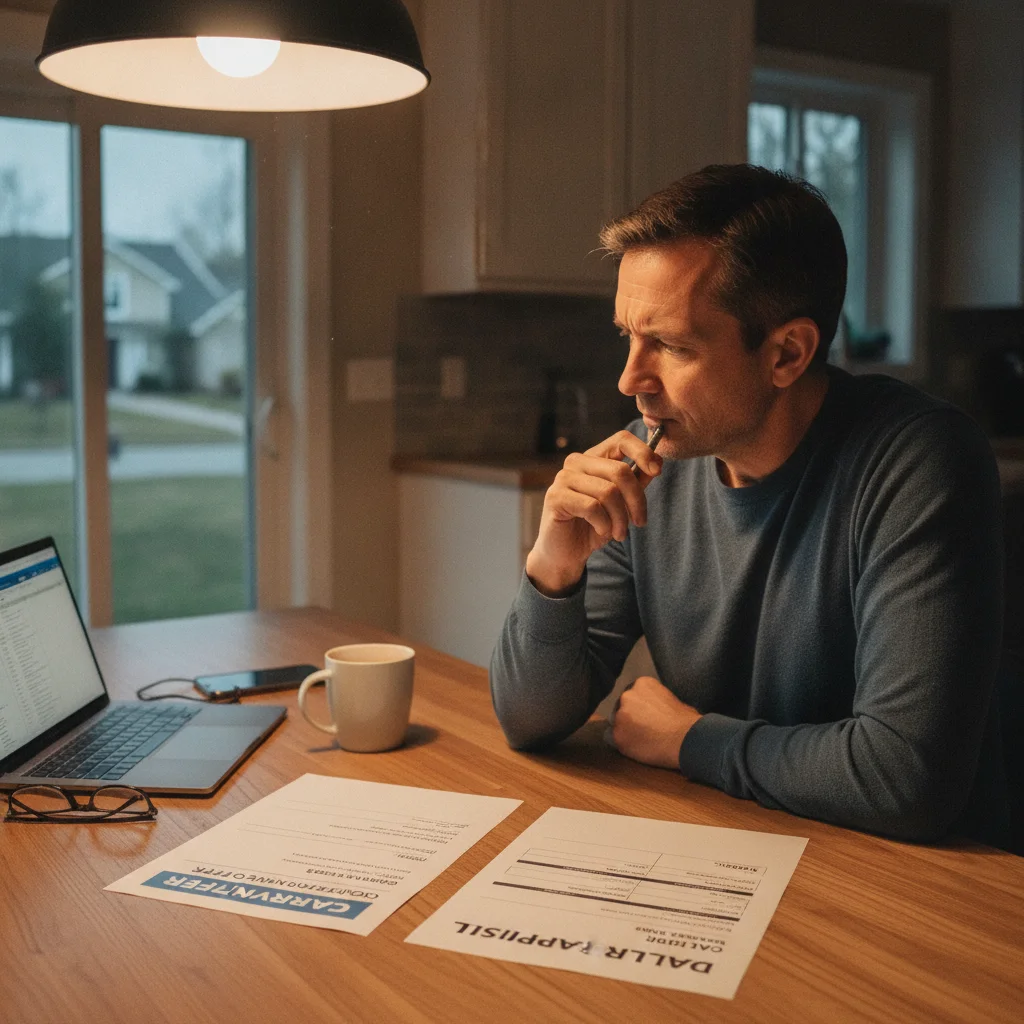
When I worked in dealership finance, we had an internal joke: the trade-in is where the deal is really made. Salespeople will negotiate the car price just enough to keep you at the table, then recoup margin in the trade appraisal. Buyers who walk in without an outside offer are almost always leaving money behind — sometimes thousands of dollars.
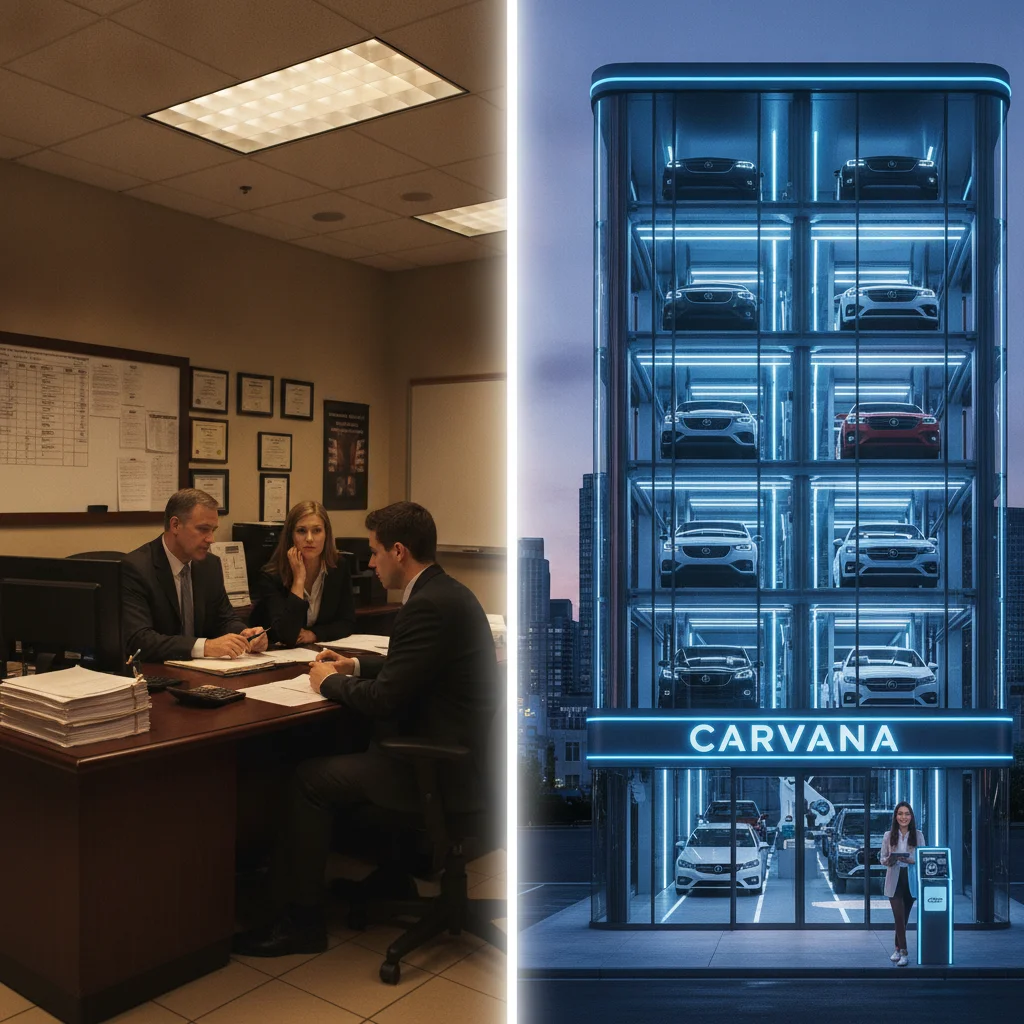
Carvana disrupted that dynamic by putting a number on your car in two minutes, giving you a benchmark the dealer can't easily dismiss. But Carvana's offer isn't automatically better once you factor in taxes, fees, and whether you're buying your next vehicle from a dealer. This comparison walks through the real math so you can stop guessing and start negotiating from a position of strength.
For a broader view of all the channels available to you, see how dealer trade-in appraisals work and what levers you can actually pull.
How Each Side Determines Your Car's Value
The Carvana Appraisal Process
Carvana runs your VIN through a proprietary pricing algorithm that weights recent retail sales data, regional demand, mileage, and days-to-turn at auction. The process takes about two minutes online. Once you confirm condition and submit photos or a video inspection, the offer is locked for seven days. There's no human negotiating against you — the number is the number.
What Carvana is doing behind the scenes is essentially solving for what they can retail the car for, minus reconditioning costs and their margin target. Their model is transparent in structure even if the exact formula isn't public. Importantly, Carvana operates nationally, which means a car with high regional demand in one market still gets priced on aggregate data — that can work for or against you.
The Dealer Appraisal Process
Dealers use a combination of tools — most commonly vAuto, Black Book, or Manheim Market Report — but the appraisal is ultimately a human decision shaped by what their lot needs right now. A used car manager who has three similar vehicles on the lot will offer less than one who has none. That subjectivity is both the weakness and the opportunity: it means the number is negotiable, but it also means it's often low by default.
The other thing dealers do that Carvana can't: bundle the trade-in into the overall deal structure. They can offer you a slightly higher trade value while adjusting the purchase price or financing terms to compensate. That's not illegal — it's just how bundled negotiations work. Your job is to separate every number and evaluate each on its own.
Always Separate the Trade-In from the Deal
When negotiating at a dealer, insist on agreeing on the trade-in value before discussing the purchase price. Tell the salesperson: "I'd like to agree on the trade-in first, then we'll talk about the new car." This prevents dealers from using your trade as a hidden adjustment to offset any discount they give you on the purchase. Dealers are trained to combine all four numbers — your job is to evaluate each one independently.
Get Your Carvana Offer Before You Need It
Don't wait until you're at the dealership to get a Carvana quote. Run the appraisal online at least a week before you plan to trade in, so you have a locked, valid offer in hand. A seven-day window gives you a full week of negotiating leverage. Print it out or show it on your phone — dealers take a written competing offer more seriously than a verbal claim.
Match Your Strategy to Your State's Tax Rules
The dealer trade-in tax offset is only valuable if your state offers it — seven states don't. Before defaulting to a dealer trade-in on a high-value vehicle, verify your state's specific rules on trade-in tax credits. Your state's DMV website or a quick call to your accountant can save you from making the wrong call based on an assumption.
For a direct comparison of how these bundled versus standalone offers play out in practice, see the full breakdown of instant offer platforms versus dealer appraisals.
The Real Numbers: A Side-by-Side Scenario
Let's run a real scenario so the abstract becomes concrete. Assume you own a 2021 Honda CR-V EX with 38,000 miles, in good condition, and you're looking to trade it in or sell it while purchasing a $35,000 vehicle. Retail market value is approximately $27,500 based on current data.
| Criteria | Carvana | Dealer Trade-In | |
|---|---|---|---|
| Typical offer vs. market value | Carvana | 85–90% of market | 75–85% of market |
| Sales tax offset on purchase | Criteria | None (pay full tax separately) | Yes — tax only on net price |
| Offer validity period | Carvana | 7 days, guaranteed | Varies, often conditional on purchase |
| Negotiability | Carvana | Take it or leave it | Negotiable with outside offers |
| Process convenience | Carvana | Home pickup, paperless | In-person, same-day |
| Risk of bundled manipulation | Carvana | None | Moderate to high |
| Best for high-value trade-ins ($25k+) | Carvana | Sometimes | Often, due to tax savings |
| Works if not buying next car from dealer | Carvana | Yes — standalone offer | Offer may not be honored |
Breaking Down the Tax Math
Here's where dealer trade-ins can close the gap significantly. In most U.S. states, when you trade in a vehicle at a dealership as part of a purchase, you only pay sales tax on the difference between the purchase price and your trade-in value. Carvana's offer is a direct cash payment — you pay full sales tax on the new vehicle separately.
Using the scenario above in a state with 8% sales tax:
- Dealer trade-in path: Tax on ($35,000 – $24,200) = tax on $10,800 = $864
- Carvana path: Tax on full $35,000 = $2,800
- Tax difference: $1,936
Now net the numbers: Carvana's $26,800 – $1,936 additional tax burden = effective value of $24,864 after tax. The dealer's $24,200 suddenly looks closer, though Carvana still comes out ahead in this example by about $664. On a $15,000 vehicle, Carvana is more likely to win cleanly. On a $40,000+ vehicle, the tax math can fully flip the equation.
10–15%
Average dealer undercut vs. instant offers
Industry data from iSeeCars and CarGurus analysis consistently shows dealer trade-in appraisals running 10–15% below instant-offer platforms on comparable vehicles.
$1,936
Tax savings on $27,500 trade-in at 8% tax
Calculated on a $35,000 purchase in a state with 8% sales tax — illustrating how dealer trade-in tax offsets can significantly close the gap with Carvana's higher raw quote.
7 days
Carvana offer lock window
Carvana guarantees its online appraisal price for seven days after confirmation, giving sellers a concrete negotiating anchor with dealer alternatives.
43 states
States with trade-in sales tax exemptions
According to the National Conference of State Legislatures, 43 states offer a sales tax offset on trade-ins applied toward a new vehicle purchase at a dealership.
Negotiating Leverage: Who Holds the Cards
This is where strategy matters as much as the raw numbers. A Carvana offer in your hand when you sit across from a dealer's used car manager changes the conversation entirely. It transforms the appraisal from a take-it-or-leave-it dealer estimate into a competitive bid they have to beat or at least justify.
Dealers will match Carvana offers — not always, not on every vehicle, but often enough that it's worth asking directly. Say it plainly: "Carvana quoted me $26,800. Can you beat that?" If they can't beat it, ask why. If they cite reconditioning costs or auction fees, ask to see the logic. That pressure alone sometimes moves the needle $500 to $1,500.
What Carvana can't offer you is the leverage of a bundled deal. If you're a strong buyer financing a new vehicle, dealers have more total deal margin to work with — and a smart buyer can extract that value in the trade even if the standalone appraisal is lower. This is why effective dealer negotiation always starts with separating the trade-in conversation from the purchase conversation.
Beware the 'Trade-In Boost' Tactic
Some dealers will suddenly raise your trade-in offer by $1,500–$2,000 once you've started talking about purchasing a vehicle. This isn't generosity — it's a restructuring move. They're usually recouping that increase through a higher purchase price, a worse interest rate, or extended loan terms. Always recheck every number in the deal after any offer is revised. If the trade went up but the purchase price didn't move, ask specifically why.
Condition Disclosures Can Change Carvana's Final Offer
Carvana's online quote is based on your self-reported condition. If the vehicle inspection at pickup reveals undisclosed issues — paint damage, accident history discrepancies, mechanical faults — Carvana will reduce the offer, sometimes substantially. To protect yourself, pull a Carfax report before quoting and be precise about condition. An honest upfront assessment means no surprises at pickup.
The cleanest version of this process — running multiple competing offers before you step foot in a dealer — is detailed in getting multiple trade-in offers before you buy. It's the single highest-ROI move you can make before any trade-in transaction.

Speed, Convenience, and Hidden Costs
Carvana's Operational Advantages
Carvana will pick up your vehicle at your home in most markets, cuts a check or initiates payment within days of inspection, and handles all title transfer paperwork. The experience is genuinely low-friction. The seven-day offer window gives you time to shop without pressure. If you're not buying another vehicle immediately, Carvana is often the fastest path to clean cash.
The catch: Carvana's final offer can change after the in-person or video inspection if the vehicle's actual condition differs from what you reported. Minor undisclosed damage, undisclosed accidents, or mechanical issues will reduce the offer — sometimes substantially. Document your car's condition thoroughly before submitting the online quote, and be honest in your initial assessment to avoid offer adjustments at pickup.
Dealer Trade-In: Speed vs. Certainty
Dealer trade-ins are theoretically faster since everything happens in one visit, but the bundled nature of the transaction means the appraisal number can shift mid-negotiation. I've seen dealers raise a trade-in offer by $1,500 only to quietly pad the vehicle purchase price by $2,000. It's not always intentional — sometimes it's just deal restructuring — but you need to track all four numbers: trade-in value, purchase price, interest rate, and term length.
The other risk: if you decide not to buy from the dealer, they have no obligation to honor the trade-in offer separately. Some will, some won't. Carvana's offer is always standalone and unconditional on a separate purchase.
For a deeper look at how Carvana stacks up against another major instant-offer competitor, Carvana vs. CarMax is worth reading before you commit.
When to Choose Each Option
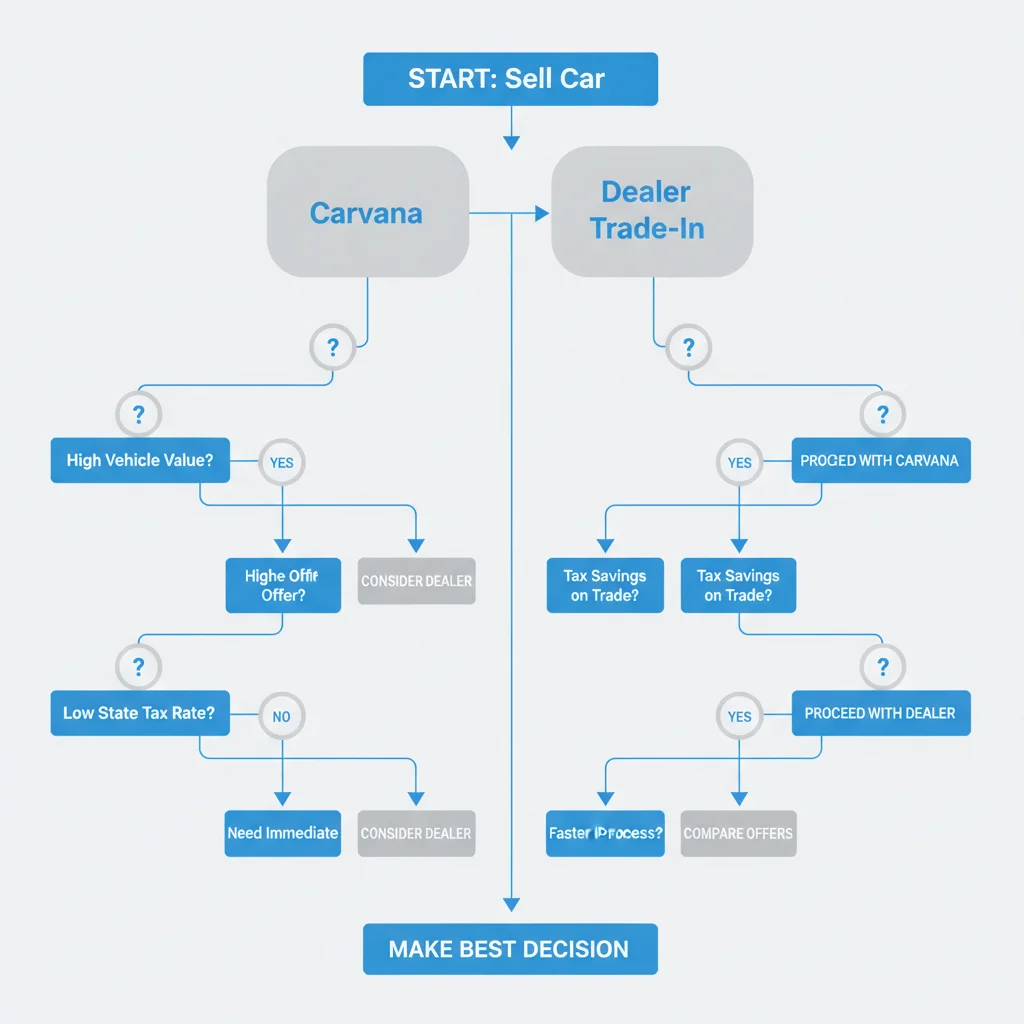
After running through the math on hundreds of deals, here's how I'd frame the decision tree:
Choose Carvana When:
- You're not buying a vehicle from a franchised dealer simultaneously
- Your vehicle is worth under $20,000 (tax savings are smaller, Carvana's premium matters more)
- You live in a state with low or no sales tax (the dealer tax advantage shrinks or disappears)
- You want a guaranteed, pressure-free transaction with no hidden bundling
- You need to close the transaction quickly without dealership back-and-forth
Choose Dealer Trade-In When:
- You're buying a vehicle from that dealer at the same time (tax offset is significant)
- Your vehicle is worth more than $25,000 (the tax savings are substantial)
- You live in a high-sales-tax state (8%+ makes the offset count)
- The dealer has matched or beaten your Carvana offer after negotiation
- You have negative equity and need to roll it into a new financed deal
Always Separate the Trade-In from the Deal
When negotiating at a dealer, insist on agreeing on the trade-in value before discussing the purchase price. Tell the salesperson: "I'd like to agree on the trade-in first, then we'll talk about the new car." This prevents dealers from using your trade as a hidden adjustment to offset any discount they give you on the purchase. Dealers are trained to combine all four numbers — your job is to evaluate each one independently.
Get Your Carvana Offer Before You Need It
Don't wait until you're at the dealership to get a Carvana quote. Run the appraisal online at least a week before you plan to trade in, so you have a locked, valid offer in hand. A seven-day window gives you a full week of negotiating leverage. Print it out or show it on your phone — dealers take a written competing offer more seriously than a verbal claim.
Match Your Strategy to Your State's Tax Rules
The dealer trade-in tax offset is only valuable if your state offers it — seven states don't. Before defaulting to a dealer trade-in on a high-value vehicle, verify your state's specific rules on trade-in tax credits. Your state's DMV website or a quick call to your accountant can save you from making the wrong call based on an assumption.
Also consider that selling privately — especially for clean, low-mileage vehicles — can outperform both options by 15–25%. If you have the time and energy, compare the dealer trade-in against a private party sale before ruling it out.
The Instant Offer Landscape Beyond Carvana
Carvana isn't the only instant-offer platform, and using just one quote undercuts the value of the process. CarMax operates over 200 physical locations and often appraises vehicles differently from Carvana — particularly on trucks, SUVs, and vehicles with high regional demand. Vroom is another digital option, though their operational logistics have historically been less reliable than Carvana's.
The smartest move is to get offers from at least two instant-offer platforms plus one or two local dealers before making any decision. The spread between those quotes will tell you something important: a tight spread means the market has a firm opinion on your car's value; a wide spread means there's room to negotiate aggressively. See how Carvana and CarMax differ on process and payout to understand which platform to prioritize first.
If you're evaluating other online platforms, Carvana vs. Vroom breaks down the differences in inventory, pricing, and return policies between the two digital-first dealers.
Finally, remember that the offer you get today reflects today's market. Used vehicle prices fluctuate with inventory cycles, fuel prices, and interest rate environments. If you're on the fence, getting quotes from multiple sources simultaneously — rather than sequentially over several weeks — gives you the most accurate picture of what your vehicle is actually worth right now.
Beware the 'Trade-In Boost' Tactic
Some dealers will suddenly raise your trade-in offer by $1,500–$2,000 once you've started talking about purchasing a vehicle. This isn't generosity — it's a restructuring move. They're usually recouping that increase through a higher purchase price, a worse interest rate, or extended loan terms. Always recheck every number in the deal after any offer is revised. If the trade went up but the purchase price didn't move, ask specifically why.
Condition Disclosures Can Change Carvana's Final Offer
Carvana's online quote is based on your self-reported condition. If the vehicle inspection at pickup reveals undisclosed issues — paint damage, accident history discrepancies, mechanical faults — Carvana will reduce the offer, sometimes substantially. To protect yourself, pull a Carfax report before quoting and be precise about condition. An honest upfront assessment means no surprises at pickup.

All claims are backed by peer-reviewed research. Sources on request.