Key Takeaways
Why Incentive Deadlines Are a Real Buying Factor
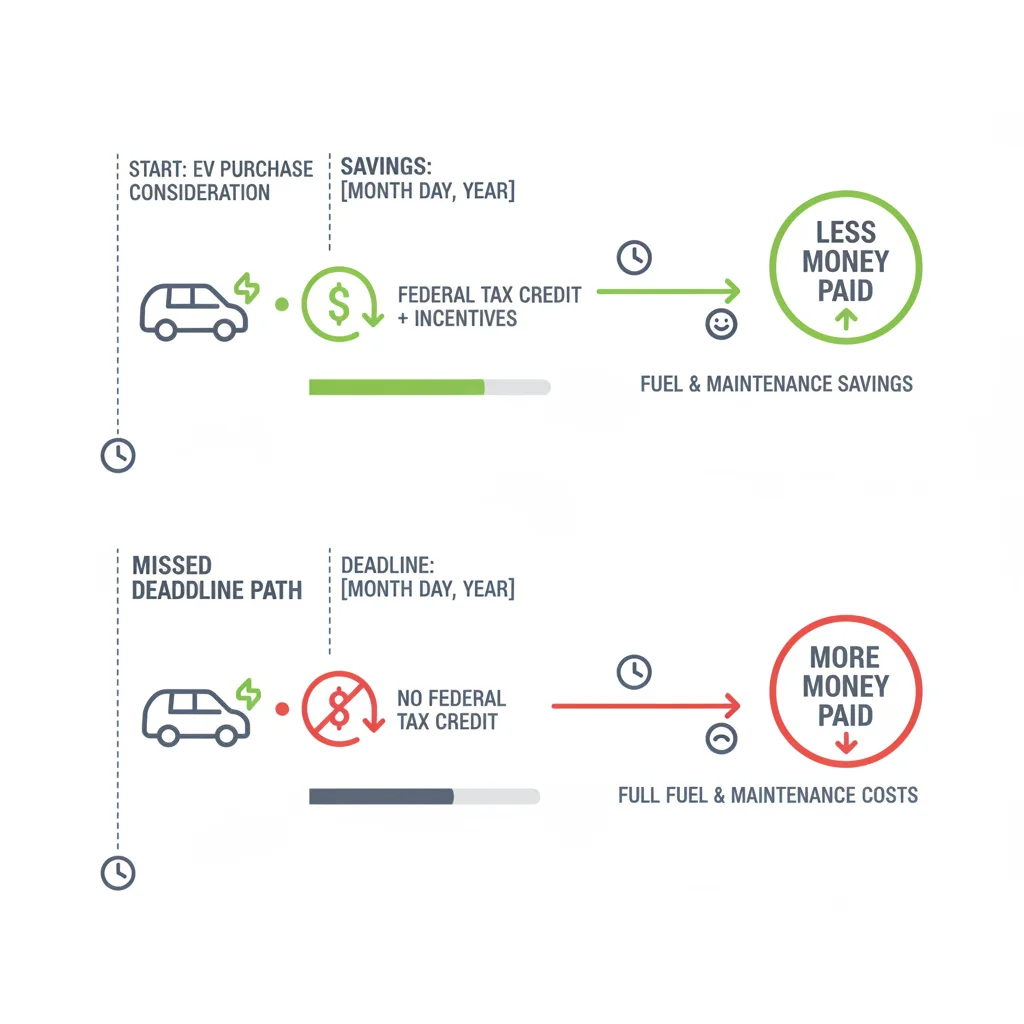
Most car buyers treat incentives as a bonus—a pleasant surprise that shows up at tax time. But when you're buying an electric vehicle, incentives can represent $3,750 to $7,500 in federal savings alone, plus potentially thousands more from state programs and utility rebates. At that scale, a misstep in timing isn't just unfortunate; it's measurable money left on the table.
The catch is that EV incentives don't operate on a simple, predictable schedule. They can expire when a manufacturer hits a sales threshold, when a state exhausts its annual budget, or when Congress passes new legislation. They can also get more restrictive overnight—new sourcing rules added by the Inflation Reduction Act (IRA) in 2023, for example, disqualified dozens of vehicles that had previously been eligible. If you weren't tracking those changes, you may have assumed you'd get a credit and then discovered at filing time that you wouldn't.
This guide walks you through how to read the incentive landscape, identify which deadlines actually matter for your situation, and structure your buying timeline so you maximize savings without rushing into a bad deal. For a foundational understanding of how the credits work before diving into timing strategy, see Getting Started With EV Incentives.
Think of this as financial planning for a car purchase rather than just shopping. The timeline you set should be driven by your personal eligibility, the vehicle you want, and the incentive clock—in that order.
Understanding the Types of Incentive Deadlines
Before you can time a purchase intelligently, you need to understand that not all EV incentive deadlines work the same way. There are four distinct types, and each requires a different tracking approach.
1. Manufacturer Sales Caps (Pre-IRA)
Under the old federal incentive structure—before the IRA replaced it in August 2022—manufacturers lost eligibility after selling 200,000 qualifying EVs. Tesla and General Motors hit that cap first. This model no longer applies to new vehicle credits under current law, but it still matters for used EVs purchased before the IRA transition date.
2. Legislative Expiration Dates
The current federal credit structure under the IRA is written into law through 2032. However, Congress can and does change tax law. Any significant shift in political control can trigger rewrites. The safest assumption is that current rules are stable in the near term, but not guaranteed across a full decade.
3. Annual State Budget Caps
Many state EV rebate programs run on a first-come, first-served basis within an annual appropriation. California's Clean Vehicle Rebate Project ran out of funds mid-year on multiple occasions before it was restructured. Colorado, Massachusetts, and New York have all had rebate programs pause when budgets were exhausted. These resets typically happen on a state fiscal-year schedule, which may not align with the calendar year.
4. IRS Guidance and Rule Changes
The IRS releases updated guidance—sometimes quarterly—that can change vehicle eligibility under the IRA's battery sourcing and critical minerals requirements. A vehicle that qualifies for the full $7,500 credit today might qualify for only $3,750 next quarter if its battery supply chain shifts. This is the most technically complex deadline type and the one most buyers underestimate. Timing Your EV Purchase Around Tax Credit Rule Changes goes deep on how to track these IRS updates systematically.

What You Need Before You Start Timing Anything
Rushing toward a deadline without verifying your own eligibility is one of the most common and costly EV-buying mistakes. The credit only helps you if you actually qualify. Here's what to confirm before you start watching any calendar.
What you will need
IRS Energy Credits Online Portal
Verify current vehicle eligibility and check which dealers are enrolled for the point-of-sale credit transfer.
fueleconomy.gov EV Incentive Lookup
Search federal and state incentives by ZIP code and vehicle to see what you qualify for in your location.
State Energy Office Website
Check the current funding status, application windows, and renewal dates for your state's EV rebate program.
Tax Software or CPA
Model the credit impact against your projected tax liability to confirm you can actually use the full credit amount.
Auto Loan Payoff Calculator
Compare financing scenarios with and without the point-of-sale credit to quantify the interest savings of upfront credit application.
EV Manufacturer Inventory Tool
Identify in-stock vehicles at nearby dealers to avoid waiting for a build that might miss a credit deadline.
The income thresholds are a particularly common blind spot. For new EVs purchased in 2024, the modified adjusted gross income (MAGI) limit is $150,000 for single filers, $225,000 for heads of household, and $300,000 for joint filers. These are hard cutoffs—even $1 over disqualifies you entirely. The IRS evaluates your MAGI from either the current or prior tax year, whichever is lower, which gives you a small planning window if your income fluctuates.
Vehicle price caps are equally firm: $55,000 for sedans and hatchbacks, $80,000 for SUVs, trucks, and vans. A vehicle listed at $81,000 receives no federal credit, full stop. Check the manufacturer's suggested retail price, not the dealer's asking price, for this determination—though note that add-on dealer markups above the vehicle price could affect your total cost calculation even if the base MSRP qualifies.
The Credit Is Nonrefundable—Verify Your Tax Liability
The federal EV tax credit (when claimed at filing rather than at point of sale) is nonrefundable, meaning it can reduce your tax liability to zero but it cannot generate a refund beyond what you've already paid in. If your total federal tax liability is $4,000 and you purchase an EV that qualifies for a $7,500 credit, you only capture $4,000 of value—the remaining $3,500 disappears. Before timing a purchase around a credit deadline, run the numbers with your actual projected tax liability for the year.
Point-of-Sale Transfer Repayment Risk Is Real
If you use the point-of-sale credit transfer and later discover you were ineligible—due to income exceeding the threshold or incorrect vehicle qualification—you will owe the full credit amount back to the IRS when you file your taxes. This isn't a penalty; it's a recapture of a credit that was applied incorrectly. Double-check your MAGI estimate and vehicle VIN eligibility before authorizing the dealer to apply the transfer.
Step-by-Step: Building Your Incentive-Aware Buying Timeline
Once you've confirmed your eligibility and understand the type of incentives you're targeting, you can build a purchase timeline that captures the maximum value. Follow these steps in order—skipping ahead often means missing a critical variable.
Confirm Your Federal Credit Eligibility Right Now
Before you look at a single calendar date, confirm that you actually qualify for the federal credit based on your current income and the vehicles you're considering. Pull your most recent tax return and calculate your MAGI. If your income is near the threshold, also project your current-year income—the IRS uses whichever year produces the lower MAGI.
Next, check the IRS's official list of qualifying vehicles at fueleconomy.gov. This list updates when IRS guidance changes, so don't rely on a vehicle brochure or a dealer's word. Confirm the specific trim level and configuration you want, because battery sourcing compliance can vary by trim on the same model.
Map All Incentives Available for Your Target Vehicle
Federal credit eligibility is just the starting point. For each vehicle on your shortlist, build a complete incentive stack: federal credit amount (either $3,750 or $7,500 under current IRA rules), your state's rebate or tax credit (if any), any utility company rebates for EV purchase or home charger installation, and any manufacturer loyalty or conquest cash offers.
Record the current status of each incentive and its expiration or next review date. For state programs, note whether the program is funded or exhausted, and when the next funding cycle begins. This becomes your incentive map—the document you'll update as you track changes over your buying window.
Identify the Nearest Hard Deadline in Your Incentive Stack
With your incentive map in hand, identify which incentive has the most imminent expiration or funding risk. This becomes your deadline anchor—the date that, if you miss it, costs you a defined dollar amount.
Rank your deadlines by financial impact. A $7,500 federal credit expiring in three months is a higher-priority anchor than a $500 utility rebate expiring next week. Don't let a small deadline distract you from protecting a larger one. If your most valuable incentive has no near-term expiration risk, you have more flexibility to shop patiently and negotiate better terms.
Set a Purchase Window That Gives You Negotiating Room
Work backward from your deadline anchor. If a credit expires December 31, your purchase window closes around December 20—not December 30. The final days of any month or year are peak times for dealers, who know buyers are rushing. Inventory gets picked over, dealers have less incentive to negotiate, and paperwork errors increase under time pressure.
If your deadline anchor is 60 days out, plan to have your financing pre-approved, vehicle selected, and test drives completed within the first 30 days. Use the second 30 days for negotiation and deal finalization—with at least one week of buffer before the actual deadline.
Get Pre-Approved for Financing Before Entering the Dealership
Pre-approval from a bank or credit union before you visit the dealer does two things. First, it separates the financing conversation from the vehicle price negotiation—a common dealer tactic is to bundle them together in ways that obscure the true cost of each. Second, it ensures you know your actual loan terms and can close quickly once you've negotiated the right price, which matters more when you're working against a deadline.
When you have your pre-approval in hand, also confirm how the point-of-sale federal credit will be applied. If you're using the dealer transfer, your financed amount should be the vehicle price minus the credit. Make sure the dealer's finance office reflects this correctly—some dealers apply the credit as a cap-cost reduction on a lease but not accurately on a purchase loan.
Verify Dealer Enrollment for Point-of-Sale Credit Transfer
If you plan to use the IRA's point-of-sale credit transfer, call or email the dealer's finance department before you visit and ask them to confirm their enrollment in the IRS Energy Credits Online system. Ask for the dealer's IRS registration confirmation number or a written statement that they are enrolled and actively processing transfers.
Do this step before you've gotten emotionally invested in a specific vehicle at a specific dealer. If a dealer isn't enrolled and you're committed to the point-of-sale transfer, you'll need to find another dealer with the same vehicle in inventory—which gets harder under time pressure.
Monitor IRS Guidance Updates in the Weeks Before Your Purchase
The IRS releases updated vehicle eligibility lists and compliance notices on an ongoing basis. Set a calendar reminder to check the fueleconomy.gov incentive database and the IRS's clean vehicle credit page every two weeks during your buying window. If a vehicle you're targeting loses eligibility due to a sourcing rule change, you want to know before you sign—not after.
Sign up for email alerts from your state's energy office if the program offers them. Some state programs post fund balance updates monthly, which lets you gauge how quickly the budget is depleting and whether you need to accelerate your timeline.
How the Point-of-Sale Credit Changes the Timing Calculus
Starting in January 2024, the IRA allowed buyers to transfer the federal EV credit directly to a participating dealer at the time of purchase. Instead of waiting until you file your taxes—potentially 15 months after you buy the car—the dealer applies the credit as a reduction to your purchase price or down payment on the spot.
This is a significant shift. Previously, if you bought a $45,000 EV in January, you'd pay full price and wait until April of the following year to receive your $7,500 credit as a tax refund. Under the new system, a participating dealer can reduce your out-of-pocket cost by $7,500 immediately, lowering the amount you need to finance and reducing the total interest you'll pay over the loan term.
Point-of-Sale Transfer Reduces Your Loan Amount
When you apply the federal credit at the dealer through the point-of-sale transfer, it reduces the amount you finance. On a $45,000 vehicle with a $7,500 credit, you're financing $37,500 instead of $45,000. At a 7% interest rate over 60 months, that's roughly $1,400 in interest savings on top of the credit itself—making the effective value of the credit closer to $8,900 when you account for financing costs.
Year-End Is Good—But Not Always Best
December is often cited as the best month to buy a car, and EV dealers are no exception to end-of-year sales pressure. However, the first week of January can also offer strong negotiating leverage if an incentive doesn't expire December 31—dealers are starting fresh quotas and inventory from the prior year is still on lots. Don't assume December 31 is always the magic date; check what your specific incentive's expiration actually is.
Track State Fiscal Year Resets, Not Just Calendar Year
Many state EV programs run on a fiscal year that starts July 1, not January 1. If a state program runs dry in March, its budget may reset in July—not January. Checking your state energy office's program page in May or June can reveal whether a new funding round is imminent, potentially making a summer purchase more valuable than a year-end rush.
The timing implication: if you're planning to use the point-of-sale transfer, confirm that your dealer is enrolled in the IRS Energy Credits Online portal before you finalize any deal. Not all dealers have registered, and some may offer the credit as a vague verbal commitment rather than a confirmed transaction. Ask to see the dealer's enrollment confirmation. If they can't show it, they may not be able to process the transfer—and you'd be back to waiting for a tax refund.
Also note that if you use the point-of-sale transfer and it turns out you weren't eligible—perhaps your income exceeded the threshold—you'll owe that money back to the IRS when you file. The transfer doesn't waive the eligibility requirements; it just shifts when the cash changes hands. This makes verifying your MAGI before purchase even more critical than it was under the old system.
For a complete breakdown of how charging-related incentives interact with your overall EV cost picture, see Federal and State Incentives That Reduce EV Charging Costs.
Common Timing Mistakes—and How to Avoid Them
Incentive deadlines create urgency, and urgency is the enemy of good deal-making. Here are the scenarios where buyers lose money trying to save money.
Accepting a Dealer Markup to Beat a Deadline
If a dealer is charging $5,000 over MSRP on a model you want, and a credit deadline is three weeks away, some buyers will pay the markup anyway. The math rarely works out. You're paying a certain $5,000 extra to capture an uncertain (or even certain) credit. Shop multiple dealers, check inventory at dealers who sell at MSRP, and factor the total out-of-pocket cost—not just the sticker price.
Buying the Wrong Vehicle Because It Qualified
A $7,500 credit on a vehicle that doesn't suit your needs, has higher long-term maintenance costs, or depreciates faster than an alternative isn't actually a great deal. The credit is a factor in your decision, not the entire decision. If the vehicle you actually want loses its credit eligibility next year, consider whether the credit alone is worth the difference, or whether waiting and buying the right car at the right price makes more financial sense overall. See EV Resale Timing for perspective on how incentive changes ripple into resale value over time.
Ignoring State Program Renewal Windows
Some buyers assume a state program is gone once it runs out of funds mid-year. Many programs refund at the start of a new fiscal year—often July 1 or January 1 depending on the state. If you're close to a state program's funding exhaustion point, waiting two months for the budget to reset could net you a rebate that's worth more than any urgency discount you'd get at end-of-year. Check your state energy office website for program status and renewal dates.
Confusing Pre-Approval With Actual Eligibility
Some state programs offer a pre-approval or reservation system that locks in your place in line. Don't confuse that reservation with a guarantee—most programs still require you to complete the purchase within a specified window and submit documentation afterward. Missing a documentation deadline can forfeit a reservation you waited months to secure.
Deadline Urgency Is a Common Sales Tactic
Dealers are aware of federal and state credit deadlines and may use them to create urgency that benefits the dealer more than you. Phrases like 'this credit expires soon' or 'we only have a few of these left' are designed to short-circuit your negotiation. Always verify deadline claims independently against IRS and state sources before allowing any deadline to rush your decision.
Don't Buy an Eligible Vehicle You Don't Actually Want
A $7,500 credit on a vehicle that doesn't fit your driving needs, depreciates faster, or carries higher insurance premiums may not be the financial win it appears. Calculate the full five-year cost of ownership for each vehicle you're comparing—including insurance, charging costs, and projected resale value—before letting credit eligibility be the deciding factor.
For the full picture on how federal credits are calculated, filed, and what documentation you'll need at tax time, EV Tax Credits: A Complete Walkthrough From Eligibility to Filing is the definitive reference. And if your EV purchase is part of a broader ownership cost calculation, don't overlook how insurance premiums for electric vehicles compare to gas models—our EV Insurance Guide covers what drives those differences.


All claims are backed by peer-reviewed research. Sources on request.