

Key Takeaways
Manufacturer subsidized rates can hit 0% APR
When automakers need to move inventory, they fund below-market rates through captive lenders. These promotions are genuine and represent savings no bank or credit union can replicate.
One-stop convenience saves time and multiple applications
A single dealer credit application reaches multiple lenders simultaneously, which can produce competitive offers without the buyer managing separate preapproval processes across institutions.
Access to a broad lender network in one visit
Large dealerships work with 10–20 lenders, including some that don't take direct applications from consumers. This network can sometimes surface a rate a buyer wouldn't find on their own.
Useful fallback when your bank declines or quotes high
For buyers whose primary financial institution doesn't offer strong auto loan terms, or for those rebuilding credit, the dealer's lender network may produce the only viable financing option.
Can be leveraged as a benchmark against outside offers
Even if you intend to use your credit union's rate, having a dealer offer in writing creates a competitive dynamic that sometimes pushes the F&I manager to beat your outside number.
Dealer rate markup adds hidden profit to your loan
Lenders allow dealers to mark up the approved buy rate by 1–3 percentage points and keep the difference. On a $35,000 loan, a 2-point markup over 60 months adds roughly $1,900 in unnecessary interest.
Monthly payment focus obscures true loan cost
F&I managers are trained to steer conversations toward monthly payments, which makes it easy to miss rate markups, term extensions, and add-on products rolled into the financed amount.
Bundled F&I products inflate total borrowing cost
GAP insurance, extended warranties, and protection packages added to the loan mean you pay interest on those products for the full term — often at rates far above what outside providers charge.
Promotional rates require near-perfect credit and shorter terms
Advertised 0% or low-rate offers are real, but they typically require a credit score above 720–740 and may be limited to 36 or 48-month terms that produce higher monthly payments.
Spot delivery risk if financing isn't fully approved
Driving off the lot before financing is finalized can leave you vulnerable to a dealer calling back days later to renegotiate terms — sometimes at a significantly higher rate than originally presented.
Less transparency than direct lender applications
When you apply through a dealer, you don't see your buy rate or how many lenders were contacted. A direct bank application gives you the full picture of what you're being offered and why.
Our Verdict
Dealer financing wins when manufacturers are running subsidized rate promotions or when your credit profile happens to align with a lender the dealer has a strong relationship with. It loses when the convenience of one-stop shopping lets a rate markup quietly add hundreds or thousands to your total cost. The move is always to know your bank or credit union rate before you walk in — then dealer financing competes on your terms, not theirs.
Best for buyers purchasing new cars during manufacturer promotional periods, or for anyone who has already secured a preapproval and wants to use it as leverage in the F&I office.
The Setup: How Dealer Financing Actually Works
Dealer financing is not a loan from the dealership. The dealer is a middleman — they collect your credit application, submit it to a network of lenders (banks, credit unions, and captive finance arms like Ford Motor Credit or Toyota Financial Services), and present you with an offer. The lender funds the loan; the dealer facilitates it.
That middleman role is where the money lives. Lenders tell the dealer your buy rate — the lowest rate the lender will accept — and the dealer is typically allowed to mark it up, often by as much as 2–3 percentage points. That spread goes to the dealer as what's called a finance reserve. On a $35,000 loan over 60 months, a 2-point markup adds roughly $1,900 in extra interest. See how dealer rate markup works for a full breakdown of this practice.
The system is not inherently dishonest, but it's structured so the dealer profits from your financing decision. Understanding that baseline changes how you approach the conversation.
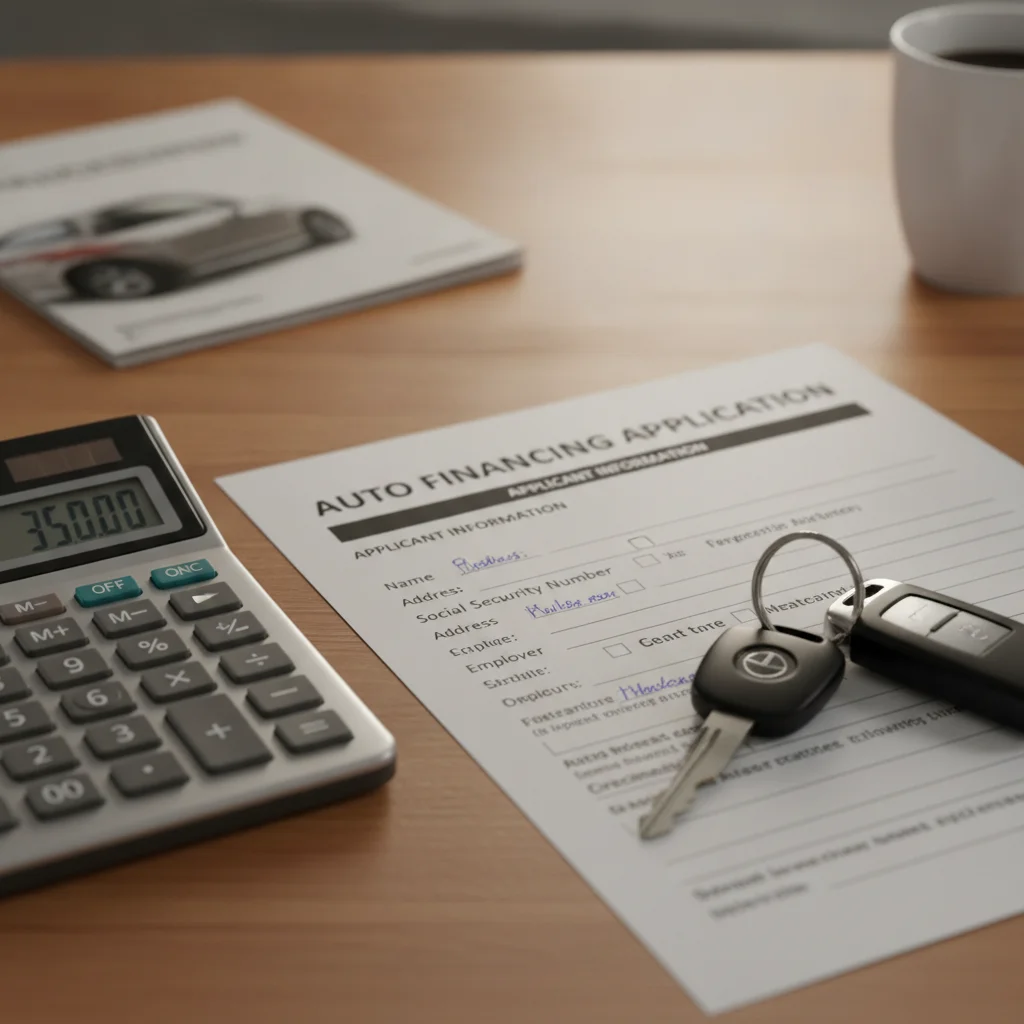
There's also the captive lender angle, which cuts in a different direction. When a manufacturer wants to move inventory, it subsidizes interest rates through its own finance arm. That's how 0% APR promotions exist — the manufacturer absorbs the interest cost so the dealer can close the deal. In those cases, dealer financing isn't just competitive, it's often unbeatable.
When Dealer Financing Genuinely Wins
There are three specific scenarios where going with the dealer's financing is the objectively smarter financial move.
Manufacturer-Subsidized Rate Promotions
If a manufacturer is running 0% or 1.9% APR on a specific model, no bank or credit union can touch that rate. These promotions are real, they apply to real buyers, and they represent free money relative to any alternative financing. The catch: you typically need a credit score above 720–740, and the promotional rate often applies only to shorter terms (36 or 48 months). If you need 72 months to make the payment work, you may not qualify for the promotional rate — read the fine print.
1–3%
Typical dealer interest rate markup range
Consumer Financial Protection Bureau research and industry reporting consistently document dealer reserve markups of 1–3 percentage points above the lender's approved buy rate.
$1,900+
Extra interest from a 2-point markup
On a $35,000 loan at 60 months, a dealer adding 2 percentage points above the buy rate generates approximately $1,900 in additional interest paid by the borrower.
0%
Manufacturer promotional APR floor
Automakers periodically subsidize financing through captive lenders to drive sales, resulting in 0% APR offers that no independent bank or credit union can match.
0.5–1.5%
Typical credit union rate advantage over banks
Federal credit union data and Bankrate surveys routinely show credit union auto loan rates running 0.5–1.5 percentage points below major bank rates for comparable credit profiles.
14–45 days
Rate-shopping window for credit score protection
FICO and VantageScore models treat multiple auto loan inquiries within a 14–45 day window as a single inquiry, meaning shopping multiple lenders costs buyers almost nothing in score impact.
When Your Bank Simply Isn't Competitive
Banks price auto loans based on their cost of funds and their assessment of risk. Dealerships, particularly large ones, have relationships with dozens of lenders simultaneously. If you have a strong credit profile, a dealer's lender network might produce a rate your bank can't match because a competing lender wants your business. This is less common but it happens — especially for buyers with credit scores in the 750+ range who represent low-risk business lenders actively want.
When You Have No Prior Offer to Compare
If you walk in without a preapproval, dealer financing is your only real-time option. This isn't ideal, but it doesn't mean you're helpless. Request the rate and term breakdown in writing before signing, then compare it to what your bank or credit union would offer when you get home. Some dealers will honor a 24-hour period to reconsider — use it.
When Your Bank or Credit Union Is the Better Call
For most buyers on used cars and for new car buyers who don't qualify for manufacturer promotions, outside financing beats what the F&I office will offer. Here's the mechanics of why.
The Markup Problem on Non-Promotional Loans
Without a manufacturer subsidy in play, the dealer's buy rate from a lender is roughly what you'd pay going directly to that same lender — then the dealer adds their markup on top. If your bank quotes you 6.9% and the dealer presents 8.5%, you're not looking at different lenders reaching different conclusions about your creditworthiness. You're often looking at the same underlying rate with a 1.6-point markup attached.
Dealer-arranged financing has real trade-offs that go beyond just the rate — including the way monthly payment focus obscures total loan cost.

Credit Unions Consistently Outperform on Rate
Credit unions are member-owned, don't pay federal income taxes on earnings, and return profits to members through lower loan rates. On an auto loan, credit union rates routinely run 0.5–1.5 percentage points below what major banks or dealer-arranged financing can offer for the same borrower profile. If you're a member of a credit union and you don't have their auto loan rate in hand before visiting a dealer, you're leaving money on the table.
The Preapproval as Negotiating Leverage
Walking in with a preapproval letter changes the entire conversation. You've already separated the vehicle price negotiation from the financing negotiation — two things dealers prefer to keep bundled because it gives them more room to maneuver. With a firm number in hand, you can legitimately tell the F&I manager: "I have 6.5% from my credit union. Can you beat it?" If they can't, you use yours. If they produce 6.1%, you switch. See how preapproval compares to dealer financing in practice for side-by-side numbers.
Manufacturer subsidized rates can hit 0% APR
When automakers need to move inventory, they fund below-market rates through captive lenders. These promotions are genuine and represent savings no bank or credit union can replicate.
One-stop convenience saves time and multiple applications
A single dealer credit application reaches multiple lenders simultaneously, which can produce competitive offers without the buyer managing separate preapproval processes across institutions.
Access to a broad lender network in one visit
Large dealerships work with 10–20 lenders, including some that don't take direct applications from consumers. This network can sometimes surface a rate a buyer wouldn't find on their own.
Useful fallback when your bank declines or quotes high
For buyers whose primary financial institution doesn't offer strong auto loan terms, or for those rebuilding credit, the dealer's lender network may produce the only viable financing option.
Can be leveraged as a benchmark against outside offers
Even if you intend to use your credit union's rate, having a dealer offer in writing creates a competitive dynamic that sometimes pushes the F&I manager to beat your outside number.
The Pros and Cons: Side by Side
No financing source is perfect across all situations. Before you decide, here's the full picture of what dealer financing brings to the table — advantages and risks both.
Dealer rate markup adds hidden profit to your loan
Lenders allow dealers to mark up the approved buy rate by 1–3 percentage points and keep the difference. On a $35,000 loan, a 2-point markup over 60 months adds roughly $1,900 in unnecessary interest.
Monthly payment focus obscures true loan cost
F&I managers are trained to steer conversations toward monthly payments, which makes it easy to miss rate markups, term extensions, and add-on products rolled into the financed amount.
Bundled F&I products inflate total borrowing cost
GAP insurance, extended warranties, and protection packages added to the loan mean you pay interest on those products for the full term — often at rates far above what outside providers charge.
Promotional rates require near-perfect credit and shorter terms
Advertised 0% or low-rate offers are real, but they typically require a credit score above 720–740 and may be limited to 36 or 48-month terms that produce higher monthly payments.
Spot delivery risk if financing isn't fully approved
Driving off the lot before financing is finalized can leave you vulnerable to a dealer calling back days later to renegotiate terms — sometimes at a significantly higher rate than originally presented.
Less transparency than direct lender applications
When you apply through a dealer, you don't see your buy rate or how many lenders were contacted. A direct bank application gives you the full picture of what you're being offered and why.
The 'Monthly Payment' Trap
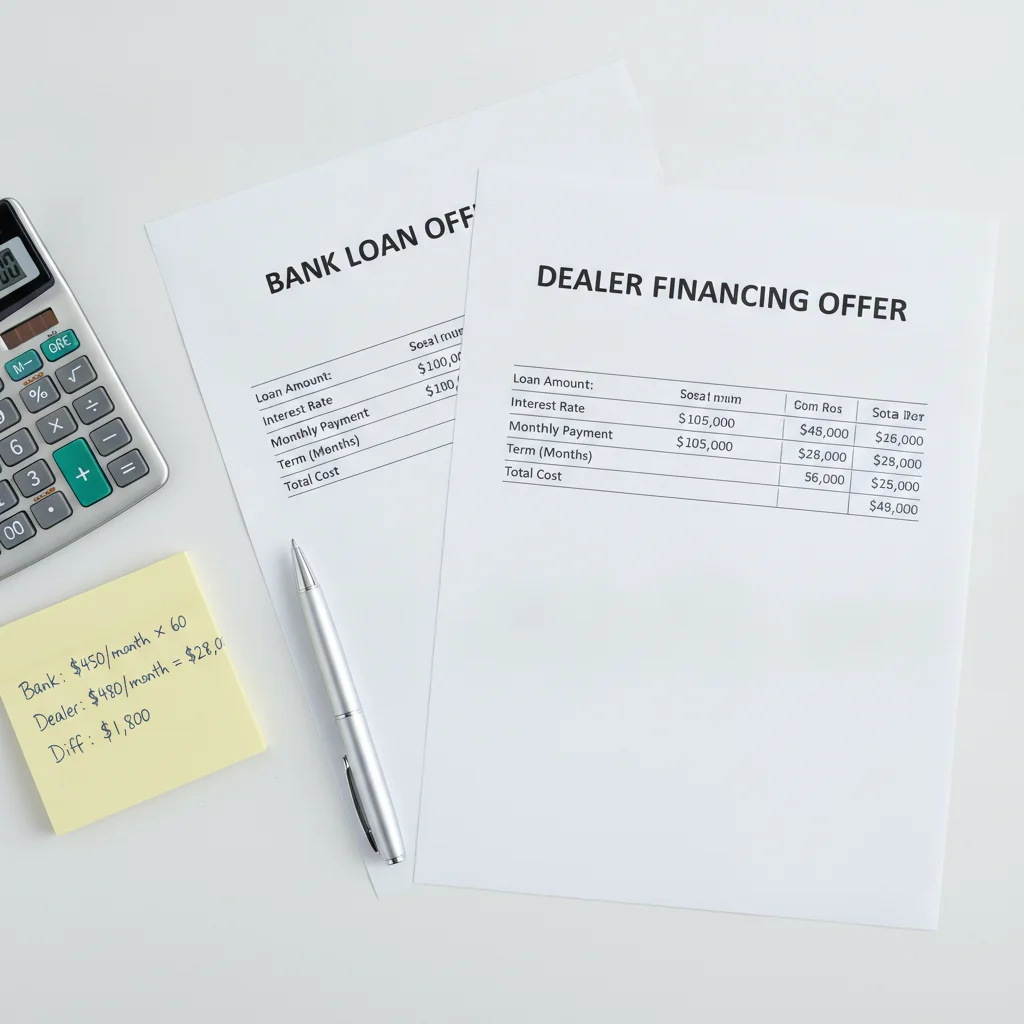
Dealers are legally required to disclose the APR on your contract, but nothing requires them to lead with it. The conversation is almost always steered toward monthly payment because a $28 difference between two rates feels smaller than the $1,700 total interest difference it represents. Always ask for the total interest paid over the life of the loan — not just the monthly number — before agreeing to any financing terms.
Captive Lenders vs. Third-Party Lenders
Captive lenders (Ford Motor Credit, Honda Financial Services, GM Financial, etc.) are owned by the manufacturer and exist specifically to support vehicle sales. They're the source of promotional rates — and also where markups still occur on non-promotional loans. Third-party lenders that dealers work with (regional banks, national banks, specialty auto lenders) are the same institutions you can often approach directly. Knowing which type funded your loan matters for understanding your options if you want to refinance.
Hard Pulls and Rate Shopping
Applying for a preapproval at your bank, your credit union, and then letting the dealer submit an application will result in multiple hard inquiries. However, credit scoring models — both FICO and VantageScore — treat all auto loan inquiries within a 14 to 45 day window as a single event for scoring purposes. Rate shopping aggressively within that window has minimal credit score impact and maximizes your leverage.
The key variable most buyers miss is total interest paid over the life of the loan, not just the monthly payment. A dealer who stretches your term from 60 to 72 months to lower your payment adds a full year of interest charges. Always run both calculations before you sign.
For buyers whose credit sits below the prime threshold, the calculus shifts again. Subprime borrowers face a different tradeoff between dealer-arranged financing and direct lenders — and the spread between offers is usually larger and more consequential.
The F&I Office: Where the Real Comparison Breaks Down
Even if the dealer's interest rate is competitive, the F&I office is designed to recover margin through other means. Extended warranties, GAP insurance, paint protection, and tire-and-wheel packages get folded into the financed amount — which means you pay interest on them too, often at the loan's full term.
GAP insurance is a real product with legitimate value if you're financing more than the car is worth. But the same coverage available at the dealership for $800–$1,200 added to your loan is available through your auto insurer for $20–$40 per year. That's a meaningful difference, and it's just one line item. How dealership F&I offices make money goes into each of these revenue streams in detail.

The practical defense: evaluate every F&I product in isolation, not as part of a monthly payment conversation. Ask what each item costs as a standalone total price, then compare it to outside alternatives before agreeing. F&I managers are trained to present everything as "only $X more per month" — that framing is specifically designed to obscure the true cost. Understanding what F&I managers are trained to sell gives you the playbook they're running.
Spot delivery — driving home before financing is fully finalized — creates additional risk. If the lender doesn't approve the original terms, the dealer can call you back to renegotiate. Spot delivery vs. completed financing explains exactly what to watch for before you take the keys.
How to Run the Actual Comparison
Comparing dealer financing to your bank isn't complicated, but it requires you to have the right information before you start negotiating, not after.
Step 1: Get Your Credit Union or Bank Rate First
Before you visit any dealership, apply for a preapproval from your bank or credit union. The inquiry will be a hard pull, but multiple auto loan inquiries within a 14–45 day window typically count as a single inquiry for scoring purposes. Getting two or three competing offers during that window costs you almost nothing in credit score impact.
Step 2: Know the Total Cost, Not Just the Rate
Use a simple loan calculator to convert each rate offer into total interest paid. A $30,000 loan at 5.9% for 60 months costs about $4,680 in interest. At 7.9%, that same loan costs $6,362. The 2-point difference is $1,682 — real money that doesn't show up obviously in a monthly payment comparison ($579 vs. $607). How APR affects your true loan cost is worth reviewing if the math here feels unfamiliar.
Step 3: Let the Dealer Compete
Tell the F&I manager you have outside financing and ask if they can beat it. If they can, you've used dealer financing as intended — as a competitive tool. If they can't, you use your preapproval and walk out with a lower cost loan. Either way, you win.
Step 4: Consider Refinancing If You Signed a Bad Deal
If you already signed dealer financing at a rate you're not happy with, the loan isn't permanent. Refinancing your dealership loan with a bank or credit union is often straightforward within the first 6–12 months, especially if your credit has remained stable. Even trimming 1.5 points off a 60-month loan can save hundreds in remaining interest.
Your credit score impacts dealer and bank financing differently — understanding that dynamic helps you target the right lender for your specific profile before you negotiate.
All claims are backed by peer-reviewed research. Sources on request.