

Key Takeaways
Option A
Dealer Financing
The convenient, one-stop-shop option — with a hidden cost built in.
Best for: Buyers who want speed and simplicity, or who qualify for manufacturer-subsidized promotional rates.
Option B
Outside Preapproval
The leverage-generating alternative that keeps the dealer honest.
Best for: Buyers who want to separate the vehicle price negotiation from financing and secure the lowest possible rate.
If you want the lowest possible interest rate and maximum negotiating power
Outside Preapproval
Arriving with a locked rate forces the dealer to compete or match it, and keeps the price conversation separate from the monthly payment shuffle.
If you qualify for a manufacturer's 0% or sub-2% promotional APR
Dealer Financing
No outside lender can beat a subsidized promotional rate — these are genuine loss-leader offers designed to move inventory, and they save real money.
If you have bruised or limited credit and need fast approval
Outside Preapproval
Credit unions in particular often approve borrowers with lower scores at far better rates than dealer-arranged subprime financing, which can carry markups exceeding 3 percentage points.
If you're buying a used car from a franchise dealer with no OEM incentives
Outside Preapproval
Used car financing through dealers carries the highest average markups — preapproval is almost always the cheaper path here.
If you're short on time and the dealer rate is within 0.5% of your preapproval
Dealer Financing
The convenience tradeoff is minor at that spread; on a typical loan, 0.5% APR difference costs roughly $200–$400 total — weigh that against your time.
How Dealer Financing Actually Works — And Where the Profit Hides
Walk into any dealership finance office and the F&I manager will present you with a financing offer. What they won't tell you is that the rate on that contract is almost never the rate the lender actually approved. Here's the mechanism: the dealer submits your application to one or more wholesale lenders (banks, captive finance arms, credit unions that work with dealers). Those lenders respond with a buy rate — the minimum rate they'll accept. The dealer then adds a markup, typically between 1% and 3%, and presents the inflated number to you as your rate.
That markup is called the dealer reserve, and it's legally permitted in most states. On a $35,000 loan at 60 months, a 2% markup over your actual qualifying rate costs you roughly $1,800 in additional interest over the life of the loan. You'll never see this on the contract — it's baked into the APR.
This isn't a theory or an edge case. It's standard operating procedure, and the F&I office is often the most profitable department in the dealership. The CFPB has documented the practice extensively, and class-action litigation over dealer reserve has resulted in settlements from multiple major lenders.

The good news: knowing this exists is the first step to neutralizing it. The second step is arriving with a competing offer in hand — which is exactly what a preapproval gives you. See what you're actually trading away when you accept dealer financing without comparing alternatives.
What Outside Preapproval Actually Gets You
A preapproval from a bank or credit union isn't just a backup plan — it's a negotiating instrument. When you arrive at the dealership with a written preapproval letter specifying your rate, term, and maximum loan amount, the entire dynamic of the finance conversation shifts.
Instead of the dealer asking, "What monthly payment are you comfortable with?" (a question designed to obscure total cost and maximize dealer profit on rate and term), you're the one setting the terms: "I have financing at 5.9% for 60 months. Can you beat that?" That's it. That's the whole conversation. Either they beat it, or you use yours.
Walking in preapproved changes the conversation from "what can you afford per month" to "what is the actual price" — a distinction that's worth thousands of dollars on most vehicle purchases.
| Criterion | Dealer Financing | Outside Preapproval |
|---|---|---|
| Rate transparency | Buy rate hidden; markup added | Rate locked before negotiation |
| Negotiating leverage | Dealer controls the rate | You set the benchmark rate |
| Application speed | Same day at dealership | Hours to 2 days online |
| Typical rate vs. market | 1%–3% above buy rate | At or near best available rate |
| Promotional rate access | Yes (OEM-subsidized offers) | No (market rates only) |
| Credit impact of shopping | Single inquiry at signing | Single event if done in 14 days |
| Flexibility on terms | Dealer controls term options | You choose term at preapproval |
| Best for credit-challenged buyers | Available but markup is higher | Credit unions often more competitive |
Credit unions are particularly worth targeting for preapproval. They are member-owned, non-profit institutions whose auto loan rates consistently undercut both banks and dealer-arranged financing. According to the National Credit Union Administration, the average new car loan rate at credit unions runs 1.5–2 full percentage points below the average at commercial banks. Many credit unions also offer preapproval decisions within hours online, with no impact to your credit score until you formally apply.
1%–3%
Typical dealer interest rate markup
The Consumer Financial Protection Bureau has documented dealer reserve markups averaging 1–3 percentage points above the lender's actual approved buy rate.
$1,800+
Extra interest cost on typical marked-up loan
On a $35,000 60-month loan, a 2% dealer reserve markup adds approximately $1,800 in additional interest paid over the life of the loan.
1.5–2%
Credit union rate advantage over banks
According to the National Credit Union Administration, average new auto loan rates at credit unions run 1.5–2 percentage points below average commercial bank rates.
14 days
Rate-shopping window with no extra credit score impact
FICO scoring models treat all auto loan hard inquiries made within a 14-day period as a single inquiry, meaning borrowers can apply to multiple lenders at no additional scoring cost.
One critical process note: when you shop multiple lenders within a 14-day window, FICO treats all auto loan inquiries as a single hard pull for scoring purposes. That means you can collect 4–5 competing preapproval offers and your credit score takes the same hit as a single application. There is no reason not to shop aggressively.
The Rate Comparison: Real Numbers, Real Difference
Abstract discussion of interest rates only goes so far. Let's put actual numbers to work.
Assume a $40,000 vehicle purchase, 10% down, $36,000 financed, 60-month term, and a buyer with a 720 credit score.
- Dealer financing (marked up): Buy rate of 5.5% + 2% dealer reserve = 7.5% APR. Monthly payment: $720. Total interest paid: $7,200.
- Outside preapproval (credit union): 5.5% APR. Monthly payment: $679. Total interest paid: $5,740.
- Difference: $41/month, $1,460 over the loan term.
Now factor in that the dealer may also have stretched the term to 72 months to lower the monthly payment optics — adding another $1,200–$1,800 in interest while obscuring the true cost. The gap widens fast.
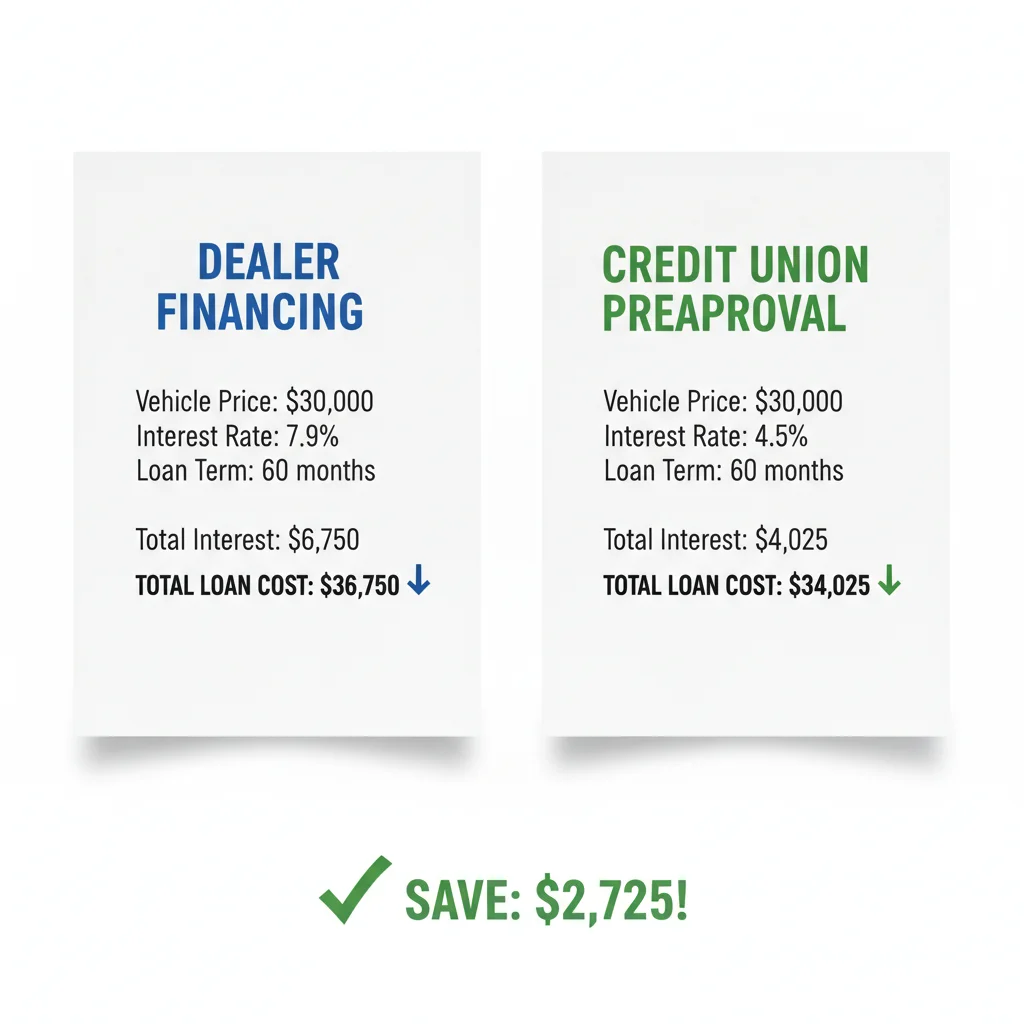
The exception — and it's real — is manufacturer-subsidized promotional financing. When a captive lender like Ford Motor Credit or Toyota Financial Services offers 0% APR for 36 months, that is a genuine subsidy funded by the manufacturer to move inventory. No outside lender competes with zero. In these cases, take the dealer financing, negotiate the vehicle price hard, and don't touch the financing side. Just verify there's no "or" clause hiding a cash rebate that would be forfeited — sometimes the rebate in lieu of the promo rate is worth more than the interest savings. Know exactly when dealer financing beats your bank before you decide.
Rebate vs. Promotional Rate: Run the Math
Many new car incentive programs offer a choice: take the manufacturer's subsidized low APR, or take a cash rebate and arrange your own financing. On a $35,000 vehicle, a $2,500 rebate financed at 5.9% APR often beats a 0% APR offer on a 36-month term — especially if you're not stretching that far into the term. Always calculate total cost of each path before choosing.
Dealer Financing Can Be Legitimate — With a Competing Offer
Some franchise dealers participate in lending networks that return genuinely competitive rates, particularly for buyers with excellent credit. The issue is never that dealer financing is categorically bad — it's that without an independent benchmark, you have no way to know whether the rate you're being shown is good, average, or padded. A preapproval converts an opaque process into a transparent comparison.
The Tactics Dealers Use to Steer You Away From Your Preapproval
Understanding the mechanics isn't enough — you need to recognize the counter-moves dealers make when you bring outside financing. These are real scripts used in F&I offices every day.
"We can probably beat that rate."
Sometimes true, often a delay tactic to get you emotionally committed to the vehicle before the numbers come back. Always ask for the rate in writing before signing anything. If they can beat your preapproval by at least 0.25%, let them — but don't abandon your letter until you have their offer on paper.
"That rate is only good if you finance through us."
This refers to price-financing bundles where a discount on the vehicle price is contingent on using dealer financing. This is legitimate — but calculate total cost both ways. Sometimes the price discount exceeds the interest premium; sometimes it doesn't. Run the math, not the feelings.
"Your bank rate won't apply to this vehicle."
Preapprovals typically have vehicle restrictions (model year limits, mileage caps on used vehicles, loan-to-value limits). Know your preapproval terms before you arrive so you can push back accurately if the vehicle actually does qualify.
Extending the term to match your monthly payment
If a dealer can't beat your rate, they may offer to match your monthly payment by extending the term. A 72-month loan at 7.5% can produce the same monthly payment as a 60-month loan at 5.5% — while costing thousands more in total interest. Always compare total cost of financing, not monthly payment. See how effective dealer negotiation strategy keeps you focused on total price and total cost, not monthly numbers.
The cleanest defense: negotiate the vehicle price first, get it in writing, then introduce your financing. Dealers who insist on discussing payment before price are using the payment to obscure the deal structure — a classic four-square tactic.
How to Get Preapproved Before You Step on the Lot
The preapproval process is faster than most buyers expect. Here's the efficient sequence:
- Pull your own credit first. Use AnnualCreditReport.com for free reports, or a monitoring service for your current score. Know your tier before lenders see you — it eliminates surprises and helps you target the right lenders.
- Apply at your primary bank or credit union. Start where you already have a relationship; existing customers often receive rate discounts of 0.25%–0.5%.
- Apply at 2–3 additional credit unions or online lenders. LightStream, PenFed Credit Union, and Consumers Credit Union consistently rank among the most competitive auto lenders nationally. All offer online preapproval within minutes to hours.
- Do all applications within a 14-day window to consolidate credit inquiries into a single scoring event.
- Collect written preapproval letters specifying APR, term options, and maximum loan amount. Bring the best one to the dealership — and keep the others in your back pocket.
Your preapproval letter doesn't obligate you to use that lender. It simply gives you a documented, concrete alternative the dealer must compete against. If the dealer beats it legitimately, great — you still win, because competition drove the rate down. If they can't, you fund through your preapproved lender and pay the dealer directly.
If dealer financing is what you end up using and the rate feels off, refinancing is a viable recovery option. Refinancing through a bank or credit union within 60–90 days of purchase can recapture savings if a better rate is available — and many lenders impose no prepayment penalty.

For buyers with credit challenges, the calculus is similar but the stakes are higher. Dealer-arranged subprime financing can carry rates well above 15% APR with markups built in. Credit unions that serve lower-score borrowers — particularly those with community development charters — often offer structured programs at dramatically lower rates. Compare dealer financing against direct lending when your credit is poor before assuming the dealer is your only option.
When Dealer Financing Is the Right Call
This isn't a blanket condemnation of dealer financing — it's a call for informed comparison. There are legitimate scenarios where dealer-arranged financing wins:
- Promotional APR offers: 0%, 0.9%, or 1.9% manufacturer-subsidized rates on new vehicles are unbeatable by any outside lender. Take them — but still negotiate vehicle price independently.
- Dealer rate matches your preapproval: If the dealer submits to their lending network and genuinely comes back at or below your preapproval rate, that's competition working in your favor. No reason to use the outside lender.
- Speed and simplicity for low-stakes purchases: On a low-dollar transaction where the rate difference amounts to under $300 total and your time has high value, the convenience of one-stop financing may be worth it.
- Captive lender loyalty programs: Some OEM captive lenders offer loyalty APR discounts (0.5%–1%) to repeat brand customers, which can close the gap with outside lenders.
Rebate vs. Promotional Rate: Run the Math
Many new car incentive programs offer a choice: take the manufacturer's subsidized low APR, or take a cash rebate and arrange your own financing. On a $35,000 vehicle, a $2,500 rebate financed at 5.9% APR often beats a 0% APR offer on a 36-month term — especially if you're not stretching that far into the term. Always calculate total cost of each path before choosing.
Dealer Financing Can Be Legitimate — With a Competing Offer
Some franchise dealers participate in lending networks that return genuinely competitive rates, particularly for buyers with excellent credit. The issue is never that dealer financing is categorically bad — it's that without an independent benchmark, you have no way to know whether the rate you're being shown is good, average, or padded. A preapproval converts an opaque process into a transparent comparison.
The through-line in all of these exceptions is that you only recognize them as genuine wins if you have a competing offer in hand. Without a preapproval, you have no basis for comparison — you're taking the dealer's word that their rate is good. With one, you know. That's the entire case for preapproval: not that dealer financing is always bad, but that you can't evaluate it without a benchmark.
For a deeper look at how the full range of dealer negotiation tactics interact with financing decisions, including trade-in valuation and add-on products, our hub covers the complete playbook.

All claims are backed by peer-reviewed research. Sources on request.