
Key Takeaways
Our Verdict
Neither dealer financing nor bank financing is universally better — the right choice depends heavily on where your credit score sits and what the dealer's lender relationships look like. Bank financing wins on transparency and rate control for strong-credit buyers, while dealer financing can outperform for mid-range credit profiles through volume-based lender relationships that individuals can't access directly.
| Best for | Recommended |
|---|---|
| Buyers with credit scores above 720 seeking the lowest total cost | Bank or Credit Union Pre-Approval |
| Buyers with scores between 580–680 who may struggle with direct bank approvals | Dealer Financing |
| Buyers targeting manufacturer 0% or low-APR promotional offers | Dealer Financing |
| Buyers who want the option to refinance quickly if rates improve | Bank or Credit Union Pre-Approval |
How Each Financing Channel Actually Works
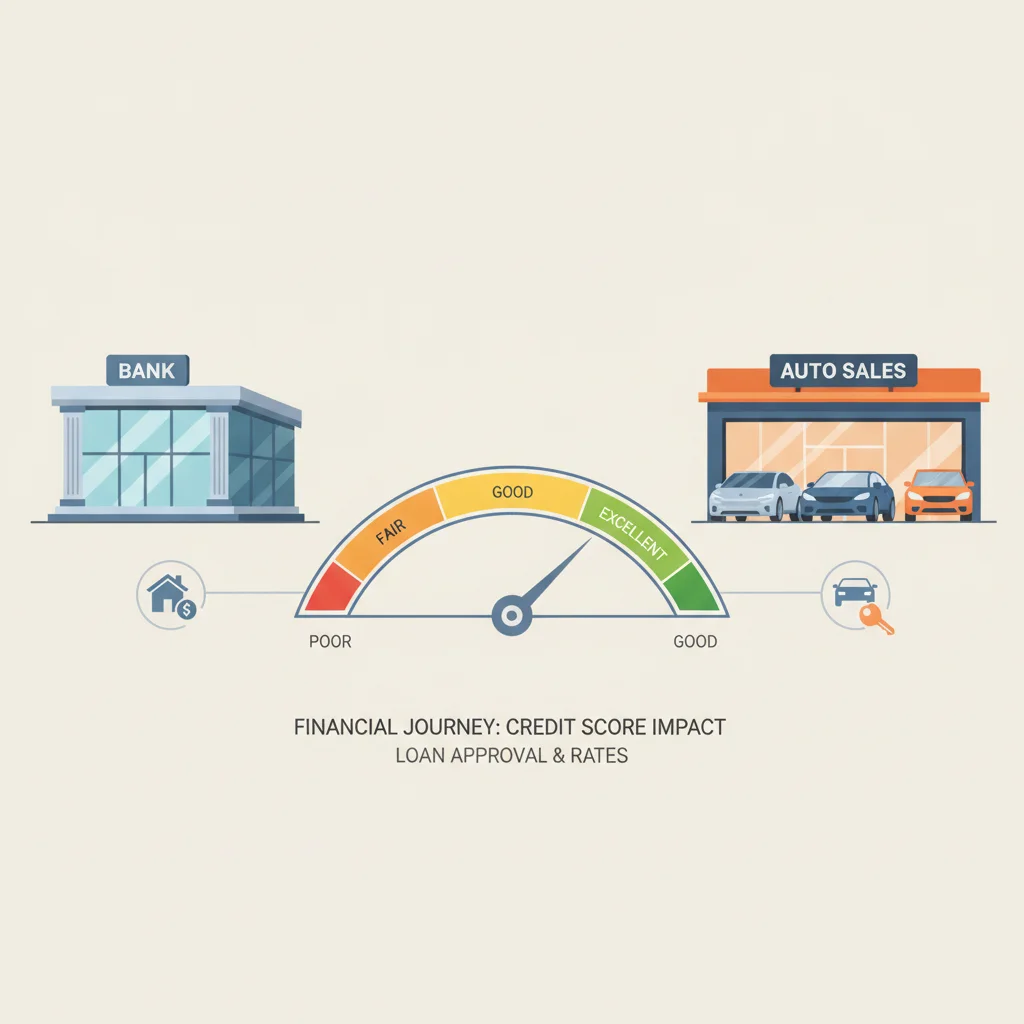
Most buyers think of financing as a single process with two starting points. It's not. Dealer financing and bank financing are fundamentally different pipelines, and your credit score travels through each one differently.
When you walk into a bank or credit union and apply for an auto loan, you get a direct quote. The institution pulls your credit, runs it through their underwriting criteria, and offers you a rate. That rate is what it is — there's no middleman taking a cut.
Dealer financing works on a different model entirely. The dealer doesn't lend you money. Instead, the F&I (Finance & Insurance) office submits your application to one or more wholesale lenders — banks, captive finance arms like Toyota Financial or Ford Motor Credit, or credit companies. Those lenders respond with a buy rate: the minimum rate they'll accept for your profile. The dealer is then allowed to mark that rate up — typically by 1 to 3 percentage points — and keep the difference as profit. This markup is called the dealer reserve.
So if a lender offers a buy rate of 5.9% on your profile, the dealer might quote you 7.9% and pocket the spread on every monthly payment over the loan term. You'd never know the buy rate unless the dealer volunteered it — which they won't.
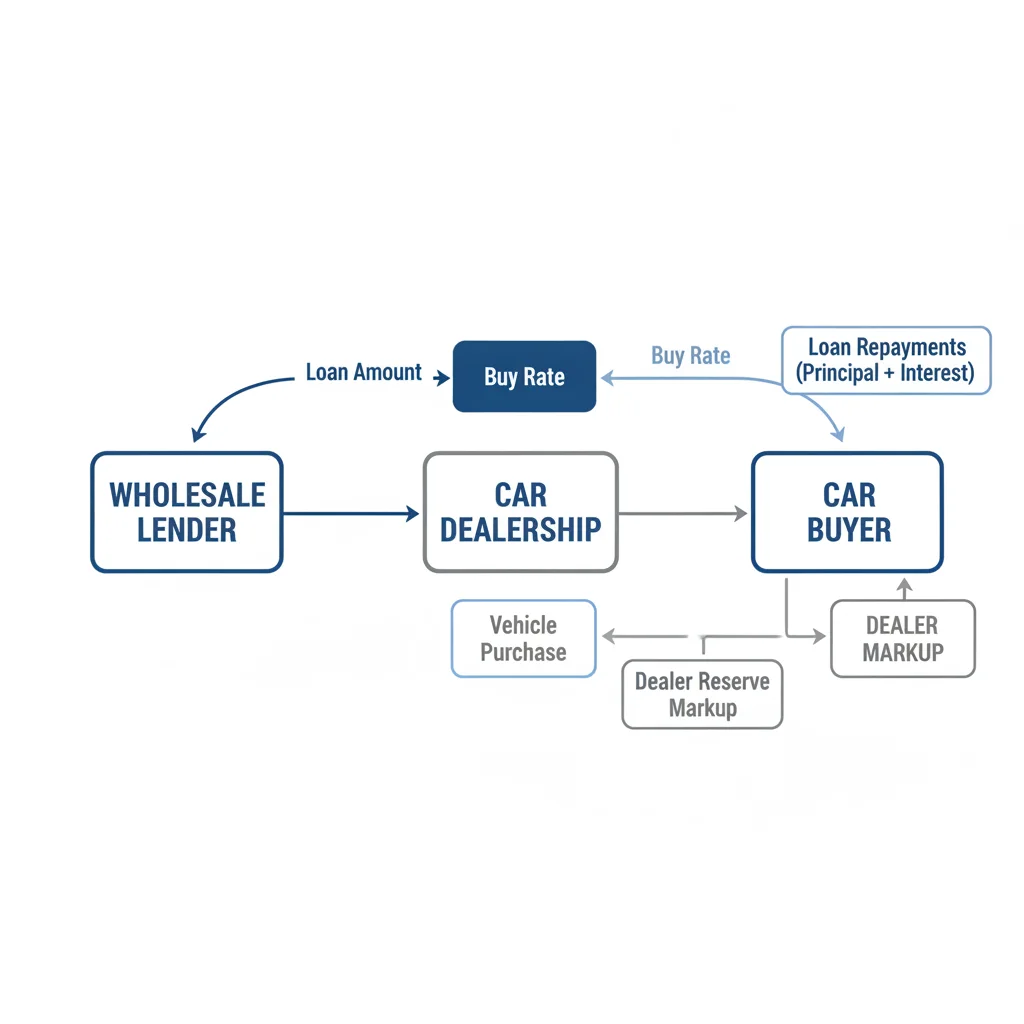
This is the core structural difference. Banks give you a retail rate directly. Dealers give you a marked-up wholesale rate — unless you negotiate, or unless the manufacturer is subsidizing the rate to move inventory.
Understanding this pipeline is what makes evaluating dealer financing against your bank offer something you can actually do with real numbers instead of guesswork.
Why the Same Credit Score Produces Different Results
Here's something most buyers don't realize until after they've signed: your credit score doesn't just determine your rate — it determines which lenders will even look at your application, and that varies between channels.
The Score Banks Use vs. the Score Dealers Use
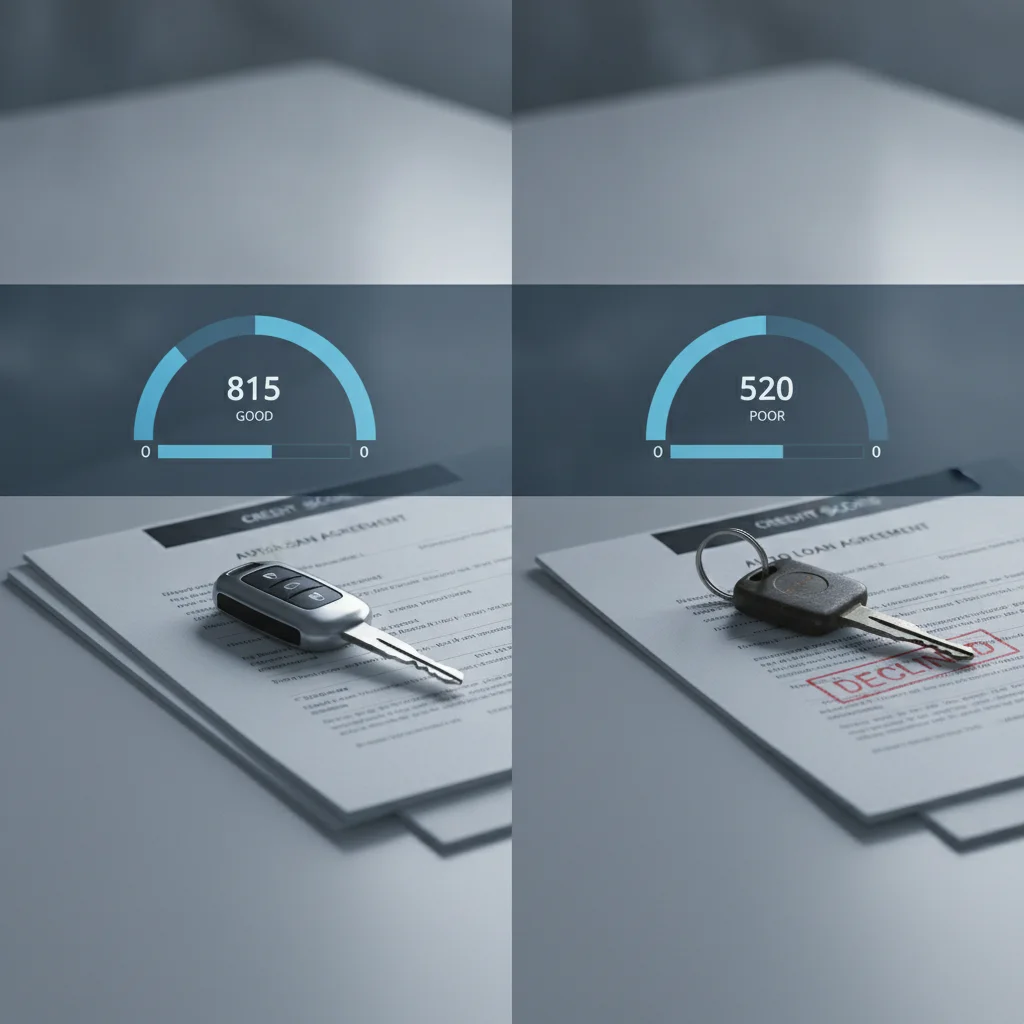
Most banks pull a standard FICO Score 8 or a VantageScore equivalent. Dealers and their lender networks most commonly pull a FICO Auto Score — a specialized scoring model that weights your history of auto loan repayment much more heavily than general credit behavior. If you've had a car loan before and paid it well, your FICO Auto Score may be meaningfully higher than your standard score. If you had a repossession years ago, it may be significantly lower.
This means your score at the dealership and your score at the bank are often different numbers — sometimes by 20 to 40 points in either direction. The auto-specific FICO Score works very differently from the one you check online, and understanding that gap can prevent a nasty surprise at the dealer.
| Criterion | Bank / Credit Union | Dealer Financing | |
|---|---|---|---|
| Rate structure | Direct retail rate quoted to you | Buy rate plus dealer markup (reserve) | |
| Score model used | Standard FICO 8 or VantageScore | FICO Auto Score (industry-specific) | |
| Transparency | High — rate is the rate | Low — buy rate not disclosed | |
| Best credit tier performance | Super prime (760+) and prime (700–759) | Near prime (650–699) via lender network | |
| Promotional rate access | None — standard rates only | Manufacturer 0%–2.9% APR offers available | |
| Approval speed | 24–48 hours (pre-approval) | 20–60 minutes at signing | |
| Subprime options | Limited; many decline below 640 | Broader network including subprime lenders | |
| Negotiability | Rate is fixed by underwriting | Dealer can sometimes reduce markup to close deal |
Lender Access and Volume Discounts
A high-volume dealership might send 500 loans per month to a given lender. That volume earns preferential buy rates that you, as an individual walking into a branch, cannot get. On the flip side, your personal credit union has underwriting criteria that may be far more favorable for your specific profile — particularly if you're a long-standing member with deposit accounts.
The practical upshot: a score of 650 might get you a 12% rate at your bank but a 9.5% dealer buy rate (before markup) because the dealer's lender specializes in that credit tier. Or the reverse — a score of 750 might get you 5.2% at your credit union but 6.8% marked up at the dealer. There is no universal answer. You have to get both numbers and compare them directly.
1–3%
Typical dealer markup above buy rate
The Consumer Financial Protection Bureau has documented dealer reserve markups typically ranging from 1 to 3 percentage points above the lender's buy rate.
$1,400+
Extra interest cost from a 1.5-point rate markup
On a $35,000 60-month auto loan, a 1.5 percentage point rate difference adds approximately $1,400 in total interest paid over the loan term.
740+
Score typically required for 0% promotional financing
Most manufacturer captive finance arms require a minimum FICO score of 740 or higher to qualify for advertised 0% APR promotional offers.
45 days
Rate-shopping window for auto loan inquiries
FICO's scoring model consolidates multiple auto loan hard inquiries made within a 45-day window into a single inquiry for scoring purposes.
Credit Score Ranges and What to Expect from Each Channel
Let's get specific. These are approximate rate ranges based on typical market conditions for a 60-month new car loan. Actual rates vary by lender, region, loan amount, and vehicle type — but these figures give you a realistic benchmark to pressure-test any offer you receive.
Super Prime (760+)
At this level, banks and credit unions compete aggressively for your business. You'll see rates near or at their floor — often 5% to 6.5% in a moderate-rate environment. Dealer buy rates will be similarly low, but the markup potential means your dealer quote might come in 1 to 2 points higher than your bank pre-approval. Always lead with your bank offer at this score tier. The dealer will often match or beat it to keep the deal in-house, or the manufacturer's captive lender may offer a promotional rate that undercuts everyone.
Prime (700–759)
You'll qualify for competitive rates at both banks and dealers, but the gap between the two channels starts to matter more. Banks quote you directly; the dealer's markup becomes real money. On a $35,000, 60-month loan, a 1.5-point rate difference costs you roughly $1,400 over the loan term. At this score range, a pre-approval from a bank or credit union is essential — use it as a ceiling, not a fallback.
Near Prime (650–699)
This is where channel selection genuinely changes outcomes. Banks get conservative at this range — many won't go below 8% to 10% for a direct borrower. But dealers with relationships to subprime-specialized lenders may access buy rates of 7% to 9% for the same profile. The markup still exists, but the dealer's baseline can be lower than what you'd get at the bank counter. Used car loans in this credit range can carry rates several points higher than new car loans, which amplifies the importance of channel selection.
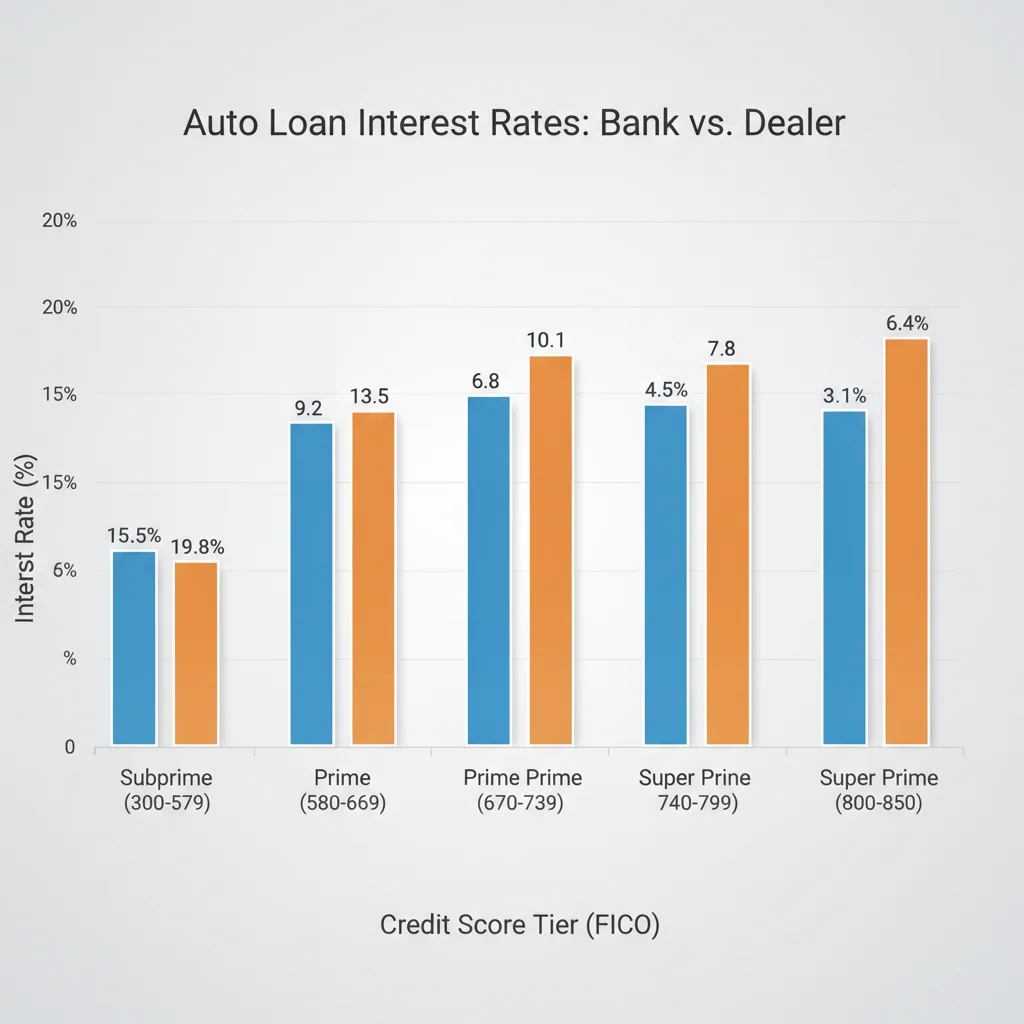
Subprime (580–649)
Most traditional banks will decline outright or offer rates above 15%. Dealers who work with specialized subprime lenders can often secure approvals — sometimes at rates between 12% and 18%, which is painful but may be the only viable path to an approval at all. The tradeoff: dealer markups in this tier are often at their maximum, and loan terms may be extended to 72 or 84 months to lower the monthly payment while dramatically increasing total interest cost.
Deep Subprime (Below 580)
At this level, expect very limited bank options and heavy reliance on buy-here, pay-here dealers or high-risk lenders accessed through franchise dealers. Rates above 20% are common. The vehicle selection may also be constrained by lender loan-to-value requirements. If you're here, rebuilding credit before purchasing is worth serious consideration — even 6 months of on-time payments can move a score enough to change your tier.
Check Your FICO Auto Score Before Shopping
Before applying anywhere, pull your FICO Auto Score — not just your standard FICO 8. Experian sells access to FICO Auto Scores directly, and some credit monitoring services include them. If your auto score is significantly higher than your general score, you may qualify for better dealer financing than you'd expect. If it's lower, a bank that uses standard FICO may actually be your better channel.
Time Your Applications in One Window
Apply to all banks and credit unions within a 14-day window to ensure FICO consolidates the inquiries. Most lenders consider a 30- to 45-day window, but 14 days is the safest bet across all scoring models. Front-load your rate shopping before you've found the specific vehicle — pre-approvals are typically valid for 30 to 60 days.
The Pre-Approval Strategy: How to Use Both Channels
The smartest play — regardless of your credit score — is to approach both channels before you set foot in a dealership. Here's why: a pre-approval from a bank or credit union gives you a concrete number to work against. It transforms the dealer's financing pitch from a black box into a negotiation.
When the F&I manager asks how you're planning to pay, say you have a pre-approval and mention the rate. One of two things happens: they beat it (good), or they can't (also good — you use your pre-approval). Either way, you win. The mistake buyers make is walking in without a reference rate and accepting whatever number the F&I office produces.
Getting pre-approved also limits the credit score damage of rate shopping. FICO's scoring model treats multiple auto loan inquiries within a 14- to 45-day window as a single inquiry. So applying to three banks and two credit unions in two weeks costs you the same credit score impact as one application. Use that window.
Never Reveal Your Pre-Approval Rate First
If you disclose your bank pre-approval rate the moment you sit down in the F&I office, the dealer has no incentive to search for a lower buy rate in their lender network. Let them run your credit and present their number first. Then, if their rate is higher, introduce your pre-approval. This sequence consistently produces better outcomes than leading with your number.
Spot Delivery Risk Is Real for Non-Prime Buyers
If your credit score is below 680, be especially cautious about driving a vehicle off the lot before the loan is fully funded and the contract is finalized. 'Conditional delivery' means the financing isn't locked — the dealer can call you back days later demanding a higher rate or larger down payment. Don't take the keys until you have a fully executed, rate-locked contract in hand.
One tactical note: don't tell the dealer your pre-approval rate immediately. Let them submit your application to their lenders first and come back with their number. If their number is better, take it. If it's worse, reveal your pre-approval and negotiate. Showing your hand too early eliminates the dealer's incentive to find you the best buy rate in their network.
After closing, the story isn't necessarily over. Refinancing with a bank or credit union after buying is a legitimate strategy — particularly if you took dealer financing quickly, your score has improved since purchase, or rates have dropped. Many buyers who accepted a 9% dealer rate at signing have refinanced to 6.5% within 12 months by simply applying to a credit union.
Manufacturer Promotions: The Exception That Changes Everything
There's one scenario where dealer financing almost always wins outright: manufacturer-subsidized promotional rates. These are the 0%, 1.9%, or 2.9% APR offers you see advertised on new vehicles. They're funded by the manufacturer's captive finance arm (e.g., Honda Financial Services, GM Financial) as an incentive to move specific models.
At these rates, no bank or credit union can compete. A 0% loan on a $40,000 vehicle over 60 months saves you approximately $6,400 compared to a 6% loan. That's not marginal — it's a major financial advantage.
The catch: promotional rates almost universally require a credit score of 740 or above, and they may require accepting the promotional financing instead of a cash rebate. On some vehicles, the cash rebate is worth more than the interest savings depending on your alternative financing rate — so do the math both ways before assuming the 0% offer is the better deal.

Also worth knowing: two buyers sitting across the same desk can receive very different rates on the same vehicle — the promotional rate you saw advertised may only apply to specific trim levels, model years, or credit tiers. Always ask which specific vehicles qualify before you fall in love with one.
Common Dealer Financing Tactics to Watch For
Knowing the structural mechanics of dealer financing means you can spot the moves that cost buyers real money.
Payment Packing
The F&I manager quotes you a monthly payment rather than a rate. Then they quietly extend the loan term or add products (extended warranties, GAP insurance, paint protection) to hit that payment while increasing your total cost. Always negotiate based on the total loan amount and APR — never on the monthly payment alone.
Rate Inflation on Trade-Ins
Some F&I offices use the rate markup to subsidize what appears to be a generous trade-in offer. They give you $1,000 more on your trade and $1,500 more in interest over the loan term. The trade-in appraisal process and the financing terms need to be negotiated as completely separate transactions.
Spot Delivery (Yo-Yo Financing)
You drive off the lot believing you have a loan, then get a call a week later saying the financing fell through and you need to come back and sign at a higher rate. This is most common for near-prime and subprime buyers. If the loan isn't fully approved before you leave the lot, you're exposed to this tactic. Insist on a fully executed contract with a locked rate before taking delivery.
Never Reveal Your Pre-Approval Rate First
If you disclose your bank pre-approval rate the moment you sit down in the F&I office, the dealer has no incentive to search for a lower buy rate in their lender network. Let them run your credit and present their number first. Then, if their rate is higher, introduce your pre-approval. This sequence consistently produces better outcomes than leading with your number.
Spot Delivery Risk Is Real for Non-Prime Buyers
If your credit score is below 680, be especially cautious about driving a vehicle off the lot before the loan is fully funded and the contract is finalized. 'Conditional delivery' means the financing isn't locked — the dealer can call you back days later demanding a higher rate or larger down payment. Don't take the keys until you have a fully executed, rate-locked contract in hand.
Misleading APR Comparisons
Dealers sometimes present dealer financing at a rate that looks close to your bank pre-approval but is structured over a longer term, making the total interest cost substantially higher. A 6.5% rate over 72 months costs significantly more than a 6.8% rate over 48 months on the same principal. Compare total interest paid, not just APR.
Credit Unions: The Often-Overlooked Middle Option
Between the dealer and the big bank sits a financing channel most buyers underuse: credit unions. Credit unions are member-owned, non-profit institutions, and their auto loan rates consistently undercut traditional banks by 0.5% to 1.5% on average — sometimes more.
If you're a member of a credit union (or can join one — many are open to geographic regions, employers, or family members), apply there first. They tend to be more flexible on near-prime profiles than banks, they don't have a dealer reserve structure, and they often offer relationship-based underwriting that considers your full financial picture rather than just your score.
The downside: credit unions may not offer the same speed as dealer financing. Dealer approvals can happen in 20 minutes; a credit union may take 24 to 48 hours. If you're buying on a tight timeline, plan ahead and get the pre-approval before you start shopping.

Some credit unions also participate in dealer indirect lending programs — meaning the dealer can submit your application to a partner credit union just like they would to a bank. Ask the F&I manager if they work with any credit unions in their lender pool. If so, the buy rate from that credit union may beat anything else in the mix.
For buyers focused on maximizing their negotiating position at the dealership, walking in with a credit union pre-approval is one of the most concrete advantages you can create before you arrive.
All claims are backed by peer-reviewed research. Sources on request.