
Key Takeaways
Option A
Dealer Financing
The all-in-one convenience option with a hidden markup.
Best for: Buyers who need fast approval and have few outside lender options, especially those with very poor credit or recent derogatory marks.
Option B
Direct Lending
The lower-cost path that requires more legwork upfront.
Best for: Borrowers who can qualify at a bank, credit union, or online lender and want to enter the dealership with negotiating leverage.
If you have very poor credit (below 580) and no preapproval options
Dealer Financing
Dealers have relationships with subprime lenders you may not be able to access directly. It's not the cheapest path, but it may be the only one available to get you into a car quickly.
If you can qualify at a credit union or online subprime lender
Direct Lending
Cutting out the dealer markup — often 1–3 percentage points — directly reduces your interest costs. Even a modest rate improvement adds up significantly on a multi-year loan.
If you want to negotiate the best possible deal at the dealership
Direct Lending
A preapproval letter sets a rate ceiling and shifts negotiating power to you. You can accept dealer financing only if it genuinely beats your outside offer.
If speed and simplicity matter more than cost
Dealer Financing
Dealer financing requires no separate application process — everything happens in the F&I office in one visit, which is valuable if your situation demands a fast resolution.
If your credit is in the 580–660 range and improving
Direct Lending
In this range, credit unions and online subprime lenders often compete meaningfully. Secure a preapproval first, then compare it honestly against any dealer offer.
The Core Difference: Who Is Actually Lending You the Money
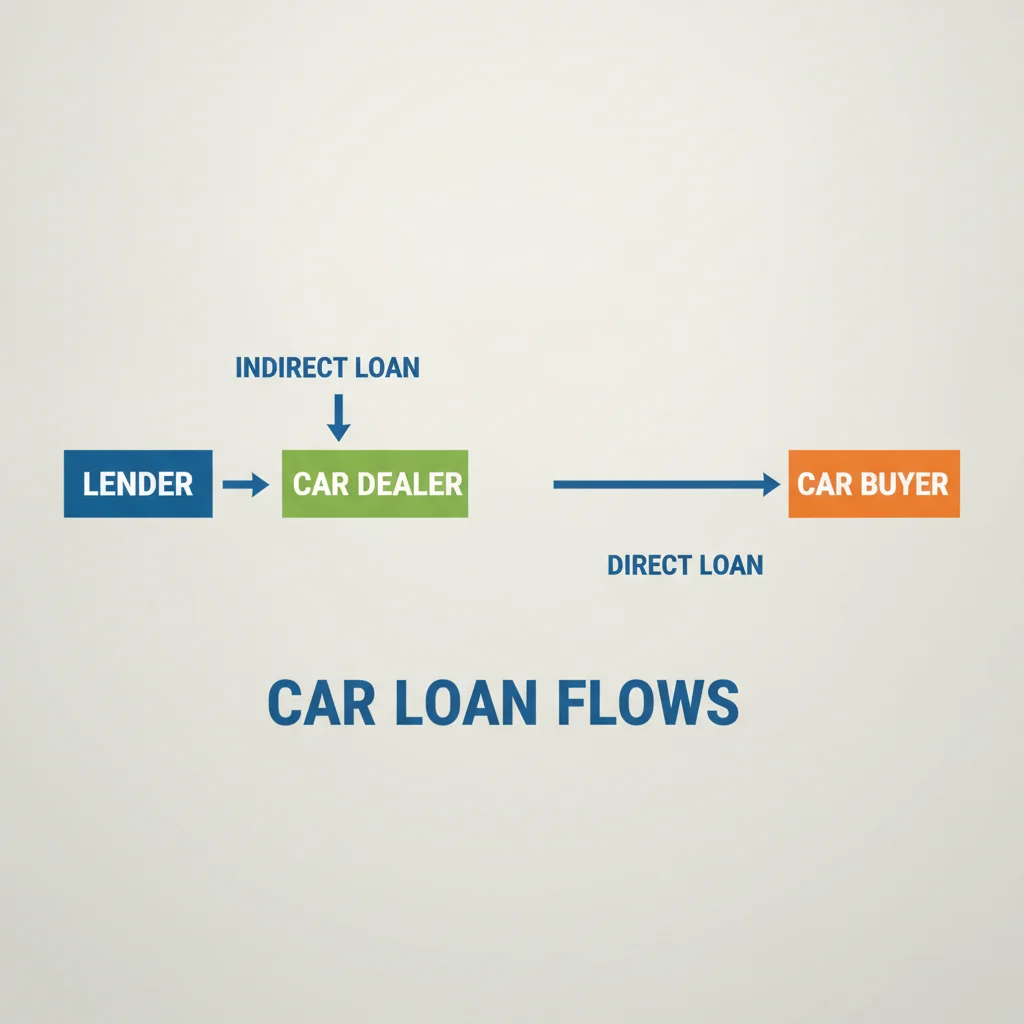
When most people talk about getting a car loan at the dealership, they assume the dealer is the lender. In most cases, that's not what's happening. The dealer is acting as a loan broker — they submit your application to one or more wholesale lenders (banks, captive finance arms, or subprime specialists), get a rate back, and then present you with a rate that's usually higher than what the lender actually quoted.
The gap between those two numbers is called the dealer reserve, and it's legal in every U.S. state. It's how the finance and insurance (F&I) department makes money on your loan. On a subprime loan, where rates are already high, a 2–3 percentage point markup on top of an already-elevated rate can add hundreds of dollars to your total repayment.
Direct lending eliminates this step entirely. You apply with a bank, credit union, or online lender yourself. If approved, they hand you a check or a preapproval letter. You bring that to the dealership and buy the car as a near-cash buyer. The lender keeps all the interest — no middleman takes a cut.
For borrowers with good credit, the dealer reserve is annoying but often negotiable. For borrowers with poor credit, the stakes are higher: your rate is already elevated, you have less room to negotiate, and the absolute dollar cost of that markup is proportionally larger. Understanding this structure is the first step to making a smarter borrowing decision.
See our guide to how credit scores affect loan rates to understand exactly how lenders price risk — and why subprime borrowers face steeper markups.
How Each Option Works in Practice for Subprime Borrowers
Let's walk through what each path actually looks like when your credit score is below 620.
Dealer Financing: The Process
You walk into a dealership, fall in love with a vehicle, and head to the F&I office. The finance manager collects your information, runs your credit, and submits your profile to a network of lenders. Within minutes — or, in some cases, a couple of hours — they come back with terms.
What you often don't see: the lender may have approved you at 14% APR, but the dealer presents you with 16.5% because that 2.5-point spread is profit for the dealer. You're not told the buy rate. You're just told, "We got you approved at 16.5%." For a borrower with limited options, that feels like a relief rather than a negotiation.
The Buy Here Pay Here model takes this further — here, the dealer is the lender, often charging 20–25% APR with no credit reporting and frequent repossessions. It's a last resort, not a first option.
Direct Lending: The Process
You apply before you visit any dealership. Your options as a subprime borrower include:
- Credit unions: Member-owned institutions that often have more flexibility than banks on credit decisions. Many have specific programs for borrowers rebuilding credit.
- Online subprime lenders: Companies like Capital One Auto Finance, Westlake Financial, or DriveTime specialize in below-prime borrowers. Approval decisions are fast, sometimes within minutes.
- Community banks: Less common, but some smaller banks maintain manual underwriting that weighs factors beyond your score.
If approved, you receive a preapproval letter — typically valid for 30–45 days — specifying a maximum loan amount and your rate. You bring that to the dealership. The dealer knows you have financing in place, which changes the entire dynamic of the negotiation.
| Criterion | Dealer Financing | Direct Lending |
|---|---|---|
| Who lends the money | Wholesale lender (bank/subprime specialist), arranged by dealer | Bank, credit union, or online lender — directly |
| Interest rate markup | Dealer adds 1–3% above buy rate | No markup — you get the lender's actual rate |
| Speed of approval | Same day, often within hours | Minutes to a few business days |
| Credit flexibility | Higher — dealers access niche subprime lenders | Lower — many direct lenders avoid deep subprime |
| Negotiating position | Weaker — you're dependent on dealer's lender network | Stronger — preapproval sets a rate ceiling |
| Transparency | Low — buy rate is not disclosed | High — you see exactly what the lender charges |
| Vehicle selection | Limited to dealer's inventory | Shop any dealership or private seller |
| Typical APR range (subprime) | 15–25%+ depending on credit tier | 12–22% depending on lender and credit tier |
For a detailed comparison of how subprime-specialized online lenders compare to traditional bank financing, see our article Online Subprime Lenders vs. Traditional Bank Financing.
The Real Cost of the Dealer Markup
Numbers make this concrete. Suppose you're financing $18,000 over 60 months.
- At 14% APR (what the lender actually approved): Your monthly payment is approximately $419, and total interest paid is roughly $7,140.
- At 16.5% APR (what the dealer presents): Your monthly payment rises to about $444, and total interest paid climbs to approximately $8,640.
That's a $1,500 difference over the loan term — just from the dealer reserve. On a loan where your rate is already elevated due to poor credit, this markup compounds a situation that's already expensive.
1–3%
Typical dealer interest rate markup
The Consumer Financial Protection Bureau has documented that dealer reserve markups typically range from 1 to 3 percentage points above the lender's approved buy rate.
$1,500+
Extra interest from a 2.5% markup on $18K loan
On an $18,000 subprime loan over 60 months, a 2.5 percentage point dealer markup adds approximately $1,500 in total interest compared to borrowing at the lender's direct rate.
38%
Subprime share of U.S. auto loan originations
According to Experian's State of the Automotive Finance Market report, borrowers with credit scores below 660 represent a significant and persistent share of all new auto loan originations.
14-day
Rate-shopping window for credit inquiries
FICO scoring models treat all auto loan hard inquiries made within a 14-day window as a single inquiry, allowing borrowers to shop multiple lenders without compounding credit score damage.
12–18 months
Typical window to qualify for refinancing
Most financial advisors recommend subprime borrowers wait at least 12–18 months of on-time payments before applying to refinance, as that track record meaningfully improves approval odds and rates.
The practical takeaway: even if you can't qualify for a direct loan on your own, knowing that a markup exists gives you a tool. Ask the dealer what the buy rate is. Many will decline to share it, but some will negotiate the spread when pushed — especially if you can show them a competing offer.
Understanding the full pros and cons of dealer-arranged financing helps you weigh whether convenience is worth the added cost in your specific situation.
What Is the 'Buy Rate' and Can You Ask for It?
The buy rate is the interest rate the wholesale lender actually approves you for — before the dealer adds their markup. Dealers are not legally required to disclose it. However, asking directly sometimes prompts a negotiation. Try: "What rate did the lender approve me at, before your markup?" Even if they won't share the number, signaling that you know the markup exists can sometimes prompt a reduction. Having an outside preapproval makes this conversation far easier.
Prepayment Penalties and Refinancing Timing
Some subprime auto loans — particularly those arranged through specialty wholesale lenders — include prepayment penalty clauses. If you pay off or refinance the loan early, you may owe additional fees. Before committing to any loan, ask directly whether prepayment penalties apply and how they're calculated. This is especially important if your plan is to refinance within the first 12–18 months after improving your credit score.
When Dealer Financing Makes Sense (Even for Bad Credit)
Direct lending is theoretically better, but "theoretically" doesn't help you if no direct lender will approve you. Here's when dealer financing is genuinely the right call:
You Can't Get a Direct Approval
Some borrowers — those with scores below 560, recent bankruptcies, or multiple repossessions — will simply be declined by most direct lenders. Dealerships that specialize in subprime financing (often advertising "bad credit, no problem") maintain relationships with wholesale lenders that specifically underwrite high-risk auto loans. These lenders don't take direct applications. The dealer is your only access point.
You Need the Car Immediately
Preapproval shopping takes time — at minimum a few days, sometimes longer if your profile requires more documentation. If your current vehicle just failed and you need transportation to keep your job, the dealership's one-stop-shop model has genuine value. Paying somewhat more in interest is a real cost, but it may be the right trade-off in a genuine emergency.
Manufacturer Incentive Rates Are Available
This is rare for subprime borrowers, but some captive finance arms (Toyota Financial, Ford Motor Credit) occasionally run incentive programs that apply to buyers with credit scores slightly below prime. Ask the dealer explicitly whether any subsidized rates apply to your tier — you may be surprised.

For more nuance on exactly when dealer financing wins and when it doesn't, the article When Dealer Financing Beats Your Bank — and When It Doesn't walks through specific scenarios side by side.
Building Your Strategy: Preapproval as a Lever
The most powerful position for any car buyer — especially one with poor credit — is walking into a dealership with a preapproval in hand. It changes the entire negotiation dynamic in two concrete ways:
- It sets a rate ceiling. You know the worst rate you'll pay. If the dealer beats it, great. If they can't, you use your preapproval. Either way, you win.
- It separates the car deal from the financing deal. Dealers often blur these together, using favorable loan terms to obscure an inflated vehicle price or vice versa. With separate financing secured, you negotiate the car price on its own merits.
Getting preapproved with bad credit requires targeting the right lenders. Start with any credit union you're eligible to join — many have looser membership requirements than you'd expect. Then check online subprime lenders. The Loan Preapproval hub covers the full process of getting preapproved and what documentation you'll need.
When applying to multiple lenders, do it within a 14-day window. Credit bureaus treat all auto loan inquiries within that window as a single inquiry for scoring purposes, minimizing the impact on your credit score.
Once you have a preapproval, bring it to the dealership — but don't reveal it immediately. Let them present their financing first. If their rate is lower than your preapproval, accept it. If it's not, pull out your letter. You're no longer a captive borrower; you're a buyer with options.
For a direct comparison of how outside preapprovals stack up against dealer-arranged loans, see Dealer Financing vs. Outside Preapproval: Which Puts More Money in Your Pocket.

After the Loan: Refinancing as a Second Chance
If you accepted dealer financing because you had no other choice — which is common — that doesn't have to be your permanent situation. Auto loan refinancing lets you replace your existing loan with a new one, ideally at a lower rate, after your credit profile has improved.
Most subprime borrowers see meaningful credit score improvement within 12–18 months of on-time payments. A jump from 560 to 620 can make the difference between qualifying for a prime loan and being stuck in subprime territory indefinitely.
Here's the refinancing play: take the dealer loan now to get the car. Make every payment on time. In 12 months, apply to refinance with a credit union or bank. If your score has improved enough, you may qualify for a rate that's 3–5 points lower, which translates to real monthly savings and lower total interest paid.
Dealership Financing vs. Refinancing with a Bank or Credit Union walks through exactly when it makes sense to refinance and how to evaluate whether the math works in your favor.
One caution: some subprime auto loans include prepayment penalties or are structured so that interest is front-loaded. Read your loan agreement carefully before assuming refinancing will save money — the savings are real in most cases, but the timing and terms matter.
If you're exploring which lenders to approach for a refinance or a first loan, the comparison in Subprime Auto Lenders vs. Credit Unions: Who Should You Apply to First? will help you prioritize your applications strategically.
What Is the 'Buy Rate' and Can You Ask for It?
The buy rate is the interest rate the wholesale lender actually approves you for — before the dealer adds their markup. Dealers are not legally required to disclose it. However, asking directly sometimes prompts a negotiation. Try: "What rate did the lender approve me at, before your markup?" Even if they won't share the number, signaling that you know the markup exists can sometimes prompt a reduction. Having an outside preapproval makes this conversation far easier.
Prepayment Penalties and Refinancing Timing
Some subprime auto loans — particularly those arranged through specialty wholesale lenders — include prepayment penalty clauses. If you pay off or refinance the loan early, you may owe additional fees. Before committing to any loan, ask directly whether prepayment penalties apply and how they're calculated. This is especially important if your plan is to refinance within the first 12–18 months after improving your credit score.

All claims are backed by peer-reviewed research. Sources on request.