

Key Takeaways
When emailing dealers for quotes, send all emails on the same day and reference that you're collecting competing bids. Mention a specific purchase date within the next 7 days — dealers respond very differently to a buyer who's ready versus one who's browsing.
Dealers prioritize leads with purchase intent. Scarcity of your timeline combined with competitor pressure is the fastest way to get a real number instead of a follow-up call.
Never give the salesperson your driver's license before you're ready to buy. Dealers run a soft or hard credit pull the moment they have your information, and that pull anchors the financing conversation before you've agreed on price.
A credit inquiry before deal terms are set gives the finance office information about your borrowing profile that they can use to calibrate offers — information asymmetry that works against you.
Ask the F&I manager: 'What is the buy rate on this loan?' They may not answer, but if they do, any rate above that is dealer markup you're paying out of pocket.
The buy rate is the lender's actual approved rate. The spread between that and what the dealer quotes you is pure dealer profit — knowing to ask for it signals you understand how the process works.
If you want an extended warranty, don't buy it at signing. You can typically purchase a manufacturer-backed extended warranty at any point while the factory warranty is still active — often at a lower price after the initial purchase pressure is gone.
Extended warranty upsell is highest-pressure at the point of sale. The same product is often available later with less urgency-driven pricing, and you'll have time to compare third-party warranty providers.
Visit the dealership on the last two to three business days of the month. Salespeople and sales managers are closest to quota pressure at that point, and real discounts appear that wouldn't exist on the 5th of the month.
Automotive sales compensation is heavily structured around monthly targets. End-of-month timing is one of the few factors entirely in the buyer's control that has a documented effect on deal quality.
How the Dealership Process Actually Works
Most buyers walk into a dealership thinking they're having a conversation. They're actually moving through a carefully engineered funnel designed to maximize the dealer's gross profit on every variable — price, financing rate, trade-in value, and back-end products. Understanding the anatomy of that funnel is the first step to navigating it on your own terms.
Here's the typical sequence a dealership uses:
- Meet and greet — a salesperson qualifies your intent and budget.
- Vehicle selection — you're shown inventory, often steered toward higher-margin units.
- Demo drive — emotional investment is built before price is ever discussed.
- Desk negotiation — the sales manager gets involved; offers and counteroffers are exchanged.
- Trade-in appraisal — your old vehicle is assessed and a number is introduced into the deal.
- Finance office (F&I) — financing is arranged and add-on products are sold.
- Paperwork and delivery — you sign and take possession of the vehicle.
Each stage is designed to create momentum that makes it psychologically harder to stop and re-evaluate. The antidote is knowing what's coming. If you want a full pre-visit preparation framework, the pre-negotiation checklist covers pricing research, financing groundwork, and trade-in valuation in a step-by-step format.
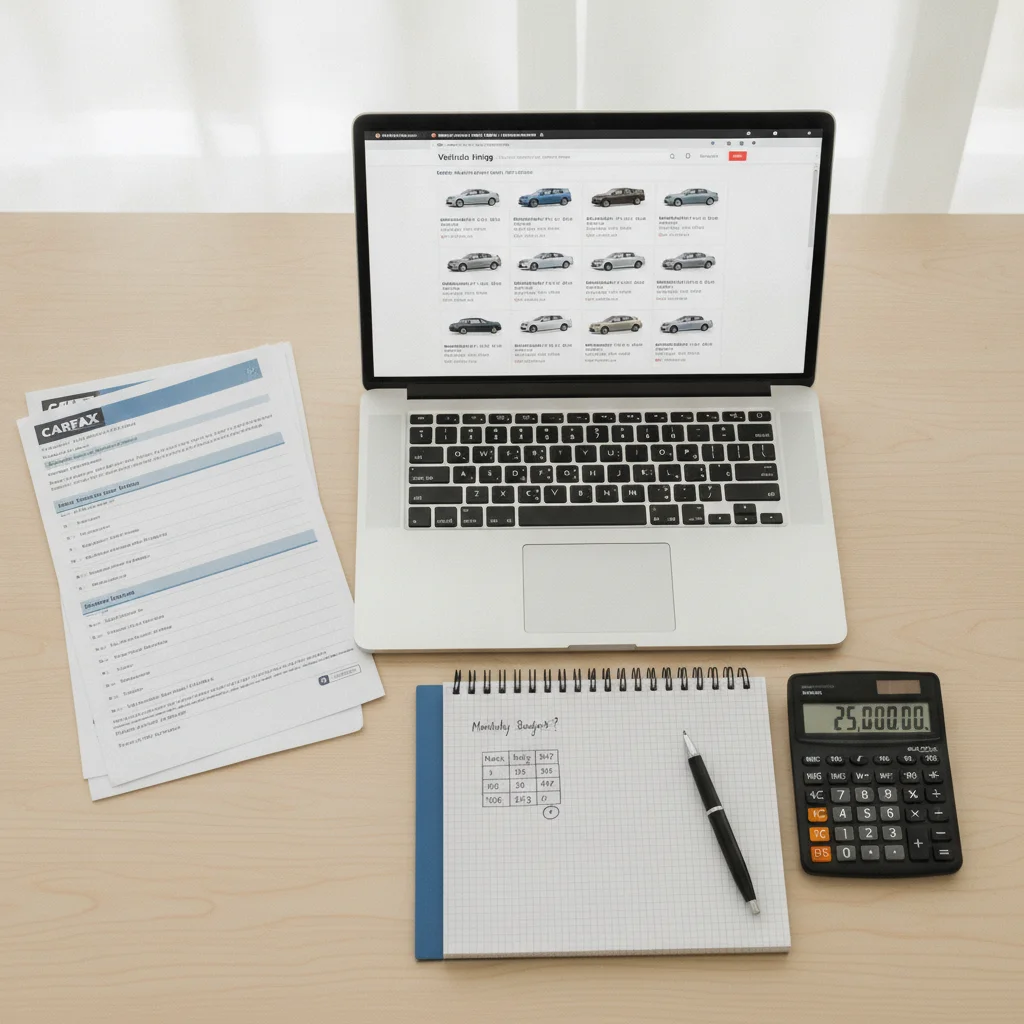
First Contact: Phone, Email, and Online Inquiries
Your negotiation begins before you set foot on the lot. The channel you use for first contact shapes the entire dynamic of the deal.
Email is the strongest opening position
When you email a dealer, you create a written record, give yourself time to think, and remove the social pressure of a live conversation. Lead with a specific vehicle (year, make, model, trim, and color), state that you are a serious buyer ready to purchase within the week, and ask for their best out-the-door price. Use those exact words: out-the-door price. That means the total you pay including taxes, title, registration, and dealer fees — not just the vehicle price.
Contact at least three dealers for the same vehicle. Tell each one you're getting quotes from competitors. This is completely true, puts them in competition for your business, and often produces quotes that are $500–$2,000 lower than any walk-in offer.
When emailing dealers for quotes, send all emails on the same day and reference that you're collecting competing bids. Mention a specific purchase date within the next 7 days — dealers respond very differently to a buyer who's ready versus one who's browsing.
Dealers prioritize leads with purchase intent. Scarcity of your timeline combined with competitor pressure is the fastest way to get a real number instead of a follow-up call.
Never give the salesperson your driver's license before you're ready to buy. Dealers run a soft or hard credit pull the moment they have your information, and that pull anchors the financing conversation before you've agreed on price.
A credit inquiry before deal terms are set gives the finance office information about your borrowing profile that they can use to calibrate offers — information asymmetry that works against you.
Ask the F&I manager: 'What is the buy rate on this loan?' They may not answer, but if they do, any rate above that is dealer markup you're paying out of pocket.
The buy rate is the lender's actual approved rate. The spread between that and what the dealer quotes you is pure dealer profit — knowing to ask for it signals you understand how the process works.
If you want an extended warranty, don't buy it at signing. You can typically purchase a manufacturer-backed extended warranty at any point while the factory warranty is still active — often at a lower price after the initial purchase pressure is gone.
Extended warranty upsell is highest-pressure at the point of sale. The same product is often available later with less urgency-driven pricing, and you'll have time to compare third-party warranty providers.
Visit the dealership on the last two to three business days of the month. Salespeople and sales managers are closest to quota pressure at that point, and real discounts appear that wouldn't exist on the 5th of the month.
Automotive sales compensation is heavily structured around monthly targets. End-of-month timing is one of the few factors entirely in the buyer's control that has a documented effect on deal quality.
Phone calls: useful but manageable
If you call, keep it short. Get a name, confirm the vehicle is in stock, and ask them to email you their best out-the-door price. Don't negotiate on the phone — dealers are better at it than you are, and you have no record of what was said.
Online lead forms
Filling out a dealer's website form immediately flags you as an inbound lead. Expect follow-up calls and emails. Provide a real email address but be selective with your phone number — once a salesperson has your number and a sense of urgency, they have leverage. The full comparison of email vs. in-person negotiation breaks down exactly how each channel affects your final price and what a paper trail is actually worth.
Arriving at the Dealership: The Opening Moves
The moment you park, you're in the dealer's environment. A few early moves protect your position before any numbers are discussed.
Don't reveal your budget
The single most common question a salesperson will ask is some version of: "What are you looking to spend per month?" That question is not friendly small talk — it's designed to anchor the negotiation around a monthly payment, which obscures the total cost of the vehicle and the interest rate you're paying. Your answer every time: "I'm focused on the out-the-door price, not the monthly payment."
Don't mention your trade-in yet
If you have a car to trade, wait until you've agreed on a price for the new vehicle before you introduce it. Dealers blend trade-in value into the overall deal, which makes it easy to give you more for your trade while quietly raising the vehicle price — or vice versa. Separate the transactions.
The demo drive is fine — enjoy it
There is nothing wrong with taking a demo drive and forming an emotional connection with a vehicle. Just recognize that's exactly what the dealer wants, and make sure it doesn't short-circuit your rational evaluation of the numbers. The drive confirms you want this car; it doesn't mean you have to buy it from this dealer at this price today.
Never Negotiate Monthly Payment First
If you anchor to a monthly payment target, the dealer can manipulate the loan term, the rate, or the vehicle price to hit that number while extracting more profit elsewhere. A $450/month payment on a 72-month loan costs you dramatically more than the same monthly payment on a 48-month loan. Always establish the out-the-door price and the APR as separate, fixed variables before payment is calculated.
Watch for Products Added Without Consent
Some dealerships install accessories — window tint, all-weather mats, paint sealant — before you arrive and present the cost as non-negotiable. These items are almost always negotiable, and you are not required to pay for anything you didn't agree to in advance. Scrutinize the buyer's order for any line items that weren't part of your negotiation.
Don't Let the F&I Office Rush You
F&I managers are trained to move through the product presentation quickly, creating a sense that the paperwork needs to be completed immediately. There is no legal reason you cannot pause, ask for time to review a product's terms, or ask for a document to take home overnight. Any dealer who refuses to give you time is a red flag.
Before you arrive, have your homework done. The dealership preparation checklist walks you through every item — from invoice pricing to insurance quotes — so nothing catches you off guard at the desk.
Negotiating the Vehicle Price
This is where most buyers make their biggest mistakes. They either start too high (accepting the sticker price as a reasonable baseline) or they negotiate without knowing what the car actually costs the dealer.
$1,896
Average cost of a 2% dealer rate markup
On a $35,000 loan over 60 months, a 2-percentage-point dealer reserve above the buy rate costs the buyer approximately $1,896 in additional interest over the loan term.
82%
Buyers who don't negotiate vehicle price
According to a 2023 Cox Automotive consumer survey, 82% of car buyers report the purchase process takes longer than expected, and a significant portion accept first or second offers without counter-offering.
$3,000–$5,000
Typical dealer gross on a new car deal
NADA data indicates that the average new vehicle front-end gross profit (before F&I products) ranges from roughly $3,000 to $5,000 per unit, with substantial room for negotiation in most transactions.
2–3%
Dealer holdback as a % of MSRP
Most manufacturers pay dealers a holdback of 2–3% of MSRP after the vehicle is sold, meaning the dealer's true cost is lower than the invoice price buyers typically use as a benchmark.
$420
Average dealer doc fee in the U.S.
The average documentation fee charged by U.S. dealerships was approximately $420 in 2023, though some states cap fees while others allow dealers to set them freely up to $700 or more.
Know your numbers before you sit down
For new cars, look up the dealer invoice price and the manufacturer's suggested retail price (MSRP). The gap between those two numbers is your primary negotiating room, though it's not the whole story — dealers also earn holdback (a manufacturer rebate of typically 2–3% of MSRP paid to the dealer after the sale) and may receive dealer cash incentives that further lower their effective cost.
For used cars, use Carfax Market Value, Kelley Blue Book, and Edmunds True Market Value to establish a realistic range. Cross-reference what similar vehicles are actually listed for — not just what dealers say they're worth.
Start below your target, not at it
If your research says the fair price is $32,500, open at $30,500. This gives you room to concede ground while still landing near your target. Make your opening offer in a matter-of-fact tone — no apology, no hedging. "Based on the invoice price and current market data, I'd like to start at $30,500."
Counter tactics you'll encounter
- The manager disappears — the salesperson takes your offer to the back. This is theater. The manager is calculating how much profit remains, not asking permission.
- The four-square worksheet — a piece of paper divided into four boxes (vehicle price, down payment, trade-in, monthly payment) designed to blur numbers. Focus only on the vehicle price box. Tell them you'll deal with the other variables separately.
- Small concessions with big strings — "We can get to your price if you add the protection package." Decline cleanly: "I'd like to keep the vehicle price separate from add-ons."

If you're comparing a private-party purchase with a dealership deal, the private transaction closing guide gives useful context on how the two processes differ in structure and risk.
Verbal Agreements Mean Nothing — Get It in Writing
If a sales manager verbally agrees to a specific price, a specific trade-in value, or a specific rate, none of it is binding until it appears in the signed contract. Do not allow yourself to be moved to the finance office on the strength of a handshake. Ask for a buyer's order or deal sheet with all agreed numbers before the F&I process begins. Discrepancies between verbal offers and written contracts are a common and costly problem for buyers who don't insist on this step.
Spot Delivery Risk: You May Not Own the Car Yet
Some dealers allow you to take the vehicle home before financing is fully finalized — called a 'spot delivery.' If the financing falls through, they will call and ask you to bring the car back or sign new terms (often worse). Never take delivery of a vehicle until all financing is complete, confirmed in writing, and funded. If a dealer insists on a spot delivery, read the spot delivery agreement extremely carefully before you drive off the lot.
The Trade-In Trap and How to Avoid It
Once you've agreed on a vehicle price, you can introduce your trade-in. By this point, you already have a signed or committed deal on the new car's price — the dealer can't easily take that back to absorb a trade-in loss.
Know your trade-in's value before you arrive
Get offers from at least two of the following before your dealership visit: Carvana, CarMax, Vroom, or a competing dealer. These are real, written offers that give you a floor. A dealer who knows you have a competing offer will appraise your vehicle more aggressively.
What dealers do with your trade
The appraiser will inspect your car and almost always come back with a number that feels low. That number reflects what they think they can make at auction if the vehicle doesn't sell on their lot — it is not a fair retail valuation. When you have competing offers in hand, the conversation changes from "take it or leave it" to "here's what I've been offered — can you match or beat it?"
Trade-In Timing Matters for Taxes
In most states, when you trade in a vehicle at the dealership, the trade-in value is subtracted from the purchase price before sales tax is calculated. This creates a real tax benefit that a private sale doesn't offer. Factor this into your comparison when deciding whether to sell privately or trade in — the math sometimes favors the dealer even if their offer is slightly lower.
Dealer Invoice Is Not the Same as Dealer Cost
Invoice price is a published number that represents what the dealer theoretically paid the manufacturer. But holdback, dealer cash, and factory-to-dealer incentives mean the dealer's actual cost is often several hundred to several thousand dollars below invoice. This is not secret information — it's reported on sites like Edmunds and TrueCar — and it's why negotiating down to invoice is not as aggressive as it sounds.
Electronic Signatures Have Full Legal Weight
Many dealers now use digital signing tablets or DocuSign-style platforms for the paperwork. Electronic signatures are legally binding in all 50 states under the E-SIGN Act. Review documents on-screen with the same rigor you'd apply to paper — and request emailed copies before you leave the lot.
For a complete, phase-by-phase breakdown of the trade-in process — including how to handle the appraisal conversation and what to do if the dealer's offer falls short — see the dealer trade-in playbook. The dealer trade-ins hub also covers how appraisal systems work and what factors dealers weight most heavily.
When emailing dealers for quotes, send all emails on the same day and reference that you're collecting competing bids. Mention a specific purchase date within the next 7 days — dealers respond very differently to a buyer who's ready versus one who's browsing.
Dealers prioritize leads with purchase intent. Scarcity of your timeline combined with competitor pressure is the fastest way to get a real number instead of a follow-up call.
Never give the salesperson your driver's license before you're ready to buy. Dealers run a soft or hard credit pull the moment they have your information, and that pull anchors the financing conversation before you've agreed on price.
A credit inquiry before deal terms are set gives the finance office information about your borrowing profile that they can use to calibrate offers — information asymmetry that works against you.
Ask the F&I manager: 'What is the buy rate on this loan?' They may not answer, but if they do, any rate above that is dealer markup you're paying out of pocket.
The buy rate is the lender's actual approved rate. The spread between that and what the dealer quotes you is pure dealer profit — knowing to ask for it signals you understand how the process works.
If you want an extended warranty, don't buy it at signing. You can typically purchase a manufacturer-backed extended warranty at any point while the factory warranty is still active — often at a lower price after the initial purchase pressure is gone.
Extended warranty upsell is highest-pressure at the point of sale. The same product is often available later with less urgency-driven pricing, and you'll have time to compare third-party warranty providers.
Visit the dealership on the last two to three business days of the month. Salespeople and sales managers are closest to quota pressure at that point, and real discounts appear that wouldn't exist on the 5th of the month.
Automotive sales compensation is heavily structured around monthly targets. End-of-month timing is one of the few factors entirely in the buyer's control that has a documented effect on deal quality.
Financing at the Dealership: The F&I Office
You've agreed on price. You've settled the trade-in. Now you're escorted to the Finance and Insurance (F&I) office — and this is where dealers make some of their largest profits, often invisibly.
How dealer financing actually works
The dealership is not a bank. They submit your credit application to multiple lenders, receive an approval at what's called the buy rate (the lender's actual approved rate), and are allowed to mark that rate up — typically by 1–3 percentage points — and keep the difference. That markup is called the dealer reserve.
On a $35,000 loan over 60 months, a 2-percentage-point rate markup costs you roughly $1,900 in extra interest. You'd never know it happened unless you came in with a competing offer.
Your counter: come in with a pre-approval
Before your dealership visit, get pre-approved at your bank or a credit union. Credit unions in particular consistently offer rates that are 0.5–2% lower than dealer financing for buyers with good credit. Bring that offer to the F&I office. Tell the finance manager you'll use your own financing unless they can beat it. They often can — because now they're competing, not setting the terms unilaterally.
“The best way to negotiate financing at a dealership is to walk in with a better offer in your pocket. When a buyer has a credit union rate to beat, the F&I manager becomes a competitor instead of a vendor — and competitors sharpen their pencils.”
— Jordan Delray, Former dealership finance manager and auto loan specialist
What the F&I office will say
Expect: "Our rates are very competitive today." That may or may not be true. The only way to know is to have a number to compare. With a pre-approval in hand, you have that number. Without one, you're trusting a person whose compensation depends on the rate you accept.
Bring Your Pre-Approval in Writing
Print your bank or credit union pre-approval letter and bring it to the F&I office. Showing it physically — rather than just mentioning you have one — makes the competing offer tangible and harder to dismiss. Dealers are more likely to match or beat a rate they can see.
Use Month-End Timing to Your Advantage
Schedule your dealership visit for the final two or three days of the month when sales teams are pushing to hit quota. Discounts and concessions that don't exist mid-month become very real when a salesperson needs one more deal to hit their bonus tier.
Take a Photo of Every Document You Sign
Before you leave the finance office, photograph every page of every document you signed. Discrepancies between what you signed and what's later processed at the lender level are rare but they do happen, and having a timestamped record protects you.
Add-Ons, Extended Warranties, and the Final Pitch
After financing is settled, the F&I manager will present a menu of products. This is the final profit center, and it can add thousands of dollars to your deal if you're not prepared.
Common add-ons and what they actually cost
| Product | Typical Dealer Price | Actual Cost to Dealer | Worth It? |
|---|---|---|---|
| Extended warranty (VSC) | $1,500–$4,000 | $500–$1,200 | Sometimes — negotiate the price |
| GAP insurance | $500–$900 | $50–$150 | Yes, but buy from your insurer |
| Paint/fabric protection | $300–$800 | $50–$100 | Rarely |
| Tire and wheel protection | $300–$600 | $100–$200 | Situationally |
| Credit life/disability insurance | Varies | High markup | Almost never |
How to handle the menu presentation
The F&I manager is trained to present multiple products quickly, sometimes bundled, sometimes with a monthly payment framing. Slow the process down. Evaluate each product individually. For anything you want, negotiate the price — these products have substantial margins. For GAP insurance, get a quote from your auto insurer first; you can often add it for $30–$50 per year versus hundreds at the dealer.
If you want an extended warranty, ask what the dealer's cost is. They won't always tell you, but the question alone signals that you know how the game works, which changes the dynamic.
Never Negotiate Monthly Payment First
If you anchor to a monthly payment target, the dealer can manipulate the loan term, the rate, or the vehicle price to hit that number while extracting more profit elsewhere. A $450/month payment on a 72-month loan costs you dramatically more than the same monthly payment on a 48-month loan. Always establish the out-the-door price and the APR as separate, fixed variables before payment is calculated.
Watch for Products Added Without Consent
Some dealerships install accessories — window tint, all-weather mats, paint sealant — before you arrive and present the cost as non-negotiable. These items are almost always negotiable, and you are not required to pay for anything you didn't agree to in advance. Scrutinize the buyer's order for any line items that weren't part of your negotiation.
Don't Let the F&I Office Rush You
F&I managers are trained to move through the product presentation quickly, creating a sense that the paperwork needs to be completed immediately. There is no legal reason you cannot pause, ask for time to review a product's terms, or ask for a document to take home overnight. Any dealer who refuses to give you time is a red flag.
When emailing dealers for quotes, send all emails on the same day and reference that you're collecting competing bids. Mention a specific purchase date within the next 7 days — dealers respond very differently to a buyer who's ready versus one who's browsing.
Dealers prioritize leads with purchase intent. Scarcity of your timeline combined with competitor pressure is the fastest way to get a real number instead of a follow-up call.
Never give the salesperson your driver's license before you're ready to buy. Dealers run a soft or hard credit pull the moment they have your information, and that pull anchors the financing conversation before you've agreed on price.
A credit inquiry before deal terms are set gives the finance office information about your borrowing profile that they can use to calibrate offers — information asymmetry that works against you.
Ask the F&I manager: 'What is the buy rate on this loan?' They may not answer, but if they do, any rate above that is dealer markup you're paying out of pocket.
The buy rate is the lender's actual approved rate. The spread between that and what the dealer quotes you is pure dealer profit — knowing to ask for it signals you understand how the process works.
If you want an extended warranty, don't buy it at signing. You can typically purchase a manufacturer-backed extended warranty at any point while the factory warranty is still active — often at a lower price after the initial purchase pressure is gone.
Extended warranty upsell is highest-pressure at the point of sale. The same product is often available later with less urgency-driven pricing, and you'll have time to compare third-party warranty providers.
Visit the dealership on the last two to three business days of the month. Salespeople and sales managers are closest to quota pressure at that point, and real discounts appear that wouldn't exist on the 5th of the month.
Automotive sales compensation is heavily structured around monthly targets. End-of-month timing is one of the few factors entirely in the buyer's control that has a documented effect on deal quality.
Signing the Paperwork: What to Verify Before You Ink
You've reached the finish line — but this is not the moment to relax. The paperwork stage is where verbal agreements can quietly turn into different numbers on a page.
The documents you'll sign
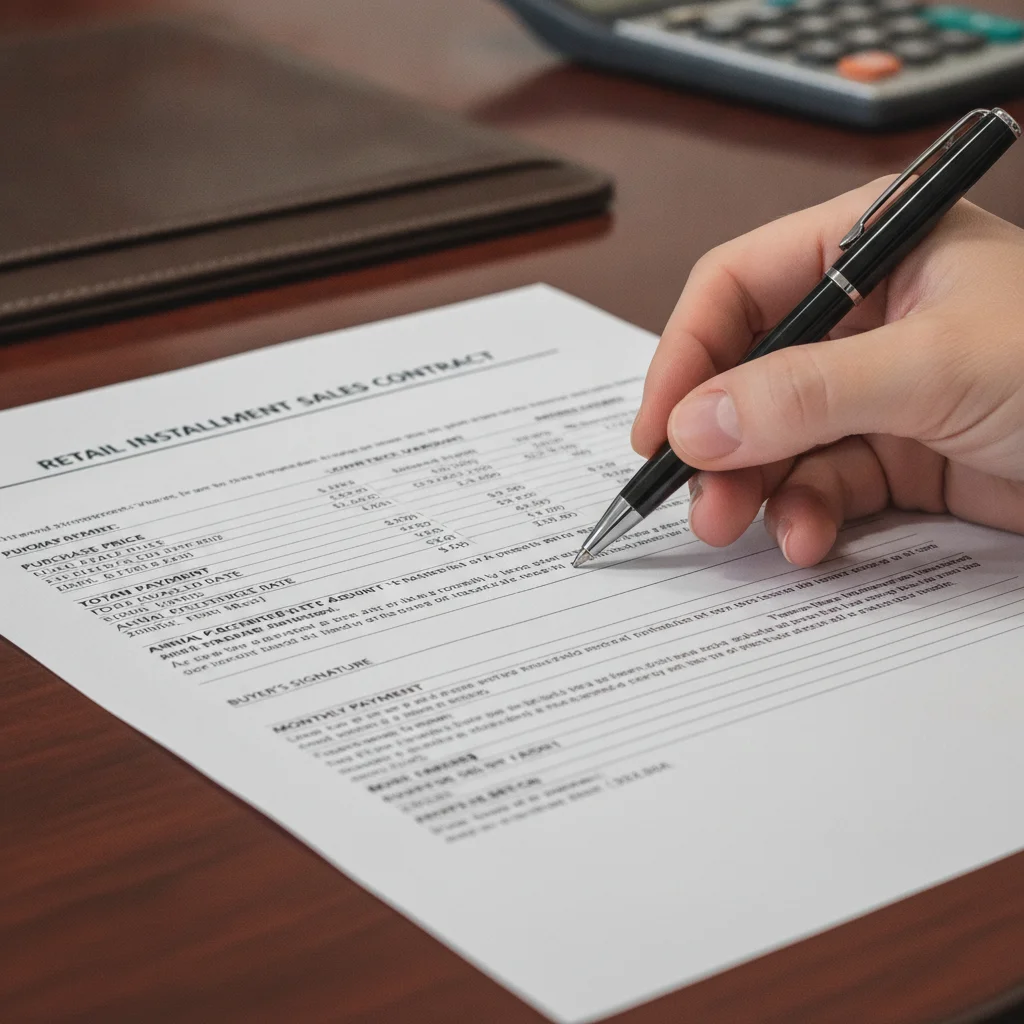
The primary contract is the retail installment sales contract (RISC) or, if you're paying cash, a purchase agreement. It will include every number from the deal. Before you sign, verify the following line by line:
- Vehicle sale price — matches your agreed number
- Trade-in allowance — matches what was agreed
- Down payment amount
- APR and loan term — matches the rate the F&I manager quoted
- Monthly payment — calculate it yourself: principal + interest over the term
- Any add-on products — present only if you agreed to them, at the price you agreed
- Dealer fees — doc fee, acquisition fee, any administrative charges you were told about
- Out-the-door total — matches what was discussed
Verbal Agreements Mean Nothing — Get It in Writing
If a sales manager verbally agrees to a specific price, a specific trade-in value, or a specific rate, none of it is binding until it appears in the signed contract. Do not allow yourself to be moved to the finance office on the strength of a handshake. Ask for a buyer's order or deal sheet with all agreed numbers before the F&I process begins. Discrepancies between verbal offers and written contracts are a common and costly problem for buyers who don't insist on this step.
Spot Delivery Risk: You May Not Own the Car Yet
Some dealers allow you to take the vehicle home before financing is fully finalized — called a 'spot delivery.' If the financing falls through, they will call and ask you to bring the car back or sign new terms (often worse). Never take delivery of a vehicle until all financing is complete, confirmed in writing, and funded. If a dealer insists on a spot delivery, read the spot delivery agreement extremely carefully before you drive off the lot.
Dealers sometimes add fees at this stage that weren't part of the negotiation — documentation fees that were never mentioned, accessories that were installed without your request, or products quietly rolled into the loan. You have every right to ask for an itemized breakdown and to object to any line item you didn't agree to.
For a full explanation of every document you'll encounter — from the buyer's order to the odometer disclosure to the arbitration clause — see Every Document You'll Sign at a Car Dealership, Explained. The paperwork and contracts hub is also a useful reference for understanding what each form commits you to legally.
When to Walk Away — and How to Do It
Walking away is the most underused tool in a buyer's arsenal. Most people treat it as a failure or an awkward social confrontation. It is neither. It is a legitimate negotiating move — and it often produces the best outcome.
When walking away makes sense
- The dealer won't move to a price supported by market data
- Fees you didn't agree to appear in the contract
- The financing rate is materially worse than your pre-approval
- You feel pressured to decide faster than the facts warrant
- Add-ons you declined keep reappearing in the deal
How to do it without burning the relationship
Stand up calmly, thank the salesperson for their time, and say: "The numbers don't work for me today. If your situation changes, I'm reachable." Leave your contact information. In the vast majority of cases, you will get a call within 24–48 hours with a materially better offer. Dealers don't want to lose a deal they've invested two hours in — especially near the end of the month when sales quotas are due.
If you're new to this process and want to understand what the experience looks and feels like before you attempt it, the first-time negotiation guide provides an honest account of what to expect at each stage and how to stay composed under pressure.
Bring Your Pre-Approval in Writing
Print your bank or credit union pre-approval letter and bring it to the F&I office. Showing it physically — rather than just mentioning you have one — makes the competing offer tangible and harder to dismiss. Dealers are more likely to match or beat a rate they can see.
Use Month-End Timing to Your Advantage
Schedule your dealership visit for the final two or three days of the month when sales teams are pushing to hit quota. Discounts and concessions that don't exist mid-month become very real when a salesperson needs one more deal to hit their bonus tier.
Take a Photo of Every Document You Sign
Before you leave the finance office, photograph every page of every document you signed. Discrepancies between what you signed and what's later processed at the lender level are rare but they do happen, and having a timestamped record protects you.
Trade-In Timing Matters for Taxes
In most states, when you trade in a vehicle at the dealership, the trade-in value is subtracted from the purchase price before sales tax is calculated. This creates a real tax benefit that a private sale doesn't offer. Factor this into your comparison when deciding whether to sell privately or trade in — the math sometimes favors the dealer even if their offer is slightly lower.
Dealer Invoice Is Not the Same as Dealer Cost
Invoice price is a published number that represents what the dealer theoretically paid the manufacturer. But holdback, dealer cash, and factory-to-dealer incentives mean the dealer's actual cost is often several hundred to several thousand dollars below invoice. This is not secret information — it's reported on sites like Edmunds and TrueCar — and it's why negotiating down to invoice is not as aggressive as it sounds.
Electronic Signatures Have Full Legal Weight
Many dealers now use digital signing tablets or DocuSign-style platforms for the paperwork. Electronic signatures are legally binding in all 50 states under the E-SIGN Act. Review documents on-screen with the same rigor you'd apply to paper — and request emailed copies before you leave the lot.
Edmunds True Market Value (TMV)
Provides real-time transaction data on what buyers in your area are actually paying for a specific vehicle, not just MSRP. Essential for establishing a credible opening offer.
NADA Guides
The industry standard for vehicle valuation used by dealers and lenders. Use it to understand what your trade-in is worth on the wholesale and retail markets.
Credit Union Loan Rate Finder
The National Credit Union Administration's locator helps you find federally insured credit unions you're eligible to join — most of which offer auto loan rates significantly below dealer financing.
Pre-Negotiation Checklist
A step-by-step walkthrough of every preparation task — pricing research, trade-in valuation, insurance quotes, and financing groundwork — to complete before your dealership visit.
Carfax Vehicle History Report
For used car purchases, a Carfax report surfaces accident history, title issues, and mileage discrepancies that directly affect what a vehicle is worth and what you should offer.
Consumer Financial Protection Bureau Auto Loan Guide
The CFPB's plain-language guide to auto financing explains dealer markup practices, your rights as a borrower, and how to compare loan offers from competing lenders.
All claims are backed by peer-reviewed research. Sources on request.