
| Number of documents typically signed | 10–25 documents (Varies by state, vehicle type, and financing structure) |
| Most legally binding document | Retail Installment Sale Contract (RISC) (Governs all loan terms and obligations) |
| Federally required disclosure | Odometer Disclosure Statement (Required by the Federal Odometer Act for vehicles under 10 model years old) |
| Finance office add-ons — required for loan? | No — all optional (Consumer Financial Protection Bureau guidance) |
| Time allowed to review documents | As long as you need (You have the legal right to read before signing — never rush) |
| Copies you're entitled to | One copy of every signed document (Request before leaving the dealership) |
| GAP insurance — dealer vs. insurer cost | 2–3x more expensive at dealer (Consumer Reports, 2023) |
| States requiring cooling-off period | Very few — most sales are final (No federal cooling-off rule applies to dealership car sales) |
Why Dealership Paperwork Feels Overwhelming (And How to Change That)
You've test-driven the car, negotiated the price, and shaken hands with the salesperson. Then you're escorted to the finance office — and within minutes, a stack of papers lands in front of you. The finance manager explains each one in under thirty seconds. You nod, you sign, and later you wonder what exactly you agreed to.
This is one of the most common experiences in car buying, and it doesn't have to go that way. Every document in that stack has a specific legal purpose, and once you understand what each one does, signing becomes a confident act rather than a leap of faith.
This reference guide breaks down every major document you'll encounter at a dealership — what it is, what it controls, and what to check before you sign. For a broader view of how all these documents fit together from first quote to final title, see the full paperwork timeline.
| Number of documents typically signed | 10–25 documents (Varies by state, vehicle type, and financing structure) |
| Most legally binding document | Retail Installment Sale Contract (RISC) (Governs all loan terms and obligations) |
| Federally required disclosure | Odometer Disclosure Statement (Required by the Federal Odometer Act for vehicles under 10 model years old) |
| Finance office add-ons — required for loan? | No — all optional (Consumer Financial Protection Bureau guidance) |
| Time allowed to review documents | As long as you need (You have the legal right to read before signing — never rush) |
| Copies you're entitled to | One copy of every signed document (Request before leaving the dealership) |
| GAP insurance — dealer vs. insurer cost | 2–3x more expensive at dealer (Consumer Reports, 2023) |
| States requiring cooling-off period | Very few — most sales are final (No federal cooling-off rule applies to dealership car sales) |
The Buyer's Order: Your Price Agreement in Writing
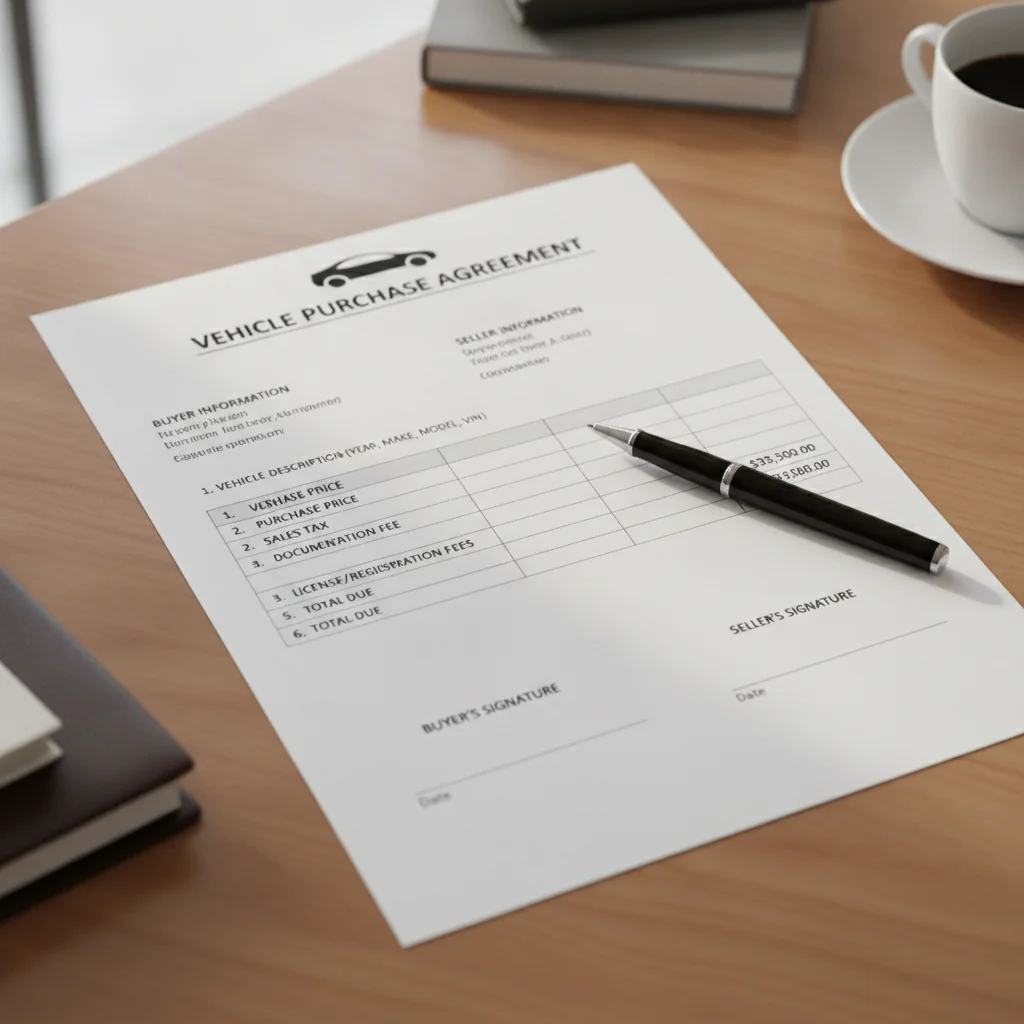
The buyer's order — sometimes called the purchase agreement or sales agreement — is the foundation of your entire transaction. It's the document that locks in the terms you negotiated on the showroom floor before any financing paperwork is prepared.
What it contains
- Vehicle identification: Year, make, model, trim, VIN, color, and mileage
- Sale price: The agreed purchase price of the vehicle
- Trade-in value: If applicable, what the dealer credited you for your trade
- Down payment: Cash or trade equity applied upfront
- Add-ons and accessories: Any dealer-installed options agreed upon
- Fees: Documentation fee, destination charge, dealer prep (if any)
- Taxes and title fees: State sales tax, registration, title transfer costs
What to verify
Before you sign, confirm that the out-of-pocket total matches what you discussed. It's common for fees to appear here that were never mentioned during negotiation. For a line-by-line explanation of every charge that may appear, see the dealer fees glossary.
Also check that the VIN matches the actual car you're buying. Errors happen, and a mismatched VIN creates title problems down the road.
The Retail Installment Sale Contract (RISC): The Heart of Your Financing
If you're financing through the dealership, the Retail Installment Sale Contract — commonly abbreviated RISC — is the most legally consequential document you'll sign. This is your loan agreement. It spells out precisely how much you're borrowing, at what interest rate, for how long, and what your monthly payment will be.
The RISC Becomes Final When You Drive Away
Unlike some consumer contracts, there is no federal cooling-off period for auto loans signed at a dealership. Once you've signed the RISC and taken delivery of the vehicle, the loan is binding. Very few states offer a rescission window, and even those that do have strict conditions. Read the contract fully before you sign — not after. If a dealer calls to tell you your financing 'fell through' days after delivery, that is a separate issue called a 'yo-yo sale,' which is a predatory practice you should be aware of.
Key fields to read carefully
- Amount financed: The total loan amount after your down payment and trade-in equity are subtracted from the vehicle price
- Annual percentage rate (APR): Your interest rate expressed as a yearly figure. Even a half-point difference can cost or save hundreds over the loan term.
- Finance charge: The total dollar amount of interest you'll pay over the life of the loan if you make every scheduled payment
- Total of payments: What you'll pay in total — principal plus interest — by the time the loan is paid off
- Monthly payment and due date: Confirm these match what you agreed to verbally
- Loan term: Number of months. A 72- or 84-month loan lowers your payment but significantly increases total interest paid.
- Prepayment penalty: Most auto loans don't carry one, but check. If it's there, you're penalized for paying off early.
- Late payment fee: The fee charged if you miss a payment deadline
The dealer markup to watch for
Dealers often mark up the interest rate above what the lender actually approved. This difference — called a dealer reserve — is legal but worth knowing about. If your lender pre-approved you at 6.5% and the dealer quotes 7.9%, that gap generates profit for the dealer. Arriving with a pre-signing checklist helps you catch this before you commit.
84 months
Most common maximum auto loan term offered by dealers
According to Experian's State of the Automotive Finance Market report, 2023, longer terms are increasingly common despite significantly higher total interest costs.
$1,000+
Average profit per vehicle from F&I products
National Automobile Dealers Association (NADA) data shows finance and insurance products consistently represent among the highest per-unit profit centers at franchised dealerships.
0.5%
APR markup that costs $500+ over a 60-month loan
On a $30,000 loan, even a half-percentage-point dealer markup adds over $500 in interest across a standard five-year term.
Title and Registration Documents: Proving Legal Ownership
A cluster of government-required documents handles the transfer of legal ownership and registration of the vehicle in your name. These aren't optional, and they're typically processed by the dealer on your behalf — but you still sign them.
Odometer Disclosure Statement
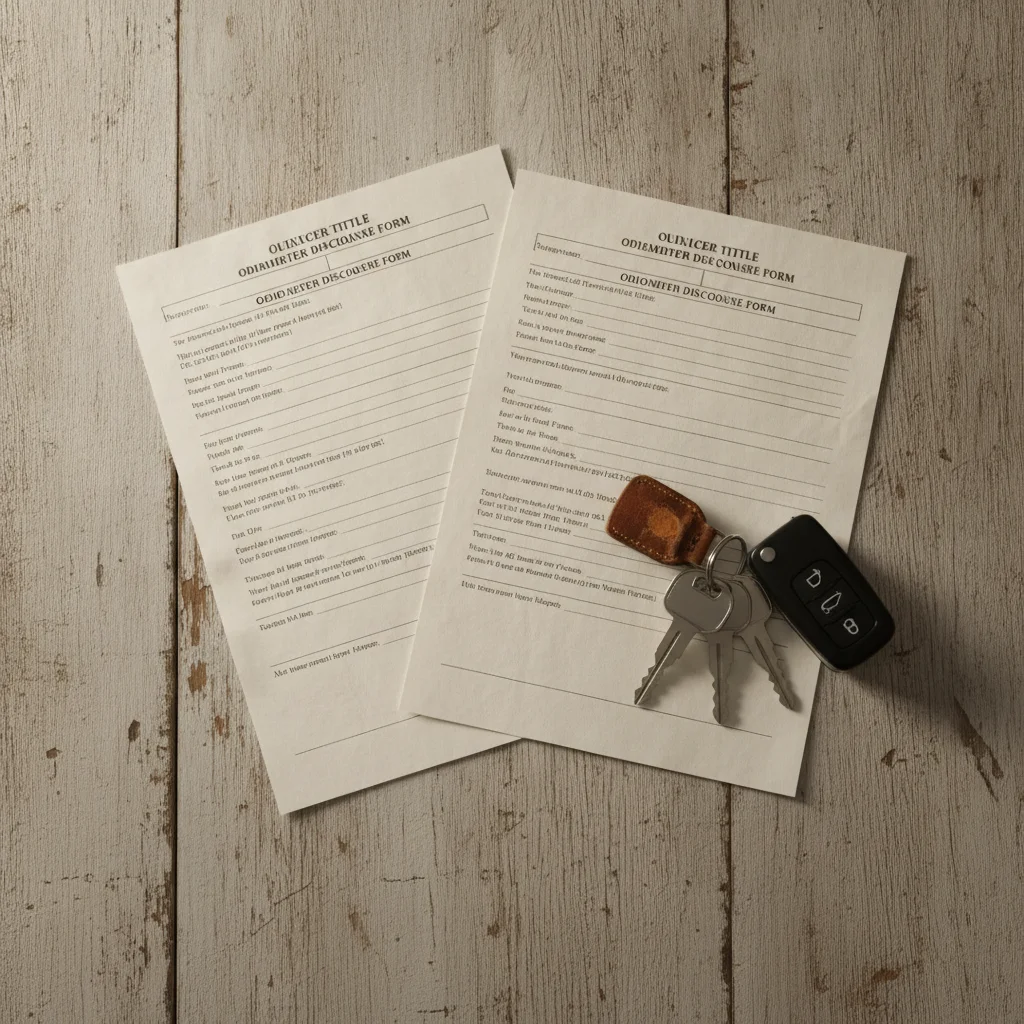
Federal law requires that the seller disclose the vehicle's mileage at the time of sale on every transaction involving a vehicle under ten model years old. For used cars, this is a critical fraud-prevention document. Verify that the mileage on the disclosure matches the odometer reading on the car and the number listed on the buyer's order.
Title Application
This form — the specifics vary by state — initiates the transfer of the title from the seller (or previous owner) into your name. If you're financing, the lender's name will also appear as a lienholder. The dealer typically handles filing this with your state's DMV. You'll receive the actual title weeks later in the mail.
Vehicle Registration Application
This application registers the car in your name with your state's motor vehicle authority. Registration fees are separate from title fees and are collected upfront. Depending on your state, registration may need to be renewed annually or biannually. For sellers handling ownership transfers, understanding title paperwork is equally important.
Lien Release (Used Cars Only)
If the used car you're buying had a previous loan on it, the dealer must present a lien release showing the prior debt is satisfied before the title can be transferred clean to you. Ask to see this document if you're buying a used vehicle.
Buyer's Order
A preliminary sales agreement listing the vehicle, agreed price, fees, taxes, trade-in credit, and down payment. It's the document that captures your negotiated deal before financing paperwork begins.
Retail Installment Sale Contract (RISC)
The binding loan agreement between you and the financing source. It specifies your APR, loan term, monthly payment, total amount financed, and total interest cost over the life of the loan.
APR (Annual Percentage Rate)
The annual cost of borrowing expressed as a percentage. Unlike a simple interest rate, APR can include certain fees, making it a more complete measure of loan cost.
GAP Insurance
Guaranteed Asset Protection insurance that pays the difference between your outstanding loan balance and the vehicle's actual cash value if the car is totaled or stolen before the loan is paid off.
Dealer Reserve
The difference between the interest rate a lender approves you for and the higher rate the dealer quotes you. The dealer keeps this spread as profit.
Odometer Disclosure Statement
A federally required document in which the seller certifies the vehicle's mileage at the time of sale. Falsifying this statement is a federal crime.
Lienholder
The financial institution (bank, credit union, or lender) that holds a legal claim on your vehicle until the loan is fully paid. The lienholder's name appears on your title.
We-Owe / Due-Bill
A written promise from the dealer to provide something — a repair, accessory, or missing item — after the sale is complete. Always get this in writing before taking delivery.
Arbitration Agreement
A clause or standalone document that waives your right to sue the dealer in court and instead requires disputes to go through private arbitration. Often included in finance contracts.
Extended Service Contract
A dealer-sold agreement that covers certain vehicle repairs after the factory warranty expires. Often called a 'warranty' by dealers, though it is technically a service contract with specific exclusions.
Title Application
A state government form that initiates the legal transfer of vehicle ownership into the buyer's name. The dealer typically files this with the DMV on your behalf.
Finance Charge
The total dollar amount of interest you will pay over the life of the loan if you make every scheduled payment. Disclosed on the RISC under Truth in Lending Act requirements.
Finance Office Add-On Agreements: What You're Buying Beyond the Car
The finance office is where dealerships generate a significant portion of their profit — not from the car itself, but from products and services bundled into your financing. Each one comes with its own contract. You are not required to purchase any of these to get a loan, though some finance managers imply otherwise.
Extended Service Contract (Often Called a Warranty)
This is not a manufacturer warranty — it's a service agreement that covers certain repairs after the factory warranty expires. The contract will specify covered components, exclusions, deductibles, and the claims process. Read the exclusions list carefully; many common failure points are excluded.
GAP Insurance Agreement
GAP (Guaranteed Asset Protection) insurance covers the difference between your loan balance and the actual cash value of your car if it's totaled or stolen. This is genuinely useful when you finance a new car with little down payment, since new vehicles depreciate faster than loans pay down. However, GAP sold at dealerships is often priced two to three times higher than the same coverage from your auto insurer — shop around.
Credit Life and Disability Insurance
These policies pay your loan balance (credit life) or your monthly payments (disability) if you die or become unable to work. Both are optional and are frequently overpriced relative to standalone term life or disability coverage.
Paint, Fabric, and Corrosion Protection
Dealers may offer protection packages covering paint sealant, interior fabric guard, or rust-proofing — often for $500 to $2,000. These are almost universally considered poor value by independent consumer advocates, since factory corrosion protection on modern vehicles is already robust.
For a complete walk through the finance office experience document by document, see the F&I office document breakdown.

Other Documents You May Encounter
Depending on your state, the type of vehicle, and your specific deal structure, additional documents may appear in the stack. Here's a quick reference for what each one means.
Arbitration Agreement
Many dealerships include a mandatory arbitration clause — either within the purchase contract or as a standalone document. Signing this means you agree to resolve any future disputes through private arbitration rather than the court system. It's worth understanding that arbitration typically favors the party with more experience in the process — the dealer. Read this carefully and know that in some states, you can opt out.
Privacy Notice and Information Sharing Authorization
Federal law (the Gramm-Leach-Bliley Act) requires dealers to disclose how they share your personal and financial information. You may also be asked to authorize sharing your data with third-party marketers. This is separate from what's required for financing.
We-Owe / Due-Bill
If the dealer promises to fix something on the vehicle or deliver an accessory after the sale (a second key fob, a repair, floor mats), a we-owe document records that commitment in writing. Do not take delivery without this in hand if something was promised — verbal commitments evaporate after you leave the lot.
Delivery Checklist / Inspection Acknowledgment
This document records the condition of the vehicle at delivery — fuel level, existing damage, operational features. Walk the car carefully before signing this. Any pre-existing damage should be noted in writing here; your signature implies acceptance of the vehicle as described.
Electronic Signature Consent (If Applicable)
If the dealership uses a digital signing system, you may be asked to consent to signing electronically. This is legally equivalent to a wet signature under the ESIGN Act. If you're buying a vehicle entirely online, you'll encounter a digital version of most of these same documents — for a detailed comparison, see how digital car buying paperwork differs.

Before You Leave: Your Copies
You are entitled to a copy of every document you sign. Ask for them before you leave — not after. Organize them at home in a dedicated folder. If a dispute ever arises about what was agreed to, these documents are your evidence.
Use the pre-signing checklist to verify your complete package before walking out the door.
CFPB Auto Loan Resources
The Consumer Financial Protection Bureau offers plain-language guides on auto financing, your rights as a borrower, and how to identify predatory loan terms before signing.
Pre-Signing Checklist for Car Contracts
A ready-to-use checklist covering price, APR, loan term, add-ons, and fees to review before you sign any dealership contract. Catches errors before they become your problem.
Federal Trade Commission: Buying a New Car
The FTC's official consumer guide explains your rights during the car buying process, including financing disclosures, add-on products, and what dealers are legally required to tell you.
Dealer Fees Glossary
A comprehensive glossary explaining every common dealer fee that may appear on your buyer's order — and which ones are negotiable versus fixed by law.
NADA Guides: Vehicle Valuation
Use NADA's valuation tool to verify the fair market value of your trade-in or the used vehicle you're purchasing before entering the finance office.
Your State DMV Title Transfer Guide
Each state has specific title transfer and registration requirements. Your state DMV's official site explains what documents are required and how long processing takes.

All claims are backed by peer-reviewed research. Sources on request.