
Key Takeaways
Option A
Spot Delivery
The conditional handover — you drive now, financing settles later.
Best for: Buyers who want the car immediately but should understand the contingency risk before accepting the keys.
Option B
Completed Financing
The fully executed deal — lender approval is locked in before you leave.
Best for: Buyers who want certainty that their rate, term, and monthly payment cannot be renegotiated after delivery.
If you want zero uncertainty about your monthly payment before leaving the dealership
Completed Financing
Only completed financing guarantees that your interest rate, loan term, and payment amount are legally locked in before you take delivery. There is nothing to renegotiate later.
If the dealer can only offer spot delivery and you choose to proceed
Spot Delivery (with conditions)
Proceed only if you read the contingency clause carefully, keep the car in original condition, and have a backup financing source ready in case the dealer calls to renegotiate.
If you are financing through a bank or credit union pre-approval
Completed Financing
Bringing a pre-approved loan to the dealership typically bypasses spot delivery entirely, since the lender has already committed to your terms before you ever sit in the finance office.
If you have challenged credit and the dealer is still shopping your loan
Completed Financing (wait if possible)
Buyers with non-prime credit are most often targeted by yo-yo financing schemes that start with spot delivery. Waiting for a confirmed approval protects you from the worst-case call-back scenario.
If you want to use the car as a trade-in or need immediate transportation
Spot Delivery (understand the risk)
Spot delivery may be unavoidable if you need the car urgently, but document every term in writing, photograph the vehicle, and never sign blank or incomplete forms.
What Spot Delivery Actually Means
When a dealership allows you to drive a vehicle home before financing is fully approved by a lender, that arrangement is called spot delivery — sometimes called a spot deal. The dealer is betting that a lender will agree to the terms you negotiated in the finance office. If the lender agrees, everything proceeds as expected. If the lender declines or asks for different terms, the dealer calls you back to renegotiate — or to return the car.
The name comes from the idea of doing a deal "on the spot" rather than waiting for formal lender confirmation. From the dealership's perspective, it has a clear upside: you take emotional ownership of the vehicle immediately. You drive it home, show it to your family, and by the time any financing hiccup surfaces, you're already attached. That psychology is not accidental.
What spot delivery does not mean is that your deal is done. The contract you signed in the finance office almost always contains conditional language — phrases like "subject to financing approval" or "contingent upon lender acceptance." That language is the legal mechanism that allows a dealer to unwind or modify the deal after you've already taken the keys.
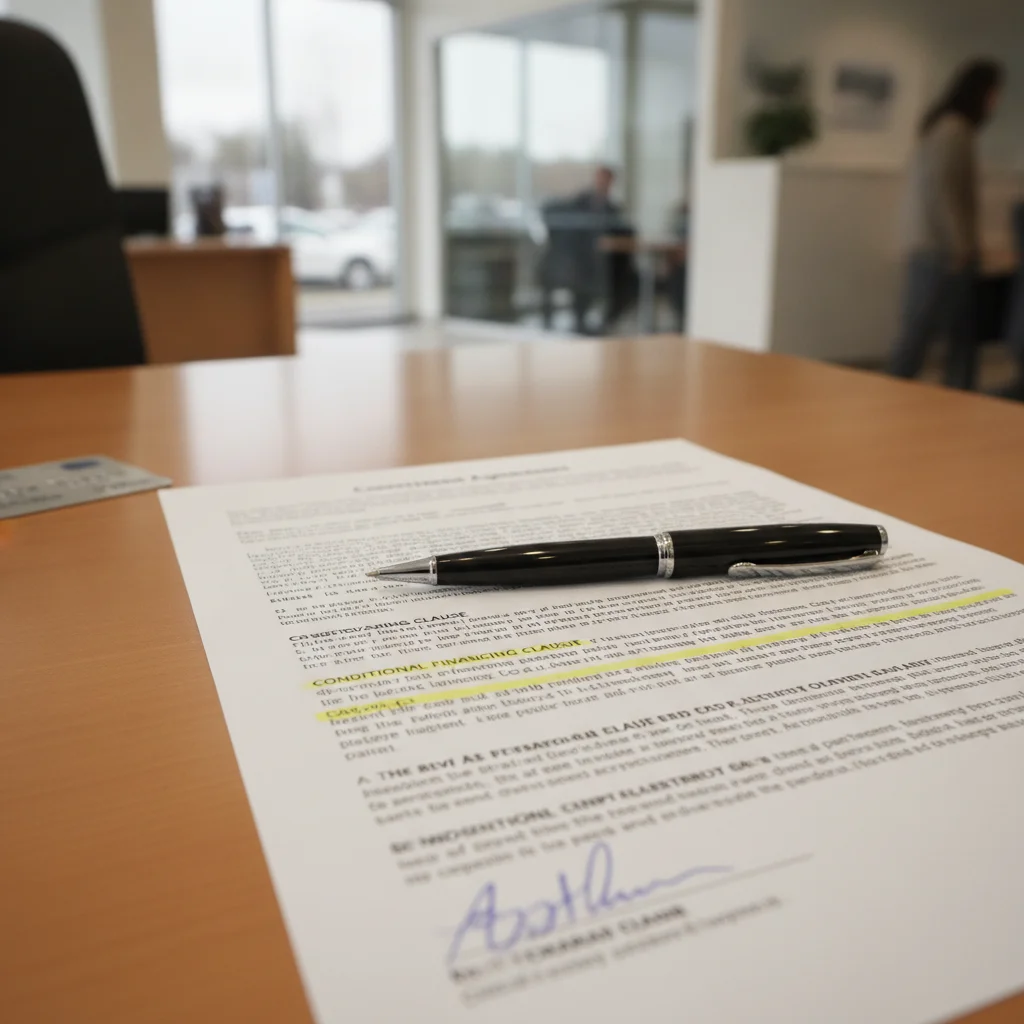
This practice is legal in most U.S. states. Some states, including California, have enacted specific regulations around spot delivery disclosures, but the majority do not require dealers to tell buyers explicitly that their financing has not yet been confirmed. That silence is exactly why so many buyers are caught off guard when the phone rings a week later.
See our guide to 'subject to financing' contract language for a detailed breakdown of how these clauses are written and what rights they create or remove.
What Completed Financing Means — and Why It's Different
Completed financing means that before you drive off the lot, a lender has formally approved your loan at the specific rate, term, and amount reflected in your contract. The dealer has submitted your application, the lender has responded with a commitment, and the paperwork has been executed to reflect that confirmed approval. Your monthly payment is what it says on the contract. Your interest rate is not going to change. The deal is done.
This is what most buyers assume is happening in every dealership transaction — and it is, but not always in the same timeframe. In many cases, dealers do secure lender confirmation before handing over the keys, especially for buyers with strong credit profiles where approval is fast and predictable. The problem is that buyers rarely ask which scenario applies to them, and dealers rarely volunteer the information.
Dealer Financing vs. Your Own Bank
Even when you plan to use dealer financing, it pays to have a pre-approved offer from your own bank or credit union as a benchmark. Dealers often mark up the interest rate above what a lender actually requires — known as the dealer reserve — which is how they earn additional profit on financing. A competing offer keeps that spread in check. See our comparison of <a href="/buying-a-car/negotiating-and-deals/dealer-negotiation/when-dealer-financing-beats-your-bank-and-when-it-doesnt">when dealer financing beats your bank and when it doesn't</a> for a side-by-side look at how to evaluate both options.
State Protections Vary Significantly
California requires specific written disclosures for spot delivery agreements and gives buyers defined rights if financing falls through. Most other states have no equivalent requirement, leaving buyers to rely on what's buried in the contract language. Before assuming you have state-level protections, check your state attorney general's consumer protection resources or consult a consumer law attorney.
The clearest path to completed financing before you ever set foot in a dealership is arriving with a pre-approved auto loan in hand. When your bank or credit union has already committed to a loan amount and interest rate, the dealer isn't waiting on lender approval — it's already secured. The finance office may still try to compete with or beat your rate, but your baseline is firm and your deal cannot be unwound on financing grounds.
Pre-approved financing changes your entire position at the dealership — shifting the conversation from "what monthly payment works for you" to "what is the actual out-the-door price of this vehicle."
Side-by-Side: How These Two Scenarios Compare
The practical differences between spot delivery and completed financing touch nearly every aspect of the transaction — from how binding your contract is on day one to who absorbs the risk if a lender declines. The table below distills the key contrasts buyers need to understand before signing.
| Criterion | Spot Delivery | Completed Financing |
|---|---|---|
| Lender approval status | Pending — not yet confirmed | Confirmed before delivery |
| Contract finality | Conditional — subject to financing clause | Binding — terms are locked in |
| Who bears financing risk | The buyer | The lender |
| Rate/payment change risk | Yes — dealer can call back to renegotiate | No — rate and payment are fixed |
| Trade-in vulnerability | High — dealer may wholesale it before deal is confirmed | Low — deal is complete at delivery |
| Typical disclosure to buyer | Often minimal or absent | Implicit in confirmed loan documents |
| Best protection for buyer | Read contingency clause; keep car unmodified | Pre-approved financing before shopping |
| Yo-yo financing risk | Yes — legally enabled by contingency language | No — no contingency to trigger |
The most consequential difference is the one that feels invisible at the time of signing: who bears the financing risk. Under completed financing, the lender absorbs that risk — they've committed, and you have a binding loan agreement. Under spot delivery, you bear the risk. If the lender declines, you are the one who must return the car, renegotiate terms, or find alternative financing on short notice.
It's also worth noting that spot delivery affects your trade-in. If you traded in your previous vehicle as part of the deal, the dealer typically takes possession immediately. If the deal unwinds, getting your trade-in back — especially if the dealer has already wholesaled it — can be extremely difficult. Always clarify in writing what happens to your trade-in if the financing contingency is not met.
For a comprehensive look at the documents involved, see the fine print buyers miss in retail installment sales contracts.
The Yo-Yo Risk: When Spot Delivery Becomes a Pressure Tactic
In its most benign form, spot delivery is simply a timing gap — the dealer expects approval and delivers the car early as a convenience. But in its worst form, spot delivery is the enabling mechanism for a practice consumer advocates call yo-yo financing.
Here's how it works: You negotiate a deal, sign paperwork, and drive home happy. A few days or weeks later, the dealer calls to say the lender declined your loan or required different terms — a higher interest rate, a larger down payment, or a shorter term. You're told you need to come back in and sign new paperwork or return the vehicle. Because you've already been driving the car, you feel pressure to accept the worse terms rather than give it back.
1 in 4
Buyers who experience post-delivery financing issues
Consumer advocacy research suggests a significant share of spot delivery arrangements result in the dealer requesting modified terms after the buyer has taken the vehicle home.
72%
Buyers unaware financing was conditional at signing
Surveys of car buyers who experienced yo-yo financing found the majority did not know their contract included a financing contingency clause when they signed.
$1,000+
Average increase demanded in renegotiated down payment
Consumer complaint data reviewed by the FTC shows dealers requesting additional down payments averaging over $1,000 when calling buyers back to renegotiate spot delivery deals.
The original paperwork you signed almost always contained contingency language that made this legal. The conditional clause was likely buried in the retail installment sales contract or a separate spot delivery agreement. Buyers who don't read that language carefully assume their deal was final — and dealers who use yo-yo tactics rely on that assumption.
For a full breakdown of how the paperwork mechanics enable this scheme, read the truth about yo-yo financing and how dealership paperwork makes it possible. Understanding the specific clauses to look for is your first line of defense.

Not every dealer uses spot delivery this way — many operate transparently and complete financing quickly without incident. But the practice is common enough, and the consumer harm significant enough, that the Federal Trade Commission has specifically flagged yo-yo financing as a deceptive practice. Knowing the warning signs is not paranoia; it's basic buyer protection.
How to Protect Yourself Before You Sign
The good news is that the risks associated with spot delivery are almost entirely avoidable if you take a few deliberate steps before signing anything.
Step 1: Ask directly whether financing is confirmed
Before you accept the keys, ask the finance manager: "Has a lender formally approved this loan at the terms shown in this contract?" Listen carefully to the answer. Phrases like "we're very confident" or "it should go through fine" are not the same as "yes, lender X has approved this loan." If the answer is anything other than an unambiguous yes, you are looking at a spot delivery.
Step 2: Read the contingency language in every document
Look specifically for phrases like "subject to financing," "contingent upon lender approval," or "this agreement is conditional." These phrases give the dealer the legal right to unwind or modify the deal. If you see them, ask what happens specifically if financing is not approved — and get the answer in writing. Our article on dealership paperwork errors buyers commonly overlook covers the documents most buyers sign without reading.
Step 3: Secure your own financing before you shop
A pre-approved loan from a bank or credit union is the cleanest solution. Your lender has already confirmed your rate and loan amount. The dealer does not need to shop your application to multiple lenders, which means there is no waiting period and no contingency. You can still listen to dealer financing offers — sometimes dealer financing genuinely beats what your bank offers — but your fallback is already locked.
Step 4: Protect your trade-in
If you are trading in a vehicle, get explicit written confirmation of what happens to it if the deal falls apart. Insist on language stating the dealer will return your trade-in in the same condition it was received, or provide equivalent value, if financing is not completed. Verbal assurances do not hold up.
Step 5: Do not modify the vehicle
If you do accept a spot delivery, do not add accessories, apply tint, or make any modifications until financing is confirmed in writing. If the deal unwinds and the car must be returned, any alterations complicate the return and can result in charges against you.
Before you ever reach the finance office, review the questions worth asking before signing any car purchase agreement. The finance office moves quickly by design — preparation is your best defense.
Making the Right Call for Your Situation
Spot delivery is not inherently predatory. In many transactions, it simply means you drive home Tuesday instead of Thursday while the dealer completes administrative confirmation with a lender who has already indicated approval. For buyers with strong credit and transparent dealers, the practical difference is minimal and the risk is low.
But "low risk" is not "no risk," and buyers who don't know what they signed are the ones who end up surprised. The problem is never the scenario itself — it's the information gap. When you know your financing is conditional, you can make an informed choice about whether to accept the car, wait for confirmation, or walk away. When you don't know, you have no real choice at all.
The size of your down payment also plays a role here. A larger down payment signals lower risk to lenders and makes same-day approval more likely, reducing the window during which you'd be exposed under a spot delivery arrangement. If you're financing a significant amount with a modest down payment, financing confirmation may take longer — and that gap is exactly where spot delivery risk lives.
If you're purchasing online, the same dynamics apply in a different form. Online car deals can fall apart at the last minute for many of the same reasons — financing hiccups, title issues, and unresolved contingencies don't disappear because the transaction started on a website.
The bottom line is straightforward: before you accept the keys, know whether your financing is complete or conditional. Ask the question. Read the contract. If you're not sure, don't drive home yet — or make absolutely certain you understand what happens next if the lender says no.

All claims are backed by peer-reviewed research. Sources on request.