
Key Takeaways
Pre-Approved Financing
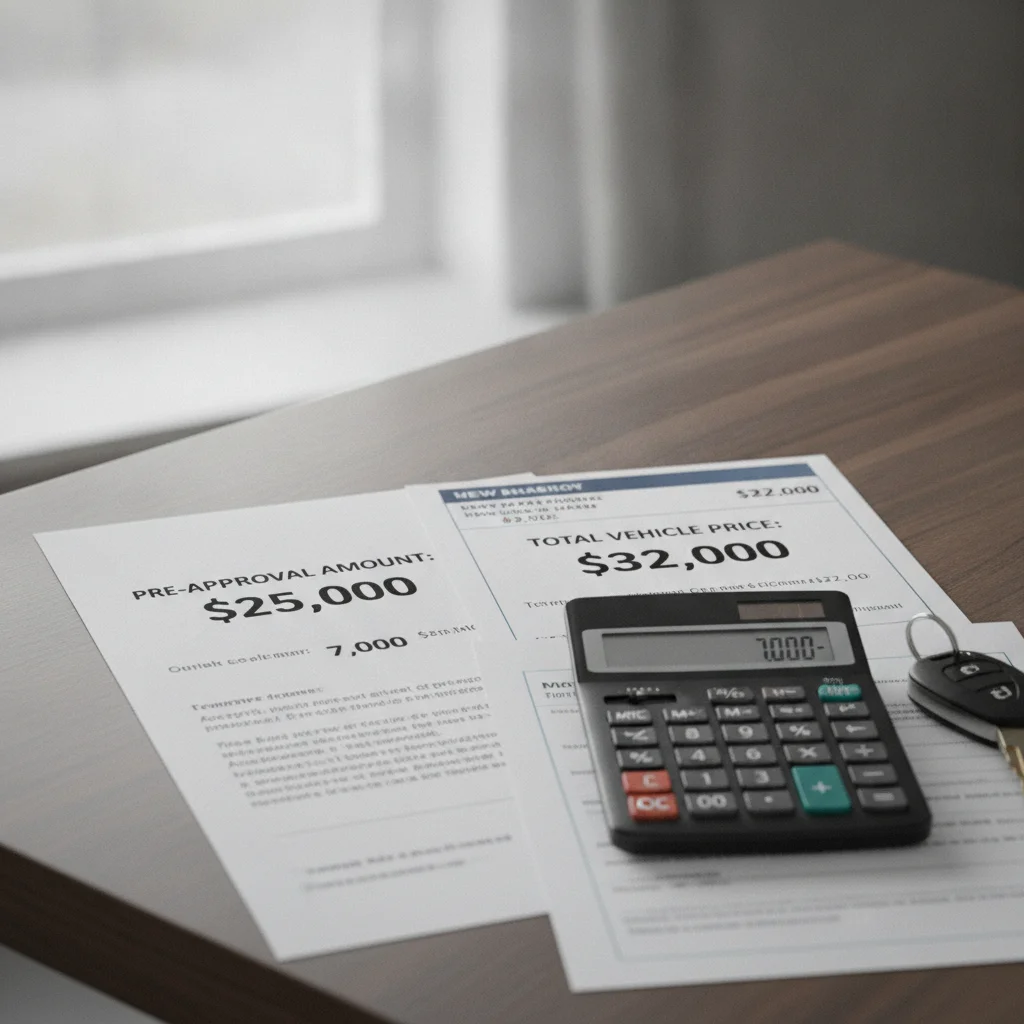
Pre-approved financing is a commitment from a bank, credit union, or online lender that they will lend you a specific amount of money at a specific interest rate to buy a car — before you ever walk into a dealership. The lender has already reviewed your credit and income, so you arrive at the dealer knowing exactly what you can borrow, at what rate, and for how long. That knowledge is leverage.
A pre-approval typically generates a hard credit inquiry and locks in a rate for 30–60 days. The final loan remains subject to vehicle verification, but the rate is generally binding if the car meets the lender's collateral criteria.
The Problem With Walking In Empty-Handed
Here's what happens when you walk into a dealership without financing arranged: you hand the finance manager a blank canvas. The single most powerful tool a dealer F&I office has is the ability to frame every conversation around your monthly payment instead of the car's actual price.
That's not an accident. It's a trained strategy with a name in the industry — "payment selling." If a buyer is focused on hitting $450 a month, the dealer has enormous flexibility to manipulate the interest rate, loan term, and add-on products while keeping that payment number in range. A buyer paying $450/month over 72 months is paying $32,400 total. The same buyer at $450/month over 84 months pays $37,800. Same payment, $5,400 more out of pocket — and most buyers never notice.
Skipping preapproval often costs buyers real money — not because dealers are necessarily dishonest, but because the structure of the transaction rewards them for keeping you focused on the wrong number.
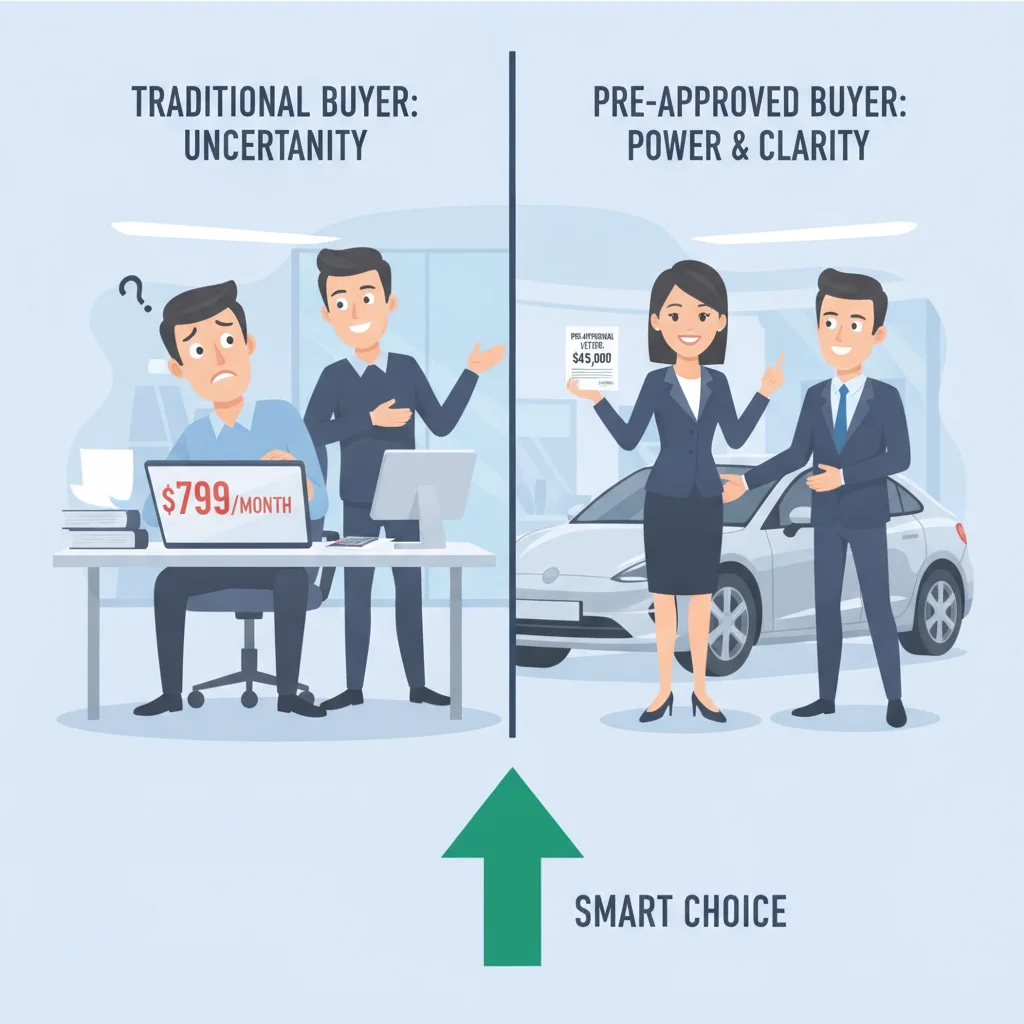
Pre-approval solves this at the root. When you arrive knowing your rate is 6.4% APR from your credit union, the dealer can't quietly quote you 8.9% and pocket the 2.5% markup — called dealer reserve — without you catching it. You have a benchmark. That benchmark is everything.
What Dealer Reserve Actually Means for Your Wallet
Most buyers don't know that dealers act as indirect lenders. When you finance through a dealership, the dealer submits your credit application to a bank or captive finance company. That lender approves you at what's called the buy rate — the lowest rate your creditworthiness qualifies for. The dealer then has the legal right to mark that rate up, typically by 1–3 percentage points, and present the inflated rate to you as your "approved" rate. The difference between the buy rate and what you're quoted is dealer reserve, and the dealer keeps it.
1–3%
Typical dealer rate markup over buy rate
According to the Consumer Financial Protection Bureau, dealers commonly mark up the lender's buy rate by 1–3 percentage points as dealer reserve.
$1,650+
Extra interest cost from a 1.5% rate markup
On a $40,000, 60-month loan, a 1.5% APR increase adds approximately $1,650 in total interest paid over the loan term.
72%
New car buyers who finance through the dealership
J.D. Power data shows roughly 72% of new car buyers accept dealer-arranged financing without comparing outside lender rates first.
14–45 days
FICO rate-shopping window for auto loans
FICO's scoring models count multiple auto loan inquiries within a 14–45 day window as a single inquiry, limiting score impact from shopping around.
$5,400
Extra cost from 12 extra months at same payment
Extending a loan from 72 to 84 months at the same $450/month payment costs $5,400 more in total — a common outcome when dealers manage to payment rather than price.
On a $35,000 loan over 60 months, the difference between 5.5% and 8.0% APR is about $2,520 in additional interest over the life of the loan. That money doesn't go to the lender — it goes to the dealer. You never see it itemized anywhere on the contract.
This isn't illegal. The FTC has regulated the practice but not eliminated it. The only reliable defense is knowing what rate you actually qualify for before you sit down — which is exactly what a pre-approval tells you.
“The dealer's finance office is a profit center, not a service center. It exists to make money for the dealership, and the less you know about your own financing options, the more money it makes.”
— Ivan Drury, Director of Insights, Edmunds
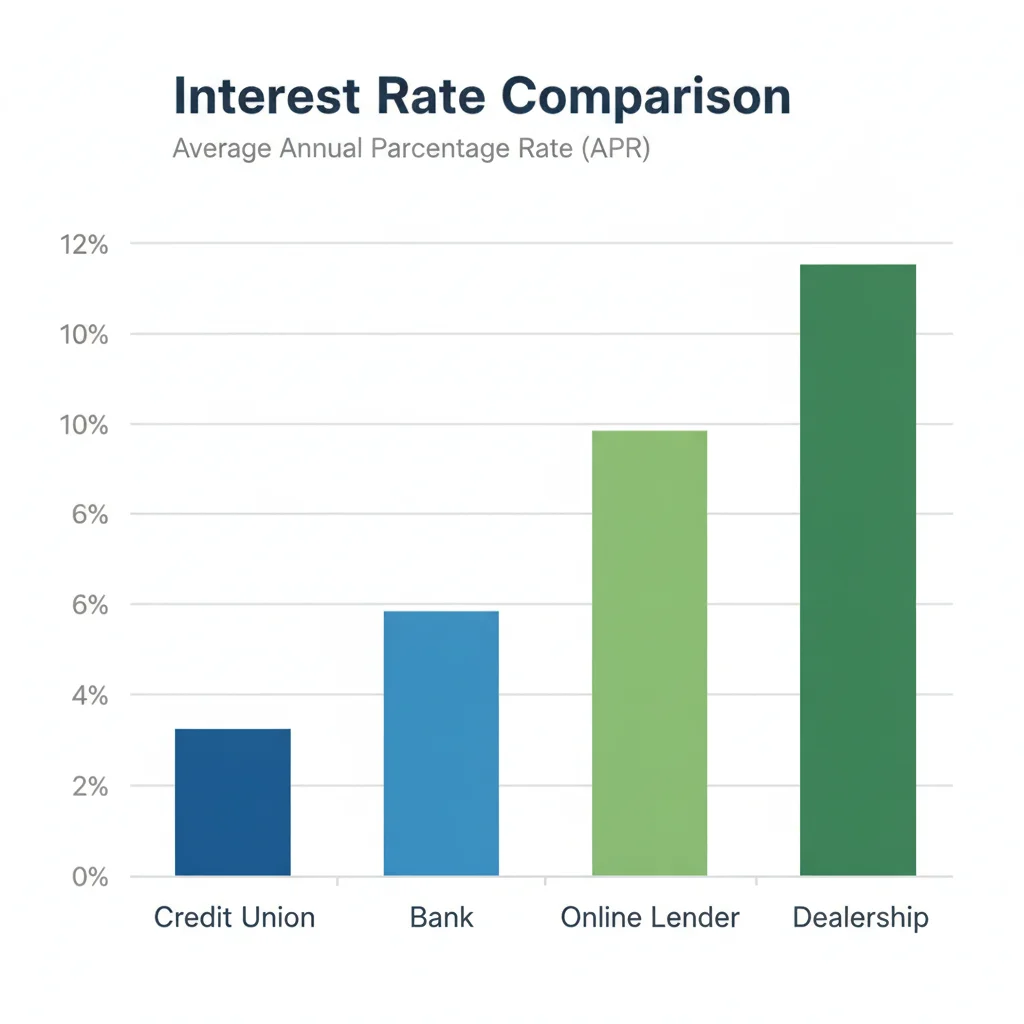
Comparing dealer financing against outside lenders shows just how wide this gap can be depending on your credit tier and the vehicle involved.
How Pre-Approval Changes the Power Dynamic
When you hand the finance manager a pre-approval letter from your credit union at 6.1% APR, something shifts immediately. You are no longer a lead to be worked — you're a buyer with a standing offer. The F&I office now has two choices: beat your rate or let you use your own financing.
Dealers can often match or beat outside rates, particularly if they have a strong relationship with a lender or access to manufacturer subvented rates. But they can only do that if they try — and they only try when they have to. Your pre-approval forces that effort.
Negotiate the Car Price First — Always
Before revealing how you plan to finance, get the dealer to commit to an out-the-door price in writing. This prevents them from compensating on the vehicle price after you reveal strong financing. The sequence matters: price first, financing second, add-ons third.
Apply to Multiple Lenders in One Week
FICO treats all auto loan inquiries within a 14–45 day window as a single inquiry for scoring purposes. Apply to your credit union, your bank, and one online lender within the same week to get competing offers without multiplying the credit score impact.
More importantly, once financing is settled (or bracketed by your pre-approval), the vehicle price negotiation becomes clean. You can negotiate the out-the-door price on its own merits — invoice, market value, competing quotes — without the monthly payment math muddying the conversation. That's the real structural change pre-approval creates.
Exactly how to use a preapproval when you arrive at the lot covers the tactical sequence in detail, but the principle is simple: separate the car price from the financing, and negotiate them sequentially, not simultaneously.

Where to Get Pre-Approved (and Which Sources Are Worth Your Time)
Not all pre-approvals are created equal. Here's the practical breakdown:
- Credit unions: Consistently offer the lowest rates for buyers with good to excellent credit. If you're a member, start here first. Many credit unions allow rate locks for 45–60 days and have flexible collateral criteria.
- Banks (where you have an existing relationship): Existing customers often get loyalty rate discounts. Check your bank's auto loan page directly — do not rely on what a dealer tells you your bank will offer.
- Online lenders (LightStream, PenFed, Consumers Credit Union): Highly competitive, fast approval decisions, and easy to compare. Good benchmarks even if you don't end up using them.
- Manufacturer captive finance (Ford Motor Credit, Toyota Financial, etc.): Sometimes offer promotional rates — 0.9% or 1.9% on new models. These can be genuine deals, but only on specific trims and only if you have tier-one credit. Always compare against your credit union rate.
Apply to two or three sources within the same week to benefit from FICO's rate-shopping deduplication rules. You want competing offers, not just one. Competition between lenders works in your favor the same way competition between dealerships does.
A step-by-step guide to the full preapproval process walks you through documents, application strategy, and what to expect from lenders at each credit tier.
Rate Shopping Won't Wreck Your Credit
A common fear is that applying to multiple lenders will tank your credit score. In practice, FICO's deduplication rules mean multiple auto loan hard inquiries within a short window count as one. Apply within 14–45 days across two or three lenders and the impact is typically just a few points — well worth the savings a competitive rate produces.
Promotional Rates Often Come With Trade-offs
Manufacturer promotional financing rates — 0%, 1.9%, or 2.9% APR offers — are real but frequently exclude cash-back rebates that may be available to buyers who finance outside. On a $40,000 vehicle with a $3,000 rebate available, the math sometimes favors taking the cash and financing at a slightly higher rate. Always run both scenarios.
The Tactical Playbook: How to Actually Use Your Pre-Approval at the Dealer
Getting pre-approved is step one. Using it correctly is what converts it into real savings. Here's the sequence that works:
- Don't lead with financing. When the salesperson asks how you plan to pay, say you're still deciding. Keep that door open. Your goal is to negotiate the vehicle price first — not simultaneously with payment terms.
- Get the out-the-door price in writing. This includes all dealer fees, documentation fees, and taxes. Never negotiate on monthly payment — negotiate on the total vehicle cost with all fees included.
- Reveal your pre-approval in the F&I office. Once you've agreed on the car price, hand over your pre-approval letter and tell them you'll use it unless they can do better. Give them the chance.
- Compare the full loan — not just the rate. If the dealer offers 5.8% over 60 months versus your 6.1% pre-approval, the dealer wins. If the dealer offers 5.8% over 72 months with $1,200 in added products rolled in, run the total cost calculation before saying yes.
- Walk away from add-ons you didn't ask for. GAP insurance, extended warranties, paint protection packages — these generate significant F&I profit. Some are worth having; most are overpriced at the dealer. You can buy GAP insurance separately for a fraction of the cost.
How to leverage a preapproval letter during negotiations digs deeper into specific scripts and responses for common F&I tactics.
Negotiate the Car Price First — Always
Before revealing how you plan to finance, get the dealer to commit to an out-the-door price in writing. This prevents them from compensating on the vehicle price after you reveal strong financing. The sequence matters: price first, financing second, add-ons third.
Apply to Multiple Lenders in One Week
FICO treats all auto loan inquiries within a 14–45 day window as a single inquiry for scoring purposes. Apply to your credit union, your bank, and one online lender within the same week to get competing offers without multiplying the credit score impact.
When Dealer Financing Is Actually the Better Call
Let's be honest about this: dealer financing wins sometimes. Manufacturer-subsidized rates — think 0% APR for 36 months on a new pickup — can be genuinely better than anything you'll find at a credit union. These promotional rates are real. They are also:
- Limited to specific models and trim levels
- Typically only available to buyers with top-tier credit (usually 720+ FICO)
- Often paired with conditions that exclude other incentives (like cash back rebates)
- Only available at new car dealers, never on used vehicles
The point of your pre-approval isn't to avoid dealer financing — it's to have a benchmark that lets you evaluate dealer financing objectively. Without your own number, you have no way to know if 3.9% from the dealer is a good deal or a mediocre one. With your credit union's 3.2% offer in hand, you know immediately.
Rate Shopping Won't Wreck Your Credit
A common fear is that applying to multiple lenders will tank your credit score. In practice, FICO's deduplication rules mean multiple auto loan hard inquiries within a short window count as one. Apply within 14–45 days across two or three lenders and the impact is typically just a few points — well worth the savings a competitive rate produces.
Promotional Rates Often Come With Trade-offs
Manufacturer promotional financing rates — 0%, 1.9%, or 2.9% APR offers — are real but frequently exclude cash-back rebates that may be available to buyers who finance outside. On a $40,000 vehicle with a $3,000 rebate available, the math sometimes favors taking the cash and financing at a slightly higher rate. Always run both scenarios.
What lenders are actually evaluating when they pre-approve you helps you understand how your credit profile translates into rate tiers — knowledge that makes any lender conversation clearer.
The Real Cost of Skipping This Step
Let's put a number on it. The average new car loan in the US is approximately $40,000 at roughly 60 months. The difference between a buyer who arrives with a pre-approval at their qualified rate versus a buyer who accepts whatever rate the dealer presents — without pushback, without a benchmark — averages 1.5–2.0 percentage points in rate markup based on industry data.
At 1.5% APR difference on a $40,000 loan over 60 months, you're paying approximately $1,650 more in interest. Do that once a decade across a lifetime of car purchases, and you've given several thousand dollars away in financing profit that had nothing to do with the price of the car.
The pre-approval process takes, realistically, 30–60 minutes across a couple of lender applications. The ROI on that hour is exceptional.
How a pre-approval anchors the entire rate negotiation explains the anchoring psychology in more detail — why having a number, any credible number, fundamentally changes how the rate conversation unfolds.

If you're concerned about bad credit options and whether a pre-approval is even achievable for your situation, understand that even a pre-approval at a higher rate from a legitimate lender is better than walking into a buy here pay here lot without any frame of reference. Know your number first, regardless of where it lands.
All claims are backed by peer-reviewed research. Sources on request.