
Key Takeaways
The Online Car Deal Illusion: Why 'Done' Isn't Always Done
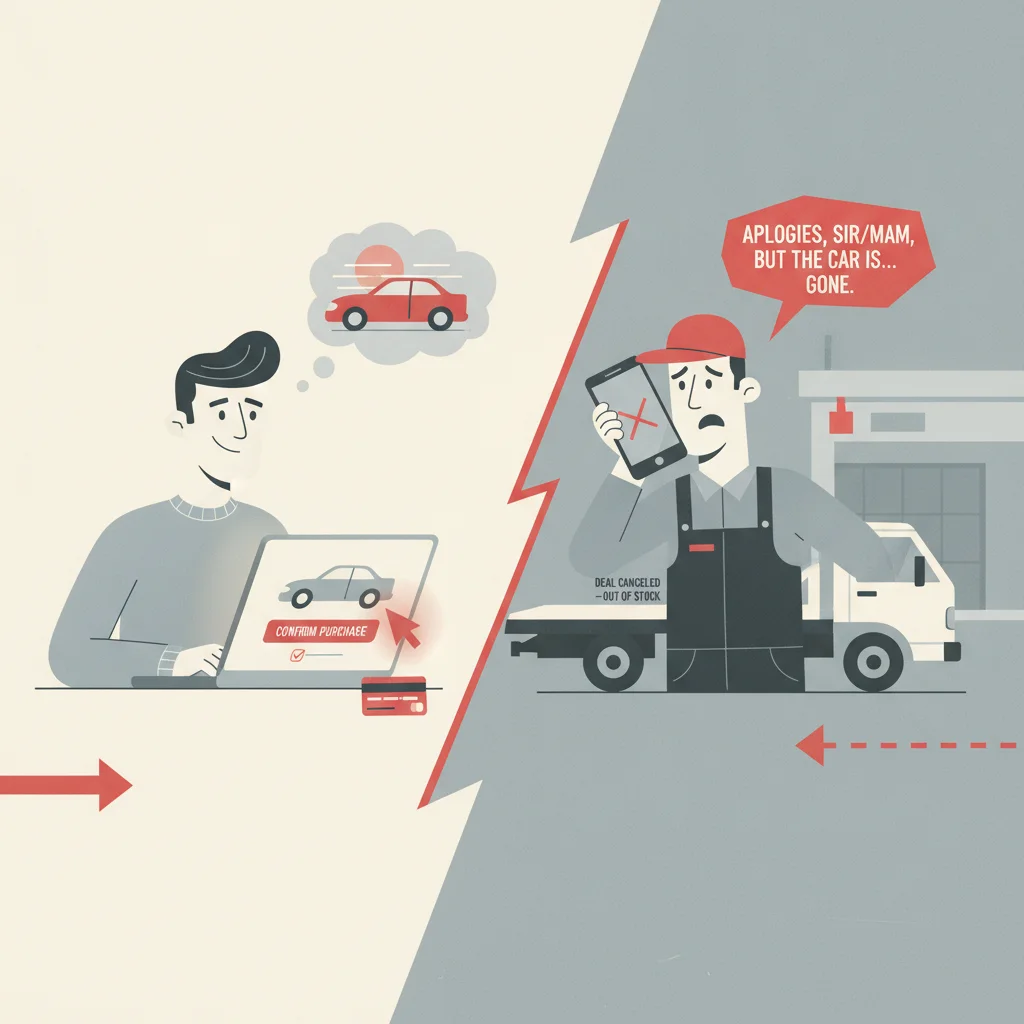
Clicking "confirm purchase" on an online car-buying platform feels decisive. You've compared trims, negotiated price via chat, uploaded your documents, and e-signed a stack of disclosures. The confirmation email lands in your inbox. It feels finished.
Then, three days before delivery, your phone rings. The deal is off — or worse, the terms have quietly changed.
I spent years on the finance side of dealerships before switching to helping buyers. I've watched dozens of online car deals collapse at the final stage, and the causes are nearly always the same handful of problems. The good news: most of them are preventable if you know what to look for before you commit.
This isn't an argument against buying cars online. Online purchasing has real advantages — no high-pressure showroom tactics, transparent pricing, and the ability to shop across a wider inventory. But the process also introduces new failure points that traditional in-person deals don't have in the same way. Understanding them is the first step to protecting yourself.
See our pre-purchase checklist for buying a car online to run through every critical verification step before you click confirm.
The Most Common Reasons Online Car Deals Fall Apart
Whether you're buying through a platform like Carvana or Vroom, or working remotely with a franchise dealership, the deal-killing culprits tend to cluster around the same categories: financing, inventory, title, and paperwork. Here's a ground-level look at each.
Treating a soft financing approval as a guaranteed loan commitment.
Why it happens: Online platforms often display pre-qualification results early in the funnel to reduce friction, which buyers naturally interpret as an approval. The language used — "you're approved for up to $X" — sounds final but is not.
Assuming an online listing reflects current, accurate inventory.
Why it happens: Buyers trust that a major platform's inventory is updated in real time. In practice, listings are often populated via third-party feeds that lag by hours or days, and vehicle condition or availability can change without the listing updating.
Not verifying clean title and lien status before committing to the purchase.
Why it happens: Buyers are often eager to lock in a good price and assume that a reputable platform has already handled title verification. Many haven't — or they've flagged a title issue internally without disclosing it to the buyer.
Failing to account for trade-in payoff timing and lender release requirements.
Why it happens: Buyers focus on the new vehicle transaction and treat the trade-in as a separate, simpler step. In reality, the payoff quote from your existing lender has a limited validity window, and the lien release process can delay the entire deal.
Signing e-documents without carefully reading and matching terms to what was agreed.
Why it happens: Remote signings often involve a high volume of documents sent in rapid succession. Buyers click through assuming the figures are consistent with the verbal or chat-based agreement. Version mismatches or last-minute additions frequently go unnoticed.
Accepting dealer pressure to proceed on revised terms after a deal disruption.
Why it happens: When a deal falls apart, buyers are often emotionally invested and anxious not to lose the car or their deposit. Dealers exploit this urgency to introduce less favorable terms — higher rates, different fees, or altered trade-in values.
1 in 4
Online car deals with a reported complication before delivery
According to a 2023 Cox Automotive car buyer journey study, roughly 25% of online vehicle transactions encountered at least one significant issue prior to delivery or deal completion.
32%
Buyers who experienced financing delays or changes after initial approval
A 2023 J.D. Power U.S. Sales Satisfaction Study found nearly a third of online car buyers reported their financing terms changed or were delayed between initial approval and final deal signing.
Up to 30 days
Trade-in payoff quote validity window
Most auto lenders issue payoff quotes valid for 10 to 30 days; if an online deal takes longer to process, the figure changes — often catching buyers off guard mid-transaction.
Understanding the patterns isn't just academic — it tells you exactly where to apply scrutiny before you're in a situation where walking away means losing your deposit or scrambling for alternative transportation.
Deposits May Not Be Automatically Refundable
Many online car-buying platforms require a deposit — anywhere from $250 to $1,000 — to hold a vehicle during the purchase process. Not all platforms treat this as fully refundable if the deal falls apart, especially if the platform claims the buyer caused the breakdown. Read the deposit policy in full before submitting any payment, and use a credit card when possible to preserve chargeback rights if a legitimate dispute arises.
Cross-State Title Transfers Add Time and Cost
If you're buying a vehicle located in a different state — common with online platforms — title transfer requirements vary significantly by state. Some states require the seller to obtain a temporary registration before shipping; others require the buyer to register in their state within a tight window after delivery. Failing to account for this can result in registration delays, additional fees, or temporary inability to legally drive the vehicle.
A 'Return Policy' Is Not the Same as a Guarantee
Several online car platforms advertise return windows of 7 to 30 days. These policies often come with mileage caps, condition requirements, and documentation demands that can void the return if not followed precisely. Before relying on a return policy as a safety net, read the full terms — including what "return" means (full refund vs. store credit vs. exchange only).
Financing: The Biggest Hidden Landmine
Online car-buying platforms often let you get a "financing estimate" or "soft approval" early in the shopping process. This is useful for budgeting, but it is not a loan commitment — and that distinction matters enormously.
Here's what actually happens behind the scenes: the platform or dealership submits your application to one or more lenders after you've agreed to terms. That's when the hard credit pull occurs, income documentation gets verified, and the lender makes a final underwriting decision. If anything in that process doesn't match what was assumed during the soft approval stage — a lower credit score than estimated, income that can't be verified, a debt-to-income ratio above the lender's threshold — the financing falls through.
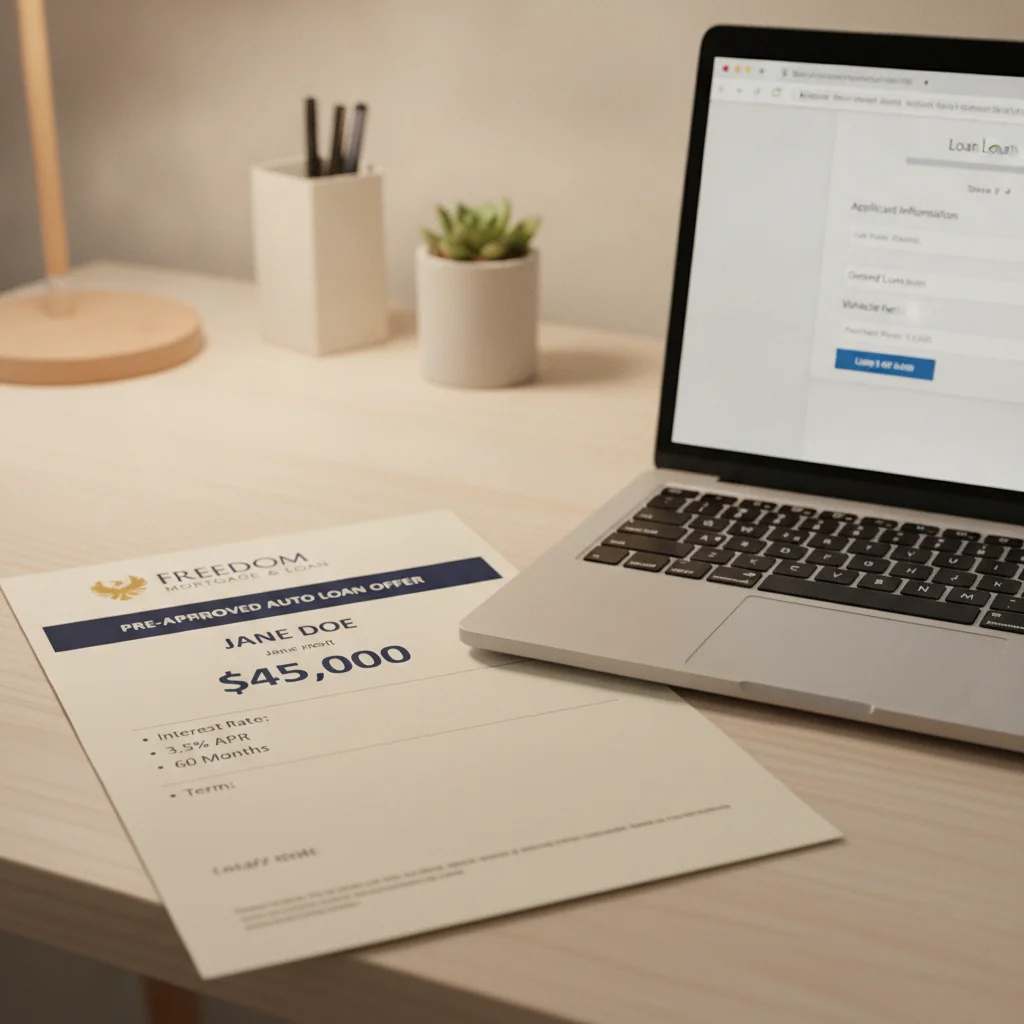
The smartest move a buyer can make is to get preapproved through their own bank or credit union before starting the online buying process. A preapproval letter gives you a real rate, a firm loan amount, and a fallback if the dealer's financing collapses. It also eliminates one of the most common last-minute deal-killers entirely.
For a deeper look at how spot delivery and incomplete financing create risk — even in traditional deals — see our piece on spot delivery vs. completed financing. The same dynamics show up in online transactions when buyers assume a soft approval equals a locked rate.
Never Assume 'Pre-Qualified' Means 'Approved'
A pre-qualification is an estimate based on self-reported information and a soft credit check. It carries no obligation from any lender and can be withdrawn or dramatically altered once actual underwriting begins. Buyers who budget based on a pre-qualification number — and then face a denial or a higher rate at final approval — often find themselves either unable to proceed or pressured into worse terms. Get a genuine preapproval with a hard pull and a commitment letter before you go through any online purchase process.
Title Problems Can Strand You After Delivery
In some cases, buyers receive a vehicle and only discover a title problem weeks later — when the registration paperwork fails to process. At that point, the vehicle may be technically unregisterable in your state until the title issue is resolved, which can take months and require legal action. Always verify clean title before delivery, not after. Platforms that push back on providing title documentation pre-sale should be treated with serious skepticism.
Inventory Problems: The Car You Bought May Not Exist
This is the one that shocks buyers the most. Online listings — even on major platforms — are often not updated in real time. A vehicle can be sold, damaged in transport, recalled, or simply miscategorized, and the listing will still appear as available while you're going through the purchase flow.
I've seen buyers complete the full online checkout, including financing and e-signature, only to be told days later that the specific vehicle was already spoken for, failed a pre-delivery inspection, or was never actually in the condition described in the listing.
This problem is particularly acute with dealership websites that aggregate inventory from multiple lots or use third-party listing feeds. The VIN is listed, the price looks right, but the physical car may be 400 miles away at a different location or sitting in a service bay with a transmission problem.
The fix is simple but requires effort: before you sign anything, call or email to verify that the specific VIN is physically on-site, has passed a pre-delivery inspection, and is available for your delivery window. Get that confirmation in writing — even a timestamped email response counts. If a platform won't give you that confirmation, treat it as a red flag.
Also worth understanding: how online car buying myths shape buyer expectations. One persistent myth is that large platforms have flawless inventory accuracy — they don't, and assuming otherwise sets you up for disappointment.
Title Issues, Trade-In Liens, and the Paperwork Traps
Title problems are the slow-moving disasters of online car deals. They often don't surface until days before delivery — or even after the vehicle arrives — because verifying clean title takes time and depends on third-party processes outside the seller's control.
The most common title-related deal-killers include: an existing lien that hasn't been fully released by a previous lender, a salvage or rebuilt title that wasn't disclosed upfront, title held in a different state than the car's current location (triggering complex cross-state transfer requirements), and outstanding registration fees or taxes tied to the VIN.
Trade-ins add a second layer of complexity. If you're trading in a vehicle with an outstanding loan, the payoff amount quoted to you has a limited validity window — typically 10 to 30 days. If the deal takes longer to process than expected, the payoff amount changes, which can throw off the entire deal structure. If the lender also requires additional documentation to release the lien, that can delay title transfer on both the trade-in and the new vehicle simultaneously.

Remote paperwork signings introduce their own failure mode. E-signature platforms used by dealerships occasionally have document versioning issues — meaning you signed one version of a contract while the dealer's system holds a slightly different version. When those don't match, the contract may be considered incomplete and require a full re-signing, sometimes with updated terms.
For comprehensive guidance on the documentation involved in any car purchase, our Paperwork & Contracts hub breaks down every document you should expect to see and what each one actually obligates you to.
And if you're concerned about the financial risk in online transactions specifically — especially when it comes to deposits and payment methods — see our guide on how to protect yourself when paying for a car online.
Never Assume 'Pre-Qualified' Means 'Approved'
A pre-qualification is an estimate based on self-reported information and a soft credit check. It carries no obligation from any lender and can be withdrawn or dramatically altered once actual underwriting begins. Buyers who budget based on a pre-qualification number — and then face a denial or a higher rate at final approval — often find themselves either unable to proceed or pressured into worse terms. Get a genuine preapproval with a hard pull and a commitment letter before you go through any online purchase process.
Title Problems Can Strand You After Delivery
In some cases, buyers receive a vehicle and only discover a title problem weeks later — when the registration paperwork fails to process. At that point, the vehicle may be technically unregisterable in your state until the title issue is resolved, which can take months and require legal action. Always verify clean title before delivery, not after. Platforms that push back on providing title documentation pre-sale should be treated with serious skepticism.
What to Do After a Deal Falls Apart — and How to Prevent It Next Time
If a deal collapses, your first priority is recovering your deposit. Most legitimate online platforms have written refund policies — request the refund in writing immediately, referencing the specific clause. If you used a credit card for the deposit, you have additional recourse through a chargeback if the seller is unresponsive.
Don't let a failed deal push you into a worse one. Dealers and platforms sometimes use the disruption as leverage — "we have another buyer interested, but we can still make this work if you accept these revised terms." That's a pressure tactic. Walk away if the new terms don't match what you originally agreed to.
For prevention, the framework is straightforward:
- Get genuinely preapproved by your bank or credit union before shopping, not just a soft estimate from the platform.
- Verify VIN availability in writing before signing any documents.
- Request a clean title report (CARFAX or AutoCheck plus a title search) as a condition of the sale.
- Confirm trade-in payoff timing with your current lender and get the valid-through date in writing.
- Review every e-document carefully before signing — check that amounts, VIN, and terms match what was verbally agreed.
- Understand the return policy fully before you commit — some platforms offer 7-day returns, others don't.

Once the deal is complete, a different set of logistics kicks in. For a clear picture of what to expect after purchase — delivery timelines, title transfers, and state registration — see our guide on what happens after you buy a car online.
Online car buying is genuinely more convenient than the traditional dealership experience for many people. But convenience doesn't eliminate risk — it relocates it. The buyers who come out ahead are the ones who treat the digital process with the same scrutiny they'd apply in a showroom, and then some.

All claims are backed by peer-reviewed research. Sources on request.