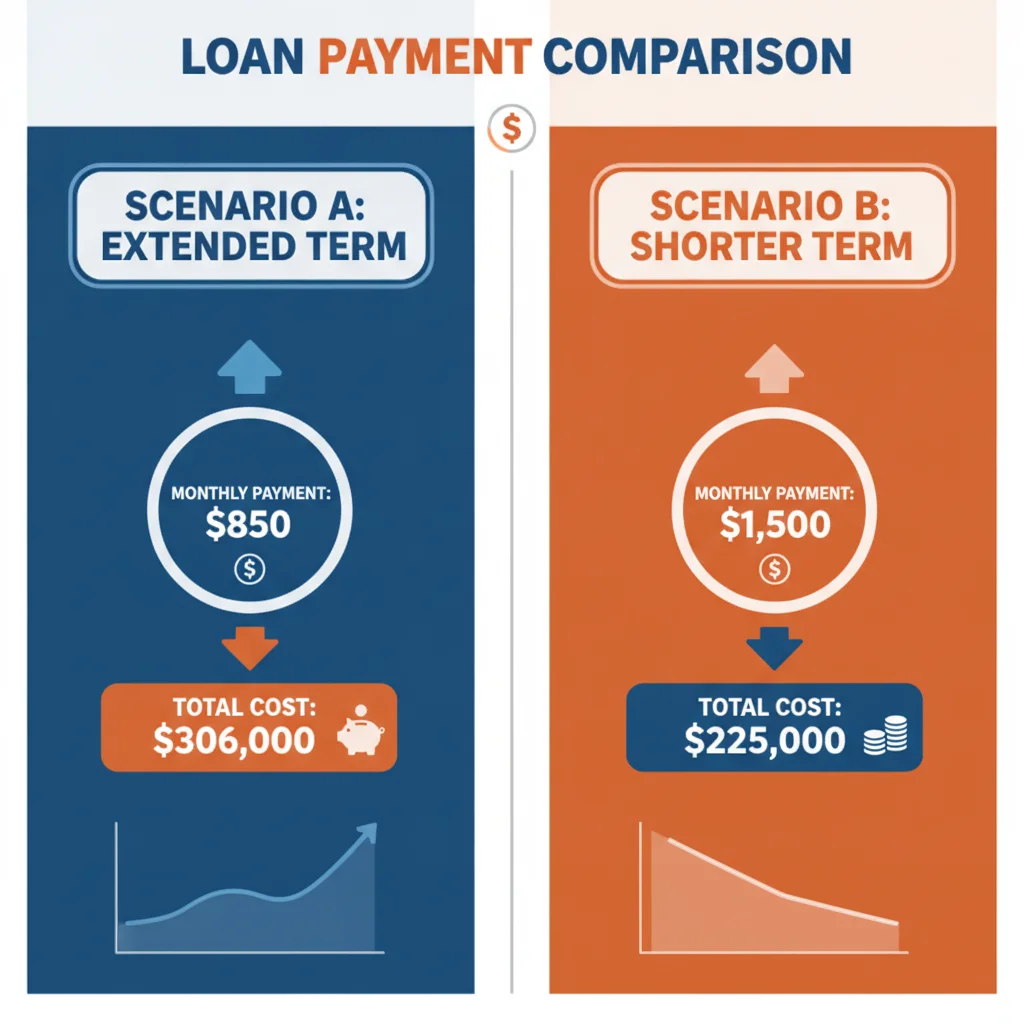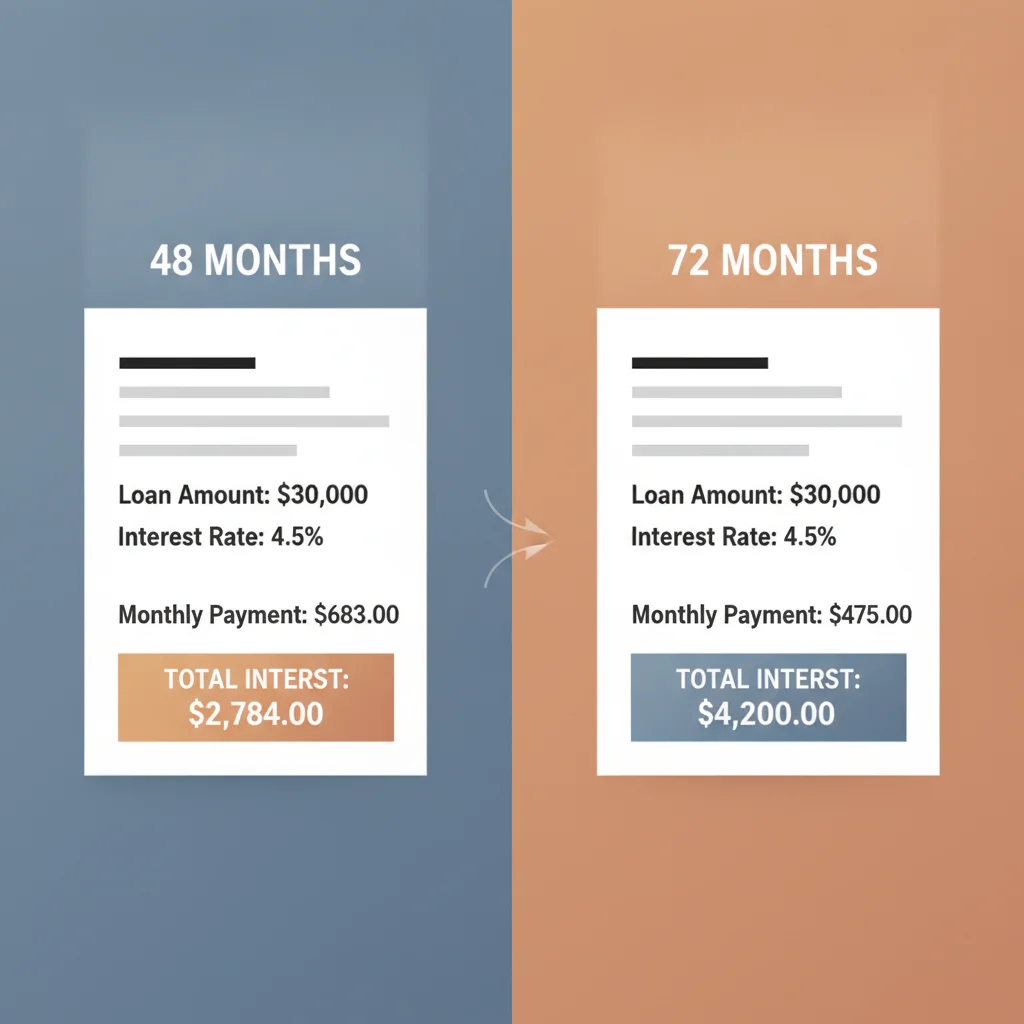
Key Takeaways
Carrying a Loan to Full Term
Carrying an auto loan to full term means making every scheduled payment until the loan is completely paid off, without paying extra or refinancing early. Most borrowers do exactly this — but it maximizes the total interest the lender collects. Every month the balance remains open, interest accrues on whatever principal is still owed.
Auto loans are typically structured as simple-interest loans, meaning interest is calculated daily on the outstanding principal balance. The longer the balance stays high, the more interest accumulates — this is why front-loaded amortization schedules charge the most interest in the earliest months.
Why Monthly Payments Are a Misleading Metric
Walk into any dealership and the conversation will almost immediately center on one number: your monthly payment. Salespeople are trained to talk this way because a lower monthly figure is easier to say yes to. But your monthly payment tells you almost nothing about what borrowing that money will actually cost you.
The real number — the one that should matter most to you as a borrower — is the total amount repaid over the life of the loan. That includes every dollar of principal plus every dollar of interest. The gap between those two figures is what the lender earns, and what you lose, in exchange for being allowed to drive the car before you've fully paid for it.
Consider a simple example. You borrow $28,000 at 7% APR. Over 48 months, your monthly payment is roughly $670, and your total interest paid comes to about $4,160. Stretch that same loan to 72 months and your monthly payment drops to $477 — but your total interest balloons to approximately $6,360. That's more than $2,200 in additional cost simply for spreading the payments out longer.
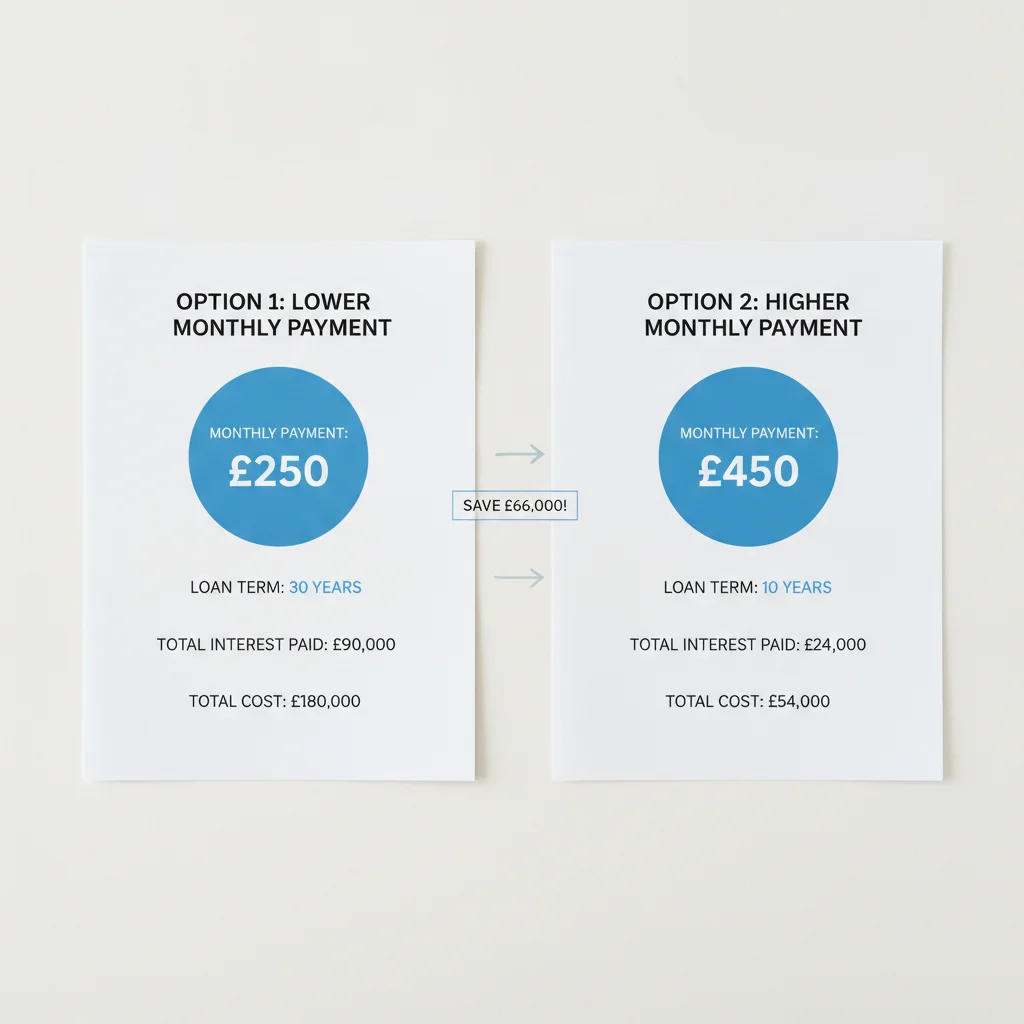
This is the fundamental trade-off that most buyers never fully reckon with. A lower monthly payment can cost you significantly more in the end — and understanding why requires a basic grasp of how auto loan interest actually works.
Check for Prepayment Penalties First
Before making extra payments or paying off a loan early, check your loan agreement for prepayment penalty clauses. While most modern auto loans in the U.S. don't carry these penalties, some lenders — particularly those offering subprime financing — may charge a fee if you pay off the balance before a certain date. This is worth confirming before you implement any early payoff strategy.
GAP Insurance and Negative Equity
Guaranteed Asset Protection (GAP) insurance covers the difference between your loan balance and your vehicle's actual cash value if the car is totaled or stolen. It's most valuable — and most necessary — on long-term loans where negative equity is most likely. If you're financing for 60 months or longer, GAP coverage is worth the cost, especially in the first two years of the loan.
How Auto Loan Interest Actually Accumulates
Most auto loans in the U.S. are structured as simple-interest loans. That means interest is calculated on your current principal balance every single day. Each time you make a payment, a portion covers the interest that has accrued since your last payment, and the remainder reduces your principal.
This structure has a critical consequence: in the early months of your loan, the vast majority of each payment goes toward interest, not principal. This is called front-loaded amortization. The principal barely moves at first, which means the base on which interest is calculated stays high for a long time.
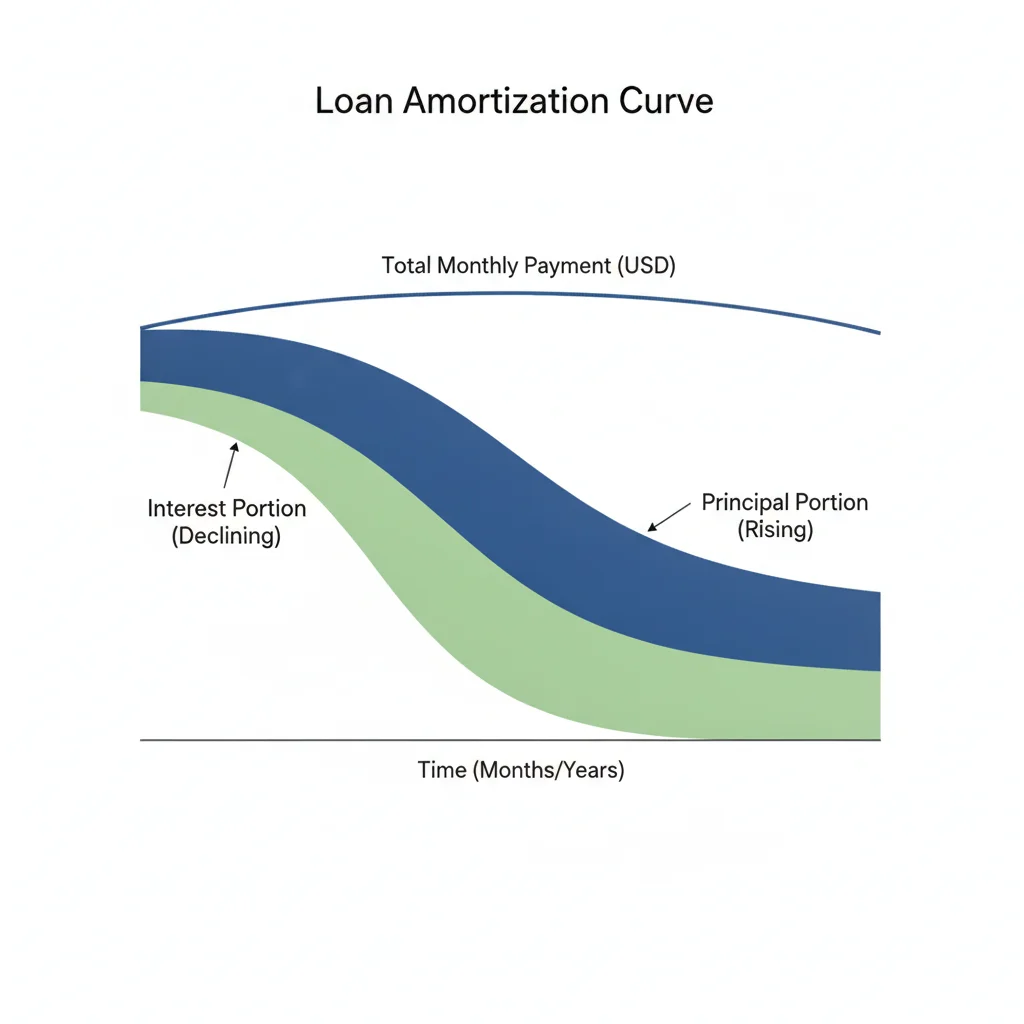
Here's a concrete look at how amortization plays out on a $28,000 loan at 7% APR over 60 months:
| Month | Payment | Interest Portion | Principal Portion | Remaining Balance |
|---|---|---|---|---|
| 1 | $554 | $163 | $391 | $27,609 |
| 6 | $554 | $151 | $403 | $25,852 |
| 12 | $554 | $136 | $418 | $23,231 |
| 30 | $554 | $91 | $463 | $15,649 |
| 48 | $554 | $38 | $516 | $6,502 |
| 60 | $554 | $3 | $551 | $0 |
Notice that in month one, nearly 30% of your payment goes straight to interest. By month 60, it's barely a rounding error. This is exactly why paying extra early in the loan yields the greatest savings — you're cutting down the principal while it's still large, which cascades through every subsequent month's interest calculation. For a detailed walkthrough of how to calculate total interest yourself, see calculating total interest paid on a car loan before you sign.
72 months
Most common new car loan term in the U.S.
According to Experian's State of the Automotive Finance Market report, 72-month loans are now the single most popular loan term for new vehicle financing.
$7,000+
Average interest paid on a 72-month new car loan
Based on average new vehicle loan amounts and prevailing APRs in 2024, borrowers carrying a 72-month loan to full term typically pay over $7,000 in interest.
~20%
New car value lost in year one
Industry depreciation data consistently shows new vehicles lose approximately 15–25% of their value within the first 12 months of ownership, creating early negative equity risk.
32%
Borrowers who are underwater on their auto loan
Edmunds reported that roughly one in three trade-in transactions in recent years involved negative equity, meaning the borrower owed more than the car was worth.
$1,200+
Typical savings from one extra payment per year
On a mid-size auto loan of $28,000 at 7% APR over 60 months, adding one additional principal payment annually can reduce total interest by over $1,200 and shorten the loan by several months.
The Real Cost of Longer Loan Terms
Auto loan terms have stretched considerably over the past decade. Where 48- and 60-month loans were once standard, 72- and even 84-month loans are now commonplace. Lenders and dealers promote these extended terms as a solution to rising vehicle prices — after all, a longer term means a lower monthly payment. But the true cost math is punishing.
Look at the same $32,000 vehicle financed at 7.5% APR across multiple term lengths:
| Loan Term | Monthly Payment | Total Interest Paid | Total Repaid |
|---|---|---|---|
| 36 months | $994 | $3,784 | $35,784 |
| 48 months | $773 | $5,104 | $37,104 |
| 60 months | $641 | $6,460 | $38,460 |
| 72 months | $553 | $7,816 | $39,816 |
| 84 months | $491 | $9,244 | $41,244 |
Choosing an 84-month loan over a 36-month loan on this vehicle costs an additional $5,460 in interest alone — enough to cover several years of car insurance or a major repair. And that calculation doesn't even account for the higher APR that lenders typically charge on longer-term loans, since extended terms represent greater risk.
Loan term length and APR interact in ways most buyers underestimate — lenders routinely charge 0.5% to 1.5% more in APR for a 72- or 84-month term compared to a 48-month term on the same vehicle. That premium compounds the total cost further.
Get Pre-Approved Before You Shop
Walking into a dealership with a pre-approved loan offer from a bank or credit union gives you a concrete benchmark. You'll know your rate, your term options, and your maximum payment before any dealer finance office gets involved. This shifts the negotiation from 'what monthly payment can you afford?' to 'can you beat the rate I already have?' — a fundamentally stronger position.
Always Ask How Extra Payments Are Applied
Before making any additional payment beyond your scheduled amount, call your lender and ask specifically how they apply overpayments. Some lenders automatically apply extra funds to future scheduled payments — which doesn't reduce principal or save you interest at all. Request in writing that any overpayment be applied directly to the principal balance.
Run the Total Cost Before Agreeing to Any Term
Before you sign any loan document, calculate total interest yourself: multiply the monthly payment by the number of months, then subtract the principal. This one number — which takes 30 seconds to compute — is the actual cost of choosing that term and rate. If the number surprises you, it's a signal to negotiate or reconsider the term length.
Negative Equity: When the Loan Outlasts the Car's Value
There's a second major risk embedded in long-term auto loans that has nothing to do with interest math: negative equity, also called being "underwater" or "upside down" on your loan.
A new car loses roughly 20% of its value in the first year and up to 50% within three years. A simple-interest loan on a long term depreciates the debt much more slowly than the vehicle depreciates in the real world. The result: for a significant portion of a 72- or 84-month loan, the car is worth less than what you still owe on it.
“The monthly payment is the most dangerous number in a car deal. It's the number that gets buyers nodding — but it hides everything that actually determines whether the deal is good or bad for them.”
— Melinda Zabritski, Senior Director of Automotive Financial Solutions, Experian
Being underwater on a loan creates serious practical problems. If your car is totaled in an accident, your insurance pays out the vehicle's current market value — not what you owe the lender. On a 72-month loan in month 18, that gap could easily be $3,000 to $6,000. Unless you carry GAP insurance, that difference comes out of your pocket.
Negative equity also makes it difficult to trade in or sell the vehicle before the loan is paid off. If you owe $22,000 and the car is worth $17,000, you either need to pay the $5,000 difference in cash or roll it into a new loan — which immediately puts you underwater on the next vehicle too.
Check for Prepayment Penalties First
Before making extra payments or paying off a loan early, check your loan agreement for prepayment penalty clauses. While most modern auto loans in the U.S. don't carry these penalties, some lenders — particularly those offering subprime financing — may charge a fee if you pay off the balance before a certain date. This is worth confirming before you implement any early payoff strategy.
GAP Insurance and Negative Equity
Guaranteed Asset Protection (GAP) insurance covers the difference between your loan balance and your vehicle's actual cash value if the car is totaled or stolen. It's most valuable — and most necessary — on long-term loans where negative equity is most likely. If you're financing for 60 months or longer, GAP coverage is worth the cost, especially in the first two years of the loan.
Strategies That Shorten Your Loan's Life (And Cut Your Cost)
The good news: you don't have to accept the full cost of carrying a loan to term. There are several practical strategies that can meaningfully reduce the total interest you pay — some you can implement before you sign, others you can deploy mid-loan.
1. Choose the Shortest Term You Can Afford
This is the single most impactful decision you make. If you can manage the higher monthly payments of a 48-month loan versus a 72-month loan, the interest savings are significant and guaranteed. Use an amortization calculator to compare total costs across terms before you commit. The Loan Terms Explained hub walks through how to interpret these numbers in practice.
2. Make Extra Principal Payments
If your loan agreement doesn't include a prepayment penalty (most modern auto loans don't), you can pay extra toward principal any time. Even an additional $75 to $100 per month applied exclusively to principal will cut months off your loan and reduce total interest meaningfully. The key word is principal — make sure your lender applies extra payments to the balance, not toward future scheduled payments.
3. Make Bi-Weekly Payments
Instead of making one monthly payment, split the amount in half and pay every two weeks. Because there are 52 weeks in a year, this results in 26 half-payments — the equivalent of 13 full monthly payments instead of 12. That extra payment each year reduces principal faster and shaves time off the loan's life.
4. Refinance to a Lower Rate or Shorter Term
If your credit score has improved since you took out the loan, or if market rates have dropped, refinancing can make real economic sense. Refinancing to a lower APR on the same remaining term reduces your interest cost. Refinancing to a shorter remaining term (even at the same rate) does the same. Just watch for any fees or penalties in your current loan agreement before pursuing this route.
5. Put More Down Upfront
A larger down payment reduces the principal you borrow from day one. Less principal means less interest across every month of the loan. A 10–20% down payment is a conventional target; even a few extra hundred dollars at signing reduces your total cost dollar-for-dollar. See the full breakdown in the full cost of a car loan over time.

Get Pre-Approved Before You Shop
Walking into a dealership with a pre-approved loan offer from a bank or credit union gives you a concrete benchmark. You'll know your rate, your term options, and your maximum payment before any dealer finance office gets involved. This shifts the negotiation from 'what monthly payment can you afford?' to 'can you beat the rate I already have?' — a fundamentally stronger position.
Always Ask How Extra Payments Are Applied
Before making any additional payment beyond your scheduled amount, call your lender and ask specifically how they apply overpayments. Some lenders automatically apply extra funds to future scheduled payments — which doesn't reduce principal or save you interest at all. Request in writing that any overpayment be applied directly to the principal balance.
Run the Total Cost Before Agreeing to Any Term
Before you sign any loan document, calculate total interest yourself: multiply the monthly payment by the number of months, then subtract the principal. This one number — which takes 30 seconds to compute — is the actual cost of choosing that term and rate. If the number surprises you, it's a signal to negotiate or reconsider the term length.
How to Calculate What Your Loan Actually Costs Before You Sign
Before you commit to any loan offer, you should know the total interest you'll pay if you carry it to full term. This calculation is straightforward and takes less than five minutes.
The Basic Formula
- Multiply your monthly payment by the number of months in the term. This gives you total repaid.
- Subtract the original loan principal from that total. The result is total interest paid.
Example: $553 monthly × 72 months = $39,816 total repaid. $39,816 − $32,000 principal = $7,816 in interest.
That's the number you should be negotiating around — not the monthly payment. If a dealer quotes you a rate and term that produces a total interest figure you're not comfortable with, you have two levers: negotiate the rate down, or shorten the term.
For a step-by-step guide to doing this math before you ever walk into a dealership, see how to calculate total interest paid on a car loan before you sign. And for a broader view of how interest rates interact with term length across different scenarios, the Interest and APR hub has detailed comparisons worth reviewing.


All claims are backed by peer-reviewed research. Sources on request.