Key Takeaways
Why Your Monthly Payment Is the Wrong Number to Focus On
Dealerships and lenders have one goal when presenting financing: make the monthly payment sound affordable. And it works. Studies consistently show that most buyers fixate on the monthly number, not the total cost of borrowing. That's a costly mistake.
Consider two buyers financing a $32,000 vehicle:
| Scenario | APR | Term | Monthly Payment | Total Interest Paid |
|---|---|---|---|---|
| Buyer A | 5.9% | 48 months | $749 | $3,952 |
| Buyer B | 7.4% | 72 months | $549 | $7,528 |
Buyer B's payment looks $200 cheaper every month. But over the life of the loan, Buyer B pays $3,576 more in interest — while also being underwater on the vehicle for a longer stretch. That's the trap a monthly-payment mindset leads you into.
Before you sign anything, you need to know the total interest figure. This guide shows you exactly how to get there — with or without a calculator app. See also how loan length and interest stack into your true cost of borrowing for a deeper breakdown.
Rate vs. APR: The Difference That Changes Your Math
Before you run any numbers, you need to know which rate you're actually working with. Many buyers confuse the interest rate (sometimes called the nominal rate) with the APR (Annual Percentage Rate). They are not the same, and the difference directly affects what you'll pay.
- Interest Rate
- The base cost of borrowing the principal, expressed as an annual percentage. It does not include any fees.
- APR
- The interest rate plus most lender fees — origination charges, documentation fees rolled into the loan — expressed as a single annual percentage. Required by federal Truth in Lending Act disclosures.
On a straightforward bank or credit union auto loan, the APR and interest rate are often identical or very close. But when a dealer finances through a captive lender and rolls in fees, the APR can be noticeably higher than the advertised rate. Always ask: What is the APR on this loan, not just the interest rate?
Never Compare Interest Rate to APR
If one lender quotes you a 5.9% interest rate and another quotes a 6.1% APR, you cannot directly compare those two numbers. The interest rate excludes fees; the APR includes them. Always request the APR from every lender and use that figure exclusively when comparing offers.
Add-Ons Rolled Into the Loan Cost More Than They Appear
A $1,500 extended warranty rolled into a 72-month loan at 7.9% doesn't cost $1,500 — it costs $1,500 plus the interest that accrues on it over six years. Always calculate the total interest impact of any add-on product before agreeing to finance it.
When comparing loan offers from multiple sources — your bank, a credit union, and the dealer — always compare APRs, not interest rates. Comparing an interest rate from one lender to an APR from another gives you a meaningless number. The loan terms hub covers how to read a full loan disclosure correctly.
What You Need Before You Calculate
You don't need a finance degree to do this math, but you do need four specific numbers from your loan offer. Get these in writing — don't rely on verbal quotes.
What you will need
Online amortization calculator
Generates a full payment-by-payment breakdown of principal and interest — faster and more detailed than manual calculation.
Scientific or financial calculator
Required for the manual loan payment formula, specifically the exponent step (1 + r)^n.
Truth in Lending Act (TILA) disclosure
The federal document that shows your APR, total of payments, and finance charge — the authoritative source for all four loan variables.
Spreadsheet software (Excel or Google Sheets)
Lets you build a custom amortization table and model different loan scenarios side by side.
How to Calculate Total Interest Paid: Step by Step
There are two reliable methods: the manual formula and an amortization calculator. The manual formula is faster for a ballpark; the amortization table gives you a payment-by-payment breakdown. Both are covered below.
Gather your four loan variables
You need these four numbers, all of which must appear on any formal loan offer or Truth in Lending disclosure:
- Loan principal (P): The amount you're financing — purchase price minus down payment and trade-in credit, plus any fees rolled into the loan.
- Annual Percentage Rate (APR): Not the interest rate — the APR. If the lender can't give you an APR, walk away or call your state's consumer finance regulator.
- Loan term (n): Number of months you'll be making payments (e.g., 48, 60, 72).
- Monthly payment (M): What you'll pay each month per the loan agreement.
If you're comparing two offers, gather all four numbers for each one. Don't compare offers that use different units — one lender quoting an APR and another quoting an interest rate means you're not comparing the same thing.
Convert your APR to a monthly rate
Auto loans use simple interest calculated monthly, so you need a monthly version of your APR. The conversion is straightforward:
Monthly Rate (r) = APR ÷ 12Examples:
- APR of 6.0% → r = 0.06 ÷ 12 = 0.005
- APR of 7.9% → r = 0.079 ÷ 12 = 0.006583
- APR of 4.5% → r = 0.045 ÷ 12 = 0.00375
Keep at least four decimal places in your monthly rate — rounding too early introduces compounding errors that make your final interest figure inaccurate.
Calculate your monthly payment using the loan formula (or verify the quoted payment)
Even if the lender gave you a monthly payment figure, verify it yourself. The standard amortizing loan payment formula is:
M = P × [r(1 + r)^n] ÷ [(1 + r)^n − 1]Where:
- M = monthly payment
- P = loan principal
- r = monthly interest rate (APR ÷ 12)
- n = number of monthly payments
Worked example: $28,000 loan, 6.9% APR, 60-month term.
- r = 0.069 ÷ 12 = 0.00575
- (1 + 0.00575)^60 = 1.4083
- Numerator: 0.00575 × 1.4083 = 0.008098
- Denominator: 1.4083 − 1 = 0.4083
- M = $28,000 × (0.008098 ÷ 0.4083) = $28,000 × 0.019833 = $555.32/month
If the dealer's quoted payment differs from your calculation by more than a few cents, ask them to explain the discrepancy. It may mean fees were rolled in that you weren't told about.
Calculate total amount paid over the loan life
This is the simplest step, and the result is often the most eye-opening:
Total Paid = Monthly Payment (M) × Number of Payments (n)Using the example above:
Total Paid = $555.32 × 60 = $33,319.20You borrowed $28,000. You will hand over $33,319.20. The difference is your total interest cost.
Subtract the principal to get total interest paid
Now subtract what you originally borrowed from the total you'll pay:
Total Interest = Total Paid − Loan PrincipalContinuing the example:
Total Interest = $33,319.20 − $28,000 = $5,319.20That's $5,319.20 in interest on a $28,000 loan at 6.9% APR over 60 months. Write this number down. This is what you're actually paying for the privilege of financing this vehicle.
Use an amortization table for a payment-by-payment breakdown
The five steps above give you the total interest figure. An amortization table goes further — it shows how each individual payment splits between principal and interest, and how much you still owe after every payment.
To build or access one:
- Online calculators: Search "auto loan amortization calculator" — enter principal, APR, and term. The table is generated instantly.
- Spreadsheet (Excel or Google Sheets): Each row represents one month. Columns: Payment #, Beginning Balance, Interest Paid, Principal Paid, Ending Balance. Interest for any month = Beginning Balance × Monthly Rate.
What the table reveals that the summary doesn't:
- In the early months of a 72-month loan at 7.9%, the majority of each payment goes to interest, not principal.
- After 12 payments on a 72-month loan, you may have paid down less than 12% of the principal despite making 17% of total payments.
- Refinancing in month 6 vs. month 36 has very different interest implications — the table shows exactly where you stand.
Compare Total Interest, Not Just Monthly Payments
When a dealer presents multiple financing options, ask them to write down the total interest paid for each scenario — not just the monthly payment. Many finance managers won't volunteer this number. If they won't provide it, calculate it yourself using the steps above before agreeing to anything.
Use a Shorter Term If the Math Supports It
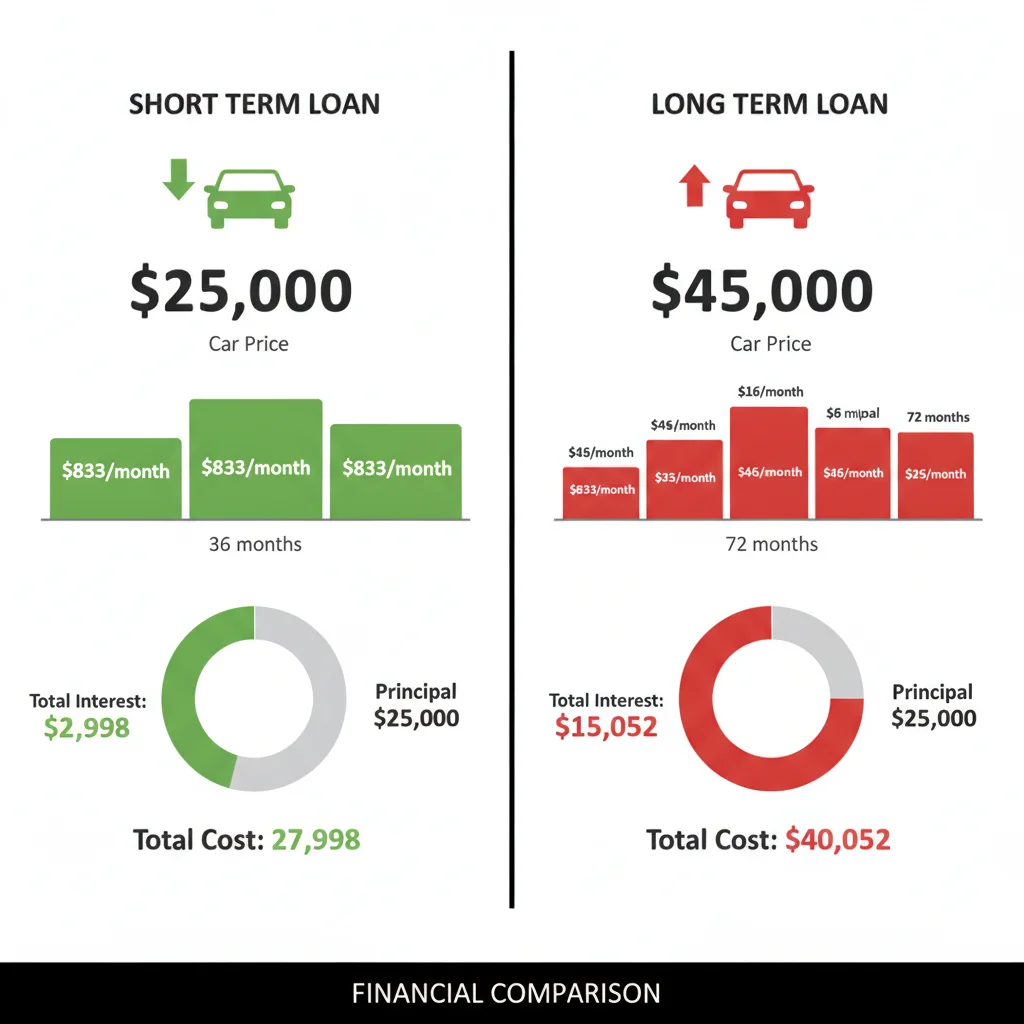
Run your calculation at 48 months before defaulting to 60 or 72. The monthly increase is often smaller than buyers expect, and the interest savings are almost always substantial. A $30,000 loan at 6.5% costs roughly $1,800 more in interest on a 72-month term versus a 48-month term.
Once you know your total interest, it's worth running the same calculation on a shorter loan term. You'll often find that bumping from 72 months to 60 months — even with a slightly higher monthly payment — can cut total interest by 20–30%. That's a real trade-off worth seeing in black and white before you sit across from the finance manager. For a full look at what carrying a loan to term actually costs, see The True Cost of Carrying an Auto Loan to Full Term.

Putting the Numbers to Work: Real-World Scenarios
Abstract math is easy to dismiss. Real numbers make it stick. Below are three common loan scenarios calculated using the methods described above.
| Loan Amount | APR | Term | Monthly Payment | Total Paid | Total Interest |
|---|---|---|---|---|---|
| $25,000 | 5.0% | 48 mo | $576 | $27,648 | $2,648 |
| $25,000 | 5.0% | 60 mo | $472 | $28,320 | $3,320 |
| $25,000 | 5.0% | 72 mo | $403 | $29,016 | $4,016 |
| $35,000 | 7.9% | 60 mo | $709 | $42,540 | $7,540 |
| $35,000 | 7.9% | 72 mo | $608 | $43,776 | $8,776 |
Notice that on the $35,000 loan at 7.9%, simply extending from 60 to 72 months — a drop of $101 per month — costs an extra $1,236 in interest. The monthly savings feel significant; the total cost difference is quietly painful.
Longer Terms Almost Always Cost More Total
Extending a loan from 60 to 72 months to lower your monthly payment will virtually always increase your total interest paid — sometimes by $1,000–$3,000 or more on a mid-range vehicle. The only scenario where a longer term makes financial sense is if you invest the monthly savings at a higher return than your loan's APR — which requires discipline few buyers actually maintain. Make this trade-off consciously, with numbers in hand, not because a lower payment sounds appealing in the moment.
Verify Every Number Against the Signed Contract
Verbal quotes from finance managers are not binding. The numbers that matter are the ones printed on the contract you sign. Before you initial anything, locate the APR, the total of payments, and the finance charge on the federal TILA disclosure — typically the first page of your loan paperwork. If any of those numbers differ from what you were quoted verbally, stop and ask for a written explanation before proceeding.
Understanding total interest also gives you leverage in the finance office. If a dealer is offering to lower your rate by 0.5% in exchange for a longer term, you can now run the numbers yourself and see whether that trade actually saves you money — it often doesn't.
After you've locked in your loan, the next logical step is understanding how extra payments change the equation. The math behind paying extra on your car loan shows exactly how even $50 more per month can slash total interest. And if you're considering a lump-sum payoff, what happens to your interest when you pay off early explains how simple interest loans handle that calculation. For a complete picture of your monthly obligation, see Calculating Your True Monthly Auto Loan Cost.
Common Mistakes That Skew Your Calculation
Even buyers who attempt this math often arrive at the wrong number. Here are the errors to watch for:
- Using the interest rate instead of APR. If fees are baked into your loan, the interest rate understates your true cost. Always use the APR on your federal Truth in Lending disclosure.
- Forgetting to account for a down payment. Your loan amount is the purchase price minus your down payment and any trade-in equity — not the sticker price. Running the formula on the sticker inflates your result.
- Ignoring add-on products. GAP insurance, extended warranties, and paint protection rolled into the loan increase your principal — and therefore the interest you pay on them. Calculate the loan with and without add-ons to see their true cost.
- Assuming the dealer's payment quote uses the rate they quoted. Finance managers sometimes quote a rate verbally, then structure the contract at a higher rate. Pull the APR directly off the contract, not the conversation.
- Using monthly rate instead of annual rate in the formula. In the manual formula, r must be your monthly rate (APR ÷ 12). Using the full APR as r produces a wildly incorrect payment figure.
Longer Terms Almost Always Cost More Total
Extending a loan from 60 to 72 months to lower your monthly payment will virtually always increase your total interest paid — sometimes by $1,000–$3,000 or more on a mid-range vehicle. The only scenario where a longer term makes financial sense is if you invest the monthly savings at a higher return than your loan's APR — which requires discipline few buyers actually maintain. Make this trade-off consciously, with numbers in hand, not because a lower payment sounds appealing in the moment.
Verify Every Number Against the Signed Contract
Verbal quotes from finance managers are not binding. The numbers that matter are the ones printed on the contract you sign. Before you initial anything, locate the APR, the total of payments, and the finance charge on the federal TILA disclosure — typically the first page of your loan paperwork. If any of those numbers differ from what you were quoted verbally, stop and ask for a written explanation before proceeding.
Running these calculations before you step into the dealership — not during the finance office appointment — gives you the clearest head. Once you're sitting in a chair being handed paperwork, time pressure works against careful math. Know your numbers ahead of time.
All claims are backed by peer-reviewed research. Sources on request.