Key Takeaways
Why Subprime Borrowers Have More Leverage Than They Think
When you first took out a subprime auto loan, the lender was pricing in significant risk. A high APR — often 15%, 20%, or even higher — reflects the lender's uncertainty about whether you'd repay reliably. But here's the thing: if you've made consistent on-time payments for the past 12–24 months, you've demonstrated exactly the behavior that makes you a better borrower now than you were then.
That behavioral track record, combined with any improvement in your credit score, is leverage. New lenders don't see you as the risky borrower from two years ago — they see a current credit report, and if that report shows responsible repayment, they'll compete for your business at better rates.
Subprime auto loan APRs can cost borrowers thousands of extra dollars over the life of a loan — and most borrowers don't realize the full damage until they run the math. A 21% APR on a $15,000 loan with a 60-month term means paying over $9,000 in interest alone. Cut that rate to 10% and total interest drops to roughly $4,000. That's $5,000 returned to your pocket.
The process of refinancing out of that loan isn't complicated, but it requires timing, preparation, and a clear-eyed look at your numbers before you apply. Understanding when refinancing makes sense is the foundation — then the steps below show you exactly how to execute it.

Below are the tools and documents you'll need before you begin:
What you will need
Auto Loan Refinance Calculator
Compares your current monthly payment and total interest against projected figures under a new rate and term.
Free Credit Score Service
Lets you check your current credit score before applying so you can target appropriate lenders.
Loan Payoff Statement
Official document from your lender showing the exact amount needed to close out your current loan today.
Vehicle History Report (e.g., Carfax)
Some lenders request this to confirm the car's condition and market value before approving a refinance.
Online Lending Marketplace (e.g., LendingTree, AutoPay, RateGenius)
Submits your information to multiple lenders simultaneously, helping you compare offers efficiently.
Pull your credit score and review your credit report
Before you approach a single lender, you need to know exactly where your credit stands today. Your credit score determines which lenders will consider you and at what rate — and if it hasn't moved much since your original loan, refinancing may not yet be worth pursuing.
Request your free credit reports from AnnualCreditReport.com (the only federally mandated free source) and check your score through your bank, credit card issuer, or a service like Credit Karma. Look for:
- Score tier: If you were deep subprime (below 580) when you borrowed and are now above 620 or 660, you've likely crossed into a meaningfully better rate tier.
- Errors: Incorrect late payments, duplicate accounts, or wrong balances can artificially suppress your score. Dispute errors with the relevant bureau before applying — removing one erroneous late payment can add 20–40 points.
- Open collections or derogatory marks: Lenders will see these. Know what's there so you're not blindsided during underwriting.
As a rule of thumb, a credit score improvement of 40–60 points or more since your original loan is a meaningful signal that refinancing is worth exploring. Less than that, and the rate reduction may be marginal.
Get your current loan payoff amount
Call your current lender or log into your account portal and request an official payoff statement. This is different from your remaining balance — it includes any accrued interest through a specific date (usually 10–30 days out). Ask for it in writing.
You need this number to:
- Know exactly how much a new lender needs to pay off your existing loan
- Determine whether you'd be underwater (owing more than the car is worth)
- Catch any prepayment penalties buried in your original contract
While you have your lender on the line, ask directly: "Does my loan have a prepayment penalty?" Some subprime lenders charge a fee — typically 1–2% of the remaining balance or a flat fee — if you pay off the loan early. If that fee eats into your projected savings, it changes the math significantly.
Check your car's current market value
Lenders refinance the car, not just you. They want to ensure the vehicle is worth at least as much as — and ideally more than — what they're lending. If you owe $14,000 but the car is only worth $10,000, most lenders will decline the application outright.
Use Kelley Blue Book (kbb.com) or Edmunds to get a private-party or trade-in value estimate. Enter your car's actual mileage, condition, and zip code to get a realistic figure.
Then calculate your loan-to-value (LTV) ratio:
LTV = Payoff Amount ÷ Vehicle Value × 100
Example: $13,500 payoff ÷ $16,000 car value = 84% LTV. Most refinance lenders prefer an LTV at or below 100–120%. Above that, you may be limited in your options. For a detailed look at what to do when you owe more than the car is worth, see Upside-Down on Your Car Loan: Can You Still Refinance?.
Also confirm your car meets basic lender eligibility requirements. Most refinance lenders require:
- Vehicle is less than 10 years old (some set it at 7)
- Fewer than 100,000 miles (some cap at 120,000)
- Not a salvage-title or rebuilt vehicle
Run the numbers before you apply
Don't apply anywhere until you understand whether refinancing will actually save you money. Use a free auto loan refinance calculator to compare your current loan against a hypothetical new one.
Here's a concrete example to illustrate the stakes:
| Scenario | Loan Balance | APR | Remaining Term | Monthly Payment | Total Interest Remaining |
|---|---|---|---|---|---|
| Current subprime loan | $14,000 | 21% | 48 months | $433 | $6,800 |
| Refinanced loan | $14,000 | 11% | 48 months | $363 | $3,400 |
| Savings | — | — | — | $70/month | $3,400 total |
In this example, cutting 10 percentage points off the APR saves $70 per month and $3,400 over four years. That's meaningful. Even a 5-point reduction would save roughly $1,500–$1,700 in interest depending on the balance.
Crucially, be cautious about extending your term to lower your payment. A longer term reduces your monthly obligation but increases total interest paid — sometimes erasing your savings entirely. For guidance on how loan timing affects your outcome, learn when refinancing pays off based on where you are in your loan.
[in_content_images:0]Shop multiple lenders and get prequalification offers
Now it's time to actually approach lenders — but strategically. Rate shopping for auto loans is credit-bureau-friendly: FICO treats multiple auto loan inquiries within a 14-day window as a single hard inquiry. So apply broadly within that window, not one at a time over several months.
Where to look:
- Credit unions: Frequently offer the most competitive refinance rates, especially for members. If you're not a member, many allow you to join with a small donation to an affiliated organization.
- Community banks: Often more flexible underwriting than big banks, with competitive rates for near-prime and prime borrowers.
- Online lenders: Companies like AutoPay, iLending, and RateGenius specialize in auto refinancing and can surface multiple offers in one application.
- Your current lender: Worth calling to ask if they'll modify your rate — some will to retain your business, without requiring a full refinance application.
When comparing offers, look beyond the monthly payment. Evaluate:
- The APR (not just the interest rate)
- The loan term being offered
- Any origination fees added to the loan balance
- Whether the lender allows early payoff without penalty
For background on how to formally get preapproved and what that process looks like, see our guide to loan preapproval.
Compare offers and choose the strongest one
Once you have two or more firm offers in hand, compare them side by side using the total cost of the loan — not just the monthly payment. Here's what to look at:
- Total interest paid: Multiply the monthly payment by the number of months and subtract the loan principal. The remainder is your true interest cost.
- APR vs. rate: APR includes fees; interest rate does not. Always compare APRs when lenders are quoting different fee structures.
- Fees rolled into the loan: Some lenders charge an origination fee (often $200–$500) and fold it into your new balance. This raises the amount you're borrowing and the interest you'll pay.
If one lender offers a slightly higher APR but no fees, it may ultimately cost less than a low-rate offer with a $400 origination fee. Run the total-cost math before deciding.
Once you've chosen, you'll submit your full application with supporting documents: pay stubs or tax returns, proof of insurance, your vehicle's VIN, and the payoff statement from your current lender. The new lender typically handles paying off your old loan directly.
Confirm your old loan is paid off and update your records
After your new loan closes, don't assume everything is handled automatically. Follow up within 2–3 weeks to confirm:
- Your old lender received the payoff and the account is closed with a $0 balance
- Your credit report reflects the old loan as "paid in full" (not "charged off" or "settled")
- The new lender has sent your first statement with the correct due date and payment instructions
- Your auto insurance reflects the new lender as the lienholder (lenders require this)
Set up autopay on the new loan immediately. A single missed payment on your new loan can undo the credit progress that made the refinance possible in the first place.
If something looks wrong on your credit report — the old loan shows an incorrect balance or status — file a dispute with the credit bureau directly. You're entitled to accurate reporting.
Common Pitfalls That Kill a Good Refinance
Even borrowers who qualify for better rates sometimes end up worse off because they made avoidable mistakes during the refinancing process. Here are the most common ones — and how to sidestep them.
Refinancing Late in Your Loan Rarely Saves Money
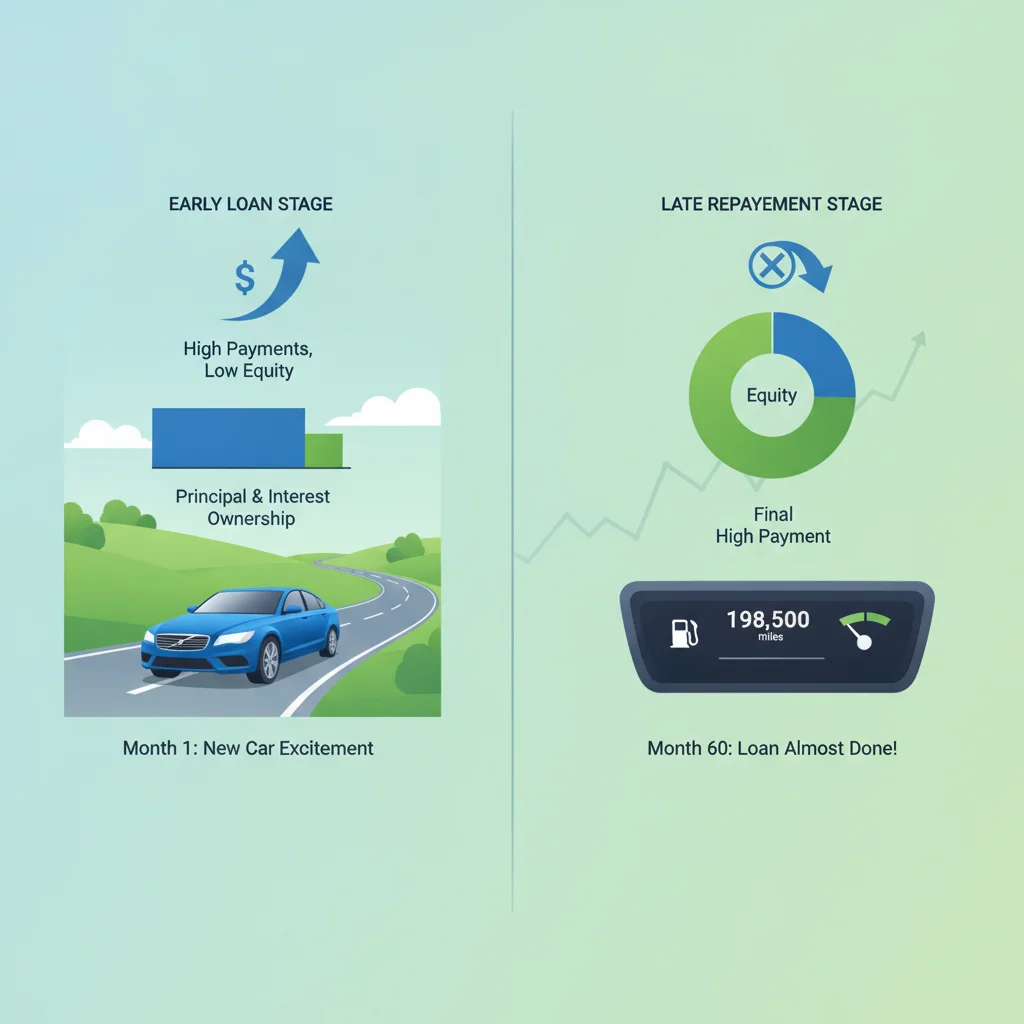
Auto loans are amortized, meaning you pay the most interest in the early months. If you're already in the final 12–18 months of repayment, most of the interest has already been paid. Refinancing at this stage resets the amortization schedule and may cost you more than it saves, even at a lower rate. Check the total interest remaining on your current loan before proceeding.
Watch for Prepayment Penalties Before You Apply
Some subprime auto loan contracts include prepayment penalties — fees charged when you pay off a loan early. These can range from a flat fee to a percentage of the outstanding balance. If your contract includes one, factor that cost into your savings calculation before submitting a refinance application. A $400 penalty against $800 in projected savings changes the picture considerably.
Your Old Loan Doesn't Close Automatically
After your refinance closes, you are responsible for confirming that your original lender received the payoff and marked the account as closed. Do not stop making payments on your old loan until you have written confirmation the payoff was received and processed. A gap in payments — even during a lender transition — can trigger a delinquency on your credit report and undo the credit progress that made the refinance possible.
Extending your term too aggressively
A lender who offers to refinance your remaining 36-month balance into a new 60-month loan is not doing you a favor. Yes, your monthly payment drops — but you're now paying interest for two extra years on a depreciating asset. Run the total-cost math first. If you're early in your loan, the timing of your refinance dramatically affects how much you save.
Applying too early after your original loan
Most lenders want to see at least 6–12 months of payment history on your current loan before they'll consider a refinance. Applying at month two means your credit hasn't had time to improve from those on-time payments, and you haven't built enough of a track record to be compelling.
Ignoring total interest in favor of monthly payments
Borrowers focused on cash flow often optimize for the lowest monthly payment rather than the lowest total cost. These are not the same thing. A $50/month reduction that extends your loan by 18 months may cost you more in interest than you save. Always calculate total interest paid under each scenario.
Not checking for rate-lock conditions
Some subprime lenders use rate-lock clauses or balloon payment structures that aren't obvious at first glance. Review your original contract carefully — or have someone with financial literacy read it with you — before assuming you can refinance freely. The real cost of borrowing with a low credit score is compounded when exit terms are unfavorable.
Shopping lenders over months instead of days
Every hard inquiry outside the FICO rate-shopping window affects your credit score individually. If you apply to three lenders in January, two in March, and one in April, that could register as six separate hits. Compress your applications into 14 days and the damage is treated as one.

What if your credit hasn't improved enough yet?
If your score hasn't moved significantly, the most powerful thing you can do is accelerate that progress before reapplying. Pay credit card balances down below 30% of your limit, avoid opening new credit accounts, and let your auto loan payment history keep compounding. Three to six months of disciplined behavior can move your score more than you might expect. Check back in with your numbers every 90 days until the refinance math tips clearly in your favor.
You can also look at the broader signals that indicate the right time to refinance to help you gauge your readiness before making a move.
Use a Rate-Shopping Window Strategically
FICO scoring models allow a 14-day window during which multiple auto loan inquiries are counted as one. Submit applications to all lenders you're seriously considering within that same two-week period. This protects your credit score while giving you the broadest possible comparison of real offers.
Credit Unions Often Beat Banks on Refinance Rates
Credit unions operate as nonprofit cooperatives, which means they typically pass savings back to members in the form of lower loan rates. If you're not already a member, many credit unions allow you to join through a small charitable donation or employer affiliation. The application takes minutes and the rate difference can be significant.
Make Extra Principal Payments While You Wait to Qualify
If your credit isn't quite ready for a refinance, consider making small additional principal payments each month on your current loan. This reduces your payoff balance, improves your LTV ratio, and means less interest accumulates while you wait — so you'll be in a stronger position when you do apply.

All claims are backed by peer-reviewed research. Sources on request.