
Key Takeaways
Loan Amortization
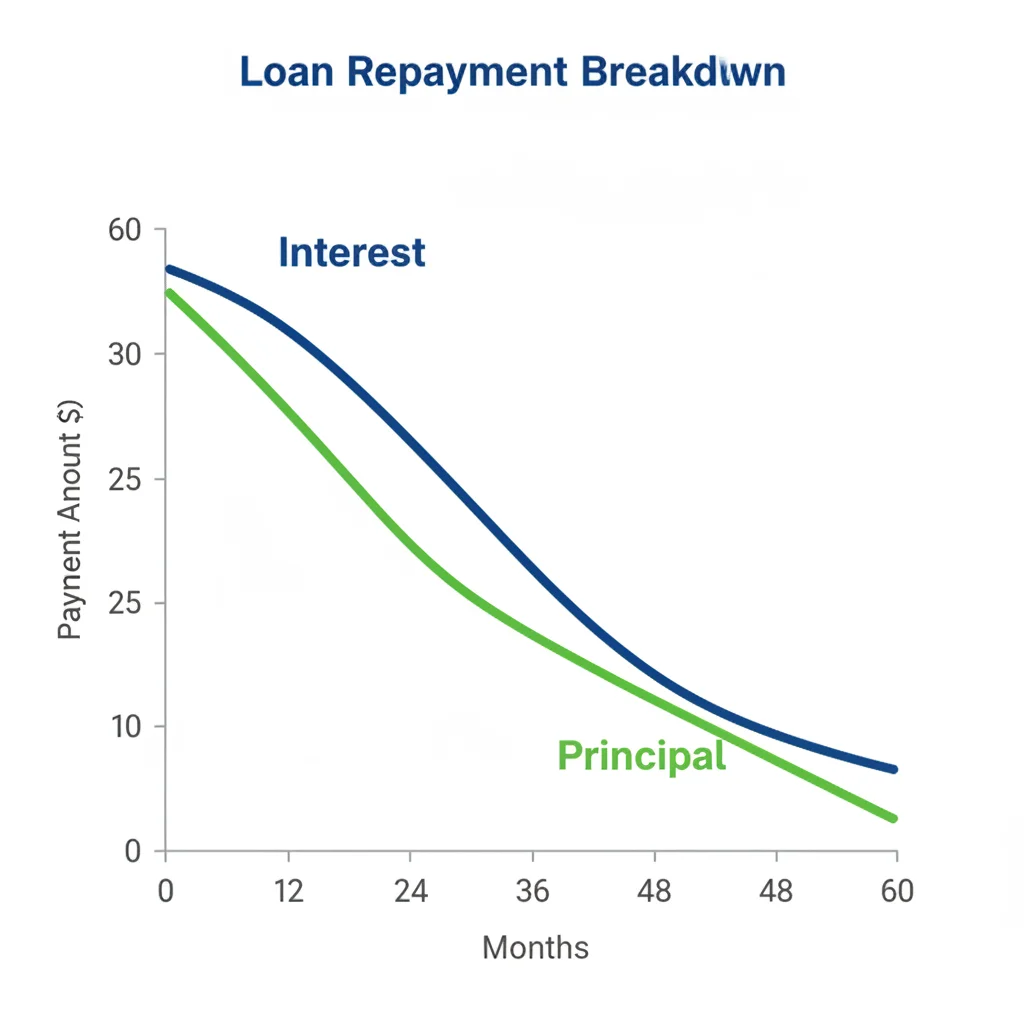
Loan amortization is the process by which your monthly payments are divided between paying down what you borrowed (principal) and paying for the cost of borrowing (interest). Early in a loan, the vast majority of each payment goes toward interest. Over time, as your balance drops, more of each payment shifts toward principal. This gradual shift is built into every standard auto loan from day one.
Lenders calculate interest on the outstanding principal balance each period using the formula: Interest = Principal Balance × (Annual Rate ÷ 12). Because the balance is highest at the start, interest charges are also highest — making the first months the most expensive relative to principal reduction.
Why Your First Car Payment Barely Dents the Balance
You've just signed the paperwork on a new auto loan. You make your first payment — let's say $525 — and feel like you're making progress. But when you check your loan balance, it's barely moved. What happened to your money?
The answer is amortization. On a $28,000 loan at 7% APR over 60 months, that first $525 payment breaks down roughly like this:
| Payment # | Total Payment | Interest Paid | Principal Paid | Remaining Balance |
|---|---|---|---|---|
| 1 | $525.00 | $163.33 | $361.67 | $27,638.33 |
| 12 | $525.00 | $140.47 | $384.53 | $23,700.00 |
| 30 | $525.00 | $100.12 | $424.88 | $16,800.00 |
| 60 | $525.00 | $3.05 | $521.95 | $0 |
Notice what changes as you move through the table: the interest portion shrinks with each payment while the principal portion grows. That's amortization doing exactly what it was designed to do. The lender collects the most interest when your balance — and their risk — is highest.
This front-loaded structure isn't a trick or a deceptive practice. It's simply how simple interest loans work. But understanding it changes how you should think about making extra payments.
The Math Behind Front-Loaded Interest
Every month, your lender calculates interest on your current outstanding balance. The formula is straightforward:
Monthly Interest = Remaining Balance × (Annual Interest Rate ÷ 12)Using our example — $28,000 at 7% APR — the first month's interest is:
$28,000 × (0.07 ÷ 12) = $28,000 × 0.005833 = $163.33After you pay that $163.33 in interest, the rest of your $525 payment — $361.67 — goes toward principal. Your new balance is $27,638.33. Next month, interest is calculated on that lower number, so the interest charge drops slightly. Repeat this 60 times and the interest portion gets smaller every single month.
Here's the critical insight: the balance doesn't drop evenly each month. In month one, only $361 worth of your payment reduces what you owe. But in month 60, nearly the entire payment is principal. The middle of the loan is where the real crossover happens — the point where more of each payment goes to principal than to interest.
~31%
Share of first payment that is interest on a 7% 60-month loan
On a $28,000 loan at 7% APR, roughly $163 of the first $525 payment — about 31% — goes to interest rather than principal reduction.
$1,000+
Potential interest savings from consistent early extra payments
Adding $100/month extra from the first payment on a $30,000, 7% APR, 60-month loan can save over $1,000 in total interest and cut the loan term by several months.
Month 28–32
Typical crossover point on a 60-month auto loan
On a standard 60-month simple interest auto loan, the interest and principal portions of each payment roughly equalize between months 28 and 32, depending on the interest rate.
13th
Extra payments per year with biweekly payment strategy
Paying half your monthly auto loan amount every two weeks results in 26 half-payments annually — equivalent to one full extra payment per year applied to principal.
This is why paying down principal before that crossover point amplifies your savings. Every extra dollar you put toward principal early eliminates not just that dollar of debt, but all the future interest that would have been charged on it for the remaining months of the loan.
Simple Interest vs. Precomputed Interest
Most auto loans in the U.S. use simple interest, meaning interest accrues daily on your current balance. This is the structure where early payoff strategies work best. Precomputed interest loans are less common but do exist — especially in subprime lending. If you're unsure which type you have, look at your loan contract's 'Method of Computing Rebate' or call your lender directly.
Low-Rate Loans: Run the Numbers First
If your auto loan rate is at or below 3%, the math of early payoff changes significantly. At that rate, every extra dollar you pay saves only a few cents per year in interest. Compare that return against alternatives — a high-yield savings account, retirement contribution match, or high-interest credit card payoff — before committing to accelerated auto loan payments.
What Happens When You Make an Extra Payment Early
Let's say in month three of that same $28,000 loan, you make an extra $500 payment and direct it toward principal. Your balance drops by $500 immediately. Now here's the chain reaction that creates real savings:
- Next month's interest charge is lower — because your balance is $500 smaller.
- More of every future payment goes to principal — the interest-to-principal split shifts in your favor permanently.
- Your loan ends earlier — because you're building equity faster, you reach zero balance sooner.
That $500 extra payment in month three doesn't just save $500. Over the remaining life of the loan, it eliminates every dollar of interest that would have been charged on that $500 balance. On a 7% loan with 57 months remaining, that one extra payment could save you upwards of $100 in future interest — and that number grows the earlier in the loan you make it.
Compare that to making the same $500 extra payment in month 55 — with only 5 months left and a tiny remaining balance. The interest savings would be negligible, perhaps just a few dollars, because there's almost no time left for that reduction to compound.
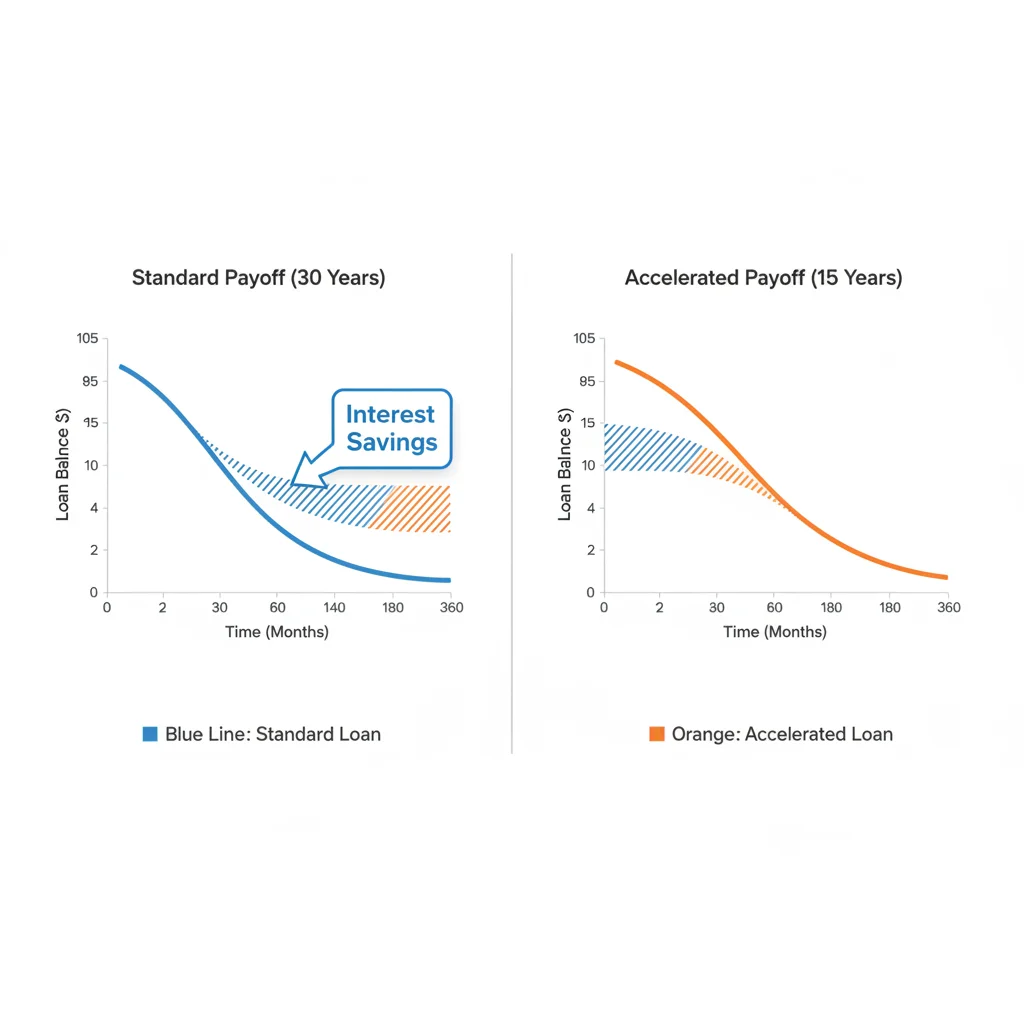
This is the core principle: time is the multiplier. The earlier you reduce the principal, the more months that lower balance has to accrue less interest.
Always Designate Extra Payments as Principal-Only
When making an extra payment, contact your lender or use their online portal to explicitly designate it as a principal-only payment. Without that instruction, many servicers will apply the extra amount to your next scheduled payment — advancing your due date — rather than reducing your balance. This distinction completely changes your savings outcome.
Start Extra Payments in Month One If You Can
The very first extra payment you make on a new loan produces more long-term savings than any future extra payment of the same size. If you have any flexibility in your budget during the first few months of a new loan, that is the highest-leverage moment to act. Even $50 extra in month one beats $100 extra in month 36.
Reading Your Amortization Schedule to Find Your Best Window
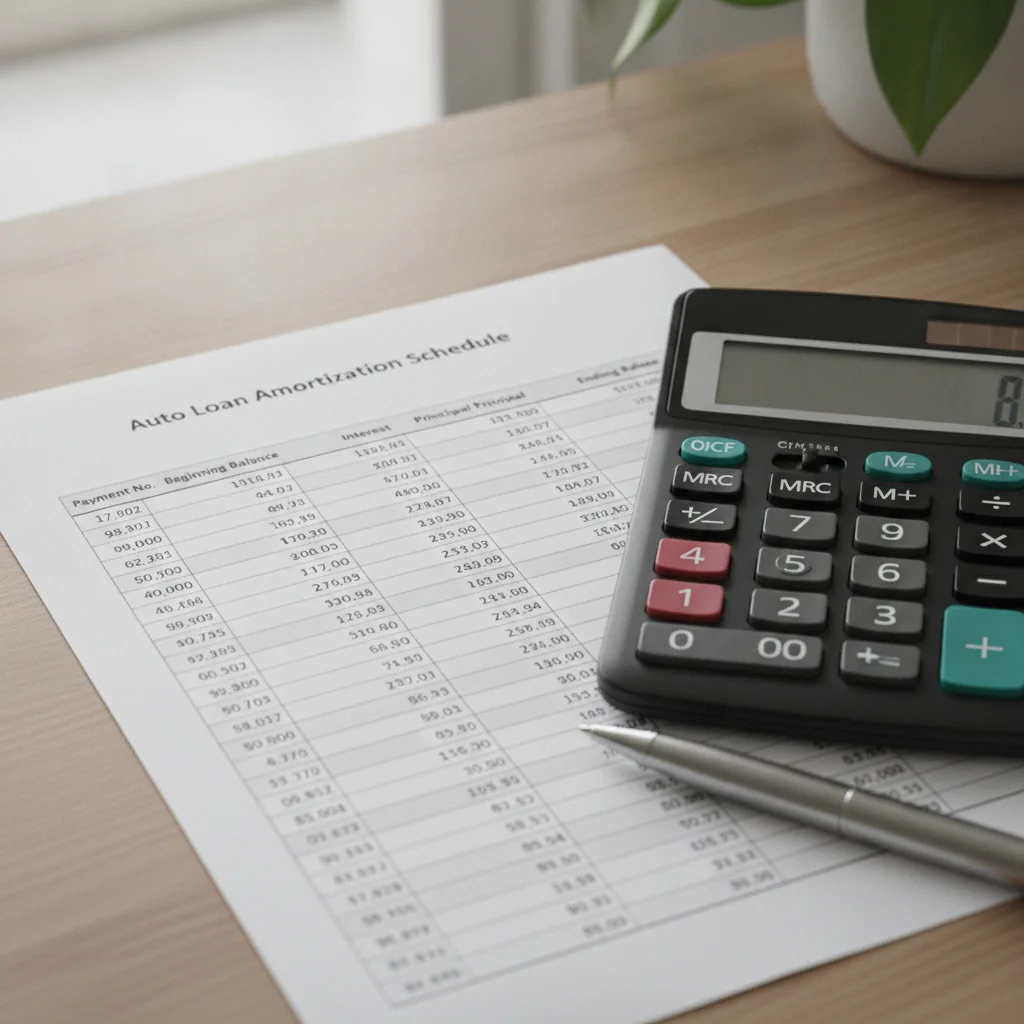
You don't have to do this math by hand. Your lender is required to provide an amortization schedule, and most online loan portals let you download it or generate it with a calculator. Knowing how to read it helps you identify exactly when extra payments have the most impact.
When you pull up your schedule, look for three columns: Interest, Principal, and Balance. Focus on the rows where the Interest column is still significantly larger than the Principal column — that's your high-impact window. For a typical 60-month loan, this window is roughly the first 18 to 24 months.
Our companion guide on reading an auto loan amortization schedule walks you through each column in detail, including how to calculate where you stand mid-loan.
One practical approach: find the row where the interest and principal columns are roughly equal. That's the midpoint of your loan's cost. Any extra payment made before that row saves more than any extra payment made after it.
Strategies to Reduce Interest by Attacking Principal Early
Once you understand why early payments matter most, the next question is how to act on it. Several approaches work well depending on your budget and loan structure.
Round Up Your Monthly Payment
If your scheduled payment is $487, pay $550 instead. That extra $63 goes directly toward principal — provided you direct your lender to apply it that way. Over a 60-month loan, rounding up consistently from month one can shave months off your payoff timeline and reduce total interest by hundreds of dollars.
Make One Extra Payment Per Year
Some borrowers use a tax refund or bonus to make a 13th payment each year. Applied entirely to principal, this can effectively cut a 60-month loan down to roughly 54 months, depending on your rate and balance.
Biweekly Payments
Instead of 12 monthly payments per year, split your payment in half and pay every two weeks. Because there are 52 weeks in a year, you end up making 26 half-payments — equivalent to 13 full payments. The extra payment hits early each year, continuously keeping your balance lower than the standard schedule.
Lump-Sum Early in the Loan
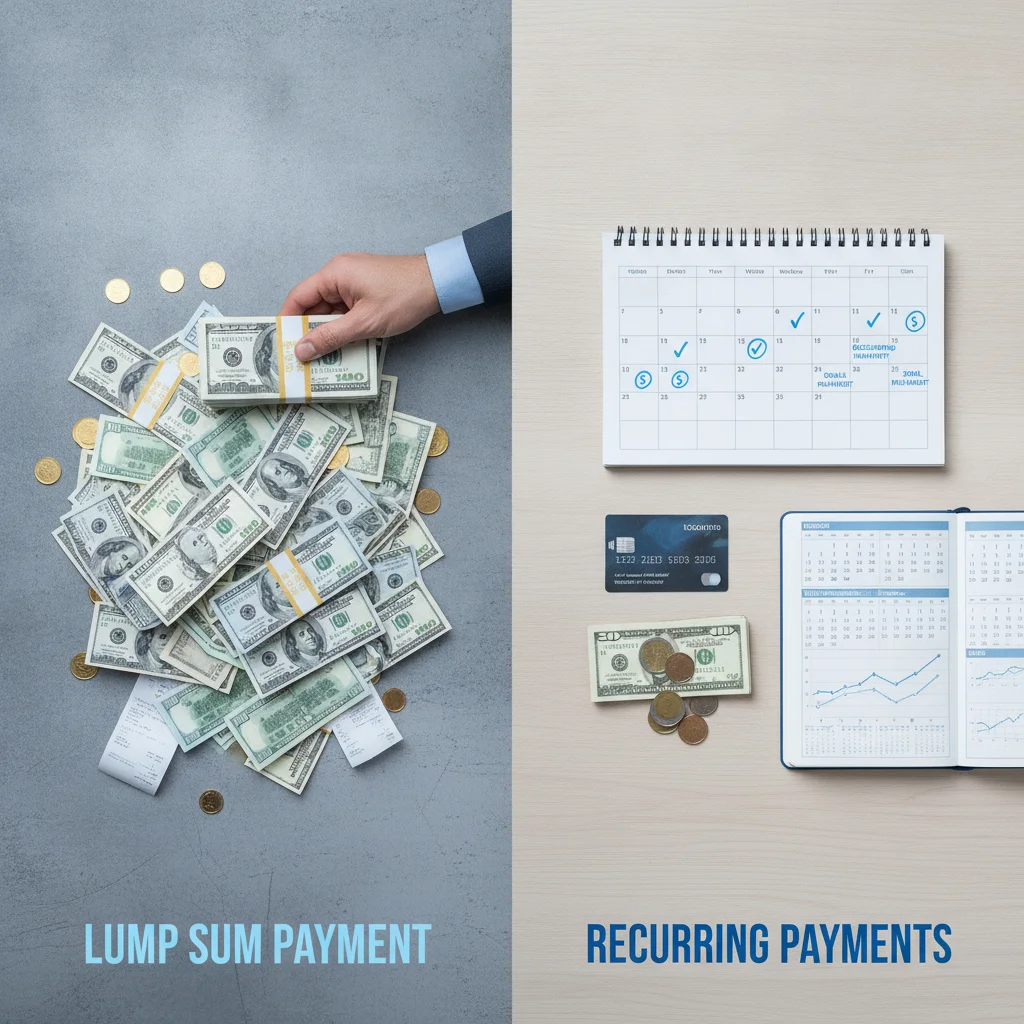
If you receive an unexpected windfall — an inheritance, a work bonus, or proceeds from selling a second car — applying it as a lump sum in the first year has the highest possible impact. Our article on lump-sum payoff vs. extra monthly payments compares this approach against steady monthly additions so you can see which fits your situation best.
Always Designate Extra Payments as Principal-Only
When making an extra payment, contact your lender or use their online portal to explicitly designate it as a principal-only payment. Without that instruction, many servicers will apply the extra amount to your next scheduled payment — advancing your due date — rather than reducing your balance. This distinction completely changes your savings outcome.
Start Extra Payments in Month One If You Can
The very first extra payment you make on a new loan produces more long-term savings than any future extra payment of the same size. If you have any flexibility in your budget during the first few months of a new loan, that is the highest-leverage moment to act. Even $50 extra in month one beats $100 extra in month 36.
Whichever strategy you choose, always confirm with your lender in writing that extra payments are being applied to principal, not to prepaid future scheduled payments. Some servicers default to advancing your next due date rather than reducing your balance — which defeats the purpose entirely.
When Early Payoff Might Not Be the Right Move
Amortization math strongly favors early payoff for most borrowers — but not universally. A few situations can reduce or eliminate the advantage.
Prepayment Penalties
Some lenders charge a fee if you pay off the loan before the scheduled end date. This fee is designed to compensate them for lost interest income. If the penalty is large enough, it can offset your savings. Always read the prepayment clause in your contract before sending extra payments.
Precomputed Interest Loans
Unlike simple interest loans (where interest accrues daily on the outstanding balance), precomputed interest loans calculate your total interest charge upfront and bake it into your payment schedule. Paying early on these loans doesn't always reduce interest proportionally. If your contract uses precomputed interest, read our detailed breakdown on when early payoff is less worthwhile before making a move.
Low-Interest Promotional Rates
Dealership financing at 0% or 0.9% APR is a case where the interest savings from early payoff are minimal. In these situations, your money might work harder in a high-yield savings account or applied to higher-rate debt. The amortization math still applies — it's just that the stakes are lower when the rate is near zero.
Simple Interest vs. Precomputed Interest
Most auto loans in the U.S. use simple interest, meaning interest accrues daily on your current balance. This is the structure where early payoff strategies work best. Precomputed interest loans are less common but do exist — especially in subprime lending. If you're unsure which type you have, look at your loan contract's 'Method of Computing Rebate' or call your lender directly.
Low-Rate Loans: Run the Numbers First
If your auto loan rate is at or below 3%, the math of early payoff changes significantly. At that rate, every extra dollar you pay saves only a few cents per year in interest. Compare that return against alternatives — a high-yield savings account, retirement contribution match, or high-interest credit card payoff — before committing to accelerated auto loan payments.
Understanding your loan type is foundational. See our hub on loan terms explained for a full breakdown of loan structures, rate types, and what each means for your payoff strategy.
“Amortization is a schedule built in the lender's favor — until you understand it. Once you do, it becomes a roadmap for exactly where to apply extra dollars to get the most out of every payment.”
— Greg McBride, Chief Financial Analyst, Bankrate
Building a Payoff Plan That Reflects Amortization Reality
The most common mistake borrowers make is treating all payments as equally valuable. They're not. A dollar paid toward principal in month two is worth far more to your total cost than a dollar paid in month 58. Once that clicks, the path forward becomes clearer.
Start by pulling your amortization schedule — today, not at some future refinancing review. Identify how much of your current payments go to interest versus principal. If you're in the first half of your loan and more than 40% of each payment is still interest, you're in the prime window for extra payments to matter.
Then look at your budget. Even $50 extra per month, applied consistently from the start, shifts the curve meaningfully. If you can push that to $100 or $150, the savings compound further.
First-time borrowers especially benefit from this framing early on. Our guide for early auto loan payoff for first-time borrowers builds on these concepts with practical starter steps. And if your loan structure involves a large down payment or you're weighing how much to put down on your next vehicle, understanding how that choice affects your starting balance — and therefore your entire amortization curve — is worth exploring at our hub on down payments.
The bottom line: amortization isn't something that happens to you — it's a system you can work with once you understand it. The earlier you act, the more of your loan's interest cost you can redirect back into your own pocket.


All claims are backed by peer-reviewed research. Sources on request.