Key Takeaways
Underwater on a Car Loan
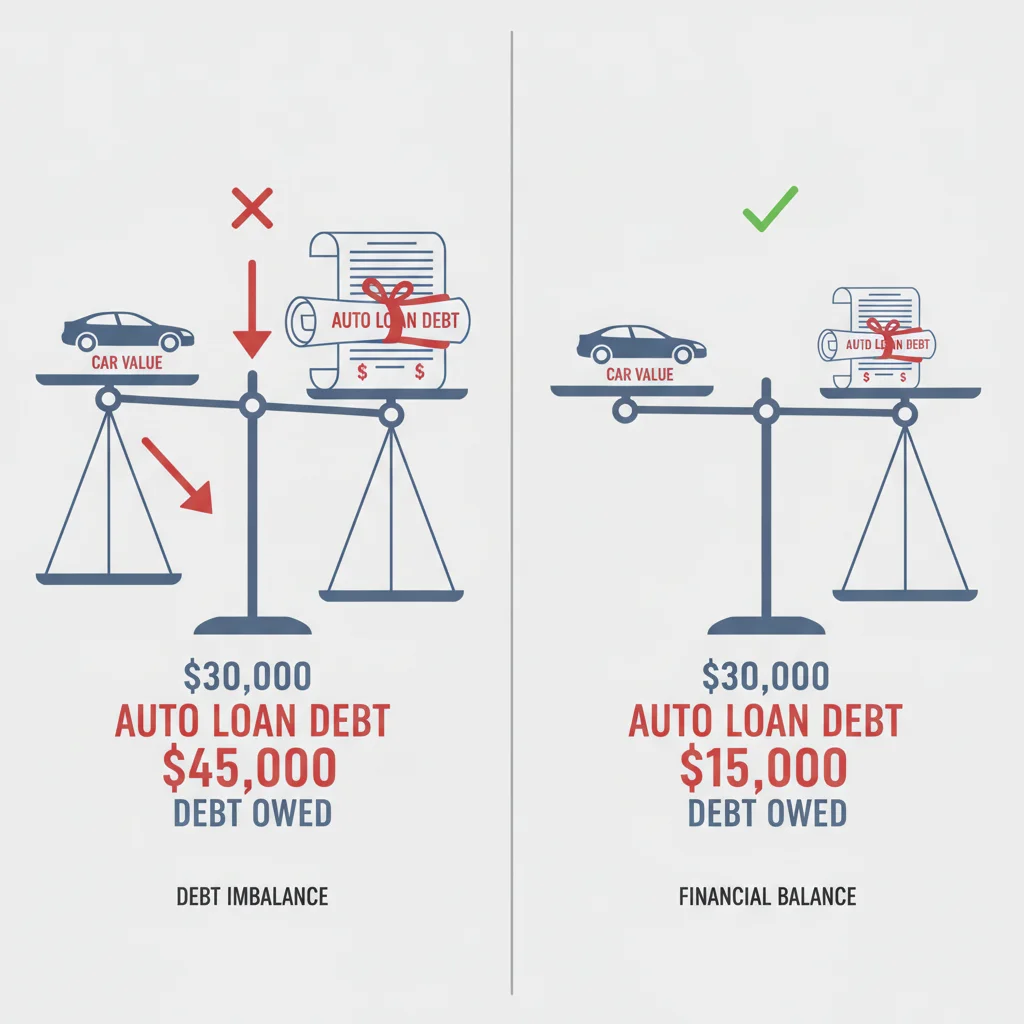
Being "underwater" on a car loan — also called being "upside down" or having negative equity — means you owe more money on your loan than your car is currently worth. For example, if your loan balance is $18,000 but your car's market value is only $14,000, you are $4,000 underwater. This gap between what you owe and what the car is worth can create serious financial problems if you need to sell, trade in, or replace your vehicle.
Negative equity is calculated as loan payoff amount minus the vehicle's current fair market value (typically determined by sources like Kelley Blue Book or NADA Guides). When this figure is negative, you have negative equity.
The Basic Idea: What Negative Equity Really Means
Every car loan involves two numbers that move in opposite directions over time: your loan balance and your car's market value. Your loan balance decreases as you make monthly payments. Your car's market value decreases as the vehicle ages and depreciates. The problem is these two numbers don't always move at the same speed — and when your loan balance falls slower than your car's value, you end up underwater.
Here's a simple way to think about it: imagine you bought a car for $30,000 and financed the entire amount at 7% interest over 72 months. Twelve months later, you've made 12 payments — but a large portion of those early payments went toward interest, not principal. Your loan balance might be around $26,500. Meanwhile, your car has depreciated and is now worth perhaps $23,000 on the open market. That $3,500 gap is your negative equity.
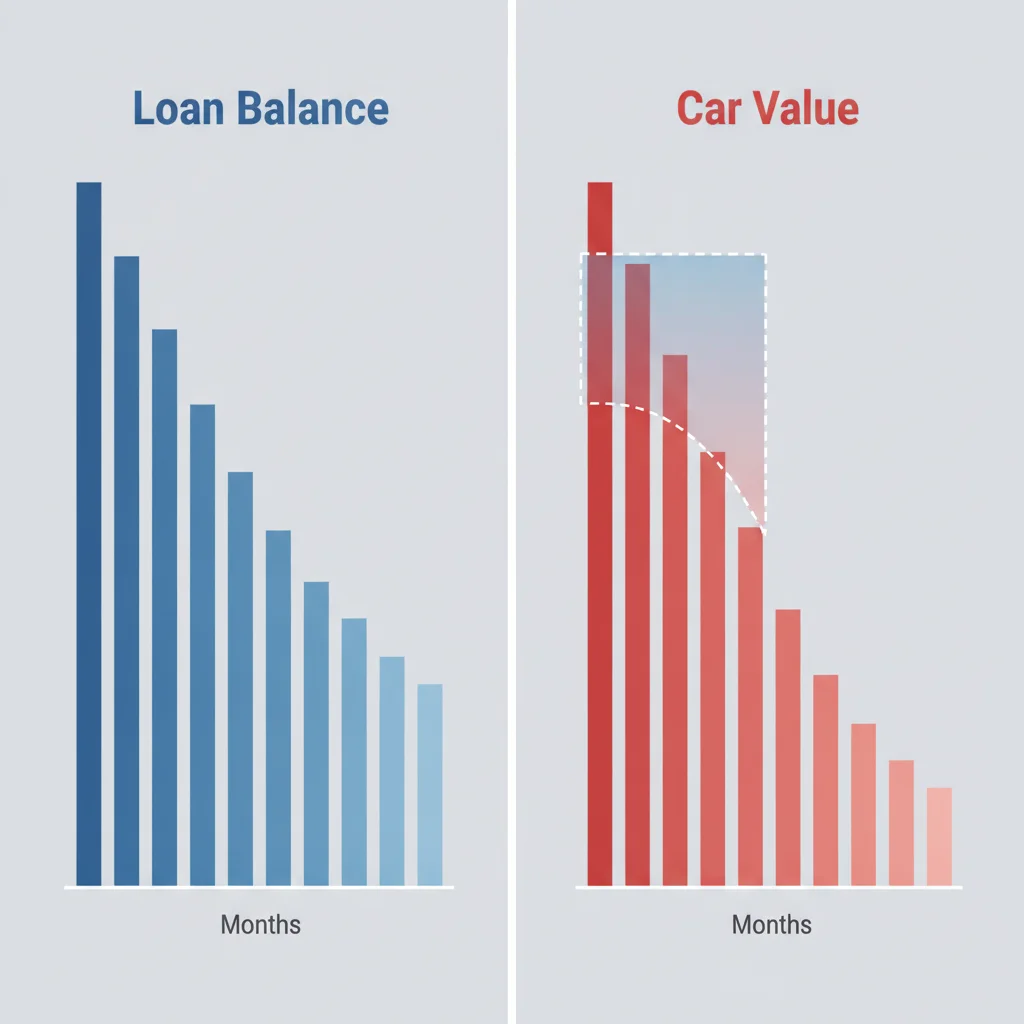
That gap isn't a penalty or a mistake — it's the natural result of how depreciation and loan amortization interact. But it becomes a real problem the moment you need to do something with the car: sell it, trade it in, or handle a total loss insurance claim. In each case, you'd still owe money even after the car is gone.
Negative equity is sometimes called being upside down because, in a sense, your financial relationship with the car is flipped. Instead of the car being an asset you could sell to recover cash, it's become a liability you'd have to pay to get rid of.
Why It Happens: The Depreciation-Loan Timing Mismatch
To understand negative equity, you need to understand two forces working simultaneously — and often against each other.
Depreciation: Fast at First, Then Slower
Cars lose value the moment they leave the lot. A brand-new vehicle can lose 15% to 25% of its value in the first year of ownership. That initial drop is steep. After the first year, depreciation continues but typically at a slower pace — often 10–15% per year through years two through five.
This front-loaded depreciation curve is the core reason negative equity happens. The vehicle's value falls fastest in exactly the period when your loan balance is still highest.
20–25%
Average new car depreciation in year one
Industry data consistently shows new vehicles lose roughly a fifth of their value within the first 12 months of ownership.
~38%
Share of trade-ins with negative equity
According to Edmunds market data, nearly four in ten trade-in vehicles carried negative equity at the time of the transaction in recent years.
84 months
Longest common auto loan term now offered
Seven-year auto loans have become increasingly common at dealerships, significantly extending the period borrowers spend underwater.
$6,054
Average negative equity amount on trade-ins
Edmunds reported this as the average negative equity balance carried by trade-in customers in recent quarterly data.
72+ months
Loan terms accounting for over half of new-car financing
Experian's automotive finance data shows that loans of 72 months or longer now make up a majority of new-vehicle loan originations.
Loan Amortization: Slow Principal Paydown Early On
Auto loans — like most installment loans — are amortized, meaning each monthly payment is split between interest and principal. In the early months of a loan, a disproportionate share goes toward interest. As the loan matures, the balance gradually shifts and more of each payment reduces the principal.
This means that in the first year or two, you're paying down your balance more slowly than you might expect. Combined with rapid early depreciation, the result is a window — sometimes a long one — where you owe more than the car is worth.
How Loan Term Length Makes It Worse
The length of your loan is one of the most powerful variables. A 48-month loan means you're paying down principal much faster than a 72- or 84-month loan. With a longer term, monthly payments are lower — which feels appealing — but you spend more time in the underwater zone because principal paydown is so slow.
According to Experian's State of the Automotive Finance Market reports, loans of 72 months or longer now account for a significant share of all new-vehicle financing. These extended terms put buyers at much higher risk of prolonged negative equity. See how down payments can offset this risk if you're considering a longer-term loan.
“The monthly payment has become the primary shopping metric for too many buyers, and that's exactly how people end up in loans that are structurally designed to keep them underwater for years.”
— Ivan Drury, Director of Insights, Edmunds
Common Causes of Negative Equity at Purchase
Negative equity doesn't only develop over time — sometimes buyers start a loan already underwater before they've even driven off the lot. Several purchase-time decisions can cause this.
Little or No Down Payment
When you finance 100% of a vehicle's purchase price, your loan balance starts equal to the full price. Subtract immediate depreciation and dealer fees, and you're already underwater on day one. A down payment of 10–20% creates a buffer that helps your loan balance stay closer to the car's actual market value.
Understanding how down payment size shapes your loan is one of the most important concepts for any first-time car buyer.
Rolling Negative Equity from a Previous Loan
One of the most dangerous patterns in auto financing is rolling negative equity from an old car loan into a new one. When a buyer trades in a car they're underwater on and adds that outstanding balance to the new loan, they start the new loan already owing more than the new car is worth. The debt doesn't disappear — it gets buried under a fresh purchase.
Ask for the Payoff Amount, Not Just the Payment
When evaluating a trade-in at a dealership, always ask for your current loan payoff amount — not just your remaining monthly payments. Dealers can obscure negative equity by focusing conversations on the new monthly payment. Knowing your exact payoff amount lets you calculate your equity position clearly before signing anything.
Use a Loan Amortization Calculator Before You Buy
Before committing to any loan term, use a free online amortization calculator to see how your balance decreases over time versus typical depreciation for that vehicle type. If the balance stays above likely market value for more than 24 months, consider increasing your down payment or shortening the term. This five-minute exercise can save years of financial stress.
Financing Add-Ons and Fees
Dealer add-ons — extended warranties, paint protection, gap insurance — are often financed into the loan rather than paid upfront. Each dollar added to the loan increases your balance without adding to the car's market value. A buyer who finances $2,000 worth of dealer add-ons starts deeper underwater from day one.
High Interest Rates
A higher interest rate means more of your early payments go toward interest rather than principal. This slows your equity build-up and prolongs the period of negative equity. Buyers with lower credit scores often face higher rates and are therefore at greater risk — another reason getting preapproved for financing before heading to the dealership matters so much.
Gap Insurance Is Worth Considering Early
If you're financing a new vehicle with less than 20% down or opting for a loan term of 60 months or longer, gap insurance can provide meaningful protection. It covers the difference between your insurance payout and your remaining loan balance if the car is totaled or stolen. Many lenders and dealers offer it, but you can often buy it cheaper through your own insurance provider.
Negative Equity and Refinancing Don't Always Mix
Some lenders will not refinance a vehicle loan if the amount you owe exceeds the car's current value. If you're underwater and hoping to refinance for a better rate, check with potential lenders about their loan-to-value requirements before applying. Improving your equity position first — through extra payments — may be a necessary first step.
Real-World Scenarios: When Being Underwater Creates Problems
Negative equity is manageable if you plan to keep the car and make all your payments. The situation becomes a genuine financial problem in these common scenarios.
Total Loss or Theft
If your car is totaled or stolen, your standard auto insurance policy pays out the car's actual cash value at the time of the loss — not your loan payoff amount. If you're $4,000 underwater and the insurance pays $16,000 on a car you owe $20,000 on, you're still responsible for that $4,000 gap — even though you no longer have a car.
This is exactly why gap insurance exists: it covers the difference between your insurance payout and your remaining loan balance. If you're financing a new vehicle with a small down payment or a long loan term, gap insurance is worth considering.
Needing to Sell or Trade In
If your financial situation changes — job loss, growing family, relocation — and you need to get out of your car, negative equity forces a difficult choice. You'd either need to pay the difference out of pocket or roll the balance into a new loan, compounding the problem.
If you're already in this situation, our guide on trading in a car with negative equity walks through what to expect and how to minimize the damage.

How Loan Term Length Shapes Your Equity Timeline
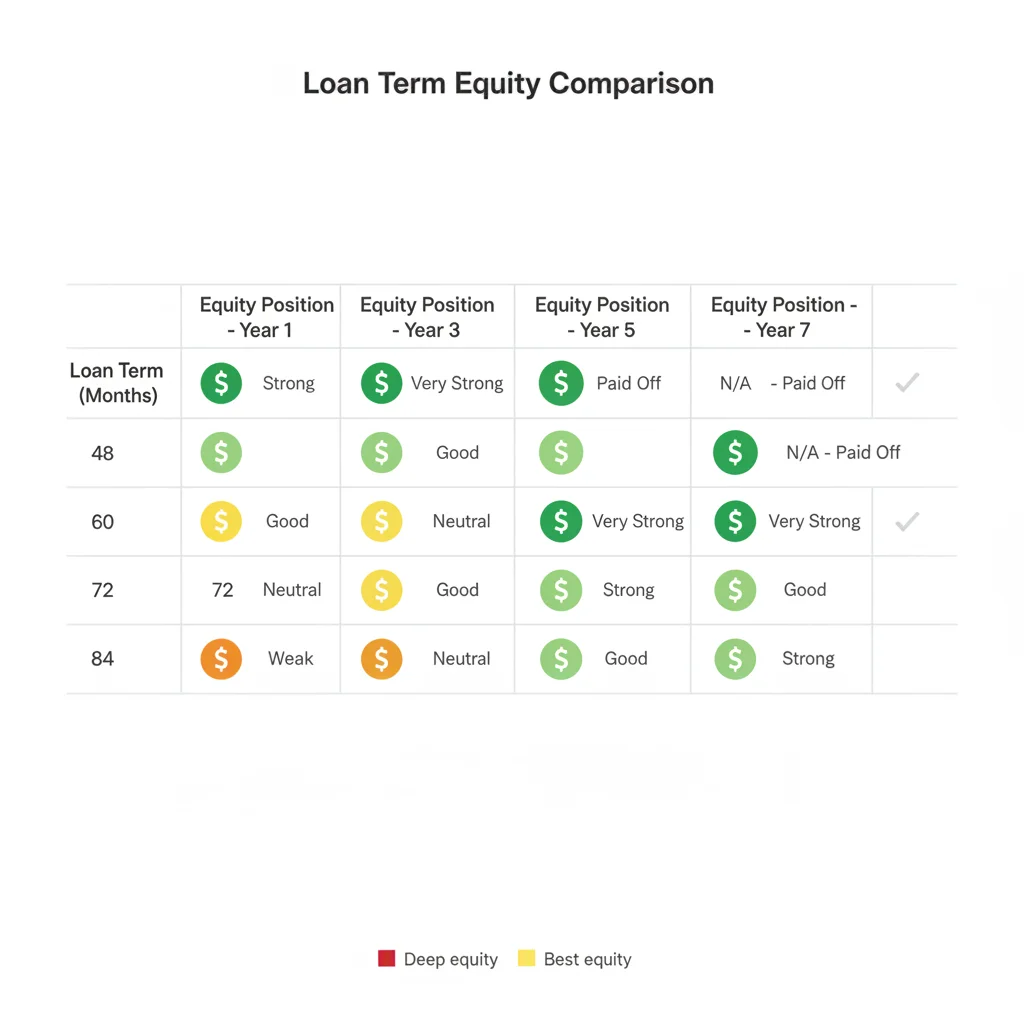
The single biggest structural decision affecting your equity trajectory is your loan term. Let's look at how different loan lengths affect the same purchase.
Assume a $30,000 vehicle purchase, 10% down payment ($3,000), and a 6.5% interest rate. You're financing $27,000. Here's how the equity situation looks across different terms:
| Loan Term | Monthly Payment | Balance After 12 Months | Approx. Car Value After 12 Months | Equity Position |
|---|---|---|---|---|
| 48 months | ~$640 | ~$21,800 | ~$23,500 | +$1,700 (positive) |
| 60 months | ~$528 | ~$23,200 | ~$23,500 | ~$300 (near break-even) |
| 72 months | ~$455 | ~$24,300 | ~$23,500 | -$800 (underwater) |
| 84 months | ~$402 | ~$25,100 | ~$23,500 | -$1,600 (underwater) |
Note how the 48-month loan reaches positive equity within the first year, while the 84-month loan leaves the buyer significantly underwater. The lower monthly payment of a longer loan comes with a hidden cost: prolonged negative equity exposure.
For buyers weighing their options, our article on how depreciation makes negative equity so common provides a deeper look at the numbers behind this pattern.
What to Do If You're Already Underwater
If you're reading this and realizing you're currently underwater on your loan, you're not out of options. Here's a practical framework for thinking through your next steps.
Option 1: Keep the Car and Wait It Out
If the car is reliable and you can comfortably make your payments, the simplest solution is to stay the course. Over time, as you pay down principal, the gap between your balance and your car's value will narrow. You'll eventually reach positive equity — especially if you make extra payments toward principal.
Option 2: Make Extra Principal Payments
Even small additional payments toward principal each month can accelerate your path to positive equity. If your budget allows an extra $50–$100 per month applied directly to principal, you can meaningfully shorten the underwater window. Always confirm with your lender that extra payments are applied to principal, not future interest.
Early payoff strategies when you're underwater can help you build a concrete plan for escaping negative equity faster.
Option 3: Refinance (Carefully)
Refinancing to a lower interest rate can redirect more of each payment toward principal, speeding up equity accumulation. However, refinancing to a longer term just to lower your payment will make the underwater problem worse. If you refinance, aim for the same term or shorter, and only proceed if you can secure a meaningfully lower rate.
Option 4: Trade In — But Know the Risks
Trading in while underwater is possible but requires careful planning. Dealers will typically add the negative equity to your new loan. This is manageable only if the new purchase has a reasonable down payment and a shorter term to compensate. Read our detailed guide on trading in a car with negative equity before pursuing this route.
Gap Insurance Is Worth Considering Early
If you're financing a new vehicle with less than 20% down or opting for a loan term of 60 months or longer, gap insurance can provide meaningful protection. It covers the difference between your insurance payout and your remaining loan balance if the car is totaled or stolen. Many lenders and dealers offer it, but you can often buy it cheaper through your own insurance provider.
Negative Equity and Refinancing Don't Always Mix
Some lenders will not refinance a vehicle loan if the amount you owe exceeds the car's current value. If you're underwater and hoping to refinance for a better rate, check with potential lenders about their loan-to-value requirements before applying. Improving your equity position first — through extra payments — may be a necessary first step.
How to Avoid Negative Equity on Your Next Car Purchase
Prevention is far easier than recovery. These habits, applied at the time of purchase, dramatically reduce your risk of ending up underwater.
- Put down at least 10–20%. This initial equity cushion absorbs the first wave of depreciation.
- Choose the shortest loan term your budget can handle. A 48- or 60-month loan keeps principal paydown ahead of depreciation much more effectively than a 72- or 84-month term.
- Avoid rolling fees and add-ons into the loan. Pay for dealer add-ons upfront or skip them entirely. Every dollar financed is a dollar of immediate negative equity.
- Buy a vehicle with strong resale value. Brands and models with historically lower depreciation rates — like certain Japanese and German models — help your equity position hold up better over time.
- Never roll existing negative equity into a new loan. Pay off the gap separately or wait until you've reached positive equity to trade.
- Get preapproved before shopping. Knowing your rate and loan parameters in advance prevents a dealer from steering you toward a longer-term loan to hit a payment target. See our hub on loan preapproval for how to get started.
Ask for the Payoff Amount, Not Just the Payment
When evaluating a trade-in at a dealership, always ask for your current loan payoff amount — not just your remaining monthly payments. Dealers can obscure negative equity by focusing conversations on the new monthly payment. Knowing your exact payoff amount lets you calculate your equity position clearly before signing anything.
Use a Loan Amortization Calculator Before You Buy
Before committing to any loan term, use a free online amortization calculator to see how your balance decreases over time versus typical depreciation for that vehicle type. If the balance stays above likely market value for more than 24 months, consider increasing your down payment or shortening the term. This five-minute exercise can save years of financial stress.


All claims are backed by peer-reviewed research. Sources on request.