Key Takeaways
Start here
What Negative Equity Actually Means
Next
How Dealers Handle Your Negative Equity
Understand the cost
The Real Cost of Rolling Over Negative Equity
Take action
How to Negotiate When You're Upside Down
Consider alternatives
Alternatives to Trading In Right Now
Make your decision
When Trading In Despite Negative Equity Makes Sense
What Negative Equity Actually Means
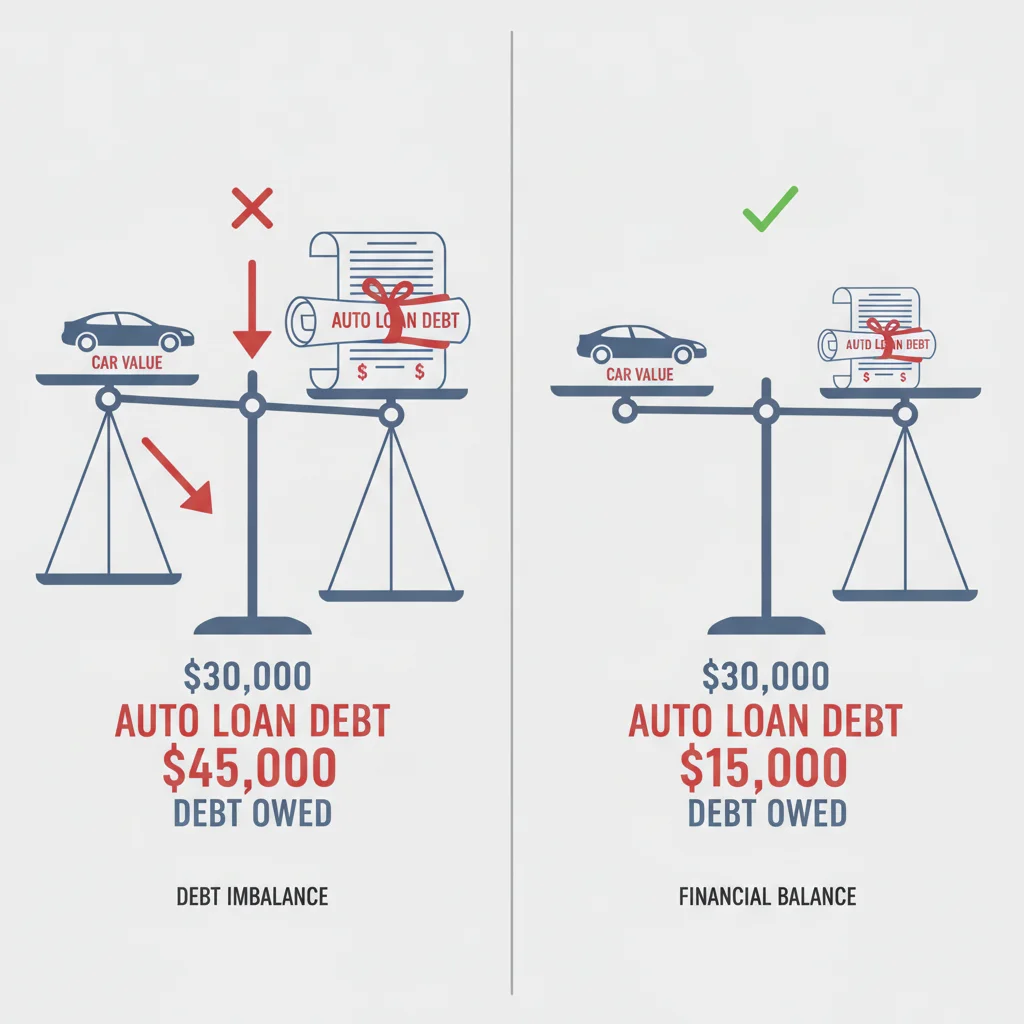
Negative equity is simply the gap between what you owe on your car loan and what the car is actually worth on the market. If your loan payoff is $22,000 but the car's trade-in value is $17,000, you're $5,000 upside down. That $5,000 doesn't disappear — it follows you into whatever financial decision you make next.
Negative equity
When you owe more on your car loan than the car is currently worth. Also called being 'upside down' or 'underwater' on your loan.
Loan payoff amount
The exact dollar amount required to fully pay off your current car loan on a specific date. This figure comes from your lender and may differ from your remaining balance shown on a statement.
Trade-in value
What a dealer is willing to pay for your current vehicle as part of a new car purchase. This is typically lower than private-party sale value.
Rollover
Adding the unpaid balance from your current loan — including any negative equity — into the financing for your next vehicle. This increases the new loan amount and total interest paid.
Loan-to-value ratio (LTV)
The percentage of a vehicle's value that a lender is financing. A $33,000 loan on a $28,000 car represents a 118% LTV — above what many lenders will accept.
GAP insurance
Coverage that pays the difference between your loan payoff and your car's actual cash value if the vehicle is totaled or stolen. Especially important when carrying negative equity.
Payment packing
A dealer tactic where extra costs — like rolled-over debt or add-on products — are absorbed into a monthly payment figure without clearly disclosing the total loan amount.
Actual cash value (ACV)
What your insurance company determines your car is worth at the time of a total loss. This is based on market value, not what you owe on your loan.
This situation is more common than most buyers realize. New cars can lose 15–20% of their value in the first year alone. If you financed with little or no money down, stretched into a long loan term, or rolled over debt from a previous vehicle, you're likely carrying negative equity right now. The problem isn't a moral failing — it's a structural feature of how most car deals are put together.
Before you walk into any dealership, you need two numbers: your exact payoff amount (call your lender directly — the dealer's estimate is often wrong) and your vehicle's current market value. Pull valuations from at least two sources — Kelley Blue Book and CarMax's online offer tool are good starting points. The difference between those two numbers is your negative equity, and it's the most important figure in any trade-in conversation.
For a deeper look at how negative equity develops in the first place, see The Upside-Down Car Loan Problem and How Down Payments Prevent It.
How Dealers Handle Your Negative Equity
Here's the part the finance office doesn't explain clearly: dealers don't pay off your negative equity. They hide it. The gap between your payoff and your trade-in value gets quietly added to your new loan balance. On a $28,000 car with $5,000 rolled in, you're actually financing $33,000 — often at a higher interest rate than you'd get if you came in clean.

The tactic dealers use to obscure this is called payment packing. Instead of showing you the full loan amount, they focus your attention on the monthly payment. A salesperson might say, "We can get you into that new SUV for just $487 a month." What they don't say is that you're paying that for 72 or 84 months, and the true loan total has ballooned because of your rolled-over debt.
Watch for these specific moves in the finance office:
- Extending the loan term to absorb your negative equity without raising the monthly payment noticeably.
- Burying the payoff in the deal sheet so it's hard to identify as a separate line item.
- Inflating the new car's price to make the loan-to-value ratio look acceptable to the lender.
- Pressuring you to add F&I products (warranties, GAP insurance, paint protection) to generate profit that offsets your negative equity on their books.
Note that GAP insurance — which covers the difference between your loan balance and your car's value if it's totaled — is actually a legitimate product when you're carrying negative equity. The problem is that dealers often mark it up 200–400% over what you'd pay through your auto insurer directly. If you need GAP coverage, buy it from your insurance company.
Trading In a Car With Existing Financing covers the mechanics of how your loan payoff is processed during a trade-in — worth reading before you sign anything.
Your Payoff Amount and Trade-In Value Are Different Things
Dealers sometimes present a single blended number that combines your trade-in offer and your loan payoff, making it hard to see the actual gap. Always ask to see the trade-in value and the loan payoff listed as separate line items. If a dealer won't separate them, that's a red flag worth addressing before you proceed.
The Real Cost of Rolling Over Negative Equity
Rolling over negative equity is one of the most expensive decisions a car buyer can make, and most people do it without fully understanding the math. Let's make the cost concrete.
| Scenario | New Car Price | Rolled Negative Equity | Total Loan Amount | Interest Rate | Term | Total Interest Paid |
|---|---|---|---|---|---|---|
| Clean trade-in | $28,000 | $0 | $28,000 | 7.5% | 60 months | $5,659 |
| $5,000 rolled in | $28,000 | $5,000 | $33,000 | 7.5% | 60 months | $6,677 |
| $5,000 rolled in, longer term | $28,000 | $5,000 | $33,000 | 7.5% | 72 months | $8,097 |
The difference between a clean trade-in and rolling $5,000 into a 72-month loan is over $2,400 in additional interest — and that's before accounting for the fact that you'll likely be upside down again on your new vehicle within 12–18 months. You're essentially starting the cycle over, but from a deeper hole.
Rolling Over Debt Can Trap You in a Cycle
Every time you roll negative equity into a new loan and finance with little or no additional down payment, you restart the depreciation clock from an already-negative position. Within 12–18 months of purchasing the new vehicle, you're likely upside down again — often by more than before. This cycle can continue indefinitely and is one of the most common causes of long-term financial stress among car owners.
There's also a compounding risk factor: the more you borrow relative to the car's value, the more exposed you are if the vehicle is totaled or stolen. Standard auto insurance pays actual cash value — not your loan payoff. Without GAP coverage, you could owe thousands on a car you no longer own.
If you're already exploring whether to refinance instead of trading in, Upside-Down on Your Car Loan: Can You Still Refinance? lays out the realistic options and lender requirements.
How to Negotiate When You're Upside Down
If you've decided to move forward with a trade-in despite negative equity, your negotiating position depends entirely on how well you've prepared. Dealers negotiate from information advantage — your job is to close that gap before you walk in.
Get Three Trade-In Offers Before Visiting Any Dealer
Online buyers like CarMax, Carvana, and Vroom will give you a binding written offer in under 30 minutes. These offers are valid for 7 days and serve as documented leverage. Any dealer that won't beat or match a competing offer is simply not competitive on your trade-in — and you should treat that number as your floor, not a starting point for negotiation.
Do the Total Cost Math — Not Just Monthly Payments
Before accepting any deal that involves rolled-over negative equity, calculate the total amount you'll pay over the life of the new loan — principal plus all interest. Compare that to what you'd pay if you kept your current vehicle and paid down the negative equity with extra payments instead. The monthly payment on a 72-month rollover deal can look reasonable while hiding a five-figure total cost premium.
Step 1: Get competing trade-in offers before visiting a dealership
Use CarMax, Carvana, and Vroom to get written offers on your current vehicle. These take 15–30 minutes online and give you a documented baseline. If a dealer knows you have a $17,500 offer in hand, they're far less likely to lowball you at $15,000.
Step 2: Negotiate the new car price independently from your trade-in
This is the most important tactical move you can make. Dealers profit by bundling everything together — trade-in value, new car price, financing rate, and F&I products — so individual line items are hard to scrutinize. Insist on agreeing to the new car's out-the-door price before you even mention your trade-in. Once the new car price is locked, then introduce the trade-in discussion.
Step 3: Know your loan-to-value ceiling
Most prime lenders cap financing at 125% of the new vehicle's MSRP or book value. If your rolled-over debt pushes the loan above that ceiling, the lender will require a cash down payment or decline the loan entirely. Calculate this before you negotiate so you know whether a cash contribution will be necessary — and how much.
Step 4: Push back on loan term extensions
When a dealer extends your loan to 72 or 84 months to absorb your negative equity, they're solving their problem at your expense. A longer term means more interest, more time upside down on the new vehicle, and less flexibility if your situation changes. If you can't make the deal work on a 60-month term without a cash contribution, that's a signal to reconsider the deal entirely.

Understanding the full mechanics of dealer trade-in appraisals will help you recognize when an offer is fair versus when you're being lowballed to create room for your negative equity to disappear on paper.
Alternatives to Trading In Right Now
Trading in is the path of least resistance, but it's rarely the path of least cost. Before committing, evaluate these alternatives against your specific situation.
Sell privately and pay the gap in cash
Private-party sales consistently return more than dealer trade-ins — often 10–20% more. If your car is worth $17,000 at a dealer but $19,500 on the private market, that $2,500 difference directly reduces the gap you need to close. You'll need to coordinate paying off your lender before transferring the title, which adds steps but is entirely manageable. Your lender can walk you through the process.
Make accelerated payments on your current loan
If your timeline is flexible, the cleanest solution is to close the equity gap before trading in. Even an extra $200–300 per month applied to principal can meaningfully reduce negative equity over 6–12 months. This approach also improves your loan-to-value ratio for lenders when you do eventually finance a new vehicle. See Early Payoff When You're Underwater on Your Car Loan for a detailed breakdown of how to approach this strategically.
Keep the car and refinance
If your current interest rate is high and your credit has improved since you got the loan, refinancing at a lower rate can reduce your monthly payment and accelerate principal paydown — without adding a new layer of debt. This only works if you can qualify for a better rate; lenders are cautious about refinancing underwater loans. Check whether refinancing while upside down is realistic for your situation.
Bring cash to the table
If you have savings available, paying down the negative equity gap in cash before or during the trade-in is mathematically better than rolling it into a new loan. You avoid paying interest on that amount for the life of your next loan, which easily saves $500–2,000 depending on the gap and the rate.
Kelley Blue Book Trade-In Value Tool
Enter your vehicle details to get an estimated trade-in range based on current market conditions. Use this alongside a dealer offer to gauge whether you're being lowballed.
CarMax Instant Online Offer
CarMax provides a firm written offer on your current vehicle that's valid for seven days. It's one of the fastest ways to establish a competitive baseline before negotiating at a dealership.
Dealer Trade-Ins Hub
A comprehensive resource on how dealer trade-in appraisals work, what affects your offer, and how to negotiate more effectively when selling your car through a dealer.
CFPB Auto Loan Calculator
The Consumer Financial Protection Bureau's free tool helps you calculate total loan costs under different scenarios — useful for comparing the real cost of rolling over debt versus paying it down first.
When Trading In Despite Negative Equity Makes Sense
I've spent most of this article explaining why rolling over negative equity is dangerous, and I stand by that. But I've also seen situations where trading in — even upside down — is the right call. Here are the scenarios where it actually makes sense.
Your current car has serious mechanical problems
If your car needs $4,000 in repairs and you're $3,500 upside down, keeping the car means paying for both the repairs and continuing to service a loan on a depreciating asset. Trading in and absorbing the negative equity may be cheaper over 12–24 months than the alternative of repair costs plus ongoing ownership expenses.
Your interest rate is significantly above market
If you financed at 18–22% because your credit was damaged at the time, and your credit score has since improved substantially, trading into a new loan at 8–9% could reduce your total cost of borrowing — even after rolling in modest negative equity. Run the math on total interest paid over both loan periods to confirm.
Your current loan is nearly paid off
If you're in the final 6–8 months of your loan and have minimal negative equity — say, $500–1,500 — the practical cost of rolling it over is low. In this narrow window, the convenience of a clean transition may outweigh the relatively small financial penalty.
You can make a meaningful cash contribution
If you can bring $2,000–3,000 to the table to cover part of the gap, you shift from a situation where you're fully funding the negative equity through expensive loan interest to one where the rollover amount is small enough that the damage is containable. This is very different from rolling the entire gap into a 72-month loan with nothing down.
Get Three Trade-In Offers Before Visiting Any Dealer
Online buyers like CarMax, Carvana, and Vroom will give you a binding written offer in under 30 minutes. These offers are valid for 7 days and serve as documented leverage. Any dealer that won't beat or match a competing offer is simply not competitive on your trade-in — and you should treat that number as your floor, not a starting point for negotiation.
Do the Total Cost Math — Not Just Monthly Payments
Before accepting any deal that involves rolled-over negative equity, calculate the total amount you'll pay over the life of the new loan — principal plus all interest. Compare that to what you'd pay if you kept your current vehicle and paid down the negative equity with extra payments instead. The monthly payment on a 72-month rollover deal can look reasonable while hiding a five-figure total cost premium.
If your credit history is already damaged and you're exploring financing options alongside a trade-in, bad credit auto loan options provides context on what lenders are realistically available to you and what rates to expect.
Whatever you decide, go in with your numbers already calculated. The dealer's finance office is not where you want to be running the math for the first time.

All claims are backed by peer-reviewed research. Sources on request.