Key Takeaways
Auto Loan Contract Terms
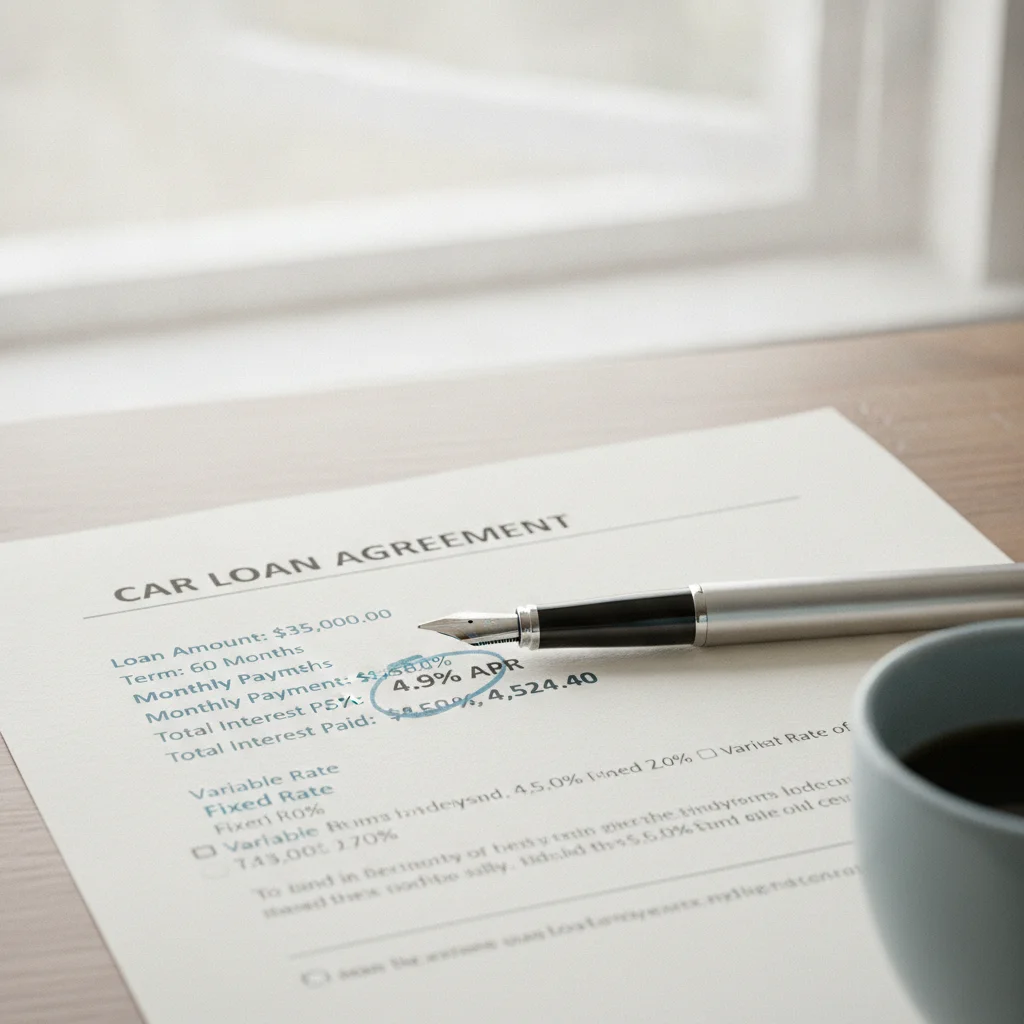
An auto loan contract contains several key numbers: the principal (amount borrowed), APR (true annual cost of borrowing), loan term (repayment timeframe), and monthly payment. Together, these figures determine how much you'll ultimately pay for your vehicle. Understanding each one allows you to compare offers accurately and avoid costly surprises.
Most auto loans use simple interest amortization, meaning interest accrues daily on the outstanding principal balance. Early payments are weighted more toward interest; later payments shift toward principal reduction.
Why the Numbers on Your Loan Contract Are Worth Decoding
When you sit down in a dealership's finance office, the paperwork arrives fast. A stack of documents lands in front of you, a finance manager walks you through a summary in under ten minutes, and before long you're signing. Most buyers focus almost entirely on the monthly payment — and lenders know it.
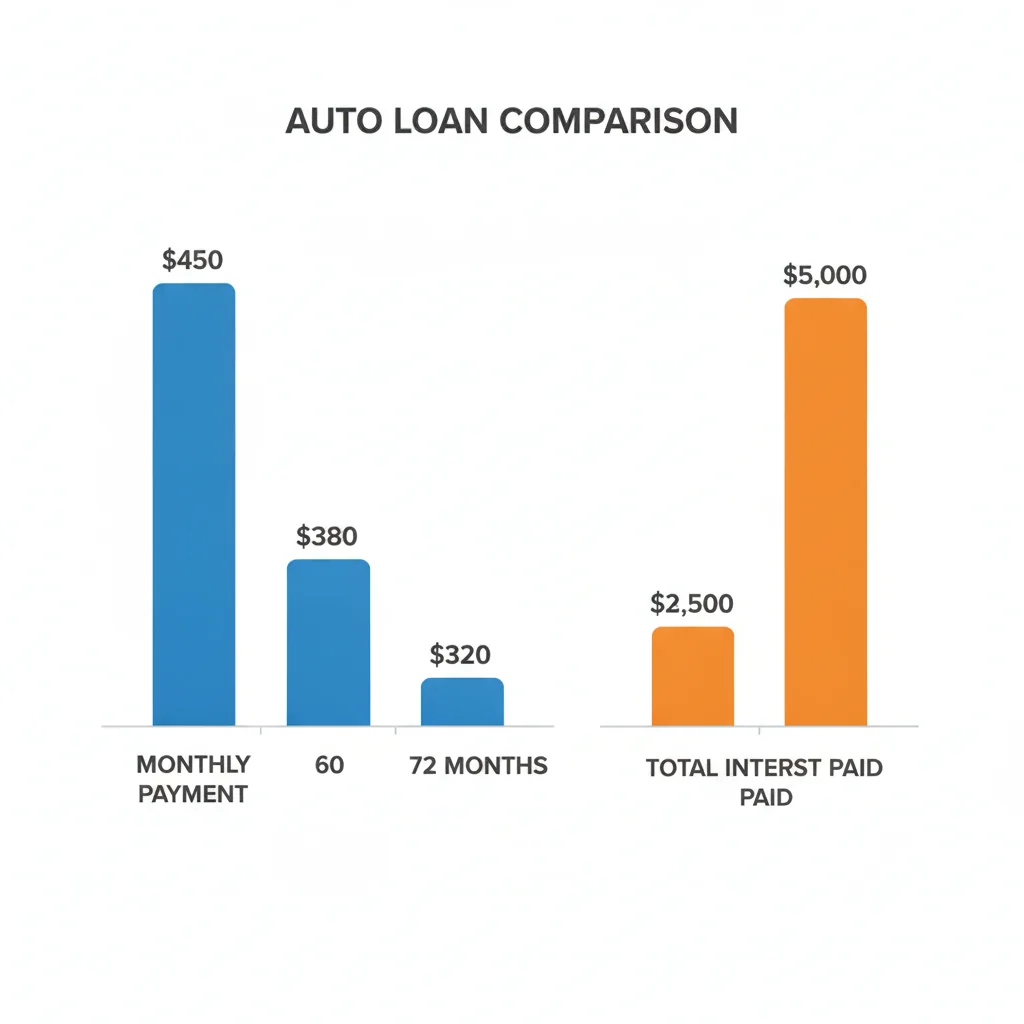
That narrow focus is expensive. The monthly payment is just one number out of many, and it's actually the easiest one for a lender to manipulate without changing the overall cost of the loan. Stretch the term from 48 months to 72 months and the monthly figure drops — but the total interest you pay can jump by a thousand dollars or more.
This guide walks you through every key number you'll see in a standard auto loan contract: what each one measures, how it connects to the others, and what it tells you about the true cost of your loan. For a broader reference of all the terminology you might encounter, see the Auto Loan Glossary: 25 Terms Every Borrower Should Know.
Principal: The Starting Point of Every Calculation
The principal is the amount you're actually borrowing — the financed amount after your down payment and any trade-in credit are subtracted from the vehicle's purchase price. If you're buying a $32,000 car, put $4,000 down, and receive $3,000 for your trade-in, your principal is $25,000.
Every other number in your loan — monthly payment, total interest, finance charge — is calculated from this starting figure. That means the principal is where your savings strategy should begin, before APR negotiations or term discussions even start. A smaller loan costs less regardless of rate.
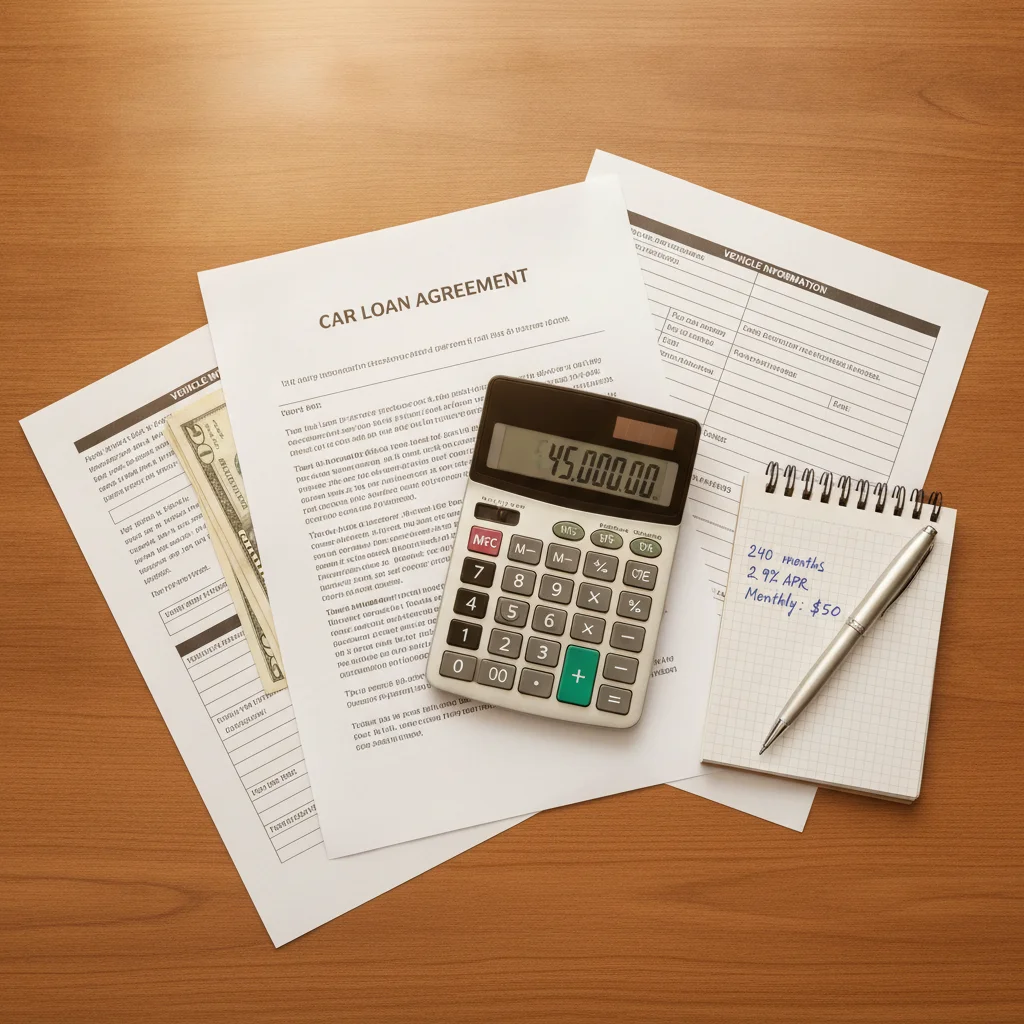
Watch for items that quietly inflate the principal in the finance office: extended warranties, GAP insurance, tire protection plans, and paint sealants are often rolled into the financed amount. Each add-on that goes into the loan accrues interest for the entire term. Understand exactly what you're financing — not just the car's price.
Add-Ons Can Quietly Inflate Your Principal
Products sold in the finance office — GAP insurance, extended warranties, paint protection, and similar packages — are often added directly to your loan balance. Every dollar rolled into the loan accrues interest for the full term. Ask to see an itemized list of everything included in your financed amount before signing, and consider purchasing add-ons separately or declining them if they aren't clearly beneficial.
Precomputed vs. Simple Interest Loans
Most auto loans use simple interest, where interest accrues daily on the declining balance — meaning extra payments directly reduce future interest. Some older or subprime loan products use precomputed interest, where the total interest is fixed upfront and baked into your payment schedule. On a precomputed loan, paying early may not save as much interest as you'd expect. Check your contract to confirm which method applies.
APR: The Number That Tells You What Borrowing Really Costs
You'll see two percentages near the top of most auto loan offers: the interest rate and the Annual Percentage Rate (APR). They look similar, but they measure different things.
The interest rate is the base cost of borrowing, expressed as an annual percentage of the outstanding balance. The APR is broader — it includes the interest rate plus any lender fees folded into the cost of the loan, also expressed as an annual rate. On a straightforward auto loan with no origination fee, the two numbers may be identical or very close. When lenders charge fees, the APR will be higher than the stated interest rate.
This is why the APR is the comparison number. When you're evaluating two loan offers side by side, use the APR — not the interest rate. A loan with a slightly lower interest rate but a higher APR is actually more expensive once fees are counted.
“Consumers who focus only on the monthly payment are often surprised by how much their car actually costs. The APR and the total finance charge are the numbers that tell the real story.”
— Patrice Alexander Ficklin, Assistant Director for Fair Lending, Consumer Financial Protection Bureau
For a deeper breakdown of how APR is structured and calculated, see What APR Actually Means on an Auto Loan.
72 months
Most common new-car loan term in the U.S.
According to Experian's State of the Automotive Finance Market report, 72-month loans have become the single most common term for new vehicle financing.
$1,389
Average monthly new-car payment (Q1 2024)
Experian's Q1 2024 automotive finance report found average monthly payments for new vehicles reached a record high, driven partly by longer loan terms masking higher vehicle prices.
23%
New-car buyers with negative equity at trade-in
Edmunds research found that roughly one in four trade-in transactions involves a buyer who owes more on their current loan than the vehicle is worth — a direct consequence of extended loan terms.
0.5%–1%
Typical APR gap: interest rate vs. APR
On loans with origination or processing fees, the APR commonly exceeds the stated interest rate by 0.5 to 1 percentage point, according to the Consumer Financial Protection Bureau's lending disclosures guidance.
~$2,400
Extra interest: 72-month vs. 48-month at 6.5% APR
On a $25,000 loan at 6.5% APR, choosing a 72-month term over a 48-month term results in approximately $2,400 more in total interest paid over the life of the loan.
Loan Term: The Number with the Longest Shadow
The loan term is the repayment period, expressed in months. Common auto loan terms run 24, 36, 48, 60, 72, and now even 84 months. The term is the most underappreciated number in a car loan because it silently controls how much total interest you pay — often more dramatically than the interest rate itself.
Here's the mechanism: interest accrues monthly on your remaining balance. A longer term means more months of interest accrual on a balance that declines more slowly. Even if the APR is identical, a 72-month loan generates far more total interest than a 48-month loan on the same principal.
| Loan Amount | APR | Term | Monthly Payment | Total Interest Paid |
|---|---|---|---|---|
| $25,000 | 6.5% | 48 months | $595 | $2,560 |
| $25,000 | 6.5% | 60 months | $488 | $3,280 |
| $25,000 | 6.5% | 72 months | $416 | $4,952 |
That $179 monthly savings from choosing 72 months over 48 months comes at a cost of nearly $2,400 in additional interest. The dealership finance office will lead with the monthly payment precisely because that number looks most manageable. Your job is to evaluate the total interest column instead.
Use the Shortest Term You Can Manage
Before accepting any loan offer, calculate what you can afford at a 48-month term. If the payment is within reach, the interest savings over a 60- or 72-month loan are significant. Even moving from 72 to 60 months can save hundreds of dollars in interest on a typical new-car loan.
Get a Pre-Approval Before Entering the Finance Office
Arriving with a pre-approved loan offer from your bank or credit union gives you a concrete baseline APR to compare against the dealer's financing. Dealers can sometimes beat outside rates — but you'll only know that if you have a competing offer in hand. Pre-approval also clarifies your actual budget before you fall in love with a vehicle.
There's a second risk to longer terms: negative equity. New vehicles depreciate fastest in their first two to three years. With a 72- or 84-month loan, you're paying down principal slowly while the car's value drops quickly. The result is a period — sometimes several years — where you owe more than the car is worth. If you sell or experience a total loss during that window, you're responsible for the gap.
Amortization: How Each Payment Is Actually Split
Amortization is the process of spreading loan repayment across a series of equal payments over time. On an amortized auto loan, every monthly payment covers both interest and principal — but the split is not equal across the life of the loan.
In the early months of repayment, interest makes up a larger portion of each payment because it's calculated on a higher outstanding balance. As you pay down the principal, the interest portion shrinks and the principal portion grows. By the final months of the loan, nearly all of each payment goes toward principal.
This has a practical implication: if you make extra payments early in the loan — or pay a lump sum in the first year — you reduce the principal faster, which reduces the interest that accrues in subsequent months. The savings compound. Making extra principal payments in the back half of the loan has far less impact.
Ask your lender for a full amortization schedule — a month-by-month table showing how each payment divides between interest and principal, and what your remaining balance is after each payment. This document is your roadmap for any extra-payment strategy. For plain-language definitions of amortization and related terms, see Auto Loan Interest: A Plain-English Glossary of Terms You'll Actually See.
The Finance Charge and the Truth in Lending Disclosure
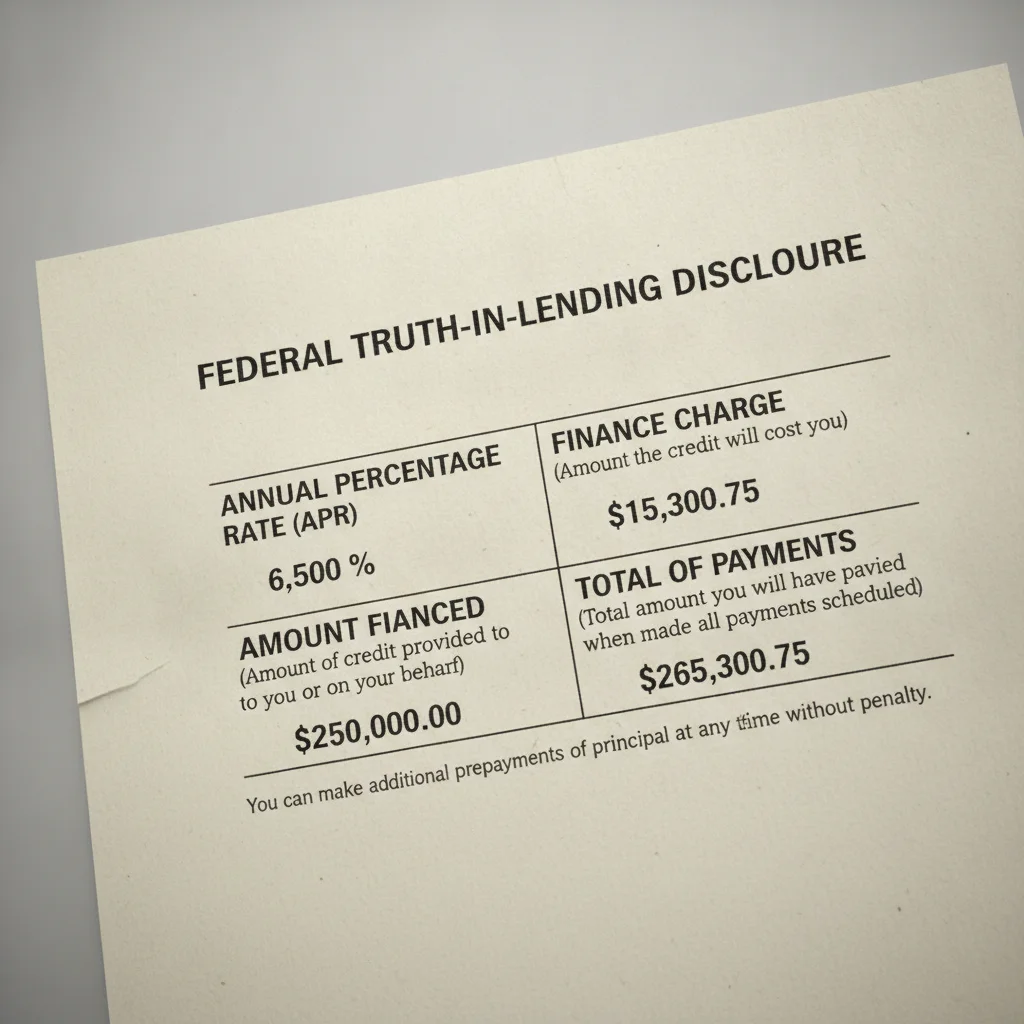
Federal law requires every auto loan contract to include a Truth in Lending Act (TILA) disclosure box. This box standardizes the presentation of loan costs so consumers can compare offers on equal footing, regardless of how the lender chooses to market the loan. The four key figures in this box are:
- Annual Percentage Rate: The cost of your credit as a yearly rate, including fees.
- Finance Charge: The total dollar amount the credit will cost you — the sum of all interest and fees you'll pay over the loan's full term.
- Amount Financed: The principal — what you're actually borrowing.
- Total of Payments: The sum of all scheduled payments: principal plus all interest and fees combined.
The finance charge is particularly useful. It converts the APR percentage into a concrete dollar figure, making it easy to compare two loan offers without mental math. A loan with a 6.5% APR and a $4,200 finance charge is definitively more expensive than one with a 6.8% APR and a $3,900 finance charge — even though the interest rate looks higher on the second option.
For a detailed walkthrough of this disclosure box and how to interpret each line, see Reading the APR Box on Your Auto Loan Agreement.
Monthly Payment: Last, Not First
After understanding principal, APR, term, amortization, and the finance charge, you're ready to look at the monthly payment — and you'll notice it flows mathematically from all those inputs. It is not a negotiating lever. It is a result.
That's the key mental shift. Buyers who start with the monthly payment are easy to steer: a dealership can hit any target payment by adjusting the term or rolling in the vehicle's price. Buyers who understand the underlying numbers negotiate on principal and APR, then check whether the resulting monthly payment fits their budget.
A practical sequence for evaluating any loan offer:
- Confirm the principal — is it only the car's price minus your down payment and trade-in, or has something been rolled in?
- Check the APR — does it match any pre-approval you received? Is it the best rate for your credit profile?
- Examine the term — is it the shortest term you can comfortably manage? Every extra month adds interest.
- Read the finance charge in the TILA box — what is the total dollar cost of this loan?
- Verify the monthly payment — does it match what your own calculations produce from the above inputs?
If any number surprises you, stop and ask for an explanation before signing. For a step-by-step approach to reading the full contract, see The Right Way to Read an Auto Loan Contract Before Agreeing to Anything. And if your purchase contract includes conditional financing language, What 'Subject to Financing' Language in a Car Contract Actually Means explains what rights that creates or removes before your loan is finalized.
Use the Shortest Term You Can Manage
Before accepting any loan offer, calculate what you can afford at a 48-month term. If the payment is within reach, the interest savings over a 60- or 72-month loan are significant. Even moving from 72 to 60 months can save hundreds of dollars in interest on a typical new-car loan.
Get a Pre-Approval Before Entering the Finance Office
Arriving with a pre-approved loan offer from your bank or credit union gives you a concrete baseline APR to compare against the dealer's financing. Dealers can sometimes beat outside rates — but you'll only know that if you have a competing offer in hand. Pre-approval also clarifies your actual budget before you fall in love with a vehicle.
Putting It All Together Before You Sign
An auto loan contract isn't designed to be read quickly — but the numbers inside it tell a complete story once you know the vocabulary. Principal sets the baseline. APR tells you the annual cost of borrowing. The term determines how long interest accumulates. Amortization explains how each payment is applied. And the finance charge converts all of that into a single dollar figure you can actually compare.
None of these numbers operates in isolation. A competitive APR on a long term can be more expensive than a slightly higher APR on a shorter one. A low monthly payment can mask a finance charge that adds thousands to the car's effective cost. Only by reading the full picture — all five numbers, in context — can you evaluate whether a loan offer is actually favorable.
The Interest & APR hub and the Paperwork & Contracts hub have additional resources that go deeper on each of these areas. Bring those concepts to the finance office and you'll be the most prepared person in the room.

All claims are backed by peer-reviewed research. Sources on request.