Key Takeaways
Why the APR Box Exists — and What It's Legally Required to Show
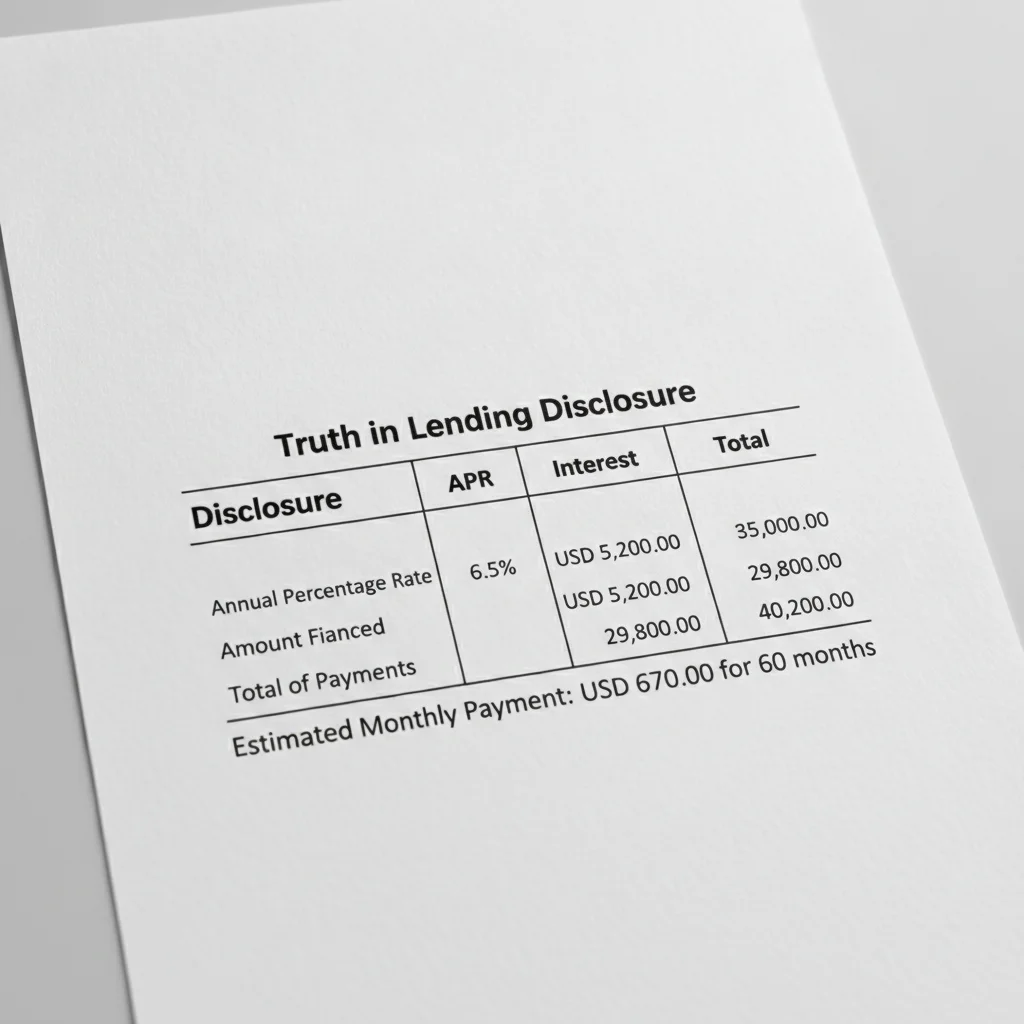
When you sit down to sign an auto loan agreement, you'll encounter a rectangular block of figures near the top of the contract. This is the Truth in Lending Act (TILA) disclosure box, and it's not optional. Under Regulation Z — the implementing rule for TILA — every consumer lender must present four specific figures before a borrower signs. The goal is straightforward: give you the numbers you actually need to compare loans apples-to-apples, regardless of how a deal was structured or marketed.
The four required disclosures are:
- Annual Percentage Rate (APR) — the yearly cost of the loan expressed as a percentage, including fees folded into the loan
- Finance Charge — the total dollar amount you'll pay to borrow the money
- Amount Financed — the net loan principal made available to you
- Total of Payments — the sum of every payment you'll make over the life of the loan
These four boxes tell a story together. None of them, read alone, gives you the full picture. Understanding what each figure represents — and how they relate to each other — is the core skill this article builds. For a broader breakdown of every number that appears throughout the contract, see Auto Loan Terms, Decoded.
Tools and Documents You'll Need
Before you walk through the disclosure box on your actual loan agreement, gather the following. Having everything in front of you lets you cross-check figures rather than take the dealer's word for any of them.
Your signed loan offer or pre-approval letter
Provides the APR and terms you were offered before visiting the dealership, giving you a baseline to compare against the disclosure box.
A basic calculator (or smartphone calculator app)
Used to verify that the monthly payment × number of payments equals the total of payments, and to cross-check the finance charge arithmetic.
Purchase agreement or buyer's order
Lists the negotiated vehicle price, fees, and any trade-in credit — the inputs needed to verify the amount financed figure.
Itemization of amount financed (requested from lender)
A TILA-required document that breaks down every component rolled into the loan principal, helping you verify the amount financed.
Pen and notepad
For writing down figures quoted during negotiation so you can compare them against the contract's disclosure box.
What you will need
Step-by-Step: Reading Each Box in the Disclosure
Work through the disclosure box from left to right, in the order TILA requires lenders to present the figures. Each step below explains what you're looking at, what the number should tell you, and what to do if something looks off.
Locate the Disclosure Box in the Contract
In a typical retail installment sales contract (the standard form used by most dealerships), the TILA disclosure appears as a four-column table near the top of the first page, usually before any signature lines. The four column headers will read — in order — Annual Percentage Rate, Finance Charge, Amount Financed, and Total of Payments.
If you're reviewing a loan agreement from a bank or credit union rather than a dealership, the layout may differ slightly, but the same four headings are required and should be easy to find. If you cannot locate the box, ask the lender to point it out before proceeding — this is a legal requirement, not optional fine print.
Read the APR and Compare It to Your Quoted Rate
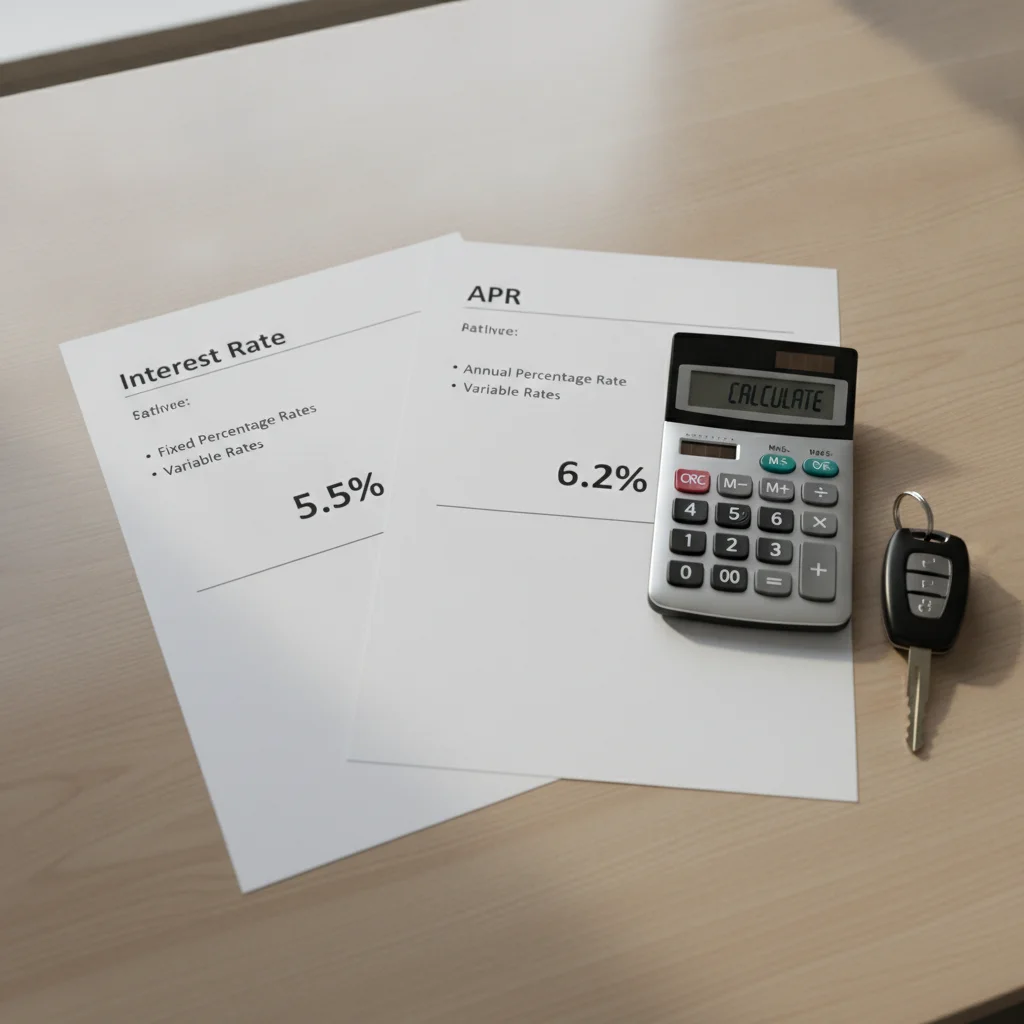
The Annual Percentage Rate is expressed as a percentage — for example, 7.49%. This number reflects the yearly cost of the loan, and unlike the simple interest rate, it includes certain lender fees that were built into the loan. That's what makes it the more accurate comparison tool when you're shopping multiple offers.
Compare the APR in the box against:
- The rate you were quoted by the salesperson or F&I manager
- Any pre-approval rate you received from your own bank or credit union
- Rates you researched before visiting the dealership
If the APR in the box is higher than what you were told verbally, stop and ask for an explanation before continuing. For a clear breakdown of why APR and interest rate can differ, see What APR Actually Means on an Auto Loan.
Check the Finance Charge
The Finance Charge is expressed in dollars, not as a percentage. It represents the total cost of borrowing — the sum of all interest and included fees you'll pay over the full loan term. For example, if your finance charge reads $4,218.00, that means you'll pay $4,218 beyond the vehicle's financed price just for the privilege of spreading the cost over time.
This figure is most useful when comparing loans of the same term length. If you're choosing between a dealer-arranged loan and a credit union loan, and both are for 60 months on the same vehicle, the one with the lower finance charge costs you less in real dollars — full stop.
Note that the finance charge typically does not include costs like sales tax, license fees, or registration charges that you may also owe but that fall outside the loan itself.
Verify the Amount Financed
The Amount Financed is the net loan principal — the dollar amount the lender is effectively lending to you. It's calculated as:
Amount Financed = Vehicle Price − Down Payment − Trade-In Credit + Financed Fees
This means the amount financed can be higher than the negotiated vehicle price if you rolled fees (such as a documentation fee, dealer-installed accessories, or add-on products) into the loan. It can also be lower if you made a substantial down payment.
Cross-check this figure against your own arithmetic using the purchase price you agreed on, your down payment receipt, and any itemized fee sheet the dealership provided. If the amount financed is higher than expected, request the itemization of amount financed — a document the lender must provide upon your request that lists every component rolled into the loan principal.
Review the Total of Payments
The Total of Payments is the single figure that answers the question: how much will I actually pay for this loan from start to finish? It equals the amount financed plus the finance charge — in other words, every dollar you'll send to the lender across every scheduled payment.
To verify this number yourself, multiply your monthly payment by the number of payments. For a $485/month payment over 60 months, the total of payments should be $29,100. If the figure in the box doesn't match that multiplication, ask for an explanation — it could indicate an origination fee, a prepaid finance charge, or a data entry error.
This is also the figure to use when comparing competing offers from different lenders. Even if two loans carry similar APRs, a difference in term length or fees can produce meaningfully different total-of-payments figures. The lower number costs you less — over the life of the loan, there's no ambiguity.
Confirm the Payment Schedule Matches the Box
Once you've verified all four TILA figures, look for the payment schedule in the contract — typically a table showing each payment date, the payment amount, and how many payments are owed. Confirm three things:
- The number of payments matches the loan term you agreed to (e.g., 60 payments for a 5-year loan)
- Each payment amount matches the monthly payment figure shown in the box
- The first payment date is what you were told — typically 30 to 45 days from the contract date
If the schedule shows a final payment that's dramatically larger than the rest — often called a balloon payment — that's a significant contract feature that should have been disclosed and discussed explicitly. Balloon payment loans are less common in standard auto financing but do exist in lease-to-own or specialty finance products.
Don't Let Time Pressure Rush Your Review
Dealership finance offices are busy environments, and F&I managers may create a sense of urgency to move you through paperwork quickly. You have the legal right to read every document before signing. Take as long as you need to verify the TILA disclosure box — a few extra minutes now can save thousands of dollars over the life of the loan.
Yo-Yo Financing Can Change Your Disclosed Terms
In a yo-yo financing situation, you drive off the lot believing your loan is finalized — then the dealer calls to say financing fell through and asks you to return and sign new paperwork, often at a higher APR. If this happens, you are not obligated to accept the new terms. Compare any revised disclosure box against your original agreement and consult a consumer finance attorney if you believe the change was improper.
Use the Disclosure Box to Shop, Not Just to Sign
You don't have to wait until you're at the signing table to see these figures. Ask any lender — including banks and credit unions — to provide a TILA disclosure or loan estimate before you commit. Having comparable disclosure boxes from multiple lenders is the fastest way to identify which offer actually costs you less.
Request an Itemization of the Amount Financed
Lenders are required by Regulation Z to provide a written itemization of the amount financed if you ask for one. This document lists every component — vehicle price, fees, add-ons, and credits — that make up the loan principal. Requesting it takes thirty seconds and gives you a complete line-by-line view of what you're financing.
How the Four Figures Work Together
Reading each box in isolation is useful, but the real insight comes from understanding the relationships between them. Here's how to use the four figures as a system.
Finance Charge = Total of Payments − Amount Financed
This is an arithmetic identity, not an approximation. If your total of payments is $28,400 and your amount financed is $24,000, your finance charge must be $4,400. If those three numbers don't satisfy that equation on your contract, ask the F&I manager to explain the discrepancy before signing.
APR Translates the Finance Charge Into a Comparable Rate
The finance charge tells you cost in dollars; the APR converts that cost into a rate so you can compare it against other loan offers — even loans with different terms or different loan amounts. A 72-month loan and a 48-month loan will show very different finance charges on the same vehicle, but comparing their APRs puts them on a level playing field. For a deeper look at why APR beats the simple interest rate as a comparison tool, read APR vs. Interest Rate on a Car Loan.
Total of Payments Is Your Real Out-of-Pocket Cost
When two dealers quote you a similar APR but different loan terms, the total of payments figure settles the argument. A lower monthly payment stretched over more months can cost you thousands more than a higher payment on a shorter loan. Always request the total of payments figure in writing before committing to any offer.
Amount Financed Is Not the Car Price
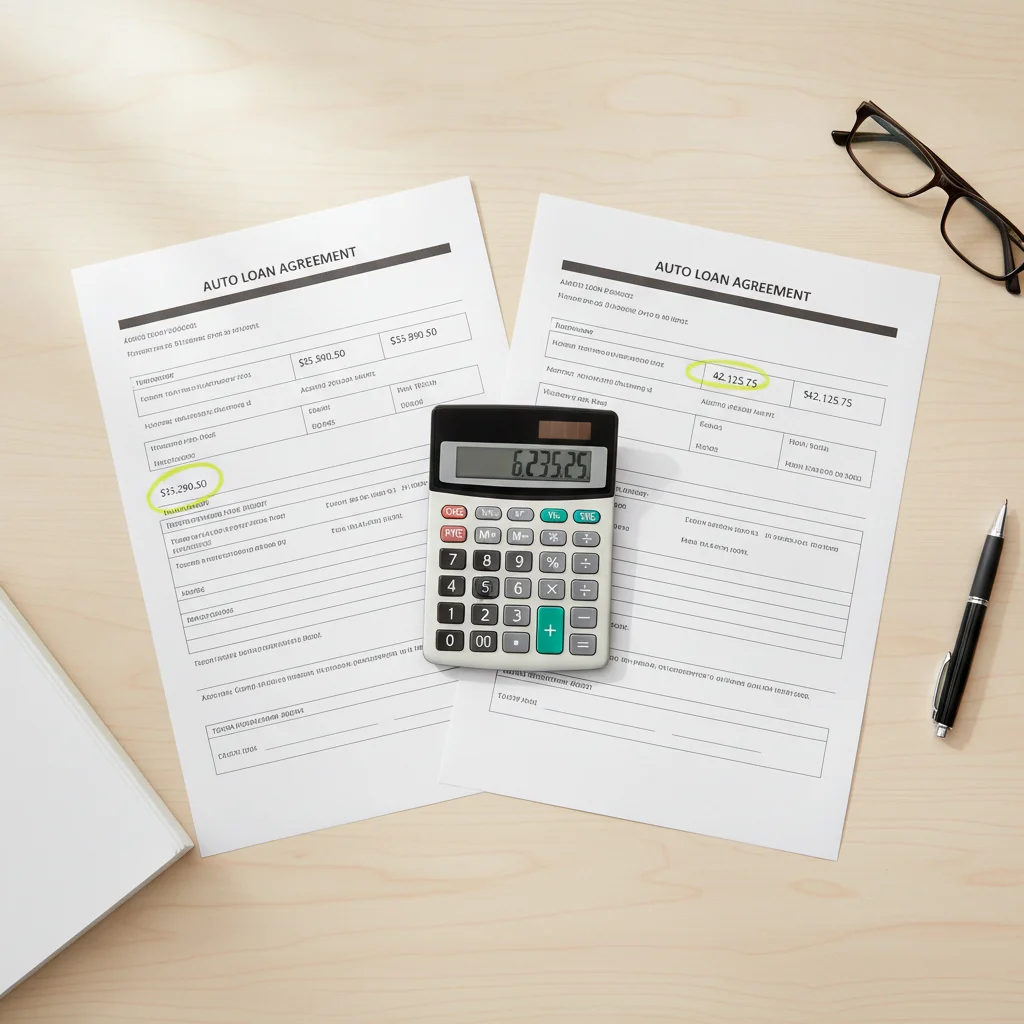
Many buyers assume the amount financed equals what they agreed to pay for the vehicle. It doesn't. The amount financed is the car price, minus any down payment or trade-in credit, plus any fees that were rolled into the loan. Understanding this prevents the common mistake of comparing the amount financed to the window sticker and wondering why the numbers don't match. For a full explanation of how fees interact with your APR figure, see The Fees Hidden Inside Your APR — and the Ones That Aren't.
Common Red Flags to Spot Before You Sign
Even buyers who understand the disclosure box conceptually sometimes miss concrete warning signs in the paperwork. Watch for these before you put pen to paper.
Never Sign a Contract with Blank Fields
Under no circumstances should you sign an auto loan contract that has blank spaces in or near the TILA disclosure box. A blank field can be filled in after signing, binding you to terms you never agreed to. Every figure — APR, finance charge, amount financed, and total of payments — must be completed before your signature goes on the page. If you're told the figures will be 'filled in later,' decline and wait until the document is complete.
Verbal Promises Are Not Legally Binding
Whatever a salesperson or finance manager tells you during negotiation is legally meaningless if it doesn't appear in the written contract. The TILA disclosure box is the legal record of your loan terms. If the APR in the box is higher than what you were verbally promised, the written contract controls — not the conversation. Always verify every quoted figure against the disclosure box before you sign.
The APR Is Higher Than What You Were Quoted
This is the most common mismatch, and it often happens because additional products — GAP insurance, extended warranties, paint protection — were added to the loan between the sales floor and the finance office. These additions can raise your APR, even if the base interest rate is the same. If the APR in the box doesn't match what you negotiated, ask for a line-by-line breakdown of what was financed.
The Payment Count Doesn't Match the Term You Agreed To
Your monthly payment multiplied by the number of payments should equal the total of payments. If the contract shows 72 payments but you agreed to a 60-month loan, that's a paperwork error — or worse, a deliberate change. Count the payments. Verify the term.
The Amount Financed Includes Items You Didn't Agree To
If the amount financed is significantly higher than you expected based on your negotiated price, down payment, and known fees, something extra was likely added. Ask for an itemization of the amount financed — lenders are required to provide one upon request under Regulation Z.
For a complete checklist of every figure worth verifying in a loan disclosure, Reading an Auto Loan Disclosure: Every Number You Need to Find walks through the full document systematically.
After You've Verified the Box: What to Do Next
Once you've confirmed that all four TILA figures are accurate and match your negotiated terms, you're ready to move forward — but a few final checks are worth making before you sign the full contract.
Verify the Payment Schedule
The contract should include a payment schedule showing each payment date and amount. Confirm that the first payment date matches what you were told and that every payment in the schedule matches the monthly payment shown in your disclosure box. Balloon payments or payments that vary significantly from the norm should prompt an immediate question.
Get Copies of Everything
Under TILA, you're entitled to a copy of the completed loan agreement at signing. Don't leave the dealership without a physical or digital copy of the full contract, including the disclosure box. If the finance manager hesitates, that's a red flag worth noting.
Compare Against Pre-Approved Offers
If you arrived at the dealership with a pre-approval from a bank or credit union, now is the moment to compare that loan's disclosure figures against the dealer's offer. The APR figure is the most efficient single comparison point, but also check the total of payments — a dealer might match your pre-approval APR while extending the term, which raises total cost. The Loan Terms Explained hub has more context on how term length affects every other figure in your contract.
If everything checks out, you've done the most important due diligence a car buyer can do. Understanding and verifying your TILA disclosure box puts you firmly in control of one of the largest financial commitments most people make.

All claims are backed by peer-reviewed research. Sources on request.