Key Takeaways
APR Difference Cost
The "APR difference cost" is the additional money you pay in total interest when your loan carries a higher Annual Percentage Rate than an alternative offer, even when that gap is small. A 0.5% APR difference might look trivial on paper, but spread across 48, 60, or 72 monthly payments it compounds into a real dollar figure — often hundreds of dollars on a typical car loan. This concept matters most when comparing financing offers from dealers, banks, or credit unions.
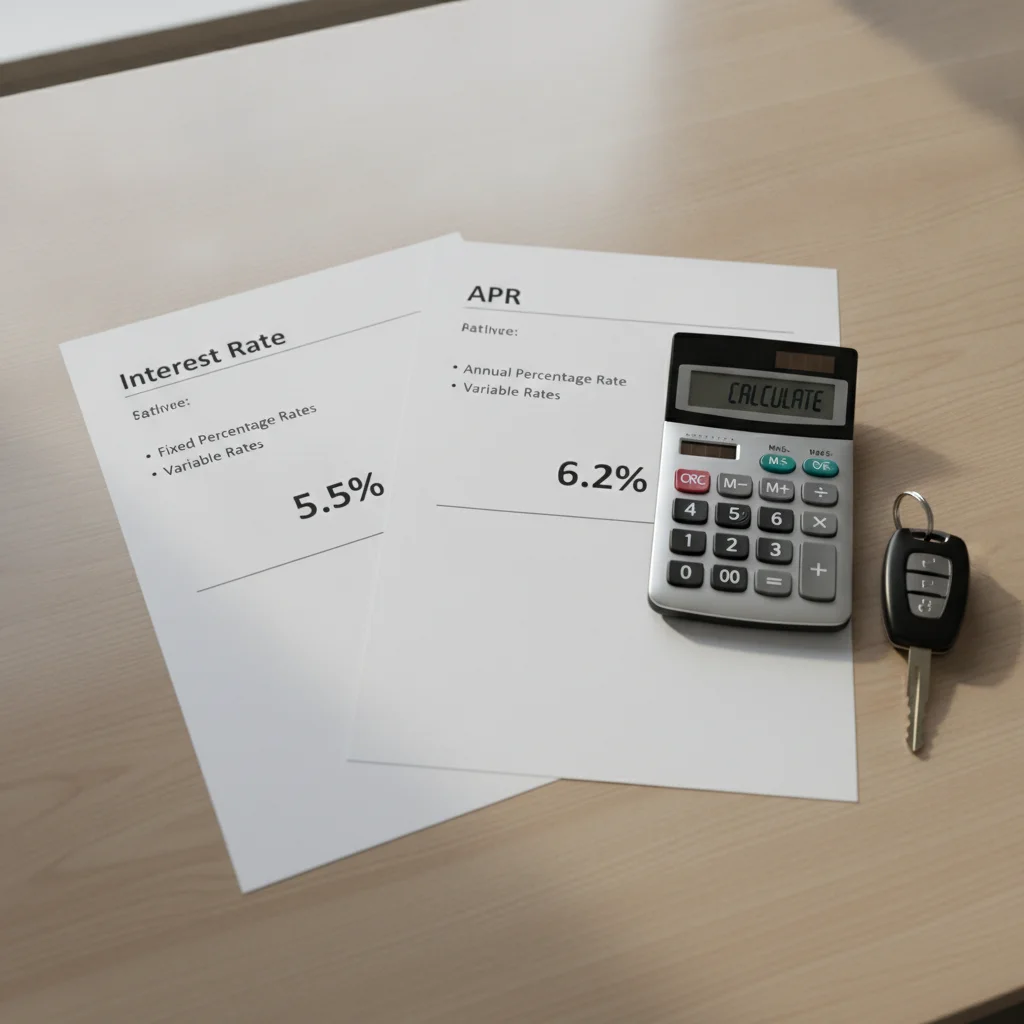
APR includes not just the nominal interest rate but also certain fees rolled into the loan cost, making it a more accurate comparison metric than the stated interest rate alone. Always compare APRs — not just rates — across competing offers.
The Real Math Behind a "Small" Rate Difference
Car shoppers obsess over monthly payments and sticker price. APR gets treated like a footnote. That's a mistake — and dealers know it.
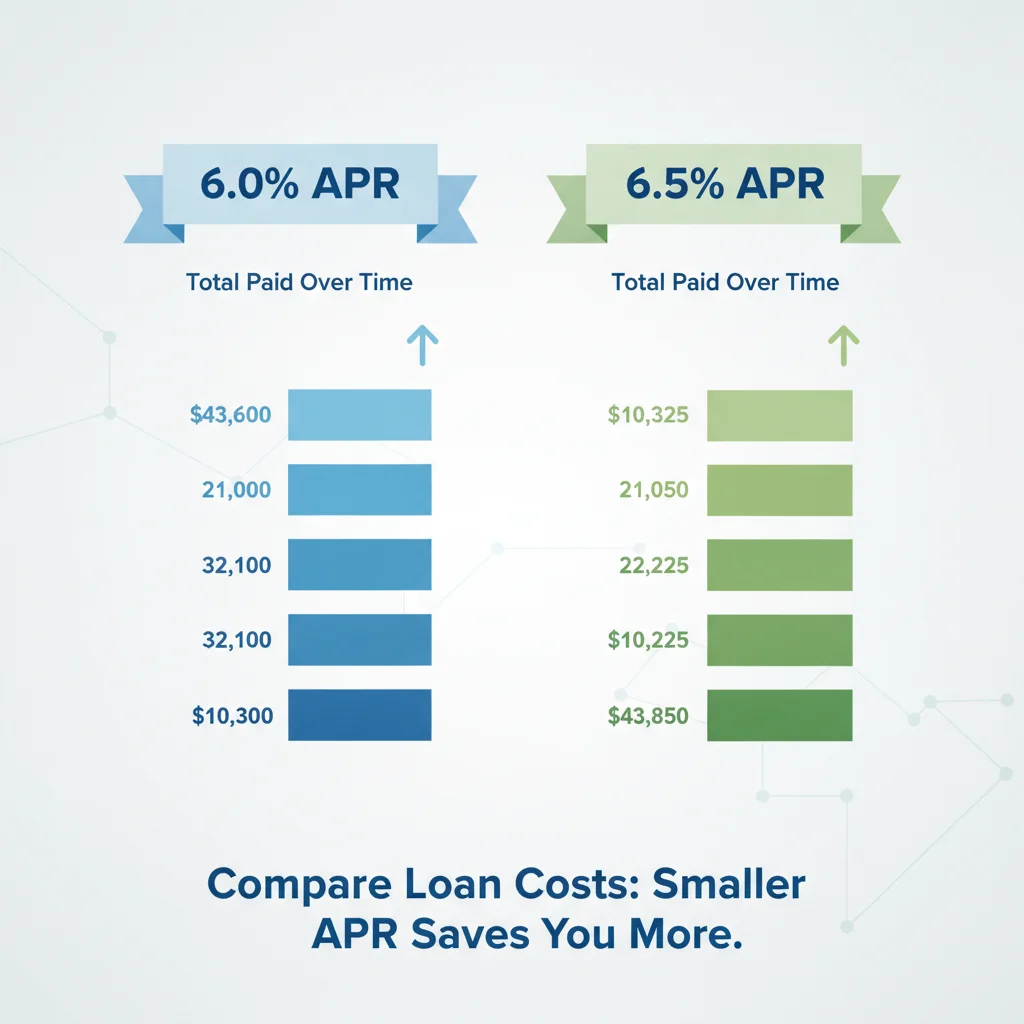
Let me show you what a half-point actually costs. Below are calculations for a $25,000 loan at three common term lengths, comparing 6.0% APR against 6.5% APR. These numbers come straight from standard amortization math — no tricks.
| Loan Term | APR 6.0% | APR 6.5% | Difference |
|---|---|---|---|
| 48 months | $587/mo — $1,178 total interest | $594/mo — $1,514 total interest | $336 |
| 60 months | $483/mo — $3,967 total interest | $488/mo — $4,300 total interest | $333 |
| 72 months | $414/mo — $4,808 total interest | $420/mo — $5,213 total interest | $405 |
None of those monthly payment differences look alarming — we're talking $5–$7 per month. But $333 to $405 in cumulative overpayment is real money: a car insurance payment, a tank of gas for six months, or a chunk of your next set of tires.
Now scale that to a $35,000 loan — which is closer to the current average transaction price — and those gaps grow to $465–$567 depending on term length. The math is unforgiving.
$333
Extra interest on a $25K/60-month loan at 6.5% vs. 6.0% APR
Based on standard amortization calculations comparing a 6.0% and 6.5% APR on a $25,000 loan over 60 months.
$48,644
Average new vehicle transaction price in the U.S. (2024)
According to Kelley Blue Book's 2024 market data, meaning the dollar impact of APR differences is larger than ever for typical buyers.
0.5%–2.5%
Typical dealer APR markup range above lender buy rate
Industry data and consumer advocacy reporting suggest dealers commonly mark up approved rates by this range, representing hundreds in hidden profit.
72 months
Most common new car loan term in the U.S.
Experian's State of the Automotive Finance Market report shows 72-month terms now represent the plurality of new car loans, amplifying rate difference costs.
$600
Savings from 0.5% lower APR on a $45K/60-month loan
Calculated via standard amortization comparing 6.0% and 6.5% APR on a $45,000 principal over 60 months.
Why Loan Term Multiplies the Damage
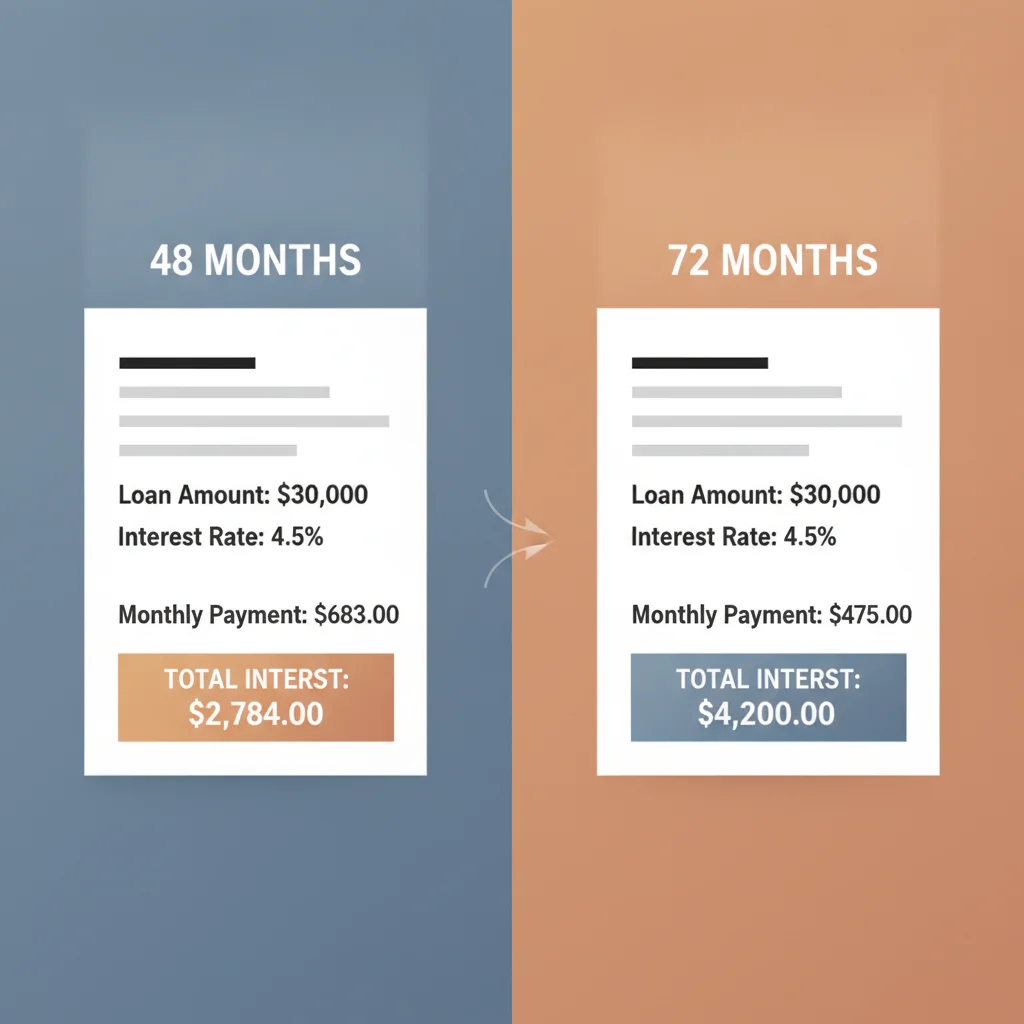
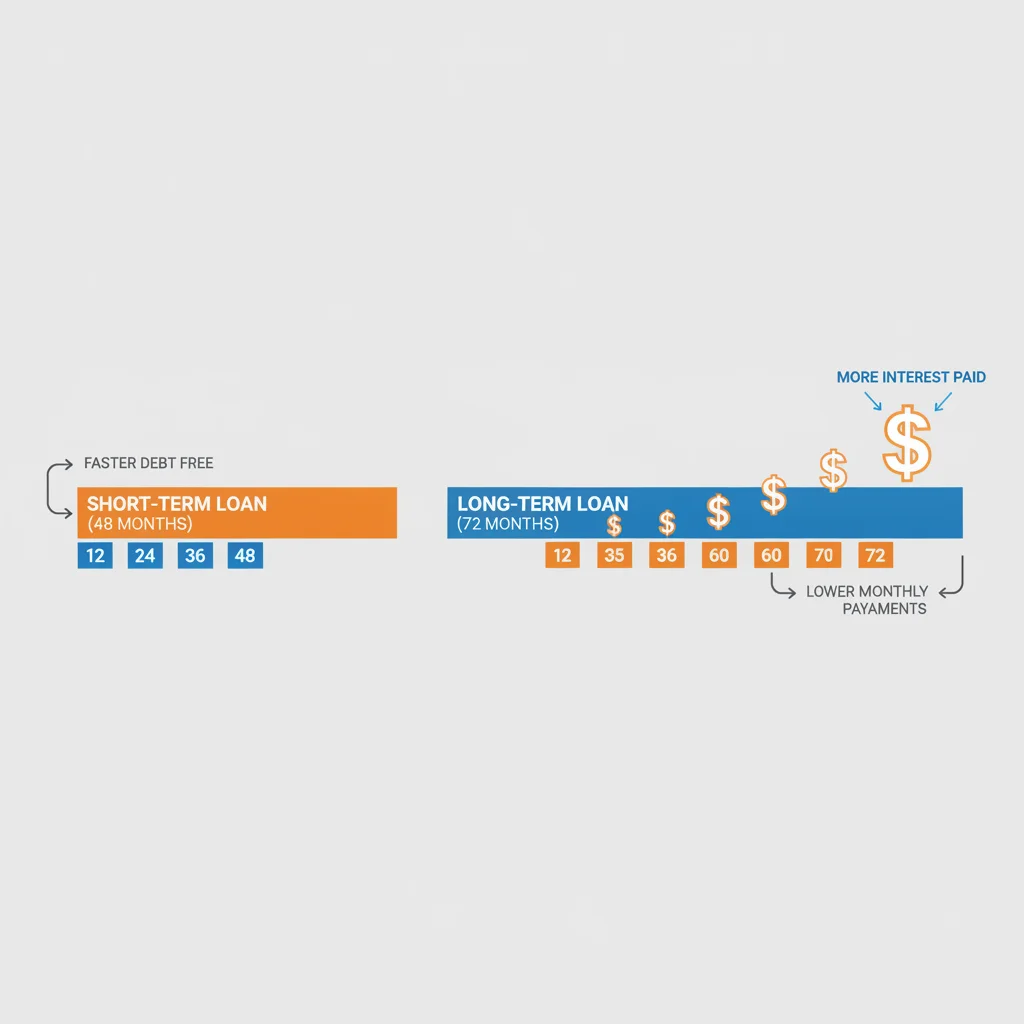
The 72-month row in that table isn't an accident. Loan term is the silent multiplier that turns a minor rate difference into a significant one. Every month you carry the loan, the higher APR is taking a slightly larger bite — and those bites add up.
Consider this framing: a 0.5% APR difference on a 48-month loan gives the higher rate 48 opportunities to cost you more. On a 72-month loan it gets 72 opportunities. That's 50% more chances to extract money from your wallet.
This is why the combination of a long term and a slightly elevated rate is the most expensive financing scenario a buyer can find themselves in. For a deep look at how term and rate interact, see Loan Term Length and APR: The Trade-Off Most Buyers Underestimate.
When a Shorter Term Isn't Feasible
Not every buyer can absorb the higher monthly payment of a 48-month loan versus a 72-month loan. If budget constraints push you toward a longer term, focus your energy on minimizing the APR itself rather than the term. Every tenth of a percent you can negotiate off the rate partially compensates for the extended exposure to interest charges. And a larger down payment reduces the principal that higher rate is applied to — see <a href="/auto-loans/loan-basics/down-payments">the Down Payments hub</a> for context.
The same principle works in reverse: shortening your loan term reduces both the time the higher rate applies and the total interest owed. Buyers who can afford $50–$80 more per month on a shorter term often come out hundreds ahead over the life of the loan.
For additional context on why identical APRs behave differently across term lengths, Why the Same APR Costs More on a Long Loan Than a Short One breaks it down in detail.
Rate vs. APR: You're Probably Comparing the Wrong Number
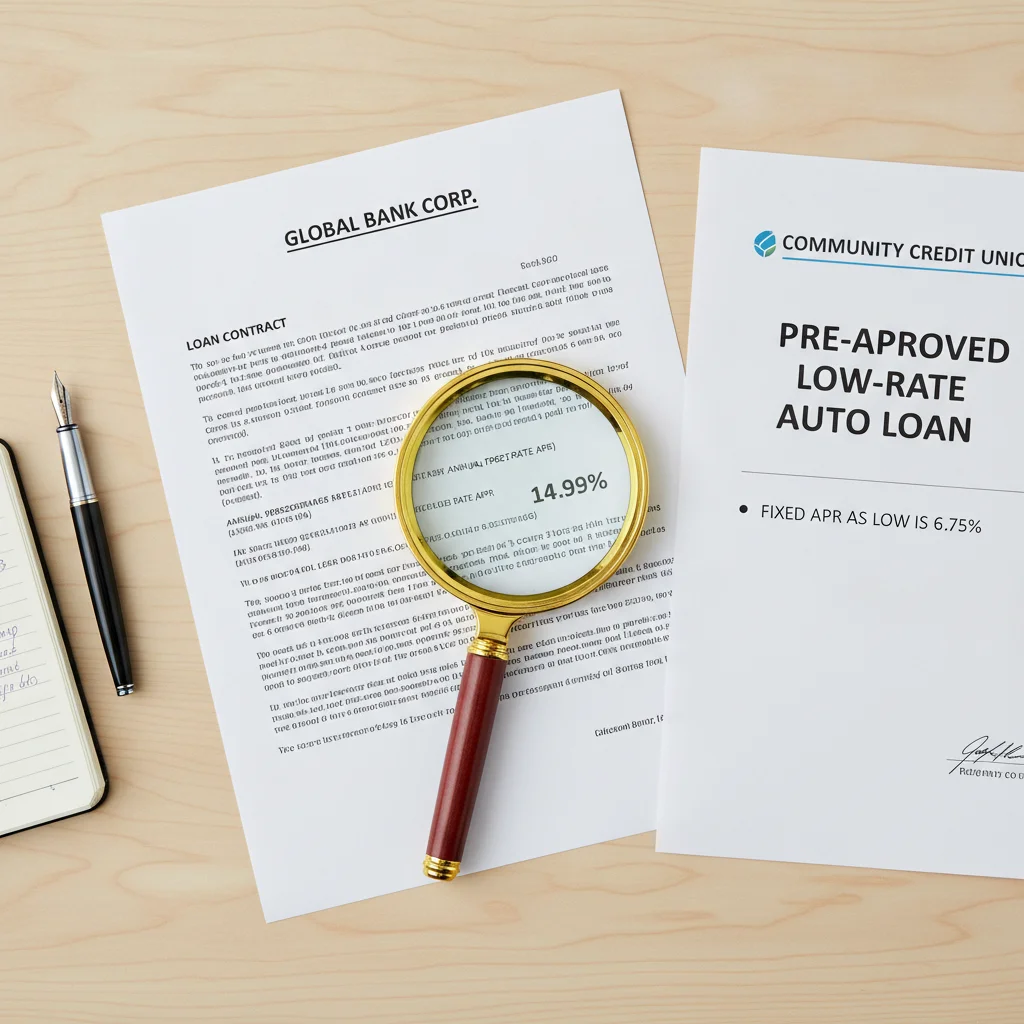
Here's a trap I saw buyers fall into constantly during my dealership days: they'd compare the interest rate on two loan offers without realizing one included an origination fee or a dealer documentation fee rolled into the financing. The offer with the lower stated rate sometimes had a higher actual cost when you factored in those charges.
That's what APR is designed to solve. The Annual Percentage Rate standardizes the comparison by folding fees into the calculation, giving you a single number that reflects the true annualized cost of the loan.
“The best protection a car buyer has against dealer financing markup is a competing offer in hand. Without it, you're negotiating blind against someone who does this for a living.”
— Jack Gillis, Executive Director, Center for Auto Safety and author of "The Car Book"
In practice, this means:
- A loan at 6.0% interest rate with $400 in fees might have an APR closer to 6.4% on a $25,000/60-month loan.
- A loan at 6.3% interest rate with no fees might have an APR of exactly 6.3%.
- The second loan is actually cheaper despite the higher stated rate.
Always ask lenders and dealers for the APR, not just the rate. If they're reluctant to show it, that's a red flag. For a full breakdown of how these two numbers differ and when it matters most, APR vs. Interest Rate on a Car Loan is required reading before you sit down at the finance desk.
Where Half-Point Differences Actually Come From
A 0.5% APR gap doesn't appear out of thin air. It almost always traces back to one of three sources:
1. Credit Score Tiers
Lenders organize borrowers into rate tiers based on credit scores. The cutoffs vary by lender, but a common structure looks like this:
| Credit Score Range | Typical Rate Tier Label | Approximate APR Range (2024) |
|---|---|---|
| 750+ | Super Prime | 5.5%–7.0% |
| 700–749 | Prime | 7.0%–9.5% |
| 660–699 | Near Prime | 9.5%–13.0% |
| 620–659 | Subprime | 13.0%–18.0% |
A score of 698 versus 702 can land you in entirely different tiers — not just a half-point gap, but potentially a 2–3% gap. The Borrowing at 720 vs. 620 article shows exactly what that translates to in monthly payment terms.
2. Dealer Markup (Reserve)
When a dealer arranges financing through a lender, the lender often approves you at a "buy rate" — say 6.0% — and allows the dealer to mark that rate up and keep the difference. A dealer markup of 0.5% on a $30,000/72-month loan puts roughly $450 straight into the dealer's pocket. This is legal and common. You won't see it disclosed on your contract. Getting pre-approved elsewhere is your primary defense.
3. Lender Competition
Banks, credit unions, and captive lenders (manufacturer financing arms) don't all price identically. The same borrower might get 6.5% from a major bank, 6.0% from a credit union, and 5.9% from a manufacturer promotion. Shopping at least three sources is the minimum due diligence — not a luxury.
Check Your Rate Tier Before You Shop
Pull your credit reports from all three bureaus at AnnualCreditReport.com at least 60 days before you plan to buy. If your score is within 10–15 points of a tier boundary — say 695 when 700 unlocks a better rate — you may be able to improve it quickly by paying down revolving balances. Even a modest score improvement can shift you into a rate tier that saves $300–$500 over the loan term.
Pre-Approval Is Your Most Powerful Tool
Apply for pre-approval through your bank or a credit union before visiting any dealership. This gives you a concrete benchmark APR that the dealer's finance office must beat to earn your business. Rate-shopping with two or three pre-approvals at once counts as a single hard inquiry if done within a 14–45 day window, depending on the scoring model — so there's no credit score penalty for shopping around.
How to Protect Yourself Before You Sign
Knowing where rate differences come from is useful. Knowing how to act on that knowledge is what actually saves money.
Get Pre-Approved First
Walk into any dealership with a pre-approval letter from your bank or credit union and you've immediately changed the negotiation dynamic. The dealer either has to beat that rate or match it. You've turned their financing offer into a competitive bid rather than a take-it-or-leave-it proposition.
Negotiate Price and Financing Separately
Dealers are skilled at blending these two conversations in ways that obscure the true cost. Negotiate the out-the-door vehicle price first — get that number locked in writing. Then, and only then, discuss financing. If you let them mix monthly payment into the price negotiation, they can inflate one to offset concessions in the other.
Ask for the Buy Rate
You won't always get it, but asking "What rate did the lender actually approve me at?" puts the dealer on notice that you understand dealer reserve exists. Some will disclose it; others won't. Either way, you've signaled you're not an easy mark.
Run the Amortization Yourself
Before signing, take the offered APR, loan amount, and term and plug them into any free online auto loan calculator. Verify that the monthly payment and total interest match what's on the contract. Discrepancies deserve an explanation.
Understanding how even a 1% rate reduction translates to savings can help you evaluate whether refinancing after the fact is worth pursuing if you didn't get the best rate at signing.

What a 0.5% Difference Looks Like Across Loan Sizes
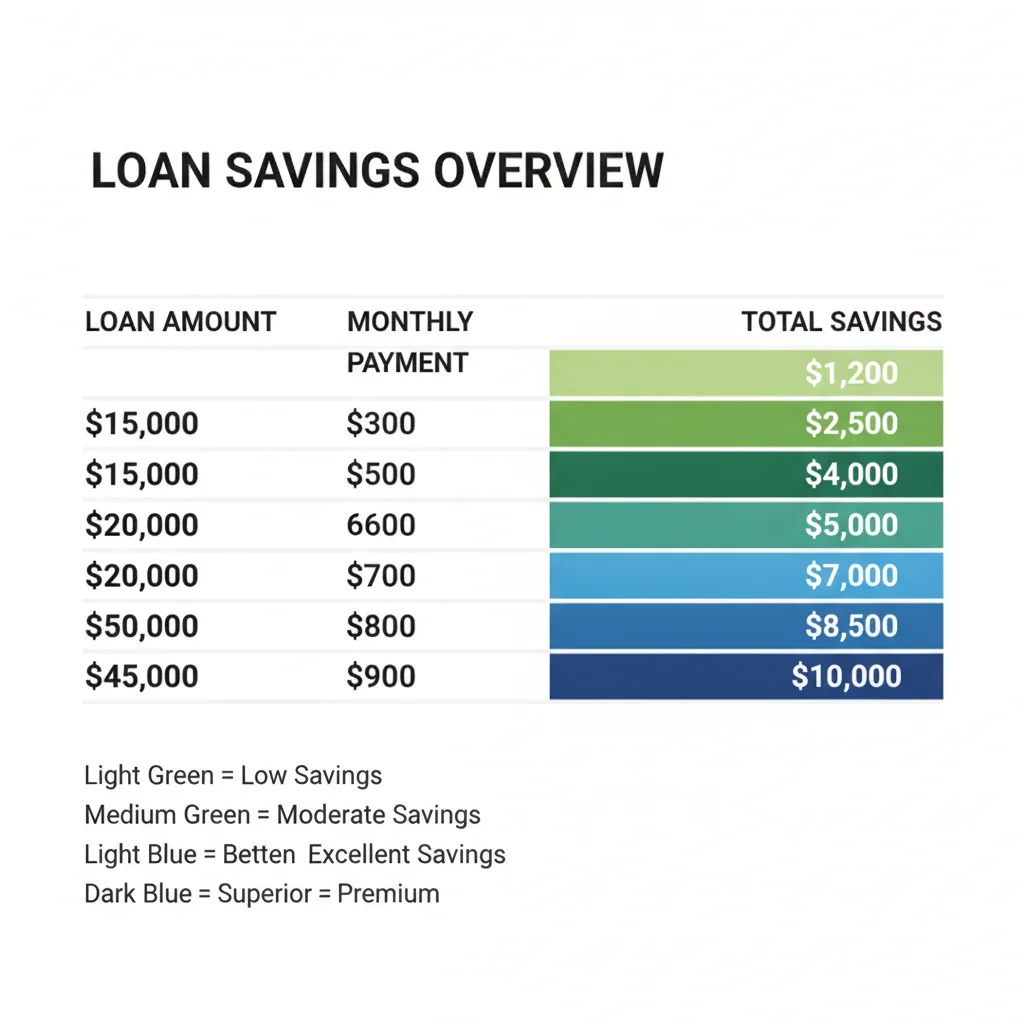
Not everyone is financing $25,000. Here's a broader view of the dollar impact of a 0.5% APR difference across loan amounts that reflect current market realities, all on a 60-month term:
| Loan Amount | Total Interest at 6.5% APR | Total Interest at 6.0% APR | Savings at 6.0% |
|---|---|---|---|
| $15,000 | $2,580 | $2,380 | $200 |
| $25,000 | $4,300 | $3,967 | $333 |
| $35,000 | $6,020 | $5,554 | $466 |
| $45,000 | $7,740 | $7,140 | $600 |
That $600 difference on a $45,000 loan is essentially a free car payment. It's also the kind of savings that's fully available to any buyer who takes 30 minutes to shop their financing before stepping onto a lot.
One factor that affects all of these numbers: your down payment. A larger down payment reduces the loan principal, which directly shrinks the dollar impact of any APR difference. Even a 0.5% rate gap on a $30,000 balance hurts less than the same gap on a $40,000 balance. The Down Payments hub covers how initial equity shapes your overall loan structure.
Check Your Rate Tier Before You Shop
Pull your credit reports from all three bureaus at AnnualCreditReport.com at least 60 days before you plan to buy. If your score is within 10–15 points of a tier boundary — say 695 when 700 unlocks a better rate — you may be able to improve it quickly by paying down revolving balances. Even a modest score improvement can shift you into a rate tier that saves $300–$500 over the loan term.
Pre-Approval Is Your Most Powerful Tool
Apply for pre-approval through your bank or a credit union before visiting any dealership. This gives you a concrete benchmark APR that the dealer's finance office must beat to earn your business. Rate-shopping with two or three pre-approvals at once counts as a single hard inquiry if done within a 14–45 day window, depending on the scoring model — so there's no credit score penalty for shopping around.
All claims are backed by peer-reviewed research. Sources on request.