
Key Takeaways
Why the Number on the Quote Sheet Isn't the Whole Story
When a dealership finance manager slides a payment quote across the desk, the figure looks deceptively clean. Four hundred and eighty-two dollars a month. Manageable, right? But that number has been stripped down to its leanest form: the bare principal and interest payment on the loan itself. It does not include what you'll owe your insurance company, what your state will charge for registration, or the steady trickle of maintenance costs that every car demands.
This gap between the quoted payment and the actual monthly outlay is where most buyers make their first financial mistake. They budget for the quote, not for the reality. The goal of this guide is to help you build the complete monthly number — one you can actually plan around.
Before we work through the steps, it helps to understand the role loan term length plays. The term — 36, 48, 60, 72, or 84 months — is the single most powerful lever in shaping what you pay each month and what you pay in total. A longer term compresses the monthly payment but stretches interest costs dramatically. See how loan length and interest stack up into total borrowing cost for a deeper look at that relationship. For now, keep it in mind as we work through every component of your true monthly cost.

What You Need Before You Start
Gathering the right inputs before you calculate prevents you from having to restart halfway through. The more precise your numbers, the more useful your final figure will be. Here's what to have ready:
What you will need
Auto Loan Amortization Calculator
Computes your monthly principal and interest payment based on loan amount, APR, and term length.
State DMV Fee Estimator
Provides accurate first-year and renewal registration and title fee totals for your specific vehicle and state.
Insurance Quote Tool
Generates a full-coverage premium estimate for the exact vehicle you're considering before you commit to buying it.
Spreadsheet (Excel or Google Sheets)
Organizes all five cost components side by side and allows quick scenario comparisons across different loan terms.
Vehicle Valuation Tool (KBB or Edmunds)
Confirms your trade-in value so you can accurately calculate your loan principal in Step 1.
Step-by-Step: Building Your True Monthly Number
Work through each step in order. Each one adds a layer to your total. By the end, you'll have a single monthly figure that reflects what owning this car will actually cost you month to month — not just what the lender is quoting.
Determine Your Loan Principal
Your loan principal is the amount you're actually borrowing — not the vehicle's sticker price. Start with the out-of-pocket purchase price (negotiated price, not MSRP), then add any fees the dealer is rolling into the loan (documentation fees, title and registration fees, extended warranty if purchased). Subtract your down payment and the value of any trade-in.
Formula:
Principal = (Vehicle Price + Rolled-In Fees) − Down Payment − Trade-In Value
Example: $32,000 vehicle + $800 in fees − $3,000 down − $4,500 trade-in = $25,300 principal.
If sales tax is being rolled into the loan (common in many states), add it here. If you're paying it upfront, leave it out of the principal and account for it separately in Step 3.
Calculate Your Monthly Principal and Interest Payment
This is the figure your lender quotes and what most people mean when they say 'the monthly payment.' Use the standard loan amortization formula, or plug your numbers into a loan calculator. You need three inputs:
- Principal (from Step 1)
- Annual Percentage Rate (APR) — confirm this is the APR, not just the interest rate
- Loan term in months (e.g., 60 months for a 5-year loan)
The formula is:
M = P × [r(1+r)^n] / [(1+r)^n − 1]
Where M = monthly payment, P = principal, r = monthly interest rate (APR ÷ 12), and n = number of months.
For $25,300 at 7.0% APR over 60 months: monthly rate = 0.07 ÷ 12 = 0.005833. M ≈ $501/month.
Account for Sales Tax and Upfront Fees Not in the Loan
If your state's sales tax and any title or registration fees were not rolled into the loan principal in Step 1, you still need to account for them — either as a lump sum due at signing or amortized across your loan term for budgeting purposes.
To convert upfront costs into a monthly equivalent for budgeting:
Monthly Equivalent = Total Upfront Costs ÷ Loan Term in Months
Example: $1,800 in taxes and fees ÷ 60 months = $30/month equivalent.
This won't appear on your loan statement, but it affects how much cash you need at signing and how your total cost of ownership looks. Include it in your monthly budget calculation even if it's a one-time payment.
Get an Actual Insurance Quote for This Vehicle
Do not estimate your insurance cost based on your current policy — rates vary significantly by vehicle. Before you commit to a specific car, get a quote from your insurer (or use a comparison tool) for that exact year, make, model, and trim level.
When you call or go online for the quote, specify that you need full coverage — comprehensive and collision — because the lender will require it. Also confirm:
- Your deductible amount (higher deductibles lower the premium but increase out-of-pocket costs after a claim)
- Whether the lender requires a specific liability limit
- Whether GAP insurance is included or must be purchased separately
Record the monthly premium. This is a fixed cost that belongs in your monthly total.
Add Registration, Taxes, and Annual Fees
Annual registration and any personal property taxes on the vehicle are real ownership costs that many buyers forget to include. Contact your state's DMV website or use their fee estimator to determine:
- Annual registration fee for your vehicle type and weight class
- Any personal property or excise tax assessed on vehicles in your state (some states charge this annually based on the car's value)
Add these together and divide by 12 to get a monthly equivalent:
Monthly Registration/Tax Reserve = Annual Total ÷ 12
Example: $240 annual registration + $180 annual property tax = $420 ÷ 12 = $35/month.
Set a Maintenance Reserve
Every vehicle requires routine maintenance — oil changes, tire rotations, brake inspections, filters — regardless of whether it's new or used. Establish a monthly reserve that you set aside specifically for these costs.
- New vehicle under factory warranty: $50–$75/month minimum
- Used vehicle under 5 years old: $75–$100/month
- Used vehicle over 5 years or over 75,000 miles: $100–$150/month or more
This reserve doesn't go toward your loan — it goes into a dedicated savings buffer. When your brakes need replacing or a tire blows, you draw from the reserve rather than from your regular income or emergency fund.
Sum All Components Into Your True Monthly Cost
Add all five figures together:
| Component | Monthly Amount |
|---|---|
| Principal + Interest Payment (Step 2) | $501 |
| Upfront Fees Amortized (Step 3) | $30 |
| Insurance Premium (Step 4) | $155 |
| Registration/Tax Reserve (Step 5) | $35 |
| Maintenance Reserve (Step 6) | $75 |
| True Monthly Total | $796 |
In this example, the dealership's quoted payment of $501 becomes a true monthly cost of $796 — a $295 difference that must exist in your budget. If it doesn't, you're not buying a $501-per-month car. You're buying a $796-per-month car with a funding gap.
Once you have your complete monthly figure, compare it to your take-home income. Most financial planners recommend keeping total vehicle costs — loan, insurance, registration, and maintenance reserve — at or below 15–20% of your monthly take-home pay. If your number pushes beyond that, consider whether a shorter loan with a higher payment (but lower total interest) makes more sense, or whether a less expensive vehicle fits your situation better. For a structured way to think through that decision, see how to factor in the full cost of a new car before visiting a dealer.
Run Multiple Term Scenarios Before Deciding
Before accepting any loan offer, calculate your true monthly cost for at least two different term lengths — typically 60 and 72 months. The difference in monthly payment may seem appealing for the longer term, but the total interest difference is often $1,000 or more. Seeing both figures side by side makes the trade-off concrete rather than abstract.
Your Budget Ceiling Isn't the Payment — It's the Total
A common mistake is determining affordability based on whether the loan payment fits the budget. That's the wrong ceiling. Calculate your true monthly total first, then work backward to determine what vehicle price and loan term produce a total that fits. This prevents the common scenario of technically affording the payment but struggling with the full cost of ownership.
How Loan Term Length Changes Everything
The monthly payment calculation in Step 2 assumes a specific loan term. But that term is a variable you can control — and changing it ripples through every other number in your budget.
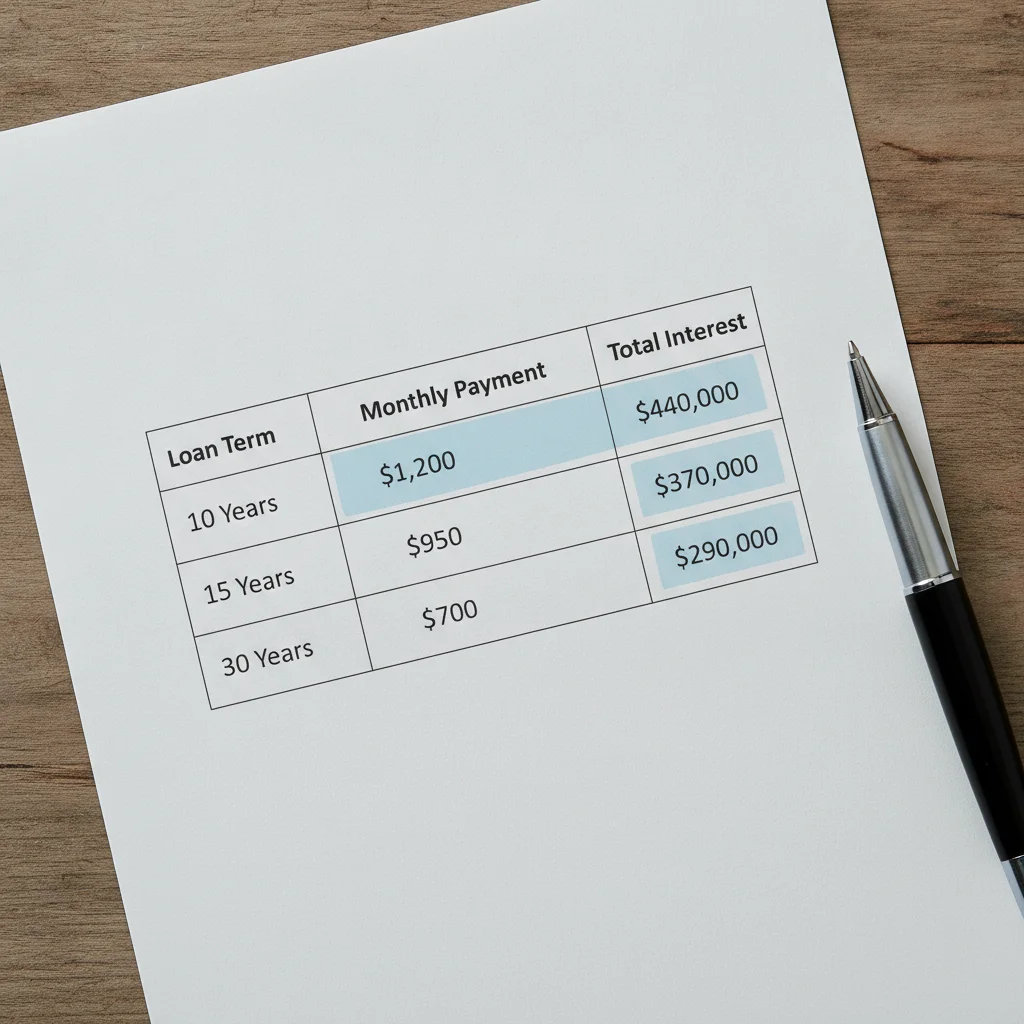
Consider a $28,000 loan at 7.5% APR. Here's how the math shifts across three common term lengths:
| Loan Term | Monthly Payment | Total Interest Paid | Total Amount Repaid |
|---|---|---|---|
| 48 months | $679 | $4,588 | $32,588 |
| 60 months | $561 | $5,674 | $33,674 |
| 72 months | $482 | $6,750 | $34,750 |
| 84 months | $425 | $7,700 | $35,700 |
The 84-month loan looks attractive on a monthly basis — $254 less per month than the 48-month option. But you pay $3,112 more in total interest, and you remain financially tied to the vehicle for seven years. During that time, the car depreciates steadily, which means there are years where you owe more than the car is worth — a condition known as being underwater or having negative equity.
Long Terms and Negative Equity Are a Real Risk
On a 72- or 84-month loan, a car depreciates faster than you pay down the principal during the early years. This creates negative equity — you owe more than the car is worth. If you need to sell, trade in, or the vehicle is totaled, you may owe thousands more than you receive. GAP insurance can protect you from the total-loss scenario, but it doesn't fix the trade-in problem.
Loan term is also where lender rates often diverge. Many lenders charge a slightly higher APR for longer terms, compounding the interest disadvantage further. Always ask for the APR — not just the payment — for each term option being offered. The how interest rates and APR affect the true cost of your car loan resource explains the distinction between rate and APR in plain terms.
If you're working through a lender's online tool, make sure you understand what it's actually calculating. Learn what inputs matter most and how to interpret calculator output correctly before relying on those figures for a real decision.
The Non-Loan Costs Most Buyers Undercount
Steps 4 through 6 in the process address the costs that live outside the loan itself. These deserve extra attention because they're the ones most frequently underestimated — or forgotten entirely.
Insurance
If you're financing, your lender will require comprehensive and collision coverage in addition to your state's minimum liability limits. This is not optional. The cost varies significantly by driver profile, vehicle type, and location, but a realistic national average for a financed vehicle runs between $120 and $220 per month. Get an actual quote — not a guess — before you commit to the vehicle. Choosing a model with higher theft rates, a powerful engine, or expensive parts raises your premium substantially. See how insurance, maintenance, and registration add up for used car buyers for a used-car-specific breakdown.
Registration and Taxes
Annual registration fees and any applicable personal property taxes vary widely by state. Some states charge a flat fee under $100 per year; others assess a percentage of the vehicle's value annually — which can run several hundred dollars on a new car. Divide your first-year cost by 12 to get your monthly equivalent. Do not ignore this line item simply because it's paid annually.
Maintenance Reserve
New cars under warranty are relatively inexpensive to maintain in the first year or two — mostly oil changes and tire rotations. Budget a minimum of $50–$75 per month as a maintenance reserve for a new vehicle, and $75–$150 for a used one outside of warranty. When an unexpected repair hits, that reserve prevents a budget crisis.
Never Budget Based on the Payment Quote Alone
The monthly payment a dealer or lender quotes covers only the loan's principal and interest. It does not include insurance, registration, taxes, or maintenance — costs that are mandatory and recurring. In most real-world scenarios, the true monthly cost of ownership is $200–$400 higher than the quoted payment. Signing a loan based solely on the payment figure without accounting for all other costs is the most common source of post-purchase financial strain for car buyers.
For a complete view of what carrying this loan to its full term will cost — combining interest, depreciation, and opportunity cost — see what letting a loan run its full course actually costs you. And if you want to quantify the interest component specifically before signing, here's how to calculate exactly how much interest you'll pay over the full life of your loan.
Putting It All Together: Your True Monthly Budget Line
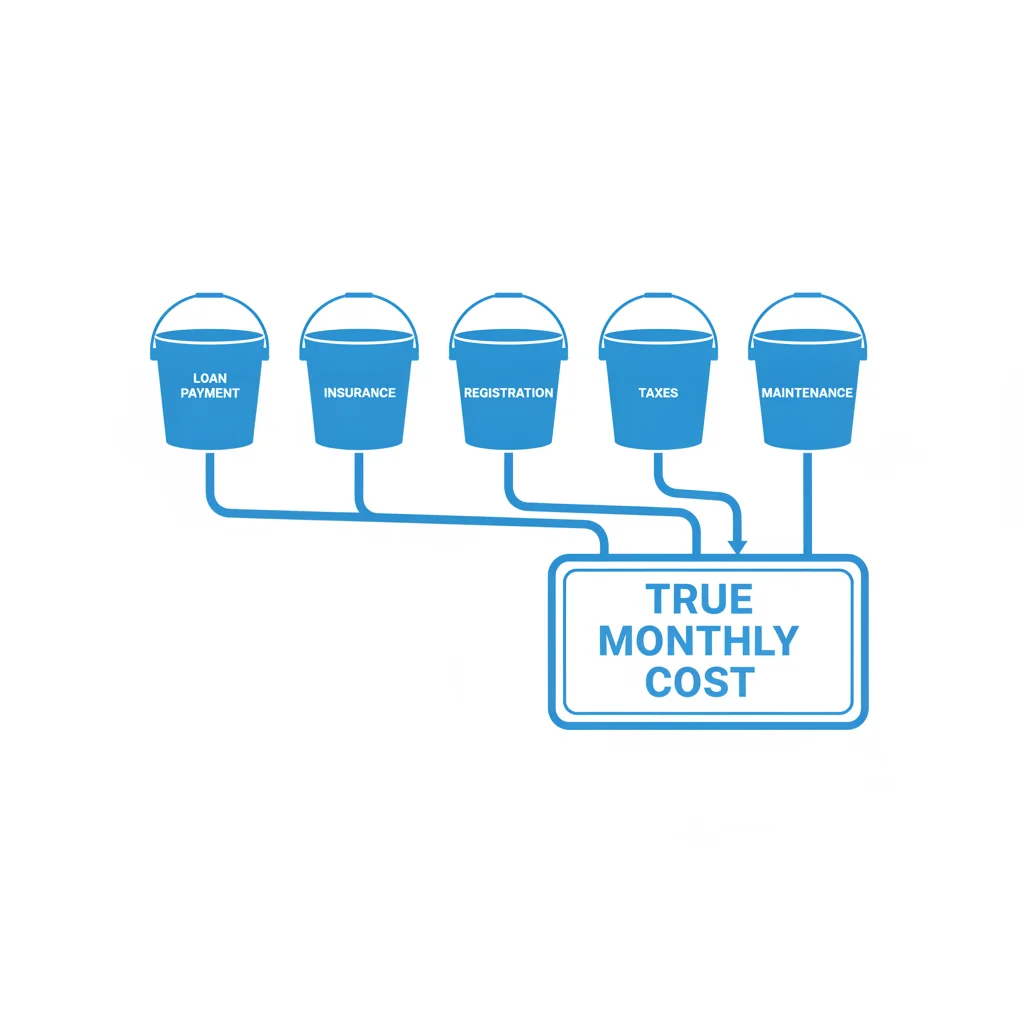
Once you've completed each step, you should have five distinct numbers ready to add together:
- Loan payment (principal + interest, calculated for your chosen term)
- Sales tax and fees, amortized (if rolled into the loan, already included above; if paid upfront, divide by loan term months)
- Insurance premium (monthly, based on an actual quote)
- Registration and property tax (annual total ÷ 12)
- Maintenance reserve ($50–$150/month depending on vehicle age and condition)
Add those five figures together. That is your true monthly cost of ownership for this vehicle. Write it down and compare it to the payment figure the dealership showed you first. The gap is typically $200–$400 on a mainstream financed vehicle. That gap is real money — and it needs to be in your budget before you sign anything.
If the total feels too high, run the numbers again using a shorter loan term (which reduces total interest, even if the monthly payment is slightly higher), a larger down payment (which lowers the principal and therefore the payment), or a less expensive vehicle. These are the three levers you actually control. Changing the loan term is often the most powerful adjustment you can make without renegotiating the purchase price itself.
The goal isn't to talk yourself out of a purchase — it's to enter into it with full information. Buyers who know their true monthly number before they sit down in the finance office are in a far stronger position to negotiate, compare offers, and walk away if the numbers don't work.

All claims are backed by peer-reviewed research. Sources on request.