
Key Takeaways
Why Preparation Matters More Than You Think
Most borrowers treat a loan application like a lottery ticket — you fill it out, submit it, and hope for the best. But lenders aren't making random decisions. They're evaluating specific signals: your credit score, your debt load, your income stability, and how much risk the vehicle itself represents. Every one of those signals is something you can influence before you apply.
This matters especially if your credit score falls in the subprime range — generally below 620. At that level, a single missed negative item on your report, a high debt-to-income ratio, or requesting too large a loan can tip the decision from marginal approval to outright denial. The good news is that small, targeted improvements often have outsized effects. A 20-point score increase, a reduced credit card balance, or a $1,500 down payment can shift you from a denial into an approval — sometimes at a meaningfully lower rate.
Before you start browsing inventory or walking dealership lots, take four to eight weeks to work through the strategies below. The time investment is modest; the financial payoff can last the entire life of your loan. For a broader picture of how your current score affects your options, start with credit score ranges and what they mean for your preapproval odds.
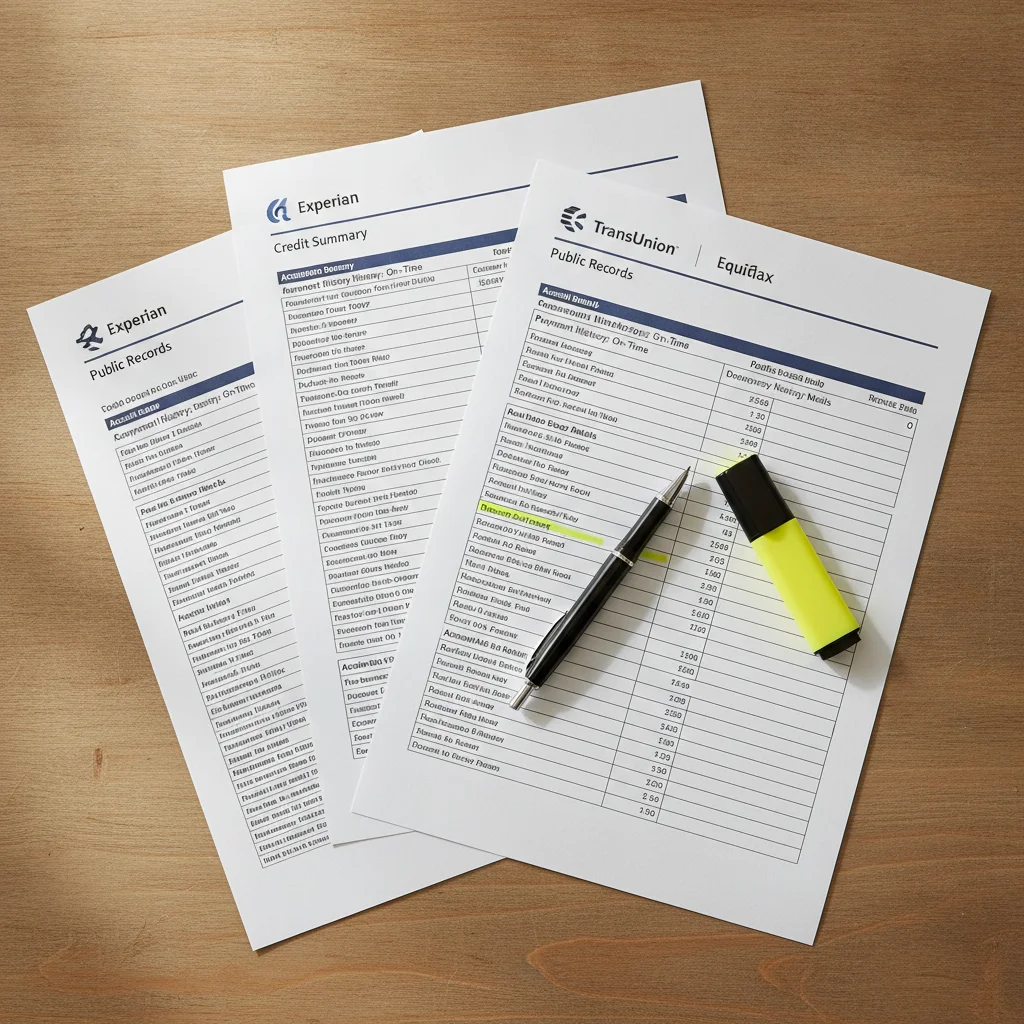
Pull Your Credit Reports and Fix What's Wrong
Your first move — before anything else — is to pull your full credit reports from all three bureaus: Equifax, Experian, and TransUnion. You can do this for free at AnnualCreditReport.com. Don't rely on a credit monitoring app alone; those summaries sometimes omit tradeline details or show slightly different data than what lenders actually see.
Once you have your reports, read them carefully. Look specifically for:
- Accounts you don't recognize — these may indicate identity theft or mixed files
- Late payments marked incorrectly — a payment reported as 30 days late when you have a bank record proving otherwise
- Balances that haven't been updated — a paid-off account still showing a balance
- Duplicate negative items — the same collection account listed twice
- Outdated derogatory marks — most negative items must fall off after seven years; bankruptcies after ten
Filing a dispute with the credit bureau is free and must be investigated within 30 days under the Fair Credit Reporting Act. If the creditor can't verify the item, it must be removed. Even getting one significant error corrected — say, a falsely reported late payment on a major account — can lift your score by 20 to 50 points.
Dispute Results Can Take Up to 45 Days
While the FCRA requires bureaus to complete investigations within 30 days, complex disputes — especially those involving debt buyers or older collection accounts — can take up to 45 days. Build this lead time into your preparation timeline. Don't assume errors will be resolved in time if you start the process fewer than six weeks before you plan to apply.
Soft Inquiries Don't Affect Your Score
Checking your own credit report is a soft inquiry and has zero impact on your score. Similarly, when lenders prescreen you for offers (those 'you may be preapproved' mailers), those are also soft pulls. Only formal credit applications — where you explicitly authorize a lender to pull your file — generate hard inquiries. Don't avoid checking your own credit out of fear of damaging it.
Don't stop at one bureau. Lenders often pull from all three, and errors frequently appear on only one report. A clean Experian file won't help you if Equifax still shows a disputed collection account.
Reduce Your Debt-to-Income Ratio Strategically
Your debt-to-income ratio (DTI) — the percentage of your gross monthly income consumed by minimum debt payments — is one of the most important underwriting factors lenders weigh, yet most borrowers never think about it. A DTI above 50% is a serious red flag for subprime lenders. Below 40% is where approvals become more reliable.
The formula is straightforward:
DTI = (Total Monthly Debt Payments ÷ Gross Monthly Income) × 100
For example, if you earn $3,500 per month before taxes and your combined minimum payments on a credit card, student loan, and personal loan total $1,400, your DTI is 40%. Add a $450 car payment and it jumps to 53% — a level many lenders won't accept.
To bring DTI down before you apply:
- Pay off small balances in full. Eliminating a $120/month minimum payment has a bigger DTI effect than making extra payments on a large balance.
- Avoid opening new credit accounts — each new account can add a minimum payment and a hard inquiry simultaneously.
- Don't co-sign loans for others in the months before your application. Co-signed debt counts fully against your DTI.
79%
Credit reports with at least one error
According to a Federal Trade Commission study, approximately 79% of consumers who identified and disputed errors on their credit reports saw a change — with many experiencing score increases meaningful enough to affect loan decisions.
30%
Of FICO score tied to credit utilization
FICO's published score factor breakdown shows that amounts owed — primarily measured as revolving utilization — accounts for roughly 30% of your total score, making it the second most impactful factor after payment history.
$5,000+
Extra interest paid by subprime vs. prime borrowers
Analysis from the Consumer Financial Protection Bureau shows that borrowers in the subprime tier routinely pay $5,000 to $10,000 more in total interest compared to prime borrowers on similarly priced vehicles over 60-month loan terms.
14 days
Rate-shopping window for auto loan inquiries
Under FICO Score 8 and VantageScore 3.0 models, multiple auto loan hard inquiries within a 14-day period are typically treated as a single inquiry, allowing borrowers to shop freely without compounding score damage.
If your DTI is currently above 50%, focus here first — before worrying about your credit score. A lower DTI can sometimes compensate for a mediocre score in ways that score improvements alone cannot.
Best Practices to Strengthen Your Application
Beyond the foundational credit and DTI work, there are several concrete practices that consistently improve approval outcomes for subprime borrowers. These aren't theoretical — they're the moves that experienced loan officers and credit counselors repeatedly see make a difference.
Dispute every inaccurate negative item on your credit report before applying
Lenders make approval decisions based on what your credit report says, not what actually happened. A single incorrect late payment can suppress your score by 30 to 60 points. Disputing errors costs nothing and legally requires bureaus to investigate and remove unverifiable items within 30 days.
Pay down revolving credit balances to below 30% utilization before applying
Credit utilization — the ratio of your current balance to your credit limit — is the second most influential factor in your FICO score, accounting for roughly 30% of the total. High utilization signals financial stress to lenders even if you've never missed a payment. Getting utilization below 30% can produce score gains within one billing cycle.
Add a co-signer with strong credit if your own profile is insufficient
A creditworthy co-signer doesn't just improve approval odds — it can dramatically reduce the interest rate you're offered because the lender has two parties to hold liable. This is particularly effective when the primary borrower has a short credit history rather than serious derogatory marks, since the co-signer essentially lends their credit reputation to the application.
Keep your loan request within a realistic range for your income and credit tier
Requesting a loan amount that exceeds what your credit tier typically supports is one of the fastest paths to rejection. Lenders have internal guidelines about maximum loan amounts for each credit band. Asking for $28,000 with a 580 score and $38,000 income will rarely succeed — not because you can't afford the payment, but because the risk profile falls outside policy.
Avoid opening new credit accounts in the 90 days before your auto loan application
Each new credit account creates a hard inquiry (typically minus 5 to 10 points) and lowers your average account age — both negative signals to auto lenders. Opening a new credit card to 'build credit' right before an auto loan application can backfire by triggering lender concerns about sudden credit-seeking behavior.
Verify your income documentation is complete and consistent before submitting any application
Lenders verify income independently — they don't just take your word for it. Inconsistencies between what you report on an application and what your pay stubs or bank statements show create underwriting flags that can stall or kill an approval. Self-employed borrowers and gig workers face particular scrutiny and need two full years of tax returns ready.
Choose the Right Vehicle for Your Credit Profile
This is the step most buyers skip entirely, and it's often the one that determines whether they get approved. Lenders don't just approve you — they approve a specific loan for a specific vehicle. The car's age, mileage, loan-to-value ratio, and overall price all factor into their risk calculation.

Here's what subprime borrowers need to understand about vehicle selection:
- Loan-to-Value (LTV) ratio matters
- If you're borrowing more than a vehicle is worth — common when rolling in negative equity from a trade-in or buying a car with high dealer markup — lenders see elevated risk. Most subprime lenders cap LTV at 120% to 130% of the vehicle's book value. Know your vehicle's current market value before you negotiate price.
- Older, high-mileage vehicles can be harder to finance
- Many lenders won't touch vehicles over 10 years old or with more than 100,000 miles. Some credit unions and buy-here-pay-here lots will, but at steep rates. A newer used vehicle in the 3–6 year range often offers the best balance of price and lender acceptance.
- Certified Pre-Owned programs offer advantages
- CPO vehicles from franchised dealerships sometimes come with manufacturer-backed financing programs that are more accessible than traditional subprime loans, often with better rates and warranties.
If you're considering using a trade-in to reduce the amount you need to borrow, see trade-in strategies to ensure you're getting fair market value before the negotiations begin.
Check Lender Policies on Vehicle Age Before Shopping
Before you fall in love with a specific car, call or check online to confirm your target lenders will finance it. Many mainstream lenders won't approve loans on vehicles older than 8–10 model years or with more than 100,000 miles. Knowing this upfront prevents wasted time and hard inquiries on vehicles that can't be financed through your preferred lender.
Save a Down Payment That Actually Moves the Needle
A down payment does two things simultaneously: it reduces the loan amount you're requesting, and it signals to the lender that you have skin in the game. Both effects improve your approval odds and can shift your interest rate downward.
“Lenders aren't looking for perfect borrowers. They're looking for predictable ones. Your job before you apply is to tell a consistent, documented story — income, stability, and some skin in the game. A meaningful down payment is one of the clearest signals you can send.”
— Melinda Opperman, President of Credit.org, a nonprofit credit counseling agency
For subprime borrowers specifically, lenders often have minimum down payment requirements — typically 10% to 20% of the vehicle's purchase price. Putting down less than the minimum doesn't just result in a higher payment; it can result in an outright denial.
But the benefits don't stop at hitting the minimum. Consider a $18,000 vehicle:
| Down Payment | Loan Amount | Monthly Payment (at 14% APR, 60 months) |
|---|---|---|
| $0 (0%) | $18,000 | $419 |
| $1,800 (10%) | $16,200 | $377 |
| $3,600 (20%) | $14,400 | $334 |
A 20% down payment saves $85 per month and over $5,000 in total interest over the life of the loan — before factoring in the rate improvement that a larger down payment often unlocks.
For a detailed breakdown of how down payment size interacts with your credit profile, see how a large down payment affects your approval odds with bad credit.
Rate-Shop Intelligently, Then Get Preapproved
Many subprime borrowers avoid applying to multiple lenders because they're afraid each application will damage their credit score. This fear is understandable but partially misplaced — and it costs them money.
The credit scoring models used by FICO and VantageScore both include a rate-shopping window. If multiple auto loan inquiries appear within a 14-day period, they are typically counted as a single inquiry for scoring purposes. This means you can apply to four or five lenders in two weeks and take only one scoring hit — usually 5 to 10 points, which is temporary.
Why does this matter? Because the difference between the best and worst offer you'll receive can be dramatic. A subprime borrower might be quoted 9.9% APR by a credit union and 18.5% APR by a dealership's finance office for the identical vehicle. On a $16,000 loan over 60 months, that's a difference of more than $4,000 in total interest paid.
The logical next step after doing your preparation work is to get formally preapproved. A preapproval gives you a real loan offer — not just a quote — that you can bring to the dealership. This shifts the negotiating dynamic entirely: you're no longer at the mercy of dealer-arranged financing. See getting preapproved for a car loan before you step on the lot for a step-by-step walkthrough of the process.
For timing considerations — including how Fed rate movements and month-end dealer incentives can affect your offer — review timing your preapproval application for the best possible rate.

If your credit file is thin rather than damaged — meaning you don't have many negative marks, just very few accounts — the strategies that help you are somewhat different. Strengthening a thin credit file to qualify for preapproval outlines the specific steps to build enough credibility for lenders to work with.
Dispute Results Can Take Up to 45 Days
While the FCRA requires bureaus to complete investigations within 30 days, complex disputes — especially those involving debt buyers or older collection accounts — can take up to 45 days. Build this lead time into your preparation timeline. Don't assume errors will be resolved in time if you start the process fewer than six weeks before you plan to apply.
Soft Inquiries Don't Affect Your Score
Checking your own credit report is a soft inquiry and has zero impact on your score. Similarly, when lenders prescreen you for offers (those 'you may be preapproved' mailers), those are also soft pulls. Only formal credit applications — where you explicitly authorize a lender to pull your file — generate hard inquiries. Don't avoid checking your own credit out of fear of damaging it.
Putting It All Together: A Realistic Timeline
None of these strategies require months of effort, but they do require sequencing. Trying to do everything simultaneously — disputing errors, paying down debt, saving a down payment, and applying — is overwhelming and often ineffective. A simple phased approach works better:
- Weeks 1–2: Pull all three credit reports, identify errors, and file disputes. Set up free monitoring through your bank or a service like Credit Karma so you're alerted to changes.
- Weeks 2–6: Focus on reducing revolving balances and eliminating small minimum payments. Avoid any new credit applications during this period.
- Weeks 4–8: Build or finalize your down payment savings. Research vehicle price ranges appropriate to your budget — use online tools to check Kelley Blue Book or Edmunds values on vehicles you're considering.
- Week 8: Apply to three to five lenders within a single 14-day window. Compare real offers on identical loan terms (same loan amount, same term length) to make an apples-to-apples comparison.
- After preapproval: Shop with confidence, knowing your financing is already in hand.
Subprime lending is not a dead end — it's a starting point. Borrowers who approach it systematically, understanding what lenders actually evaluate and addressing those factors directly, consistently achieve better outcomes than those who apply impulsively and hope for the best. The strategies above aren't complicated. But they require you to act before you fall in love with a specific car — and that discipline is often the hardest part.

For the full picture of the preapproval hub, including what it means and how to use it strategically, see Loan Preapproval.

All claims are backed by peer-reviewed research. Sources on request.