Key Takeaways
The Hidden Cost of Walking In Unprepared
Most car buyers spend weeks researching trim levels and color options but walk into the finance office with zero leverage over the most expensive part of the deal — the loan. Without a preapproval, you're not a buyer with options; you're a captive customer. The finance manager knows it, and so does every lender they call on your behalf.
Here's what actually happens behind that closed door: the dealer submits your credit application to multiple lenders and receives rate quotes. The lender's quote — called the buy rate — is the lowest rate you'd actually qualify for. The dealer is then legally permitted to mark that rate up, often by 1–3 percentage points, and pocket the difference as additional profit. Without a competing offer in your hand, you have no idea what the real rate should be.
That spread might sound small. On a $35,000 loan over 60 months, a 2-percentage-point markup adds roughly $1,900 in extra interest. On a 72-month term, it's closer to $2,300. That money goes directly to the dealership — not to lower your price, not to cover taxes, and certainly not to benefit you.

This isn't speculation — it's the business model. And the single most effective countermeasure is arriving with a preapproval letter from a bank, credit union, or online lender before you set foot on the lot. See our detailed breakdown of how pre-approved financing shifts the negotiation to understand just how dramatically the conversation changes when you hold a competing offer.
Common Mistakes Buyers Make by Skipping Preapproval
These aren't abstract errors. Each one has a direct dollar cost and a specific dealership tactic designed to exploit it. Recognizing them is the first step to avoiding them.
Letting the dealer control the financing conversation from the start by not having a competing offer.
Why it happens: Most buyers see financing as something the dealership handles, not something they should arrange independently beforehand. They show up focused on the car, not the loan.
Focusing on monthly payment instead of total loan cost.
Why it happens: Monthly payments feel manageable and concrete. Finance managers are trained to steer buyers toward payment-based thinking because it obscures the effects of rate markups and extended loan terms.
Assuming the dealer's financing offer is close to the best available rate.
Why it happens: Buyers trust that dealers shop around for competitive rates on their behalf. In reality, dealers earn a reserve — a markup above the lender's buy rate — as compensation for arranging financing.
Skipping the credit union option because it seems inconvenient.
Why it happens: Many buyers don't realize they can join a credit union specifically to access better loan rates, or assume the application process is slow. They default to their regular bank or the dealer's offer.
Accepting a dealer add-on bundle without understanding the financing impact.
Why it happens: Add-ons like GAP insurance and extended warranties are often rolled into the loan amount at the close of the deal. Buyers who are focused on monthly payment don't notice that they've just financed an extra $2,000–$4,000 at their loan's interest rate.
Not locking in the preapproval rate before negotiating the trade-in.
Why it happens: Buyers bring up the trade-in early, giving dealers another variable to manipulate. An inflated trade-in offer often comes packaged with a worse interest rate or inflated vehicle price elsewhere in the deal.
Don't Reveal Your Preapproval Rate Too Early
If you hand the finance manager your preapproval letter before agreeing on a vehicle price, you've shown your hand. A savvy finance manager may use that number to structure a deal that looks like it beats your rate while recapturing margin elsewhere — on the vehicle price, trade-in, or add-ons. Always finalize the vehicle sale price before the financing conversation begins.
Watch Out for Spot Delivery Financing Reversals
Some dealers let you drive home the car before financing is fully finalized — known as spot delivery or 'yo-yo financing.' Days later, they call to say your financing fell through and you need to return or accept worse terms. If you have a confirmed preapproval from an outside lender, this tactic has no leverage over you. Without one, you may feel forced to accept the new, worse deal.
The Real Numbers: What Rate Markups Actually Cost You
Abstract warnings only go so far. Let's look at concrete numbers that illustrate exactly what skipping preapproval costs over the life of a loan.
1–3%
Typical dealer financing rate markup above buy rate
The Consumer Financial Protection Bureau has documented that dealer markup on auto loans commonly ranges from 1 to 3 percentage points above the lender's actual approved rate.
$2,150+
Extra interest from a 2-point rate markup on a $32K loan
On a 60-month $32,000 loan, a 2-percentage-point markup above the lender's buy rate costs the buyer approximately $2,150 in additional interest over the loan term.
80%
Car buyers who finance through the dealership
According to industry data from J.D. Power, roughly 80% of new vehicle buyers who finance do so through dealership-arranged financing rather than an external lender.
0.5–1%
Average credit score impact from multiple auto loan inquiries
FICO research shows that rate-shopping inquiries for auto loans within a 14–45 day window are treated as a single inquiry, typically reducing scores by fewer than 5 points.
1.5–2%
Average rate advantage of credit unions over dealer financing
National Credit Union Administration data consistently shows credit union auto loan rates averaging 1.5 to 2 percentage points below rates from dealer-arranged bank financing for comparable credit profiles.
Consider two buyers with identical credit profiles — both score a 720 FICO and qualify for a 6.5% buy rate on a $32,000 loan. Buyer A walks in with a credit union preapproval at 6.5% and uses it as a ceiling. Buyer B skips preapproval and accepts the dealer's offer at 8.9% without questioning it. Over 60 months, Buyer B pays approximately $2,150 more in interest. Over 72 months, that gap widens to nearly $2,700.
Now add the compounding factor: dealers who sense no rate resistance also tend to be less flexible on the vehicle price itself. A buyer fixated on monthly payments — a classic symptom of no preapproval — is far easier to load up with add-ons like paint protection, GAP insurance at inflated margins, and extended warranties priced well above cost.
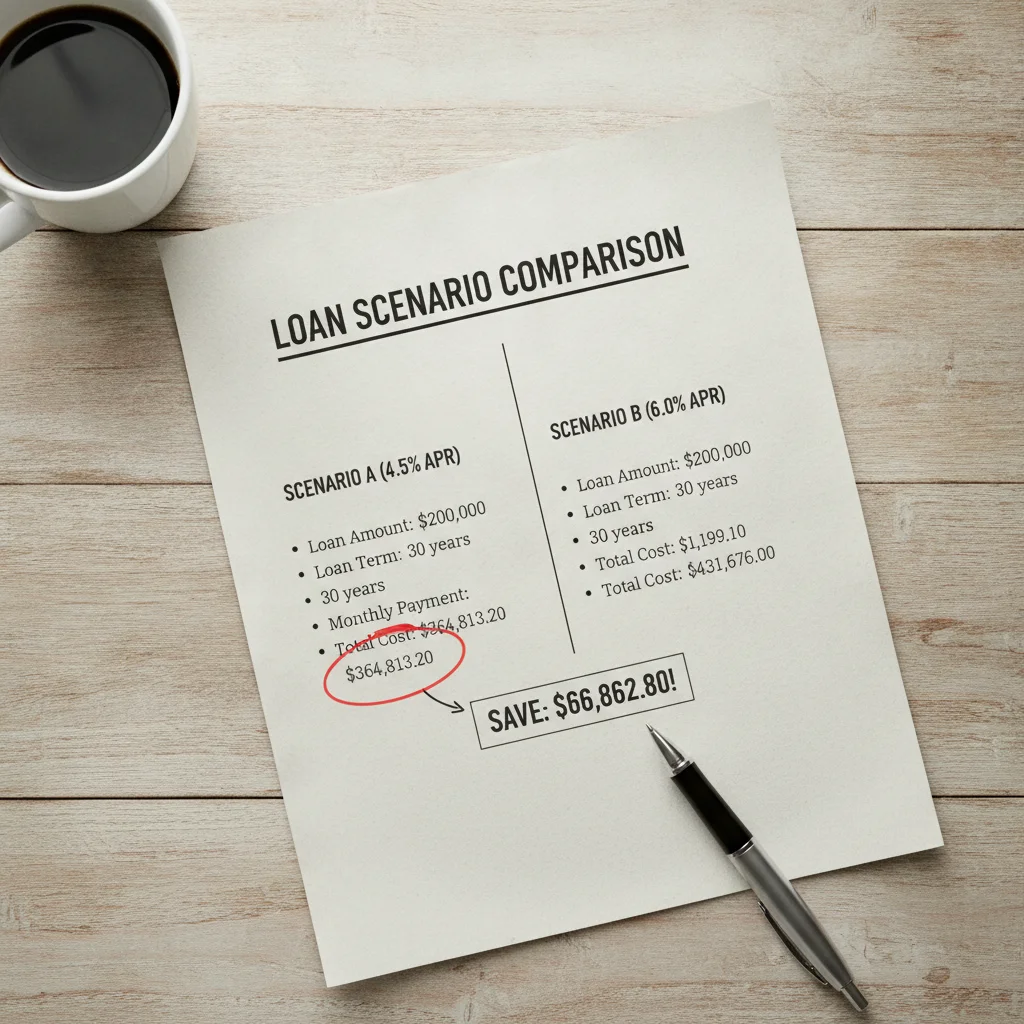
Your understanding of how APR affects total loan cost is one of the most valuable tools you can bring to a dealership. Even a half-point difference in rate on a five-year loan matters — and dealers know most buyers won't do that math in real time.
The Dealer's Rate Is Always Negotiable
Many buyers believe the rate presented in the finance office is fixed — set by the lender, non-negotiable. That is false. The dealer has direct control over whether to mark up the rate and by how much. When you present a competing preapproval, you remove the dealer's ability to obscure the real rate. They must either match or beat it, or lose the financing business entirely. Never accept the first number without asking whether they can do better.
Your Preapproval Has an Expiration Date
Most auto loan preapprovals are valid for 30 to 60 days. Don't get preapproved months in advance and assume it's still current when you're ready to buy. Time your preapproval applications to the last two weeks before you plan to visit dealerships. If your search extends beyond the validity window, renew your applications — it's a quick process and ensures your rate is based on current market conditions and your current credit profile.
How to Get Preapproved Before You Shop
Preapproval is not complicated. The confusion around it — including the myth that it damages your credit — is largely responsible for why so many buyers skip it. The reality is that multiple auto loan inquiries within a 14–45 day window are typically treated as a single hard inquiry by major credit scoring models. Shopping three or four lenders costs you almost nothing on your credit score and can save you thousands on your loan.
Where to Apply
- Your primary bank or credit union: Existing relationships often yield better rates. Credit unions in particular consistently undercut dealer financing.
- Online lenders: Institutions like LightStream, PenFed, and others offer competitive rates and fast digital preapproval, sometimes within hours.
- A second credit union: If you're not already a member of a credit union, many allow you to join online before applying. Rates are often 1–2 points below what dealers arrange.
What You'll Need
- Proof of income (recent pay stubs or tax returns)
- Driver's license or government ID
- Social Security number for the credit pull
- Approximate loan amount and desired term
Once you have two or three preapproval letters in hand, you walk into the dealership knowing your floor. The dealer can try to beat your rate — and sometimes they genuinely can, especially with manufacturer incentives on new cars — but they can't obscure what a fair rate looks like. That's leverage. Here's exactly how to use that preapproval as a rate anchor during negotiation.
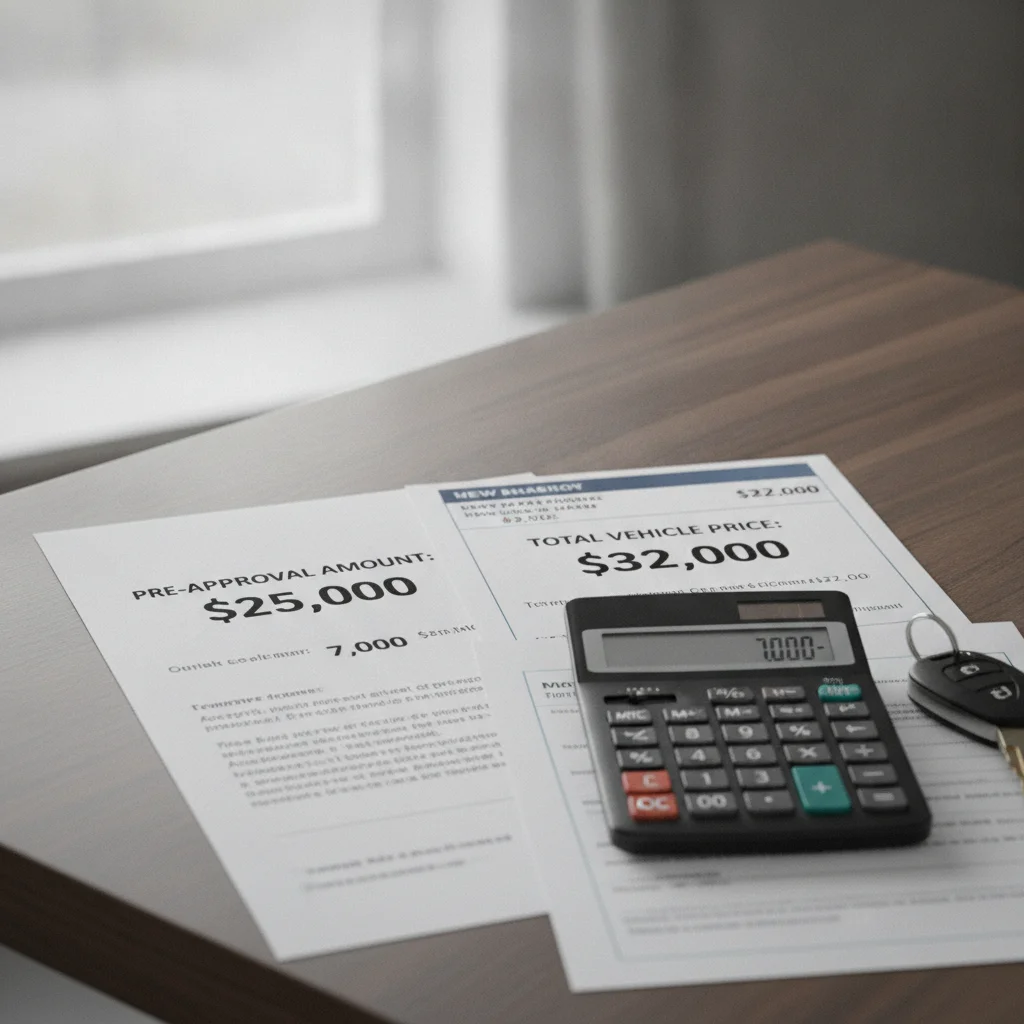
Also worth addressing: if you're concerned your preapproval amount won't cover the full vehicle price, that's a solvable problem. Learn your options when the preapproval falls short — from adjusting your down payment to negotiating the vehicle price down.
Myths That Keep Buyers From Getting Preapproved
Several widely held beliefs discourage buyers from getting preapproved before shopping. Most of them are either outright wrong or dramatically overstated. These preapproval myths cost buyers real money — here's a quick breakdown of the most damaging ones:
- "It will hurt my credit score."
- Multiple auto loan inquiries within a short shopping window count as one inquiry under FICO and VantageScore models. The impact is minimal — typically 5 points or fewer — and temporary.
- "The dealer won't accept my outside financing."
- Dealers are required to accept preapproved financing if you choose to use it. They may prefer their own financing (because of the markup), but they cannot legally block yours. They can, however, try to beat it — which benefits you.
- "I need to know the exact car first."
- Most preapprovals are issued for a loan amount and term, not a specific vehicle. You can shop with a preapproval for a general budget and finalize the vehicle later.
- "Dealer financing is always competitive."
- Manufacturer-subsidized rates (like 0% APR promotions) can genuinely beat outside offers — but only on specific models during specific periods. Standard dealer-arranged financing almost always includes a markup. The only way to know if a dealer's offer is good is to have something to compare it against.
Understanding how your credit score directly affects the rates lenders will offer also helps you approach preapproval with realistic expectations — and may motivate you to spend a few months improving your score before you apply.
Using Your Preapproval Effectively at the Dealership
Having a preapproval letter doesn't automatically protect you — you have to use it correctly. Here's the sequence that works:
- Negotiate the vehicle price first. Don't mention financing until you've agreed on a sale price. Once price is settled, reveal your preapproval and ask if they can beat it. Mixing price and financing negotiations gives the dealer too many levers to work with.
- Ask for the buy rate. After revealing your preapproval, ask the finance manager what rate the lender actually approved you at — before markup. Some will tell you. If they won't, your preapproval rate is already your ceiling.
- Decline add-ons you don't need. The finance office is where dealers recapture profit they lost on price. GAP insurance, paint sealant, and extended warranties are often priced at 2–3x their cost. Research these independently before your visit and decide in advance what, if anything, you actually want.
- Check the final paperwork. Verify that the rate, term, and loan amount in the contract match what was agreed verbally. Errors — intentional or otherwise — happen more often than buyers expect.
Lenders offer different rates for the same application — which is exactly why getting multiple preapprovals before you shop is worth the small effort it requires. Walking in with the best rate you've already been offered gives you a benchmark that no dealer can easily obscure.

The Dealer's Rate Is Always Negotiable
Many buyers believe the rate presented in the finance office is fixed — set by the lender, non-negotiable. That is false. The dealer has direct control over whether to mark up the rate and by how much. When you present a competing preapproval, you remove the dealer's ability to obscure the real rate. They must either match or beat it, or lose the financing business entirely. Never accept the first number without asking whether they can do better.
Your Preapproval Has an Expiration Date
Most auto loan preapprovals are valid for 30 to 60 days. Don't get preapproved months in advance and assume it's still current when you're ready to buy. Time your preapproval applications to the last two weeks before you plan to visit dealerships. If your search extends beyond the validity window, renew your applications — it's a quick process and ensures your rate is based on current market conditions and your current credit profile.

All claims are backed by peer-reviewed research. Sources on request.