Key Takeaways
Subprime Auto Loan
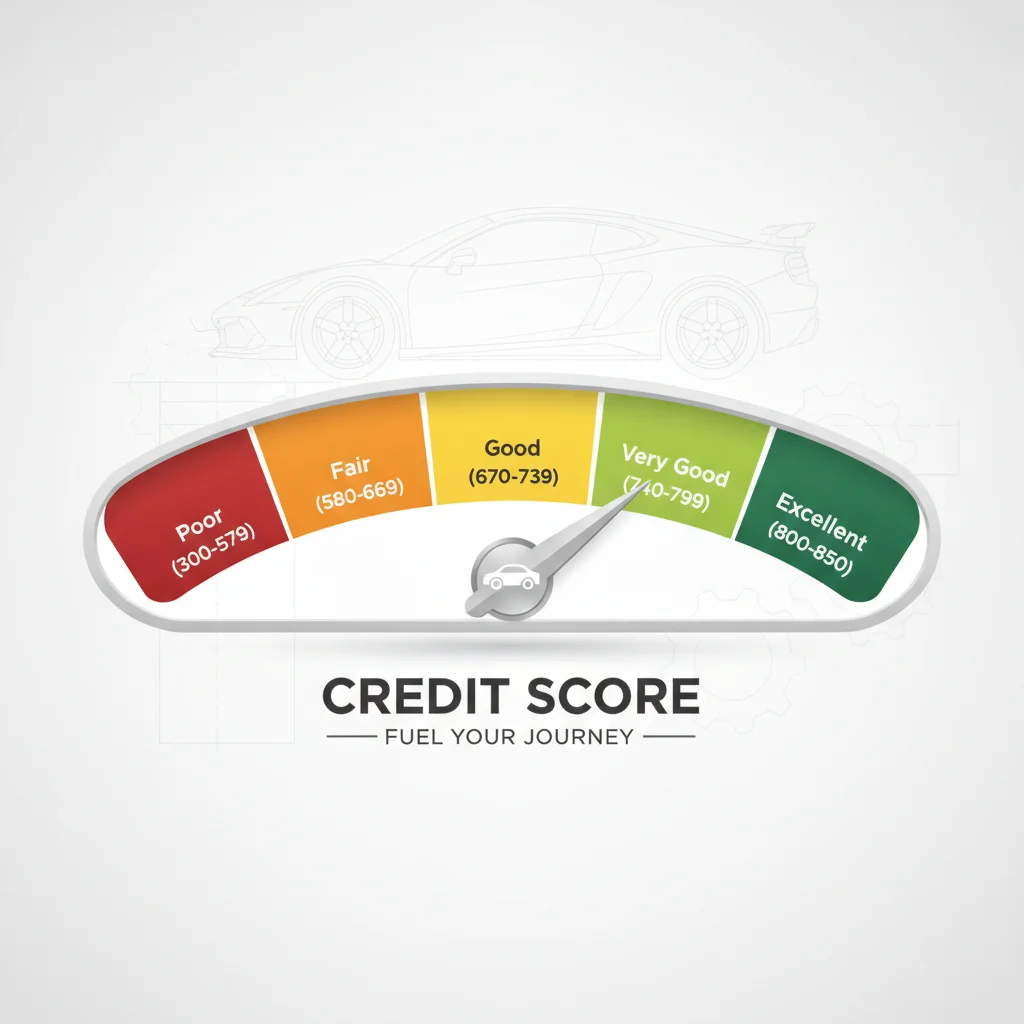
A subprime auto loan is a car loan issued to a borrower whose credit score falls below the threshold lenders consider 'prime' — typically a FICO score under 620. Because lenders see these borrowers as higher-risk, they charge higher interest rates and may attach stricter conditions to the loan. The label 'subprime' isn't a personal judgment — it's a risk classification that directly shapes the terms you'll be offered.
Credit bureaus and lenders may use slightly different cutoffs, but the Consumer Financial Protection Bureau (CFPB) broadly defines subprime as a credit score below 620, with 'deep subprime' applying to scores below 580.
How Lenders Categorize Borrowers by Credit Risk
When you apply for a car loan, the lender doesn't just see your name and income — they run your credit and instantly slot you into a risk tier. These tiers drive nearly every number in your loan offer: the interest rate, the loan term options, the down payment requirement, and sometimes even which vehicles you're approved to finance.
The tier system generally looks like this:
| Tier | Typical FICO Range | What It Means for Rates |
|---|---|---|
| Deep Subprime | Below 580 | Highest rates, fewest lenders |
| Subprime | 580–619 | Elevated rates, stricter terms |
| Near-Prime | 620–659 | Moderately higher rates |
| Prime | 660–719 | Competitive rates |
| Super Prime | 720+ | Best available rates |
These ranges aren't universal — each lender sets its own thresholds — but they're consistent enough that you can use them as a reliable guide. For a more detailed breakdown of each tier and what they mean for your specific loan offer, see how credit score tiers affect auto lending.
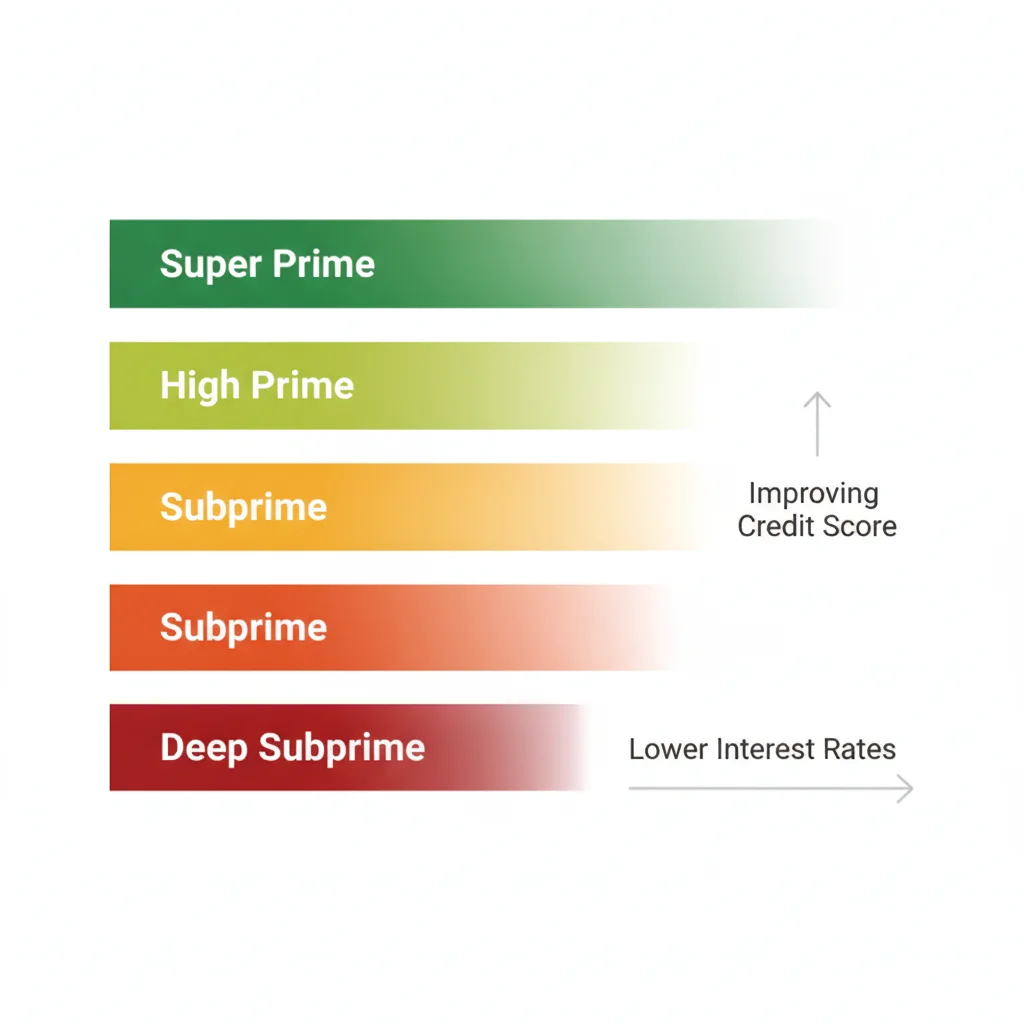
The key takeaway here: lenders are not evaluating you as a person. They're assessing statistical risk. Borrowers in lower credit tiers have, on average, higher rates of missed payments and defaults — and lenders price for that risk by charging higher interest.
What 'Subprime' Actually Changes About Your Loan
Being classified as subprime doesn't just mean a higher interest rate. It changes the entire structure of what you're offered — and understanding each element helps you push back or negotiate where possible.
Interest Rate (APR)
This is the biggest and most visible impact. Subprime borrowers routinely see APRs in the 12–20% range, compared to 5–8% for prime borrowers. On a long loan term, this difference compounds significantly. To see exactly how these numbers play out over a real loan, explore the real cost of borrowing with a low credit score.
Loan Term Restrictions
Some lenders restrict subprime borrowers to shorter loan terms to limit their exposure. Others push longer terms to reduce monthly payments and make approval easier — but longer terms mean more total interest paid. Understanding what loan terms actually mean for your total cost is essential before you sign.
Down Payment Requirements
Lenders often require larger down payments from subprime borrowers — sometimes 10–20% of the vehicle's value. This reduces the lender's risk if you default and the car needs to be repossessed. A larger down payment also lowers your loan-to-value ratio, which can slightly improve the rate you're offered.
Vehicle Restrictions
Some lenders won't finance older vehicles (typically 7–10 years old) or high-mileage cars for subprime borrowers. This isn't arbitrary — older vehicles are harder to repossess profitably if a borrower defaults. It's worth asking lenders upfront what vehicle restrictions apply before you shop.
Subprime Doesn't Mean Predatory — But Watch for It
Subprime auto lending is a legitimate, regulated market serving millions of borrowers. However, some lenders — particularly certain buy-here-pay-here dealers — operate with far less oversight and may charge rates or structure loans in ways that benefit them significantly at your expense. If an APR exceeds 25% or a dealer is reluctant to show you the full loan contract before signing, treat that as a red flag and walk away.
Loan Structure: Secured vs. Unsecured
Nearly all auto loans — subprime or otherwise — are secured loans, meaning the vehicle itself serves as collateral. This is part of why auto loans are more accessible than unsecured personal loans for people with lower credit. For a deeper look at how this structure affects you as a borrower, see secured vs. unsecured auto loans for borrowers with poor credit.
Why Lenders Don't All Use the Same Cutoff
One of the most important — and least-discussed — facts about subprime lending is that the label isn't standardized across lenders. A credit union might define subprime as anything below 640, while an online lender might set its cutoff at 600. A captive finance arm of an automaker might offer near-prime rates to borrowers at 615 during a promotional period.
This variability is actually good news for borrowers. It means:
- Your score at one lender's threshold might qualify you for better terms at another.
- Lenders competing for your business is real, even at lower credit scores.
- Applying to multiple lenders within a short window gives you comparison leverage.

Lenders also weigh factors beyond your credit score. Debt-to-income ratio, employment stability, time at your current address, and whether you've had a repossession in the past are all variables that can tighten or loosen what you're offered — sometimes independently of your score tier.
“The most effective thing a subprime borrower can do is treat the first loan as a credit-building tool with an expiration date — not a permanent financial arrangement.”
— Melinda Zabritski, Senior Director of Automotive Financial Solutions, Experian
This is why getting preapproved before you visit a dealership is so valuable when you're in the subprime range. Preapproval gives you a concrete offer to compare against the dealer's financing, and it prevents you from being steered into terms that benefit the dealership's financing partner rather than your wallet.
The Credit Score Ranges Lenders Actually Use
It's worth being specific about numbers, because many borrowers don't realize how close they might be to a tier boundary — or how much a modest score improvement could shift their loan offer.
38%
Share of U.S. auto loans to subprime borrowers
According to Experian's State of the Automotive Finance Market report, borrowers with credit scores below 660 represent a substantial portion of all auto loan originations each year.
~7–12%
Typical APR gap between prime and subprime
Experian data consistently shows subprime auto loan rates running 7 to 12 percentage points higher than prime rates, depending on the lender and loan term.
$5,000+
Extra interest paid on a typical subprime loan
On a $20,000 used car loan over 60 months, the difference between a 7% prime rate and a 16% subprime rate can exceed $5,000 in total interest paid.
580
CFPB's deep subprime score threshold
The Consumer Financial Protection Bureau defines deep subprime as a FICO score below 580, the tier where loan approval becomes significantly more difficult.
14–45 days
Rate-shopping window with single inquiry treatment
FICO and VantageScore models group multiple auto loan inquiries within this window as a single inquiry, allowing borrowers to comparison shop without compounding credit score damage.
If your score is 610, you're technically subprime by most lenders' definitions. But if you can bring that score to 625 before applying — by paying down a credit card balance, disputing an error on your report, or simply allowing a few months of on-time payments to accumulate — you may cross into near-prime territory with multiple lenders.
Time Your Application Strategically
If your credit score is within 10–15 points of the next tier boundary, it may be worth delaying your loan application by 30–60 days. Paying down revolving credit card balances — ideally below 30% of your limit — can produce a measurable score increase in a single billing cycle. Even moving from 610 to 625 can open up better lender options.
Build in a Refinance Plan From Day One
Before you sign a subprime loan, ask the lender directly whether there are any prepayment penalties. If there are none, commit to making on-time payments for 12–18 months and then checking your score for refinancing eligibility. Many lenders — including credit unions — actively market refinance offers to borrowers who've demonstrated payment consistency, sometimes at dramatically lower rates.
For a side-by-side view of how each score range translates to loan terms, see the credit score ranges lenders use when evaluating auto loan risk. Understanding where you stand — and where the next tier begins — is the foundation of a smarter borrowing strategy.
What Subprime Borrowers Can Do Right Now
Being labeled subprime on a loan application isn't a dead end. It's a starting point. Here are the most effective steps you can take to either improve your position before applying or get the best deal available in the subprime market.
1. Check Your Credit Report Before Any Lender Does
Errors on credit reports are more common than most people realize. A mistaken late payment, an account that belongs to someone else, or a debt that's been paid but still shows as outstanding can all drag your score below a tier boundary. You're entitled to free reports from all three bureaus at AnnualCreditReport.com. Disputing errors before applying costs nothing and can meaningfully move your score.
2. Know Your Score Tier Before Walking In
Don't let the dealership be the first entity to tell you what tier you're in. Pull your FICO score (not just a VantageScore estimate) before you apply anywhere. Many credit card issuers and banks now provide this for free. Knowing your number puts you in a position to evaluate whether the rate you're offered reflects your actual risk tier or whether you're being quoted something higher.
3. Shop Multiple Lenders, Not Just the Dealership
Dealership financing is convenient, but convenience has a cost. Dealers often mark up the interest rate above what the lender actually requires — a practice called dealer reserve. By getting competing offers from credit unions, online lenders, or banks first, you have a benchmark the dealer must compete against.

4. Consider the Loan Term Carefully
Subprime lenders sometimes offer longer terms to make monthly payments look manageable. A 72- or 84-month loan on a used car with a 17% APR may leave you owing more than the car is worth within 18 months — a situation called negative equity. Run the total cost numbers, not just the monthly payment.
5. Plan for Refinancing
A subprime loan today doesn't have to be your loan forever. Many borrowers use a subprime loan to establish a payment history, build their credit score, and then refinance into a lower-rate loan within 12–24 months. Go in with that plan in mind, and make sure your original loan has no prepayment penalties that would block you from refinancing.
Moving Beyond the Subprime Label
The most important thing to understand about being labeled subprime is that it is a snapshot, not a sentence. Lenders are looking at your credit history up to today — not your future behavior. Every on-time payment you make on your auto loan is reported to the credit bureaus and contributes to improving your score over time.
Borrowers who take a subprime loan and make consistent payments often see their credit score improve by 40–80 points within the first 18 months — sometimes enough to refinance into a prime tier loan and significantly reduce their interest rate and monthly payment.
Time Your Application Strategically
If your credit score is within 10–15 points of the next tier boundary, it may be worth delaying your loan application by 30–60 days. Paying down revolving credit card balances — ideally below 30% of your limit — can produce a measurable score increase in a single billing cycle. Even moving from 610 to 625 can open up better lender options.
Build in a Refinance Plan From Day One
Before you sign a subprime loan, ask the lender directly whether there are any prepayment penalties. If there are none, commit to making on-time payments for 12–18 months and then checking your score for refinancing eligibility. Many lenders — including credit unions — actively market refinance offers to borrowers who've demonstrated payment consistency, sometimes at dramatically lower rates.
The subprime label feels stigmatizing, but it's a workable financial position for millions of Americans. Understanding exactly what it means — how it defines your loan terms, why lenders use it, and what you can do to move beyond it — is the foundation of borrowing smarter, not just borrowing.

All claims are backed by peer-reviewed research. Sources on request.