| Score model most auto lenders use | FICO Auto Score 8 or 9 (myFICO, 2024) |
| Deep subprime threshold | Below 580 (Consumer Financial Protection Bureau (CFPB)) |
| Subprime range | 580–619 (CFPB auto loan market reports) |
| Nonprime (near-prime) range | 620–659 (Experian State of the Automotive Finance Market, 2024) |
| Prime range | 660–719 (Experian State of the Automotive Finance Market, 2024) |
| Super prime threshold | 720 and above (Experian State of the Automotive Finance Market, 2024) |
| Average APR for deep subprime (new vehicle) | 14%–25%+ (Experian Q4 2023 auto finance data) |
| Average APR for super prime (new vehicle) | Under 5% (Experian Q4 2023 auto finance data) |
| Rate inquiry window (counts as one hard pull) | 14–45 days (FICO scoring model guidelines) |
| Share of auto loans originated to subprime borrowers | Approx. 14% (Experian State of the Automotive Finance Market, Q4 2023) |
Why Credit Score Ranges Matter More Than the Number Itself
Most borrowers focus on their credit score as a single number. Lenders don't. What they actually care about is which tier that number falls into — because tiers are what drive loan pricing decisions.
Think of it like a tax bracket. Earning $75,001 versus $74,999 puts you in different brackets even though the practical difference in income is tiny. Credit tiers work the same way. A score of 619 and a score of 621 are almost identical in terms of creditworthiness, but many lenders treat them very differently — one may qualify as "subprime," the other as "nonprime" — and that classification alone can add hundreds or even thousands of dollars to your total loan cost.
Understanding the tiers lenders actually use — not just the labels you see on free credit monitoring apps — gives you a clearer picture of what to expect when you walk into a dealership or apply online. It also helps you understand exactly how much improving your score by even 20–30 points could change your options.
For a deeper look at how these tiers influence what you'll actually pay over the life of a loan, see The Real Cost of Borrowing With a Low Credit Score.
| Score model most auto lenders use | FICO Auto Score 8 or 9 (myFICO, 2024) |
| Deep subprime threshold | Below 580 (Consumer Financial Protection Bureau (CFPB)) |
| Subprime range | 580–619 (CFPB auto loan market reports) |
| Nonprime (near-prime) range | 620–659 (Experian State of the Automotive Finance Market, 2024) |
| Prime range | 660–719 (Experian State of the Automotive Finance Market, 2024) |
| Super prime threshold | 720 and above (Experian State of the Automotive Finance Market, 2024) |
| Average APR for deep subprime (new vehicle) | 14%–25%+ (Experian Q4 2023 auto finance data) |
| Average APR for super prime (new vehicle) | Under 5% (Experian Q4 2023 auto finance data) |
| Rate inquiry window (counts as one hard pull) | 14–45 days (FICO scoring model guidelines) |
| Share of auto loans originated to subprime borrowers | Approx. 14% (Experian State of the Automotive Finance Market, Q4 2023) |
The Five Credit Score Tiers Auto Lenders Use
Auto lenders — whether banks, credit unions, or finance companies — broadly segment borrowers into five risk categories. The exact cutoffs vary by lender, but the framework below reflects industry consensus based on FICO Auto Score usage. These tiers apply to both new and used vehicle financing, though used car loans often carry stricter criteria at each level.
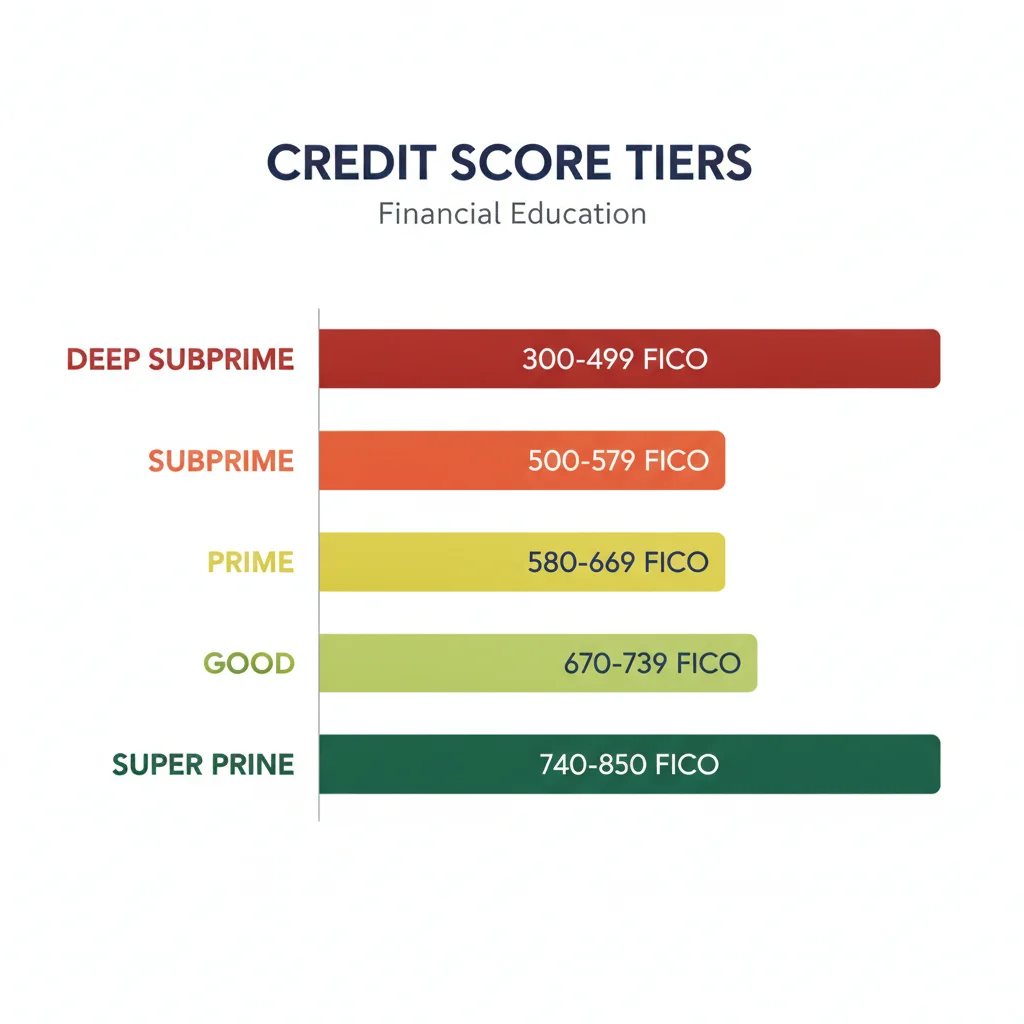
Deep Subprime: Below 580
This is the highest-risk tier in the eyes of lenders. Borrowers with scores below 580 have typically experienced serious derogatory events — collections, charge-offs, repossessions, or bankruptcy. Traditional banks and credit unions rarely lend at this tier. Financing, when available, comes from specialized subprime lenders or buy-here-pay-here (BHPH) dealerships.
- Typical APR range: 14%–25%+ for new vehicles; even higher for used
- Common conditions: Large down payments (often 20% or more), GPS tracking devices installed by the lender, very short loan terms or very long terms with balloon payments
- Practical reality: Monthly payments may appear manageable, but total interest paid over the loan can equal or exceed the vehicle's purchase price
What 'Subprime' Actually Means on a Car Loan Application explains how lenders officially categorize this tier and what changes about your loan structure when you land here.
Subprime: 580–619
Scores in the 580–619 range still signal meaningful credit risk but open up slightly more options. Some captive lenders (manufacturer-affiliated finance arms) and a broader pool of specialized subprime lenders will consider these applicants, particularly with a sizable down payment or a co-signer.
- Typical APR range: 10%–18% for new vehicles
- Common conditions: Down payment requirements of 10%–20%, proof of income documentation, possible requirement for full-coverage insurance before funding
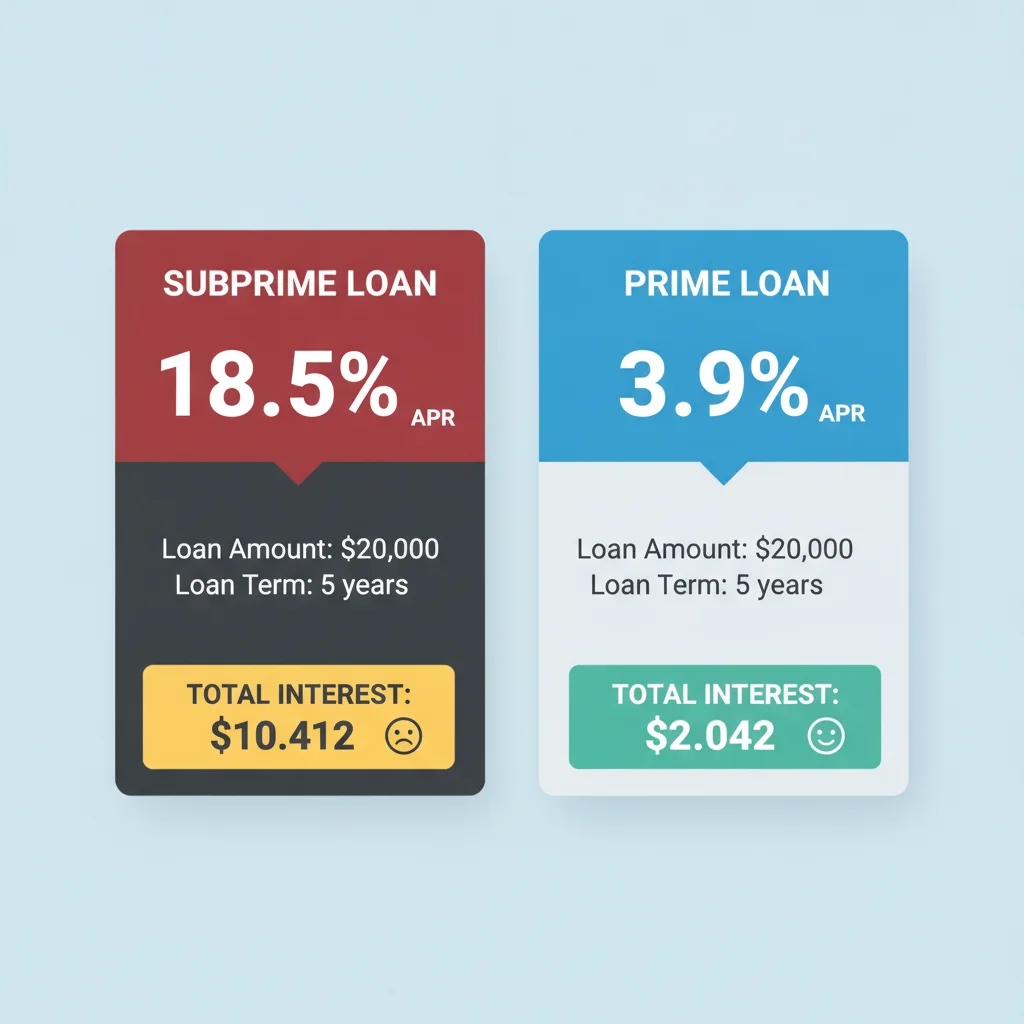
- Practical reality: Approval is possible, but loan terms are restrictive; total interest paid on a $25,000 loan over 60 months at 15% APR is approximately $10,700
Nonprime (Near-Prime): 620–659
The nonprime range sits at the crossroads of limited and standard lending. Borrowers here aren't locked into subprime products, but they aren't accessing the best rates either. This is the tier where shopping multiple lenders — credit unions in particular — makes the biggest practical difference.
- Typical APR range: 7%–12% for new vehicles
- Common conditions: Down payments of 10% or more recommended; lenders may approve but push longer terms to lower payments
- Practical reality: Crossing from 619 to 620 can shift your available lenders meaningfully; crossing 660 unlocks even better options
Prime: 660–719
Prime borrowers access mainstream lending channels — most banks, credit unions, and captive finance companies. Rates are competitive, loan terms are flexible, and conditions are far less restrictive. This is the tier where borrowing becomes straightforwardly functional rather than costly and constrained.
- Typical APR range: 4%–8% for new vehicles
- Common conditions: Standard documentation; down payment encouraged but often not required; loan terms from 36–72 months available
- Practical reality: A borrower at 700 pays dramatically less in total interest than a borrower at 620 on the same vehicle — often $4,000–$7,000 less over a 60-month term
Super Prime: 720 and Above
Super prime borrowers are the lenders' preferred customers. They receive the lowest available rates, the most flexible terms, and often qualify for promotional financing offers (0% APR deals from manufacturers are almost exclusively available to this tier).
- Typical APR range: 0%–5% for new vehicles, including promotional offers
- Common conditions: Minimal; these borrowers are courted, not scrutinized
- Practical reality: The difference between 720 and 800 within this tier is usually negligible — both access the best rates
$10,700
Estimated total interest on a $25K loan at 15% APR over 60 months
Compared to roughly $3,300 in total interest at a 5% APR prime rate — a difference of more than $7,000 on the same vehicle.
14%
Share of new auto loans originated to subprime borrowers
According to Experian's State of the Automotive Finance Market report, Q4 2023.
~100 points
Typical score gap between subprime and super prime tiers
Moving from 620 to 720 can reduce your APR by 8–15 percentage points depending on the lender and loan type.
45 days
Rate-shopping window for auto loan hard inquiries
Under FICO's newer scoring models, multiple auto loan inquiries within 45 days count as a single hard pull on your report.
20%+
Typical minimum down payment required for deep subprime borrowers
Many specialty subprime lenders and buy-here-pay-here dealers require substantial down payments to offset high LTV risk.
For a detailed breakdown of how these tiers translate into specific APR ranges and available term lengths, see What Credit Score Ranges Mean for the Loan Terms You'll Actually Get.
What Lenders Actually Look at Beyond the Score
Your credit score tier opens or closes doors, but lenders layer additional factors on top of it before making a final decision. Understanding these factors helps subprime and nonprime borrowers strengthen their application even when they can't immediately improve their score.
FICO Auto Score
A specialized version of the FICO credit score designed for auto lending. It weights your history of repaying auto loans more heavily than a standard FICO 8 score. Most major auto lenders use FICO Auto Score 8 or 9.
Subprime
A lending classification applied to borrowers with credit scores typically below 620. Subprime loans carry higher interest rates and stricter conditions to compensate lenders for the elevated risk of default.
Loan-to-Value Ratio (LTV)
The ratio of the loan amount to the vehicle's market value, expressed as a percentage. A 100% LTV means you're financing the full purchase price. Lenders use LTV to assess collateral risk — lower LTV generally means better loan terms.
Debt-to-Income Ratio (DTI)
Your total monthly debt payments divided by your gross monthly income, expressed as a percentage. Lenders use DTI to evaluate whether you can afford the proposed loan payment alongside your existing obligations.
Payment-to-Income Ratio (PTI)
The proposed monthly car payment expressed as a percentage of your gross monthly income. Many subprime lenders use PTI (commonly targeting below 15–20%) as a standalone affordability check separate from total DTI.
Buy-Here-Pay-Here (BHPH)
A type of dealership that provides in-house financing directly to customers, often to those who cannot qualify for conventional loans. BHPH loans typically carry very high interest rates and limited consumer protections.
Hard Inquiry
A credit check triggered when you formally apply for a loan. Hard inquiries temporarily reduce your credit score by a small amount. Multiple auto loan inquiries within a 14–45 day window generally count as a single inquiry.
Captive Lender
A finance company owned by or affiliated with an auto manufacturer, such as Ford Motor Credit or Toyota Financial Services. Captive lenders may offer promotional rates exclusively to prime or super prime borrowers.
Debt-to-Income Ratio (DTI)
Lenders calculate your monthly debt obligations — including the proposed car payment — as a percentage of your gross monthly income. Most lenders prefer a DTI below 45%–50%. If your score is borderline, a strong income with low existing debt can offset some credit risk in the lender's model.
Loan-to-Value Ratio (LTV)
LTV compares the loan amount to the vehicle's market value. Borrowers with lower credit scores are often required to keep LTV below 100% — meaning no negative equity rolled in, and a meaningful down payment applied. Some subprime lenders cap LTV at 110%–115% even with a down payment, which limits how much vehicle you can finance.
Payment-to-Income Ratio (PTI)
Some lenders specifically target the monthly payment as a percentage of monthly gross income, separate from total DTI. A common threshold is 15%–20%. This is especially common at subprime-focused lenders who want assurance the payment fits your budget regardless of other obligations.
Time at Current Address and Employment
Stability signals matter in subprime lending. Lenders often look for at least 12 months at the same address and 12 months with the same employer. Recent moves or job changes can work against you even with an otherwise acceptable application.
Credit Score Impact covers how these factors interact with your score to shape the overall loan offer lenders build for you.
Lender Cutoffs Are Not Universal
The score ranges described in this article reflect industry consensus, but individual lenders set their own thresholds. A credit union may consider a 610 score as nonprime while a bank treats it as deep subprime. This is why applying to multiple lenders matters: the same score can produce meaningfully different outcomes depending on who's evaluating it.
Income Verification Is Stricter in Subprime Lending
Subprime lenders almost universally require documented proof of income — pay stubs, bank statements, or tax returns — before funding a loan. Self-employed borrowers or those with irregular income may face additional scrutiny. Prepare these documents before you apply to avoid delays that could affect your rate lock.
Your Score Tier Can Change Between Application and Funding
Auto loan approvals sometimes take several days to fund. If your credit score changes during that window — due to a new inquiry, a missed payment, or a reported balance change — your lender may reprice the loan or withdraw the offer. Avoid opening new credit accounts or missing any payments between approval and signing.
How Credit Score Tiers Affect Preapproval Odds
Getting preapproved before you shop is one of the smartest moves a car buyer can make — but preapproval success rates vary significantly by tier. Lenders use preapproval to screen applicants, and some simply decline to preapprove below certain score thresholds.
| Credit Tier | Score Range | Preapproval Likelihood | Who Typically Lends |
|---|---|---|---|
| Deep Subprime | Below 580 | Very Low | Specialty subprime lenders, BHPH dealers |
| Subprime | 580–619 | Low to Moderate | Subprime-focused lenders, some captive finance |
| Nonprime | 620–659 | Moderate | Credit unions, some banks, captive finance |
| Prime | 660–719 | High | Most banks, credit unions, captive finance |
| Super Prime | 720+ | Very High | All mainstream lenders, best promotional rates |
Preapproval also has a secondary benefit: it puts a rate cap in your hand before you negotiate. Even a subprime preapproval from a credit union gives you leverage against dealer-arranged financing, which often carries a markup above the lender's actual rate.
Credit Score Ranges and What They Mean for Your Preapproval Odds has a detailed breakdown of how each tier affects your probability of getting preapproved and what conditions typically come attached.

Practical Steps for Subprime and Nonprime Borrowers
If your score places you in the subprime or nonprime range, you're not without options — but you do need a strategy. The following steps are ordered by impact and practicality for borrowers who need a vehicle now, not after a year of credit rebuilding.
1. Get Your Actual FICO Auto Score
The score your bank or credit card app shows you is usually a generic FICO 8 or VantageScore — not the FICO Auto Score 8 or 9 that most auto lenders use. These versions weight your auto loan repayment history more heavily. You can purchase your FICO Auto Score at myfico.com. The number may be different — sometimes higher, sometimes lower — from what you're used to seeing.
2. Apply to Multiple Lenders Within a 14-Day Window
When you apply for an auto loan, each application triggers a hard inquiry on your credit report. Multiple inquiries within a 14-day period (some scoring models extend this to 45 days) count as a single inquiry for scoring purposes. Use this window to apply to a credit union, a bank, and at least one online lender before visiting a dealership. Compare offers based on APR, total interest paid, and term — not just monthly payment.
3. Bring a Meaningful Down Payment
For subprime borrowers, a down payment does two things: it reduces your LTV ratio (making you a less risky loan), and it reduces the monthly payment, which makes approval more likely for lenders using PTI thresholds. Even $1,500–$2,000 down can shift a lender's decision on a marginal application.
4. Consider a Co-Signer Strategically
A co-signer with strong credit can unlock prime-tier rates even if your own score is subprime — because the lender's risk is now partially backed by the co-signer's creditworthiness. Be clear with your co-signer: if you miss payments, their credit takes the hit, and they are legally obligated for the debt.
5. Understand What You're Signing
Subprime loan agreements frequently contain terms that prime borrowers never encounter: GPS or starter-interrupt devices, mandatory arbitration clauses, prepayment penalties on some products, and aggressive default provisions. Read every page. Ask the lender to explain any clause you don't understand before signing.
Loan Terms Explained is a useful reference for decoding the language in your loan agreement before you commit.
Lender Cutoffs Are Not Universal
The score ranges described in this article reflect industry consensus, but individual lenders set their own thresholds. A credit union may consider a 610 score as nonprime while a bank treats it as deep subprime. This is why applying to multiple lenders matters: the same score can produce meaningfully different outcomes depending on who's evaluating it.
Income Verification Is Stricter in Subprime Lending
Subprime lenders almost universally require documented proof of income — pay stubs, bank statements, or tax returns — before funding a loan. Self-employed borrowers or those with irregular income may face additional scrutiny. Prepare these documents before you apply to avoid delays that could affect your rate lock.
Your Score Tier Can Change Between Application and Funding
Auto loan approvals sometimes take several days to fund. If your credit score changes during that window — due to a new inquiry, a missed payment, or a reported balance change — your lender may reprice the loan or withdraw the offer. Avoid opening new credit accounts or missing any payments between approval and signing.
myFICO Auto Score Purchase
The official source for purchasing your FICO Auto Score 8 — the score most auto lenders actually use. Knowing this number before applying prevents surprises at the dealership.
CFPB Auto Loan Complaint Database
The Consumer Financial Protection Bureau's public complaint database lets you look up complaints filed against specific auto lenders, which is especially useful when evaluating subprime or BHPH lenders.
Experian Automotive Finance Market Report
Quarterly data on average APRs, loan terms, and credit tier breakdowns across new and used vehicle financing. Useful for benchmarking the offer you receive against market norms.
NCUA Credit Union Locator
The National Credit Union Administration's free tool to find federally insured credit unions you may be eligible to join — credit unions often offer better rates than banks for nonprime borrowers.
Credit Scores and Insurance: An Important Distinction
Your credit score doesn't only affect your auto loan — it also affects your car insurance premium in most states. But the score insurers use is different from the FICO Auto Score lenders use, even though both are called "credit scores."
Insurers use a credit-based insurance score, which weights factors like payment history and account age differently than a lending credit score. A borrower might have a score that qualifies them for nonprime lending but still land in a preferred insurance tier — or vice versa. The two systems are related but not interchangeable.
This matters practically because subprime borrowers often carry higher insurance costs on top of their higher loan costs, compounding the total monthly expense of vehicle ownership. Before budgeting for a car purchase, factor in both the loan payment and an accurate insurance estimate for your tier.
Credit-Based Insurance Scores vs. Lending Credit Scores explains exactly how the two scoring systems differ and why your insurance rate may not move in the same direction as your loan rate when your credit changes.
Similarly, if you're trying to understand how insurers classify your overall risk — not just your credit — What Insurers Mean by 'Risk Tier' — and Which Tier You're In breaks down the carrier risk pools and how you're assigned to one.
Lender Cutoffs Are Not Universal
The score ranges described in this article reflect industry consensus, but individual lenders set their own thresholds. A credit union may consider a 610 score as nonprime while a bank treats it as deep subprime. This is why applying to multiple lenders matters: the same score can produce meaningfully different outcomes depending on who's evaluating it.
Income Verification Is Stricter in Subprime Lending
Subprime lenders almost universally require documented proof of income — pay stubs, bank statements, or tax returns — before funding a loan. Self-employed borrowers or those with irregular income may face additional scrutiny. Prepare these documents before you apply to avoid delays that could affect your rate lock.
Your Score Tier Can Change Between Application and Funding
Auto loan approvals sometimes take several days to fund. If your credit score changes during that window — due to a new inquiry, a missed payment, or a reported balance change — your lender may reprice the loan or withdraw the offer. Avoid opening new credit accounts or missing any payments between approval and signing.

All claims are backed by peer-reviewed research. Sources on request.