Key Takeaways
Option A
Secured Auto Loan
The standard, collateral-backed loan most lenders offer.
Best for: Subprime borrowers who want the widest lender access and the lowest available rates by pledging the vehicle as collateral.
Option B
Unsecured Auto Loan
A personal loan used for a car purchase, with no vehicle lien.
Best for: Borrowers who need flexible ownership terms or are buying vehicles that don't qualify as collateral, and can accept significantly higher rates.
If you have poor credit and need a reliable vehicle to get to work
Secured Auto Loan
Secured loans are far more accessible for subprime borrowers and offer lower rates than unsecured alternatives. The repossession risk is real but manageable with careful budgeting.
If you're buying an older, high-mileage vehicle that lenders won't accept as collateral
Unsecured Auto Loan
Lenders often decline to secure loans against vehicles over a certain age or mileage. An unsecured personal loan may be your only financing path for these purchases.
If you want to preserve full ownership rights and avoid a lien on the title
Unsecured Auto Loan
With no lien, you own the vehicle outright and lenders cannot repossess it. However, expect to pay substantially more in interest over the loan's life.
If you're trying to rebuild credit while keeping monthly costs manageable
Secured Auto Loan
Secured loans typically report to all three credit bureaus and carry lower monthly payments at the same loan amount, making them better suited for credit-building strategies.
If you've been denied a secured auto loan and need financing quickly
Unsecured Auto Loan
A personal loan from an online lender can fund quickly and doesn't require a lien process. Just compare APRs carefully — rates for poor-credit borrowers can be steep.
How Each Loan Type Is Structured
When a lender calls a loan secured, they mean there's a specific asset — in this case, the car — that they can legally claim if you stop making payments. The vehicle title carries a lien, which is a legal notation giving the lender priority ownership rights until you pay off the balance. You drive the car, maintain it, and insure it, but the lender holds a claim on it. That claim is what makes them willing to lend to you in the first place.
An unsecured loan has no such attachment to any asset. When you take out an unsecured personal loan to buy a car, the lender has no right to take that specific vehicle if you default. Instead, they'd have to pursue you in court for the debt, report the delinquency to credit bureaus, and potentially send the balance to collections. The car itself stays with you — at least until a judgment is enforced. That's a meaningfully different risk structure for the lender, which is why they price unsecured loans so much higher.

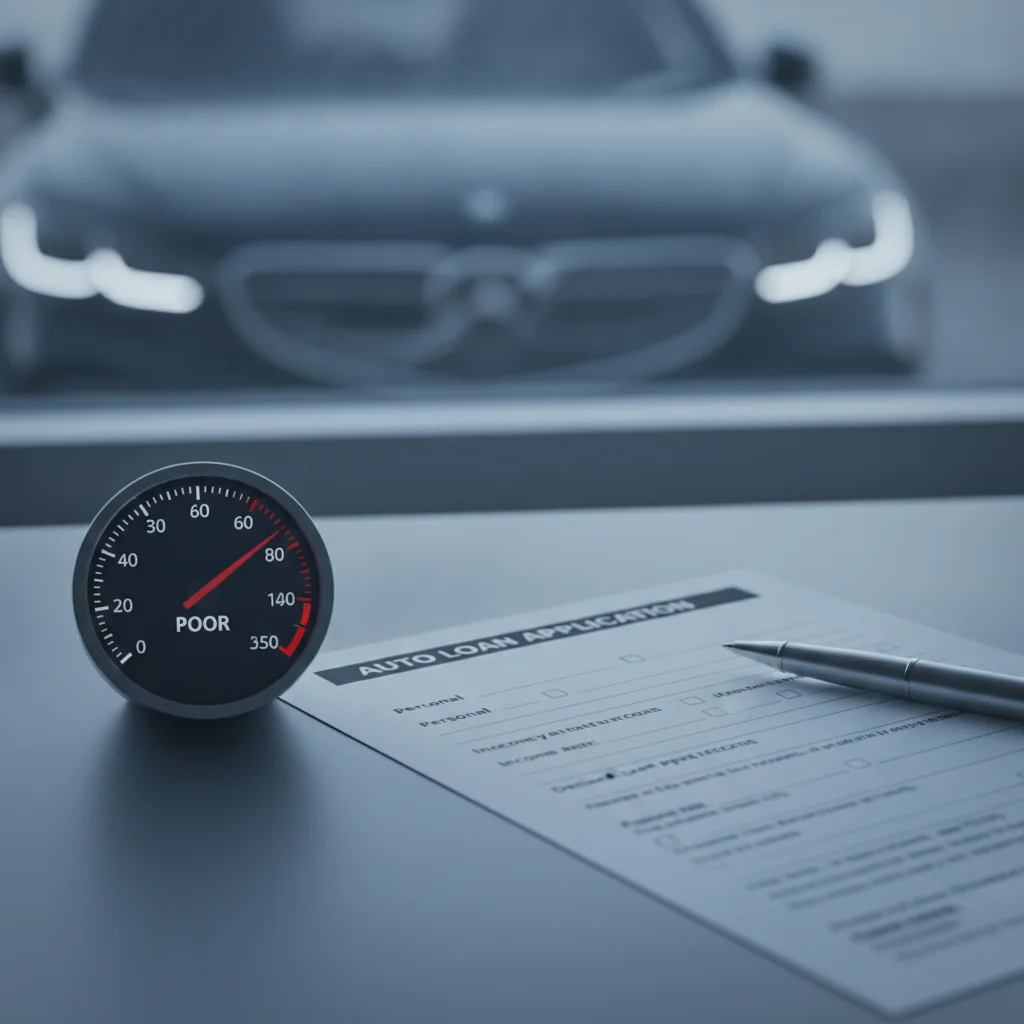
For subprime borrowers — generally those with credit scores below 620 — this structural difference matters enormously. Lenders who serve this segment are already accepting elevated default risk. The vehicle as collateral is what makes that risk tolerable enough to approve the loan at all. Strip away the collateral and the math changes: fewer lenders will participate, and those who do will charge substantially more. To understand why lenders segment risk this way, it helps to know what the subprime label actually means on your application.
Rate Differences and What They Cost You
The interest rate gap between secured and unsecured loans is not subtle, especially for borrowers with poor credit. According to Experian's State of the Auto Finance Market data, subprime borrowers (scores 501–600) paid average APRs around 11–14% on new secured auto loans and considerably more on used vehicles. Now compare that to unsecured personal loans for poor-credit borrowers, where rates routinely land between 20% and 36% — sometimes higher with predatory lenders.
14.08%
Average APR for subprime secured auto loans (used)
Experian's State of the Auto Finance Market Q4 2023 reported average rates of approximately 14% for subprime borrowers on used vehicle secured loans.
Up to 36%
Maximum APR on unsecured personal loans for poor credit
Most reputable online personal loan lenders cap APRs at 36%; predatory lenders and payday-adjacent products can exceed this significantly.
~$5,000
Extra interest cost on a $15K unsecured vs. secured loan
Calculated over a 60-month term comparing 14% APR (secured) to 28% APR (unsecured) on a $15,000 loan balance.
620
Credit score threshold commonly defining 'subprime'
Most lenders define subprime as a FICO score below 620, though cutoffs vary; deep subprime is often categorized below 580.
Let's put that in dollar terms. Suppose you need $15,000 to buy a reliable used car:
- Secured loan at 14% APR over 60 months: Monthly payment ≈ $349 | Total interest paid ≈ $5,940
- Unsecured loan at 28% APR over 60 months: Monthly payment ≈ $432 | Total interest paid ≈ $10,920
That's nearly $5,000 more in interest for structurally the same debt — just without collateral attached. For a borrower already stretched by a subprime rate, adding an extra $83 per month and nearly $5,000 in total cost is a serious burden. It's not hypothetical either; this is the realistic range for poor-credit borrowers shopping unsecured personal loans from online lenders.
Your credit score directly shapes the rates lenders will offer you, and that's true for both loan types. But the amplifying effect of being unsecured hits hardest at the bottom of the credit spectrum — precisely where subprime borrowers sit.
| Criterion | Secured Auto Loan | Unsecured Auto Loan |
|---|---|---|
| Collateral required | Yes — the vehicle itself | No asset pledged |
| Typical APR (subprime borrower) | 10%–20% depending on score | 20%–36%+ for poor credit |
| Lender availability | Wide — most auto lenders | Narrow — personal loan lenders only |
| Approval difficulty (poor credit) | Moderate — collateral offsets risk | High — no collateral backstop |
| Default consequence | Repossession of vehicle | Collections, judgment, wage garnishment |
| Vehicle age/condition limits | Yes — lender sets collateral standards | No vehicle restrictions |
| Lien on vehicle title | Yes | No |
| Credit-building potential | Strong — reports to all bureaus | Varies by lender |
| Best suited for | Most subprime borrowers | Older vehicles or denied applicants |
Who Actually Offers Each Loan Type to Subprime Borrowers
Here's the practical reality: if you walk into most subprime-focused auto lenders, buy-here-pay-here dealerships, or credit unions with a request for an auto loan, you're getting a secured product. That's the standard. The vehicle secures the debt, the lender files a lien on the title, and you get your keys. This is the dominant structure across the market for the simple reason that it works for both sides — borrowers get lower rates and approved more often; lenders get a recoverable asset if things go wrong.
Unsecured auto loans, in practice, usually means personal loans used to buy a car. You'd get this from:
- Online personal loan lenders such as LendingClub, Upstart, or Avant — some of which specifically market to fair or poor credit borrowers
- Credit unions — some offer personal loans to existing members even with imperfect credit, often at better rates than online lenders
- Banks where you already have an account — existing relationships can sometimes unlock small personal loans that aren't available to new customers
What you're unlikely to find is a mainstream auto lender — or a dealer's finance department — offering you an unsecured car loan. They're not set up for it and have no incentive to remove the collateral protection. If you're comparing lender types more broadly, see how online subprime lenders compare to traditional bank financing in terms of approvals and rates.

One important caveat: vehicles themselves can disqualify a secured loan. Lenders won't accept a 15-year-old car with 200,000 miles as collateral — the asset isn't worth enough to protect them if they need to repossess and sell it. In that scenario, an unsecured personal loan might be the only financing available at all, because no lender will put a lien on a vehicle they consider uncollectable.
When a Vehicle Is Too Old to Secure a Loan
Most traditional lenders will not accept a vehicle older than 8–10 years or with more than 100,000–125,000 miles as loan collateral. The reasoning is simple: an aging car depreciates quickly and may not sell for enough to cover the outstanding balance if repossessed. If the vehicle you want to buy falls into this category, ask the lender directly whether they'll hold a lien on it. If they won't, an unsecured personal loan or a buy-here-pay-here arrangement may be your only options — each with different trade-offs worth evaluating carefully.
The Repossession Risk Is Real — But So Is the Rate Risk
Some borrowers instinctively prefer unsecured loans because they've heard the words "repossession" and want to avoid that outcome entirely. That's understandable. Repossession is stressful, damaging to your credit, and can leave you both without a car and still owing money if the sale of the repossessed vehicle doesn't cover your balance — a situation called a deficiency balance.
But here's the trade-off that often gets missed: unsecured loans carry their own severe consequences for default. Without collateral, lenders compensate by charging more interest upfront. If you default on an unsecured loan, the lender still reports it to credit bureaus, still sends it to collections, and can still pursue a court judgment — which can lead to wage garnishment in many states. You keep the car, yes, but the financial damage to your credit and your wages can be just as severe.
The more honest frame is: secured loans front-load the asset risk; unsecured loans back-load the financial and legal consequences. Neither is consequence-free. What matters is which risk profile you can actually manage given your budget.
If your income is stable and you can genuinely afford the monthly payment on a secured loan, the lower rate makes it the better financial choice. If there's meaningful uncertainty — you're self-employed, income is seasonal, or the car is older and might need expensive repairs — factor that into the math before committing. For additional context on buying older vehicles with subprime financing, financing a used car with bad credit carries extra risks worth knowing before you sign.
How to Approach Your Decision as a Subprime Borrower
Given the real-world landscape, most subprime borrowers will end up with a secured auto loan — not because it's forced on them, but because it's the most accessible and affordable option available. Here's how to approach that decision strategically rather than passively:
- Get preapproved before you visit a dealership. Preapproval from a bank, credit union, or online lender tells you exactly what rate and amount you qualify for on a secured basis. It gives you negotiating leverage and prevents dealers from inflating your rate through their financing markup. See what loan preapproval means and how to get it before you start shopping.
- Compare at least three lenders. Rate spread between lenders is significant for subprime borrowers — sometimes 3 to 5 percentage points on the same credit profile. Subprime-focused lenders and credit unions both serve this segment; comparing subprime auto lenders to credit unions can help you decide where to apply first.
- Ask about the lien process. On a secured loan, confirm how and when the lender files the lien, and what documentation you'll receive. You should receive a copy of the title once the loan is paid off — some borrowers don't know to expect this.
- If you're considering an unsecured personal loan, use a loan calculator to run total cost of ownership side-by-side with secured alternatives. A lower monthly payment on an unsecured loan is almost never the case — but some borrowers get confused by marketing. Run the numbers.
- Consider whether dealer financing or direct lending fits your situation. Dealer financing versus direct lending for poor-credit borrowers is a meaningful choice that affects your rate and how much control you have over the process.

None of these steps requires financial expertise — they just require knowing the right questions to ask before you sit down at a desk. The goal is to avoid letting urgency or limited options push you into terms that hurt your long-term financial health.
The Bottom Line on Loan Structure for Poor-Credit Borrowers
Secured auto loans dominate the subprime market for a reason: collateral is what makes lenders willing to extend credit to borrowers they'd otherwise turn away. If the vehicle secures the debt, the lender has a recovery path — and that path reduces the risk premium they charge you in interest. For most poor-credit borrowers, secured is the realistic path, and it's not necessarily a bad one if the terms are fair and the payment is genuinely affordable.
Unsecured personal loans used for car purchases exist and are sometimes the only option — particularly for older vehicles, non-traditional purchases, or borrowers who've been denied secured financing entirely. But they come at a steep cost in interest, and they're harder to qualify for precisely because the lender has no asset backstop. The perception that they're safer because there's no repo risk doesn't hold up when you look at the full range of default consequences.
Understanding this structural difference doesn't just help you choose a loan — it helps you read a loan offer critically. When a lender quotes you a rate, knowing whether the loan is secured or unsecured tells you whether that rate is reasonable for your situation or whether you're being priced as if you have no collateral even when you do. That kind of informed skepticism is your best protection in a market where subprime borrowers are frequently the target of predatory pricing.

All claims are backed by peer-reviewed research. Sources on request.