
Key Takeaways
Why Preapproval Changes Everything at the Dealership
Here's what the finance office doesn't want you to know: when you walk in without financing, the dealership controls three separate profit levers — the vehicle price, the trade-in value, and the interest rate. Most buyers negotiate only the first one and give the other two away entirely. Preapproval eliminates the third lever before you even sit down.
A preapproval letter from a bank, credit union, or online lender tells you the maximum amount you can borrow, at a specific APR, for a defined loan term. That number is your floor. The dealer's finance manager must beat it if they want the financing income — and many times, they can through manufacturer incentives or lending relationships you don't have access to on your own. But they only try harder when they know you have a real alternative in your hand.
This guide walks you through every step of the preapproval process: from pulling your credit to comparing offers and walking into the showroom with leverage. For a broader look at how the process works end to end, see The Auto Loan Preapproval Process, Start to Finish.

One more thing worth stating clearly: preapproval is not a commitment to buy. You can get preapproved, walk onto three lots, and buy nothing. It's information gathering with zero downside — other than a minor, temporary credit inquiry.
What You Need Before You Apply
Slow applications almost always come down to missing paperwork. Lenders need to verify your identity, income, and existing debt load before they'll issue a real offer. Getting these documents together before you open a single application is the single fastest way to move through the process.
What you will need
For a complete lender-specific checklist broken down by document type, see Documents You Need Before Applying for Auto Loan Preapproval. The list there covers edge cases — self-employment income, recent job changes, and co-borrower requirements — that can otherwise derail your application.
AnnualCreditReport.com
Pull your free credit report from all three bureaus to spot errors before lenders see them.
Credit score monitoring app (e.g., Credit Karma, Experian)
Check your current credit score so you can target lenders whose credit tier matches your profile.
Online lender or bank preapproval portal
Submit your preapproval application digitally — faster than in-branch and usually returns a decision within minutes.
Credit union membership
Credit unions routinely offer lower APRs than banks for the same credit profile — worth joining before you apply.
Auto loan calculator
Model different loan amounts, rates, and terms so you can compare lender offers on total cost, not just monthly payment.
Step-by-Step: Getting Your Preapproval
Follow these steps in order. Skipping ahead — particularly applying to lenders before checking your credit — is the most common mistake that leaves buyers stuck with worse terms than they deserved.
Pull Your Credit Reports and Fix Any Errors
Go to AnnualCreditReport.com and download all three reports — Equifax, Experian, and TransUnion. You're looking for two things: inaccurate negative items (a collection that isn't yours, a late payment that was actually on time) and your overall debt-to-income picture.
Dispute any errors directly with the bureau that's reporting them before you apply. Removing a single incorrect derogatory item can move your score enough to drop you into a better rate tier. This step takes a few days if done early — don't skip it to save time.
Know Your Credit Score Range and Target Lenders Accordingly
Different lenders serve different credit tiers. Applying to a lender that primarily works with prime borrowers when you have a subprime score wastes a hard inquiry. Use a free score estimator (Credit Karma, your bank's app, or Experian's free tier) to understand roughly where you sit:
- 720+: You qualify for the best rates at most banks and credit unions. Apply broadly.
- 660–719: Good rates available; credit unions will often beat banks here.
- 580–659: Expect higher rates; online lenders like Capital One Auto Finance and MyAutoLoan.com may be your best options.
- Below 580: Rates will be high. Consider a co-borrower or a larger down payment to offset the rate impact.
Gather All Required Documents Before Opening Any Application
Have every document from the prerequisites list physically in front of you or in an open browser tab before you start the first application. Most online lenders will ask for the same core set of information:
- Full legal name, address, and date of birth
- Social Security number
- Employment status, employer name, and length of employment
- Gross monthly or annual income
- Housing costs (rent or mortgage payment)
You won't always need to upload documents immediately — some lenders only verify if you proceed to full approval — but having them ready prevents you from abandoning a half-completed application.
Apply to at Least Three Lenders Within a 14-Day Window
Rate shopping is protected under FICO's scoring model. Multiple auto loan inquiries made within a 14-day period are treated as a single inquiry for scoring purposes (some newer models extend this to 45 days, but 14 days is the safe universal window). Do not spread your applications out over weeks — batch them.
Apply to a mix of lender types for the best comparison:
- Your primary bank or an existing financial institution where you have a relationship
- At least one credit union (local or national like PenFed or Navy Federal if you're eligible)
- At least one online lender (Capital One Auto Finance, LightStream, or a multi-lender marketplace like MyAutoLoan.com)
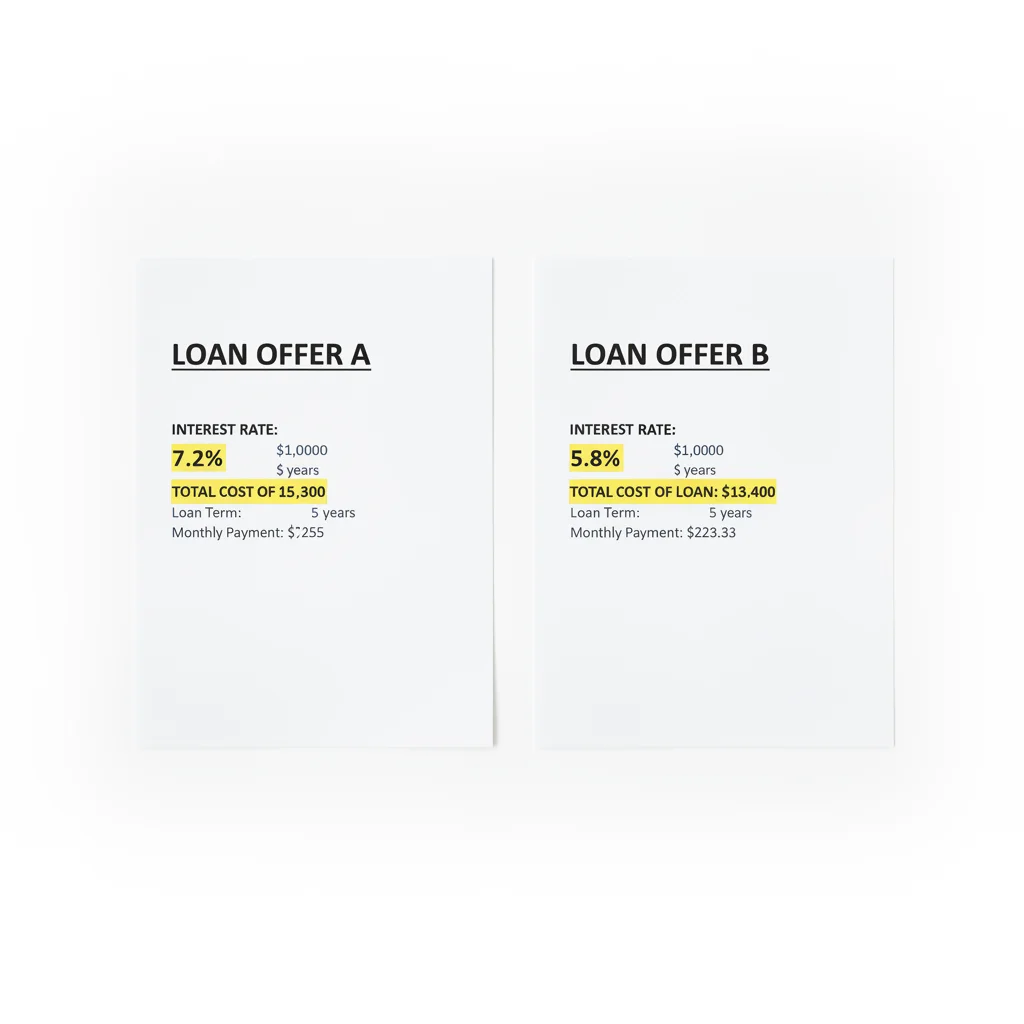
Compare Offers on APR, Term, and Total Loan Cost — Not Monthly Payment
When your offers come back, resist the instinct to compare them by monthly payment. The payment is a function of rate and term — a longer term reduces the payment but dramatically increases total interest paid.
Compare offers using these three metrics:
| Metric | What to Look For |
|---|---|
| APR | Lower is better; this is your primary comparison point |
| Loan Term | Shorter terms save interest even if the payment is higher |
| Total Interest Paid | Multiply your monthly payment by the number of months, then subtract the principal — this is what the loan actually costs you |
Pick the offer with the lowest total cost that fits your monthly budget, not the lowest payment.
Accept Your Best Offer and Understand the Terms Before You Shop
Once you've selected your preferred preapproval, read the offer letter carefully before you head to a dealership. Know the following cold:
- Maximum loan amount: You cannot finance more than this without going back to the lender.
- APR and loan term: These are your comparison benchmarks with the dealer.
- Expiration date: Most preapprovals are valid 30–45 days. Plan your shopping accordingly.
- Vehicle restrictions: Some lenders won't finance vehicles over a certain age or mileage. Confirm your target car qualifies.
Bring a printed copy of the offer letter to the dealership. A physical document signals that you're serious and prepared — it carries more weight in a negotiation than saying "I got preapproved somewhere."
Once you have at least two or three offers in hand, you're ready to walk onto a lot. If you're buying new, review what to expect from the purchase side at Buying New Cars.
Don't Let the Dealer Run Your Credit Without Reason
When you have a preapproval in hand, you do not need to authorize the dealership to run your credit unless you're actually considering their financing offer. Dealers routinely ask to run credit early in the process — ostensibly to "see what you qualify for" — which generates a hard inquiry that benefits them by giving them leverage over you. Decline until you're ready to compare their offer against yours.
Using Your Preapproval as a Negotiating Tool
This is where most buyers make a second mistake: they mention the preapproval too early. Never lead with it. Negotiate the out-the-door vehicle price first, as if you're paying cash. Once you've agreed on price, then bring up financing.
Hand the finance manager your preapproval letter and say something like: "I'm preapproved at % APR for months. If you can do better, I'll use your financing. If not, I'll fund through my lender." That's the entire conversation. You don't need to justify it, explain it, or negotiate the rate like it's an opening bid.

If the F&I manager pivots to monthly payment instead of APR — "We can get you into this car for $450 a month" — redirect immediately. Monthly payment is a distraction. A longer term or a higher rate can produce the same monthly number while costing you thousands more over the life of the loan. Insist on comparing APR and total loan cost, not payment.
Never Negotiate on Monthly Payment
The single most effective dealer tactic is to shift the conversation from price and APR to monthly payment. Once you're anchored on a payment number, the dealer can extend the loan term, increase the rate, or bundle in add-ons — all while keeping the payment where you agreed. Always negotiate the out-the-door price first, then compare APR and total loan cost. Monthly payment is the last thing you confirm, never the first.
Your Preapproval Amount Is a Ceiling, Not a Budget
Being preapproved for $45,000 does not mean you should spend $45,000. Lenders set preapproval limits based on your debt-to-income capacity, not on what's financially comfortable for you. Before you shop, decide independently what monthly payment fits your actual budget, work backward to a maximum vehicle price using your preapproved rate and term, and stick to that number regardless of what the dealership says you qualify for.
After you've settled on financing, you'll face a menu of add-ons: extended warranties, GAP insurance, paint protection, tire-and-wheel packages. Each one is negotiable, and most are marked up significantly. GAP insurance is the one product genuinely worth considering if you're putting less than 20% down — but buy it at the dealer rate only if it's cheaper than your own insurer's offering. For help understanding the paperwork that comes next, see Paperwork & Contracts.
Common Mistakes That Undercut Your Preapproval
Even buyers who get preapproved sometimes lose the advantage by making avoidable errors between approval and signing. Here's what to watch for:
- Letting the preapproval expire: Most offers are valid for 30–45 days. If your shopping runs long, you may need to reapply — which means another credit pull and potentially different terms if market rates have moved.
- Changing your financial profile after approval: Don't quit your job, take on new debt, or make large purchases on credit between preapproval and loan closing. Lenders sometimes re-verify employment and credit just before funding.
- Applying for credit at the dealership before you intend to use it: When the sales desk asks to run your credit "just to see what we can do," that's a hard inquiry that helps them, not you. You already have your preapproval — you don't need their quote unless it beats yours.
- Forgetting to account for taxes, fees, and add-ons: Your preapproval covers up to a maximum loan amount. If the out-the-door price plus fees exceeds that ceiling, you'll need to cover the difference in cash or go back to your lender.
Rate Shop Aggressively — The Credit Impact Is Minimal
Many buyers apply to only one lender out of fear of damaging their credit score. This is a costly myth. FICO's scoring model groups all auto loan inquiries within a 14-day window into a single inquiry. Applying to five lenders costs you no more than applying to one — and the savings from finding even a 0.5% better rate can easily exceed $500 on a typical loan.
Preapproval Works on Used Cars Too
Most buyers associate preapproval with new car purchases, but it's just as effective — and often more important — on used car purchases where dealer markups on financing are typically higher. Just confirm with your lender that the specific vehicle you're considering meets their age and mileage requirements before you commit.
If your credit score isn't where you'd like it to be, preapproval is still worth pursuing — it benchmarks where you stand and what rate you realistically qualify for today. See Bad Credit Auto Loans From Start to Funded: The Full Timeline for a full walkthrough of what the timeline looks like when your credit needs work.

All claims are backed by peer-reviewed research. Sources on request.