| CarMax offer window | 7 days from written appraisal (CarMax.com offer terms, 2024) |
| Carvana offer window | 7 days from digital acceptance (Carvana.com offer terms, 2024) |
| Vroom offer window | Typically 7 days (may shorten in soft markets) (Vroom.com offer terms, 2024) |
| KBB Instant Cash Offer window | 3 days at participating dealer (KBB.com Instant Cash Offer terms, 2024) |
| Dealership-based instant offer window | 3–5 days (dealer discretion) (General industry practice) |
| Typical re-quote drop in declining market | $500–$2,000 on average transaction (Industry estimates based on 2022–2024 used car market data) |
| Mileage update trigger | Crossing a platform mileage band (varies by platform) (Platform terms, Carvana and CarMax) |
| Most common re-quote cause | Condition discrepancy at inspection (Platform seller FAQ documentation) |
Why Offer Expiration Matters More Than Most Sellers Realize
The phrase "instant offer" implies speed on the buyer's side. What it doesn't advertise is the deadline it places on you. Every platform that generates an algorithm-based price for your vehicle attaches an expiration window to that number — and how you handle that window determines whether you walk away satisfied or scrambling for a re-quote at a lower price.
Expiration policies exist for a straightforward reason: the used car market moves. Wholesale auction prices shift week to week, regional inventory swings affect retail demand, and fuel price spikes can flip the value of a truck versus a hybrid overnight. Platforms protect themselves from being locked into a price they quoted when conditions were different. That's legitimate — but it creates real pressure for sellers who need time to make a decision.
Understanding exactly how long these offers last, what resets the clock, and what triggers a forced re-quote will help you time your sale correctly. Before diving into platform-by-platform specifics, it helps to understand how these platforms generate and fund their offers in the first place — because the mechanics directly explain why expirations are set where they are.

The bottom line: treat an instant offer like a coupon with a hard expiration date, not a standing agreement. If you're not ready to transact within the window, you may need to re-enter the funnel at a lower number.
Platform-by-Platform Expiration Windows
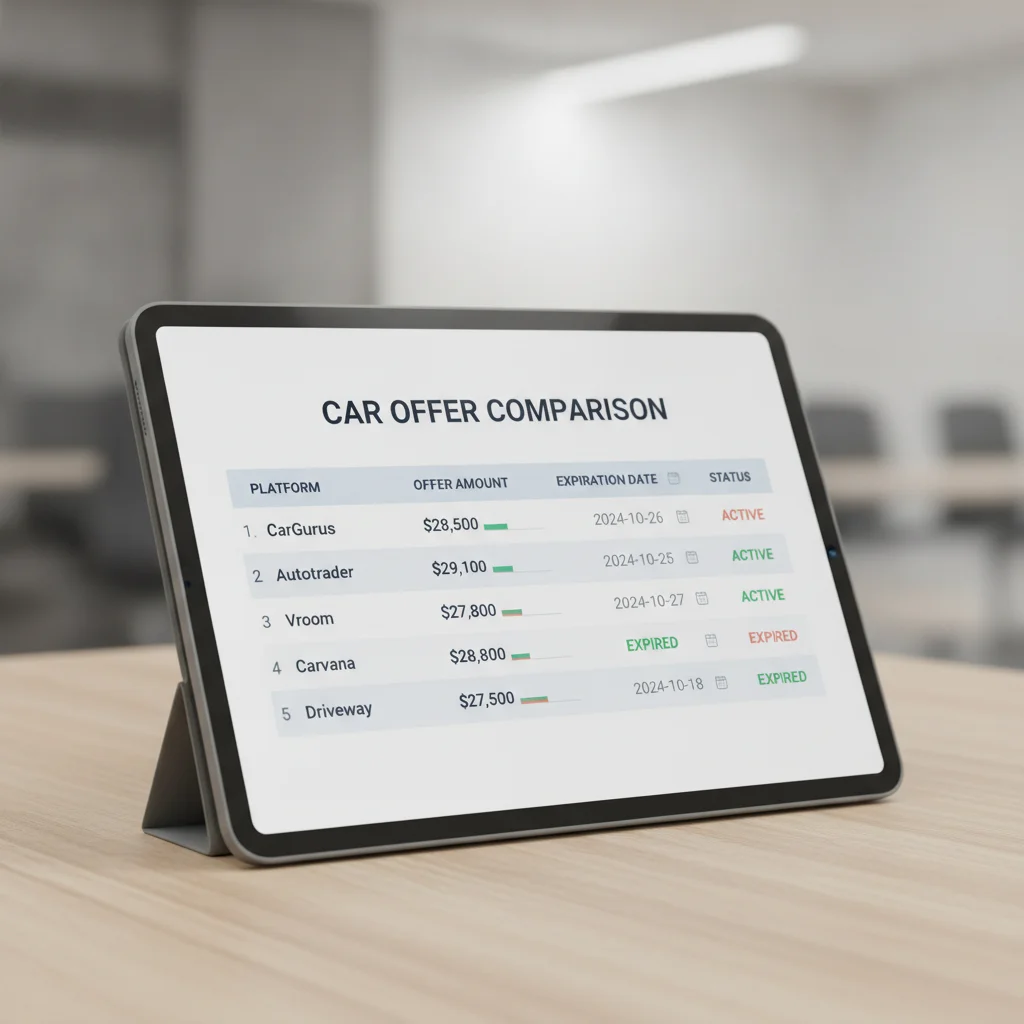
Expiration policies are not standardized across the industry. Each major platform sets its own window, and some vary by state or vehicle type. The table below reflects current general policies — always confirm directly with the platform at time of offer, since these terms do change.
| CarMax offer window | 7 days from written appraisal (CarMax.com offer terms, 2024) |
| Carvana offer window | 7 days from digital acceptance (Carvana.com offer terms, 2024) |
| Vroom offer window | Typically 7 days (may shorten in soft markets) (Vroom.com offer terms, 2024) |
| KBB Instant Cash Offer window | 3 days at participating dealer (KBB.com Instant Cash Offer terms, 2024) |
| Dealership-based instant offer window | 3–5 days (dealer discretion) (General industry practice) |
| Typical re-quote drop in declining market | $500–$2,000 on average transaction (Industry estimates based on 2022–2024 used car market data) |
| Mileage update trigger | Crossing a platform mileage band (varies by platform) (Platform terms, Carvana and CarMax) |
| Most common re-quote cause | Condition discrepancy at inspection (Platform seller FAQ documentation) |
A few observations worth calling out:
- CarMax (7 days): Among the strictest windows in the industry. CarMax physically inspects vehicles before finalizing, so their seven-day clock starts from when you receive the written offer after the in-person appraisal — not from your online submission. If you submit online and wait a week before going in, you haven't consumed any of the offer window yet. But once paper is in hand, the countdown is real.
- Carvana (7 days): Carvana's offer is generated online without a physical inspection upfront. Their seven days begins at digital acceptance. One important nuance: if you delay scheduling your vehicle pickup beyond seven days, Carvana will re-run their pricing algorithm. In a declining market, that second quote is almost always lower.
- Vroom (varies, typically 7 days): Vroom has historically matched Carvana's window but has been known to quietly reduce it to five days during periods of rapid market depreciation. If you're selling in a soft market, don't assume seven days — confirm in writing.
- KBB Instant Cash Offer / dealer network (3 days): The shortest standard window in common use. KBB's offer routes to a participating dealer, and dealers operate with much tighter inventory risk tolerance than the national platforms. Three days is genuinely short — plan to act the same week you receive it.
- AutoNation / dealership-based instant offers (typically 3–5 days): Dealer group instant offers usually mirror KBB's tighter windows. Some dealers will honor an expired quote if market conditions haven't moved, but this is a favor, not a right.
For a broader look at what these platforms are actually offering you beyond the headline price, see what instant cash offer services are really offering you — including fee structures and condition adjustment policies that can reduce your net payout.
What Triggers a Re-Quote Before the Clock Expires
Expiration windows are the advertised deadline — but several events can force a re-quote even within those windows. This is the part sellers consistently get surprised by.
Online Quote vs. In-Person Offer: Know the Difference
Many platforms distinguish between an online estimate (generated before inspection) and a formal written offer (generated after inspection or VIN verification). The expiration clock typically starts only on the formal written offer. Submitting online and waiting a week before visiting CarMax, for example, does not consume your seven-day window. Confirm which stage your quote is at before assuming the clock has started.
Lien Payoff Delays Can Eat Your Window
If you still owe money on your vehicle, the platform must receive a payoff amount from your lender before completing the transaction. Lender payoff processing can take three to five business days. On a seven-day offer, that leaves almost no margin. Request your payoff quote from your lender before submitting your vehicle to any platform — not after.
Extensions Are Possible but Not Guaranteed
Carvana and CarMax customer service representatives do have limited authority to extend offers by two to three days in some circumstances. This requires a proactive request before expiration, a legitimate reason (title delay, scheduling conflict), and depends on market conditions at the time. Never rely on an extension as your default strategy — treat the stated window as the real deadline.
Condition Discrepancies
Every instant offer is conditioned on the information you provide. If your description says "good condition" and the vehicle arrives with an undisclosed accident repair, a cracked windshield, or significant paint oxidation, the platform will adjust — sometimes dramatically. This isn't a violation of their terms; it's explicitly permitted in the fine print of every major platform. The adjustment typically happens at vehicle pickup or inspection, after you've already committed to the transaction mentally.
Mileage Changes
Adding meaningful miles between quote and sale can trigger a re-quote. The threshold varies — Carvana and CarMax both use mileage bands — but driving the car an extra 500 miles in a week rarely matters, while crossing a tier boundary (e.g., going from 29,800 to 30,200 miles) can reduce the offer by several hundred dollars. Check whether you're near a round-number mileage tier before scheduling your appointment.
Market Repricing Events
Some platforms reserve the right to reprice offers if their underlying wholesale data changes significantly during your window. This is most common during auction weeks when prices swing sharply. Vroom and Carvana both include market-change clauses in their offer terms. In practice, this is rare during a stable week — but during periods of rapid used car depreciation, it does happen. Selling during a soft market carries specific risks with instant offers that are worth understanding before you commit to a window.
VIN-Level Data Changes
Platforms run VIN checks at multiple points in the process. If an accident report, title issue, or lien shows up that wasn't disclosed, the offer is subject to immediate revision. Pull your own Carfax or AutoCheck report before submitting — eliminate surprises you can't explain.
Instant offer
An algorithm-generated price for your vehicle provided immediately upon submission of vehicle details. The offer is conditional on the accuracy of the information you provide and subject to a fixed expiration window.
Offer expiration window
The number of days a platform will honor its quoted price. After this window closes, the seller must request a new quote based on current market data, which may be lower.
Re-quote
A new price generated by a platform after the original offer has expired or after a condition discrepancy is identified. Re-quotes are based on current market data and are frequently lower than the original offer in a declining market.
Condition adjustment
A reduction to an offer price made at the time of vehicle inspection when the car's actual condition differs from what was disclosed in the original submission. This can occur even within the active offer window.
Mileage band
A pricing tier used by platforms that assigns vehicles to valuation categories based on odometer ranges (e.g., 20,000–30,000 miles). Crossing a band boundary during the offer period can trigger a lower price.
Market repricing clause
A contractual provision allowing a platform to revise its offer during the active window if underlying wholesale market data changes significantly. Most common during periods of rapid used car depreciation.
How to Use the Expiration Window Strategically
The expiration clock doesn't have to work against you. With the right timing strategy, you can use it as a negotiating tool and a competitive benchmark.
Stack Competing Offers
Most platforms don't know you've gotten offers elsewhere — and they don't care. Get offers from two or three platforms on the same day, so the expiration windows align. This lets you legitimately compare live numbers and potentially present a competing offer when negotiating. See what's actually negotiable on instant offer platforms — having a documented competing offer is one of the few real levers you have.
Don't Request an Offer Until You're Ready to Act
This sounds obvious, but sellers routinely get a quote out of curiosity, let it expire, and then discover the re-quote is lower. If you're not within two weeks of being ready to complete the transaction, don't start the clock. Use the time to gather your title, confirm your payoff balance if you have a loan, and get your paperwork organized. The full timeline of an instant car sale shows every step that needs to happen between quote acceptance and payment — it's longer than most sellers expect.
Ask for an Extension Before It Expires
Most platforms won't advertise this, but customer service representatives at Carvana and CarMax have latitude to extend offers by a few days in low-volume periods. Call before the expiration, not after. Explain your situation — a pending payoff check, a title delay, a scheduling conflict. Extensions aren't guaranteed, but a proactive request succeeds more often than most sellers realize. Once the offer has expired, you're back in the queue at current market rates.
Time Your Sale to Market Conditions
Instant offer platforms update their pricing algorithms frequently — sometimes daily. If you believe used car values are trending upward (e.g., strong spring retail demand, low auction supply), getting a quote at the beginning of that trend and completing the sale within the window locks in an upside. Conversely, if the market is softening, don't shop around for a month while the platform's buy price drops under your feet. Speed is your friend in a declining market. Timing your purchase or sale around market cycles is a skill that pays real dollars — the same principle applies on the sell side.
7 days
Standard offer window at CarMax and Carvana
Both platforms hold offers for seven days from the point of formal offer generation, per their 2024 terms of service.
3 days
KBB Instant Cash Offer validity at dealerships
KBB's dealer-routed offers carry one of the shortest standard windows in the industry, reflecting dealer inventory risk tolerance.
$500–$2,000
Typical re-quote reduction in a soft market
Industry analysis of the 2022–2024 used vehicle value correction period shows re-quotes often come in meaningfully below original offers.
~60%
Re-quotes triggered by condition discrepancies
Platform seller FAQ data and industry surveys indicate undisclosed condition issues are the leading cause of offer revisions at inspection.
2–3x
More offers received by sellers who stack platforms simultaneously
Sellers who request offers from multiple platforms on the same day have more live competing numbers before any offer expires.
Re-Quotes: What Happens When You Miss the Window
Let's be direct about what a re-quote usually means in practice: a lower number. Here's why.
When a platform re-prices your vehicle, they're not working from the same snapshot of market data they used the first time. They're using current data. In a flat market, the re-quote might be nearly identical. In a declining market — which has characterized much of the post-pandemic used car correction — re-quotes can come back $500 to $2,000 lower on a typical late-model used vehicle. That's not a rounding error; it's a meaningful percentage of the transaction value on a $15,000 car.
There's also a psychological dimension. After you've mentally accepted a number and planned around it, a lower re-quote feels like a loss even if it's objectively fair. Sellers in this position often accept the lower number anyway because they've already committed to the platform's process. The platforms know this. Don't put yourself in that position by letting a quote expire without a plan.
If you do miss your window, here are the practical steps:
- Don't panic-accept the first re-quote. Request the re-quote in writing, then immediately get a competing quote from at least one other platform. You need a benchmark.
- Ask what changed. A good customer service rep will tell you whether it was a mileage reassessment, a market adjustment, or a condition flag. That tells you whether the lower number is defensible or a negotiating opening.
- Evaluate private-party alternatives. If the re-quote has dropped significantly, the delta between instant sale convenience and private-party proceeds may now justify the extra effort. Run the numbers honestly — factor in your time, listing fees, and the risk of a deal falling through.

The re-quote experience is also a good diagnostic for the platform's overall reliability. A platform that re-quotes significantly below their original offer without a clear condition or market justification is one worth avoiding for future transactions.
How Instant Offer Platforms Actually Work
Breaks down the mechanics behind algorithm-based pricing, how offers are funded, and why expiration policies are structured the way they are. Essential context before you accept or negotiate any instant offer.
Negotiating With an Instant Offer Platform
Covers where real leverage exists in the instant offer process — including how to use competing offers and condition documentation to push back on adjustments.
The Full Timeline of an Instant Car Sale
Day-by-day breakdown of every step from quote to payment. Useful for planning your sale so lien payoffs, title paperwork, and scheduling don't cause you to miss your offer window.
Carfax Vehicle History Report
Pull a Carfax report on your own vehicle before submitting to any platform. Knowing what the platform will see eliminates surprises at inspection that can trigger a condition-based re-quote.
Selling During a Soft Market: Instant Offers Under Pressure
Explains how instant offer platforms reprice during used car market downturns and what strategies sellers can use to protect their net proceeds when values are declining.

All claims are backed by peer-reviewed research. Sources on request.