Key Takeaways
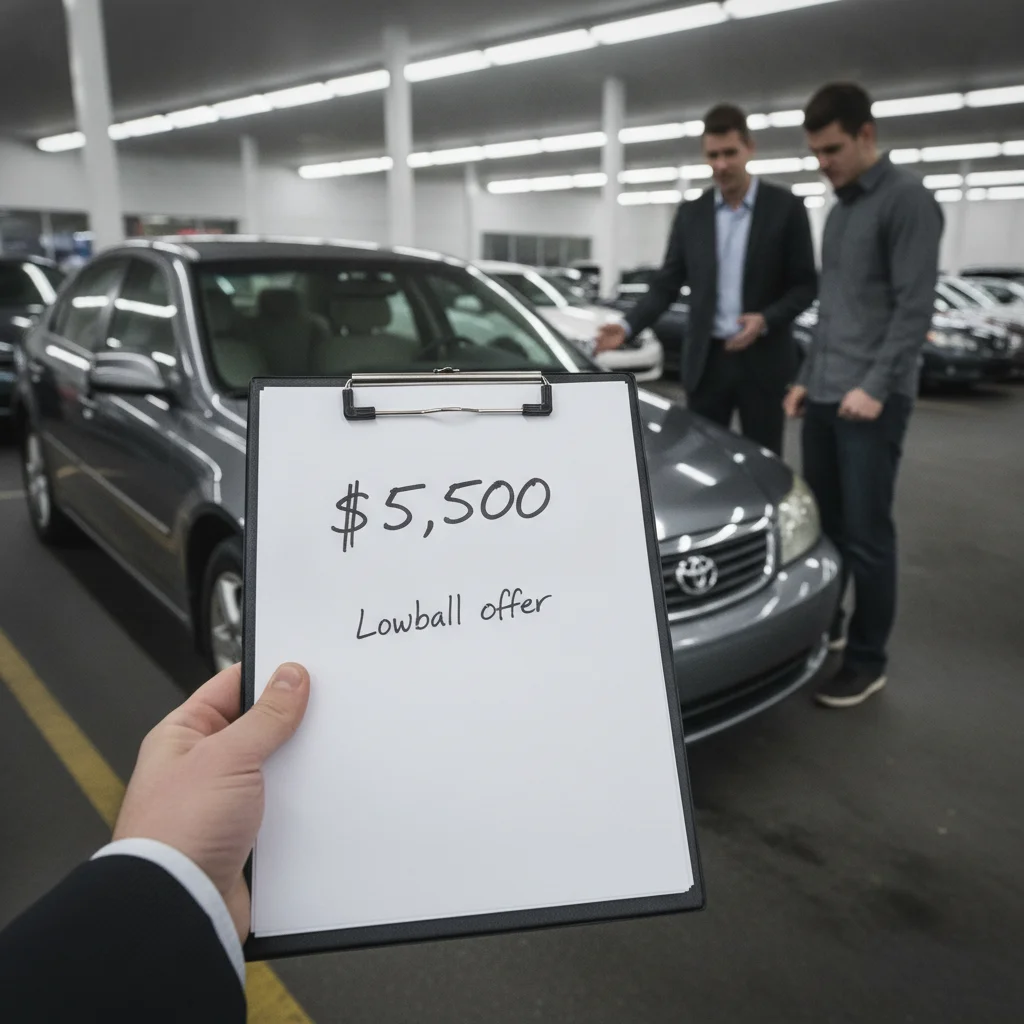
Dealer Trade-In Lowball Offer
A dealer lowball offer is an intentionally low initial appraisal of your vehicle's trade-in value — typically well below what the dealer expects to sell the car for or what competing buyers would pay. It's a negotiation tactic, not an honest assessment. Dealers use it to maximize their margin on the resale of your vehicle while making you feel like you're getting a fair deal on the new car purchase.
The gap between a dealer's opening trade-in offer and the vehicle's actual wholesale or retail value is often called 'recon spread' or 'front-end gross.' On average, dealers mark up used vehicle resale prices by $1,500–$4,000 above what they paid through trade-in appraisals.
The Business Logic Behind a Low First Offer
Dealers don't lowball you because they're careless — they do it because it works, and because the math rewards them every time it does. Understanding the financial structure of a dealership makes the strategy obvious.
When a dealer takes your car in trade, they're buying it at wholesale. They'll either resell it on their used lot at retail, or send it to auction if it doesn't meet their standards. Either way, the difference between what they paid you and what they sell it for is profit. That spread is called front-end gross on the used vehicle, and every dollar they save on your appraisal adds directly to it.
Here's what the internal math can look like on a typical $15,000 trade-in vehicle:
| Scenario | Trade-In Offer | Retail Sale Price | Dealer Gross |
|---|---|---|---|
| First offer accepted | $11,500 | $15,800 | $4,300 |
| After negotiation | $13,200 | $15,800 | $2,600 |
The dealer still makes money at $13,200 — they just make less. That's the critical insight: there is almost always room between their first offer and what they're willing to pay. The question is whether you know enough to push into that space.

This is also why dealers rarely volunteer their best number upfront. Opening low costs them nothing if you accept. If you push back, they can move up incrementally. The risk of starting high is that they leave money on the table for no reason. So they don't.
See why dealers systematically undervalue trade-ins for a deeper breakdown of the mechanics involved.
The Four Tactics Dealers Use to Justify a Low Number
A lowball offer rarely arrives naked. Dealers dress it up with justifications designed to make you feel the number is fair, inevitable, or non-negotiable. Knowing these tactics in advance takes away their power.
Reconditioning Costs: Real but Often Overstated
Dealers legitimately incur costs to prepare trade-ins for resale — safety inspections, detail work, minor mechanical repairs. These costs are real, but they're frequently inflated during appraisal to suppress the offer. If a dealer mentions reconditioning as justification for a low number, ask for an itemized written estimate. Legitimate costs will survive scrutiny; inflated ones won't.
The Sales Tax Offset on Trade-Ins
In most U.S. states, the value of a trade-in reduces the taxable purchase price of your new vehicle. On a $40,000 new car with an 8% sales tax rate, a $15,000 trade-in could save you roughly $1,200 in taxes. This offset doesn't always appear in online trade-in calculators, so factor it into your decision if you're weighing a dealer trade against a private sale.
1. Inflated Reconditioning Costs
Every used vehicle that comes onto a dealer's lot needs some work before sale — detailing, minor repairs, maybe new tires. Dealers have real reconditioning costs, but they frequently overstate them during appraisal to justify a lower offer. A dealer might quote $1,800 in recon costs on a car that realistically needs $400 of work.
Counter it: If a dealer references reconditioning costs, ask for an itemized estimate. Vague numbers are negotiating theater — specifics hold them accountable.
2. The Auction Threat
"This car would only bring $X at auction" is a classic line. It's designed to anchor your expectations at wholesale rock-bottom. But a car that would bring $10,000 at auction doesn't mean the dealer plans to send it to auction — if it's a desirable vehicle, it'll go on their lot at a substantial markup.
Counter it: Check what identical vehicles are actually retailing for on their lot and on sites like AutoTrader or Cars.com. If their own retail price is $15,500, the auction argument falls apart.
3. The Four-Square Method
This is the dealership's most sophisticated bundling tactic. The salesperson presents a single worksheet showing monthly payment, purchase price, down payment, and trade-in value — all at once. By mixing everything together, they can give you a higher trade-in number while quietly inflating the vehicle price or loan terms to compensate. The net result is the same: the dealer doesn't lose money.
Counter it: Negotiate each variable independently. Lock in the new car price first. Introduce the trade-in second. Financing last. Dealers have proven methods for shrinking what you net — the four-square is the most common.
4. The Urgency Play
"This offer is only valid today" or "We have three buyers already looking at this model" — urgency is manufactured to prevent you from doing what you should do: getting competing quotes. Don't let artificial time pressure override the 20 minutes it takes to get a Carvana or CarMax offer online.
Get Competing Quotes Before You Enter the Lot
Spend 30 minutes before your dealership visit running your VIN through Carvana, CarMax, and KBB Instant Cash Offer. Save or print each result with the date and dollar amount visible. Walking in with documented numbers flips the negotiation dynamic — you're no longer guessing at your car's value, and neither is the dealer.
Negotiate the New Car Price First
Always agree on the out-the-door price of the vehicle you're buying before introducing your trade-in. Once that price is locked in writing, bring in the trade-in discussion as a separate transaction. This prevents the dealer from using one number to quietly offset the other — a move that's nearly invisible when both are on the table at once.
What Your Car Is Actually Worth — Before You Walk In
The single most powerful thing you can do before any dealer conversation is know your car's real market value. Not a vague range — a specific, defensible number with documented sources.
$1,500–$4,000
Typical dealer trade-in markup spread
Industry estimates from iSeeCars and Edmunds research suggest dealers routinely resell trade-in vehicles at $1,500–$4,000 above what they paid through appraisal.
56%
Car buyers who don't research trade-in value first
A 2023 Cox Automotive study found that more than half of consumers trade in their vehicle without obtaining a competing written offer beforehand.
$2,200
Average gap between dealer offer and private party value
Kelley Blue Book data consistently shows private party sale values running $1,500–$3,000 above dealer trade-in offers for the same vehicle in comparable condition.
3–5 days
Time to get meaningful competing quotes
Carvana, CarMax, and KBB Instant Cash Offer all provide binding written quotes that remain valid for 7 days, giving sellers a real negotiating window.
Here's how to build that number:
- Run your VIN through Carvana and CarMax. Both give instant, real offers that are valid for several days. These are your floor — a dealer should beat or match them to earn your trade.
- Check KBB Instant Cash Offer and Edmunds True Market Value. These tools give you a data-anchored range for your vehicle's condition and mileage.
- Look at comparable listings on AutoTrader and Cars.com. Find 5–10 vehicles identical to yours (same year, trim, mileage within 10%) and note the retail asking prices. The dealer will sell your trade at those prices — so you'll know their margin.
- Get a second dealer appraisal. Visit a competing dealer and ask for a trade-in quote without mentioning the first. Use the higher number as leverage.

Walk into the dealership with printed or saved quotes. A verbal claim that "Carvana offered me more" is easy to dismiss. A screenshot with a date and a specific dollar amount is not.
For a systematic approach to using those quotes in the room, competing offers give you real leverage — here's how to use them strategically.
How to Counter the First Offer Without Blowing Up the Deal
Most buyers freeze when they get a low number because they don't know how to respond without seeming difficult or risking the whole transaction. The truth: dealers expect pushback. Trained salespeople are more suspicious of a buyer who immediately accepts than one who negotiates calmly.
Here's a reliable counter sequence:
- Don't react emotionally. Look at the number, pause, and say: "This is lower than what I was expecting based on my research. Can you walk me through how you got here?" This opens a dialogue without confrontation.
- Present your competing offers. "I have a written offer from Carvana for $14,200. What would it take to match that?" You're not making a demand — you're giving them a target.
- Isolate the trade-in from the new car deal. If they try to bundle, say: "Let's agree on the new car price first, then we'll figure out the trade." This prevents them from masking a low offer inside a favorable-looking monthly payment.
- Be willing to pause. "I'll think about it" is surprisingly powerful. Dealers lose deals every day to indecision — they'd rather improve the offer than watch you walk to a competitor.
- Know your walkaway number. Before you go in, set a minimum you'll accept on the trade. If they won't meet it and you have a Carvana or CarMax offer in hand, selling outright and buying with cash or outside financing is always an option.
“The trade-in is where dealers make some of their most reliable money. Most buyers focus on the sticker price of the new car and barely question what they're given for the old one — and that's exactly what the dealership is counting on.”
— Philip Reed, Former senior consumer advice editor, Edmunds
If the dealer claims their offer is final, that's rarely true. A dealer's 'final offer' rarely is — there are specific tactics that keep the conversation alive even after that door appears to close.
When to Walk Away and Sell Elsewhere
Not every trade-in negotiation is worth winning. Sometimes the right move is to skip the dealer entirely and sell the car yourself or to a direct buyer. Here's how to think through that decision.
The math is simple: if Carvana offers $14,500 and the dealer won't go above $12,800, you're leaving $1,700 on the table to save yourself the inconvenience of a separate transaction. For most people, that's not worth it — especially if the vehicle is easy to sell.
Private party sales typically net the most — often $2,000–$4,000 above even the Carvana/CarMax range — but they come with real costs: time to list, screen buyers, arrange test drives, handle paperwork, and accept the security risk of cash transactions with strangers.
A useful rule of thumb: if the gap between the dealer's best offer and your next-best alternative is over $1,500, seriously consider selling separately. Below that, the convenience of a one-stop trade usually wins.
Reconditioning Costs: Real but Often Overstated
Dealers legitimately incur costs to prepare trade-ins for resale — safety inspections, detail work, minor mechanical repairs. These costs are real, but they're frequently inflated during appraisal to suppress the offer. If a dealer mentions reconditioning as justification for a low number, ask for an itemized written estimate. Legitimate costs will survive scrutiny; inflated ones won't.
The Sales Tax Offset on Trade-Ins
In most U.S. states, the value of a trade-in reduces the taxable purchase price of your new vehicle. On a $40,000 new car with an 8% sales tax rate, a $15,000 trade-in could save you roughly $1,200 in taxes. This offset doesn't always appear in online trade-in calculators, so factor it into your decision if you're weighing a dealer trade against a private sale.
Also worth knowing: in most states, trading in a vehicle reduces the taxable sale price of the new car. If you're in a state with high sales tax and buying a $40,000 vehicle, a $15,000 trade-in could save you $900–$1,200 in taxes — a factor that often tilts the math back toward trading in, even if the dealer's offer is slightly lower than alternatives.
Maximizing trade-in value involves knowing not just what to negotiate, but when to walk. The red flags that a dealer is undervaluing your trade can help you recognize when a deal isn't worth salvaging.

All claims are backed by peer-reviewed research. Sources on request.