Key Takeaways
Interest Rate Environment
An interest rate environment refers to the general direction and level of borrowing costs at any given time — whether rates are low, high, rising, or falling. For car sellers, it matters because most buyers finance their purchase, so the cost of a loan directly affects how much they're willing or able to pay. When rates climb, monthly payments on a given price rise, which forces buyers to either negotiate the price down or walk away entirely.
The Federal Reserve's benchmark federal funds rate heavily influences auto loan rates offered by banks and credit unions. A 200-basis-point increase in that rate can translate to $30–$60 more per month on a typical used-car loan, meaningfully compressing what buyers will offer.
Why Financing Costs Are a Seller's Problem Too
Most sellers think about their asking price in terms of what the car is worth — miles, condition, trim level, comparable listings. That's the right starting point. But there's a second number that shapes what a buyer will actually hand you: the monthly payment they'll owe after they drive away.
Here's the thing a lot of private sellers miss. When rates are low, a buyer can afford to borrow more without their monthly payment jumping. When rates are high, that same buyer — same income, same credit score — qualifies for less or feels the pinch on every dollar they borrow. They're not being cheap. Their actual purchasing power has shrunk.
That compression doesn't disappear just because you listed your car at a fair market value. It transfers directly into lower offers, longer time on market, and buyers who are more aggressive about negotiating. As a seller, the rate environment is your problem whether you borrowed a dime or not.

Understanding this dynamic is the first step toward pricing smart and timing your sale to get what your car is actually worth. The private-party sales process gives you more control than trading in — but only if you use that control wisely.
The Mechanics: How Rate Changes Flow Into Offer Prices
Let's put some real numbers on this so it's not abstract. Say you're selling a clean 2020 SUV and the realistic market price is $22,000. A buyer financing that full amount at 5% over 60 months pays about $415 per month. If rates jump to 8%, that same loan costs around $446 per month. That's $31 more every single month for five years — $1,860 more over the life of the loan.
Buyers don't think in total-loan terms. They think in monthly payment terms. So when rates rise, one of two things happens: the buyer stretches to a longer loan term to keep the payment tolerable, or they negotiate your price down to get back to the payment they budgeted for.
$31/mo
Payment increase on a $22,000 loan at 8% vs. 5%
Based on a standard 60-month used-car loan calculation; illustrates how a 3-point rate increase compresses buyer budgets on a mid-range private-party sale.
~85%
Share of used-car buyers who finance their purchase
According to Experian's State of the Automotive Finance Market reports, the vast majority of used-car transactions involve a loan, making financing costs central to what buyers can offer.
$1,860
Extra total interest on a $22,000 loan at 8% vs. 5%
Over a 60-month term, a 3-point rate difference adds nearly $1,900 in interest — a figure many buyers translate directly into downward pressure on the purchase price.
6–8 weeks
Lag before published used-car values reflect rate changes
Industry observers note that valuation guides like Kelley Blue Book and Edmunds update on market transaction data, which can lag real-time rate-driven demand shifts by several weeks.
If that buyer has a firm $420/month ceiling, a jump to 8% rates means they now need the car priced around $21,200 to stay in budget — about $800 less than you were asking. Multiply that logic across a pool of buyers and you'll see why high-rate environments drag private-party sale prices down market-wide.
This is the same dynamic that savvy buyers consider when timing their own purchases. A lower sticker price in a high-rate environment can still cost them more in total. As a seller, recognizing that buyers know this math — or at least feel it intuitively — helps you set realistic expectations.
Rate Changes Affect Buyer Psychology Too
It's not just math. When rates rise sharply and get heavy news coverage, buyers become more cautious overall — even those who could still afford to buy comfortably. A sense that 'now is a bad time to take on debt' can reduce your buyer pool beyond what the payment calculations alone would predict. Expect more tire-kickers and lower conversion on inquiries during high-rate news cycles.
Published Values Lag the Market
Kelley Blue Book, Edmunds, and similar guides reflect completed transactions — meaning they can be several weeks behind real-time market shifts driven by rate changes. In a rapidly rising-rate environment, your car may be worth less in practice than the guides currently show. Cross-check with active listings and days-on-market data on platforms like CarGurus to get a more current read.
How Different Rate Cycles Affect What You Can Ask
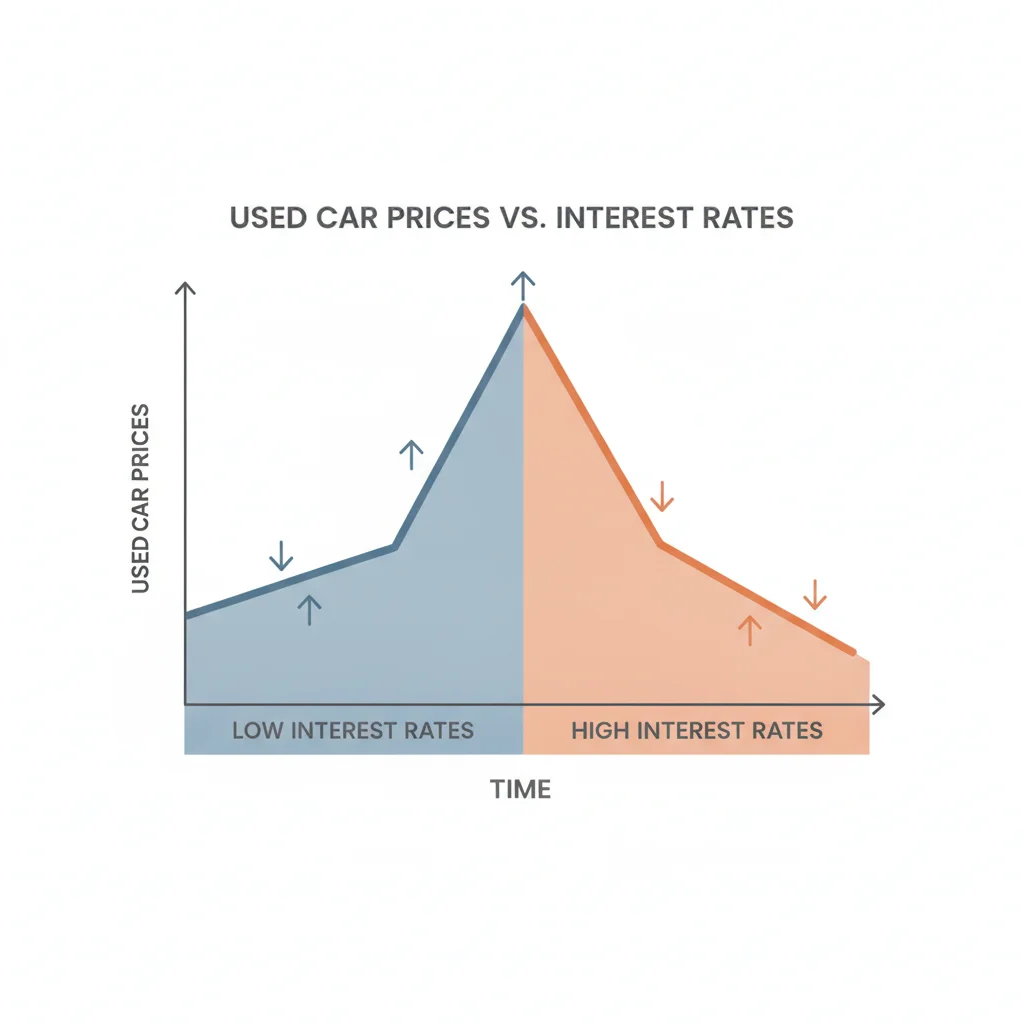
Rate environments don't flip overnight, but they do cycle over years. Knowing where you are in that cycle — and where things appear to be heading — can change how you price and when you list.
Low-Rate Environments
When rates are low (think sub-5% on used auto loans), buyer purchasing power is at its peak. A buyer with a $400/month budget can afford a significantly larger loan. Private-party demand tends to be strong, buyers are less price-sensitive, and you'll see shorter time-on-market. This is when you can list confidently at the top of a reasonable price range and expect competitive interest.
Rising-Rate Environments
This is where sellers get caught off guard. The car market data — Kelley Blue Book, Edmunds, CarGurus — tends to lag rate changes by weeks or months. Buyers feel the squeeze before the published values fully adjust. If you're listing during a rate-hiking cycle, expect buyers to push back on price more aggressively, even if your listing looks right according to the guides. Build in a bit of room to negotiate.
High-Rate Plateaus
Once rates have been elevated for a sustained period, the market adjusts. Published used-car values drift lower to reflect reduced buyer demand. Buyers who are in the market have either adapted their expectations or are choosing shorter loan terms or bringing larger down payments. Prices are lower across the board but the market is still functional — you just have to set your expectations accordingly and price to what buyers can actually finance, not what similar cars sold for 18 months ago.
Falling-Rate Environments
Rate cuts are a tailwind for sellers. As financing gets cheaper, buyers who were priced out return to the market, demand ticks up, and prices firm. If you have flexibility on timing, listing when rates are falling or have recently fallen can meaningfully improve your outcome. Seasonal timing matters too — overlapping a rate drop with a strong seasonal demand window (spring, early summer) can produce the best combination of buyer interest and price support.
Which Vehicles Feel Rate Pressure Most
Not every car responds the same way to rate shifts. The more a vehicle's purchase typically depends on financing — and the larger the loan amount — the more rate-sensitive its price tends to be.
Higher-Priced Vehicles
Trucks, full-size SUVs, and luxury cars carry larger loan balances. On a $40,000 truck, a 3-point rate increase can add $60–$80 per month to a 60-month payment. That's real money, and buyers feel it acutely. Expect more negotiation pressure on premium private-party listings during rate-hiking cycles.
Budget Vehicles and Cash Buys
Cars priced under $10,000–$12,000 are frequently purchased with cash or small personal loans, which means traditional auto-loan rates matter less. Sellers in this segment are somewhat insulated from rate swings, though overall economic confidence (which tracks with rate environments) still plays a role in buyer activity.
In-Demand or Low-Supply Models
When a specific model is hard to find — a popular trim, a recently discontinued nameplate, a clean example of a sought-after sports car — buyer competition can override rate headwinds. Supply and demand still trumps financing costs when there simply aren't many alternatives. Market conditions and inventory levels interact with rate environments, not replace them.
Know Your Vehicle's Rate Sensitivity
Before listing, ask yourself: would a typical buyer in this price range pay cash or finance? If your car is under $12,000, you likely have a meaningful cash-buyer pool that's insulated from rate swings. If it's $20,000 or more, assume most buyers are financing and build your pricing strategy around current loan rates accordingly.
Don't Anchor to Last Year's Comps
If rates have risen significantly since a reference sale you're using as a benchmark, that comp is misleading. A car that sold for $24,000 when rates were at 5% may now realistically command $22,500 at 8.5% — even if it's in identical condition. Use recent sold prices, not listings, and check the date.
What Sellers Can Actually Do About It
You can't control the Fed. But you can make smarter decisions with the rate environment as one of your inputs.
1. Check current auto loan rates before you price
Spend five minutes on Bankrate or your local credit union's site before setting your asking price. If used-car loan rates are sitting at 9–10%, factor that into your expectations. Compare what a buyer would pay monthly at current rates versus 12 months ago at lower rates, and price accordingly.
2. Give yourself negotiating room
In a high-rate environment, expect buyers to negotiate harder. Price your car 5–8% above your true floor so you have room to meet them without giving away equity. Setting the right asking price is a balance between attracting buyers and protecting your margin.
3. Emphasize financing-friendly aspects of your car
A lower loan balance reduces the pain of a high rate. If your car is priced well under competitors, highlight that in your listing. Buyers doing payment math will notice when a comparable car is listed $2,000 cheaper — in a high-rate market, that difference is amplified because it reduces the total interest they'll pay.
4. Consider timing if you have flexibility
If you're not in a rush, watch rate trends. A Federal Reserve rate-cutting cycle that's just getting started can shift buyer demand meaningfully within a few months. That said, don't sit on a depreciating asset waiting for perfect conditions — every month parked is more depreciation. Weigh the cost of waiting against the likely price benefit.
5. Know your buyer's perspective
Understanding how credit scores affect loan rates helps you understand your buyer pool. A buyer with strong credit will get a better rate than the average, meaning they're less squeezed by rate hikes. If your car targets a buyer segment that typically has strong credit — think certified professional crowd for a clean luxury sedan — you may have more pricing flexibility than you'd expect in a high-rate market.
“Car buyers don't think about what the vehicle costs — they think about what the monthly payment costs. When rates move, that number moves, and sellers who don't account for it are pricing in a vacuum.”
— Ivan Drury, Director of Insights at Edmunds

Reading the Market Before You List
Before putting up that listing, spend 20 minutes doing a rate-aware market scan. Here's how I'd approach it:
- Pull current used-car loan rates from two or three sources — a national bank, a credit union, and an online lender. Average them.
- Run a payment calculation for your expected asking price at those rates over 48 and 60 months. That's what your buyer will see when they run the numbers.
- Compare to listings from 6–12 months ago if you have access to sold-price data on CarGurus or similar platforms. Are current asking prices trending lower? Higher? That tells you where rate-driven demand pressure is pushing the market.
- Check days-on-market for similar listings. If comparable cars are sitting for 45–60 days, buyers aren't biting at current prices — whether from rate sticker shock or just general hesitation. Price aggressively to move.
- Note any recent Fed signals. If rate cuts have been announced or expected, buyer sentiment may improve faster than published values reflect. This is a mild tailwind — don't price on optimism, but be aware.
None of this takes long, and it separates you from the 80% of private sellers who just slap on a Kelley Blue Book number and wonder why they're not getting calls.
Rate Changes Affect Buyer Psychology Too
It's not just math. When rates rise sharply and get heavy news coverage, buyers become more cautious overall — even those who could still afford to buy comfortably. A sense that 'now is a bad time to take on debt' can reduce your buyer pool beyond what the payment calculations alone would predict. Expect more tire-kickers and lower conversion on inquiries during high-rate news cycles.
Published Values Lag the Market
Kelley Blue Book, Edmunds, and similar guides reflect completed transactions — meaning they can be several weeks behind real-time market shifts driven by rate changes. In a rapidly rising-rate environment, your car may be worth less in practice than the guides currently show. Cross-check with active listings and days-on-market data on platforms like CarGurus to get a more current read.

All claims are backed by peer-reviewed research. Sources on request.