Key Takeaways
Interest Rate Environment
An interest rate environment refers to the general level of borrowing costs across the economy at a given time—shaped primarily by Federal Reserve policy and broader market conditions. When rates are low, car loans are cheaper and monthly payments shrink for the same purchase price. When rates are high, the same loan principal costs significantly more to carry each month. Understanding where rates stand—and where they're likely headed—can be just as important as negotiating a lower sticker price.
The Federal Reserve sets the federal funds rate, which influences—but doesn't directly equal—auto loan APRs. Lenders also factor in your credit profile, loan term, and vehicle type when setting your personal rate.
Why the Rate Environment Matters as Much as the Price Tag
Most car shoppers focus almost entirely on the sticker price. They negotiate down a few hundred dollars, feel good about the deal, and drive off the lot. But in a high-rate environment, that victory can be largely erased by the financing terms attached to the purchase.
Here's a concrete example. Suppose you're choosing between two scenarios:
| Scenario | Vehicle Price | APR | Term | Monthly Payment | Total Interest Paid |
|---|---|---|---|---|---|
| High-Rate Market | $32,000 | 9.5% | 60 months | $671 | $8,260 |
| Low-Rate Market | $35,000 | 4.5% | 60 months | $651 | $4,060 |
The "cheaper" car in the high-rate environment costs $4,200 more in interest over the life of the loan—and carries a higher monthly payment. You paid less for the car and more for the money. That's the core lesson: the cost of borrowing is part of the purchase price, whether you think of it that way or not.
This is why understanding the interest rate environment—not just current inventory prices—is a foundational skill for any smart car buyer. The APR you're offered interacts with your loan amount and term in ways that compound over years, not months.
How the Federal Reserve Shapes Your Auto Loan APR
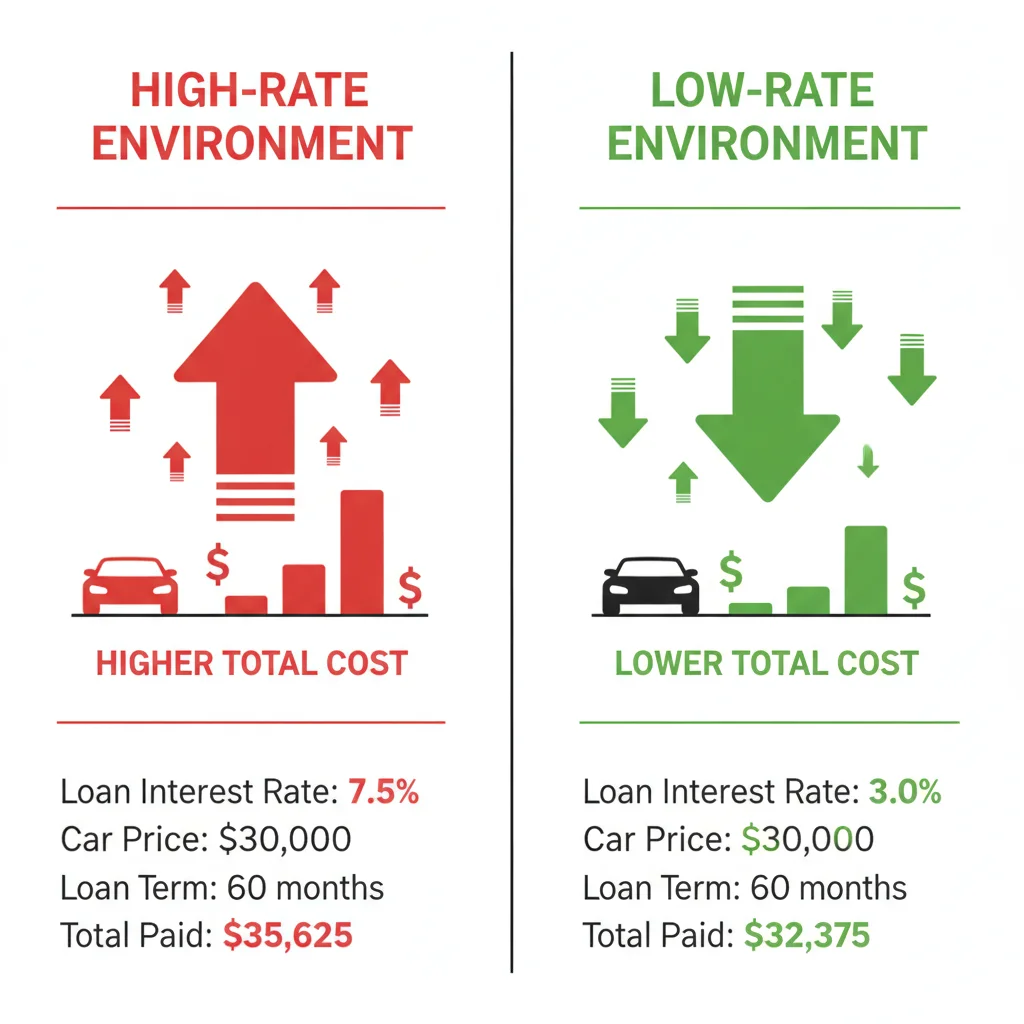
When the Federal Reserve raises or lowers its benchmark federal funds rate, it doesn't directly set your auto loan APR—but it pulls the entire lending market in one direction. Banks and credit unions fund their loan portfolios partly through instruments tied to benchmark rates, so when the Fed moves, auto loan rates follow within a few weeks.
Here's a simplified version of how rate changes travel from Washington to your dealership:
- Fed raises rates: Borrowing costs for banks increase.
- Banks reprice loan products: New auto loan APRs at credit unions and banks tick up within 2–6 weeks.
- Dealer financing adjusts: Captive finance arms (like Ford Motor Credit or Toyota Financial Services) reprice their offers to stay competitive.
- Manufacturer incentives respond: Some automakers will subsidize rates to prop up sales volume, temporarily insulating buyers from full rate increases.
The inverse is equally true. When the Fed cuts rates, lender APRs drift lower—though often more slowly than they rose. This asymmetry matters: lenders tend to pass rate increases on to borrowers quickly, but rate cuts can take longer to appear in advertised offers.
$4,200+
Extra interest cost from a 5-point rate difference
On a $35,000 loan over 60 months, the difference between a 4.5% and 9.5% APR results in over $4,200 more in total interest paid.
2–6 weeks
Lag between Fed rate changes and auto loan repricing
Auto lenders typically adjust advertised rates within 2 to 6 weeks following a Federal Reserve rate decision, according to industry lending data.
$10,000+
Credit score interest gap on a $30,000 loan
In a high-rate environment, a borrower with poor credit (below 620) may pay over $10,000 more in interest than an excellent-credit borrower on the same $30,000, 60-month loan.
1.5%
Rate drop threshold that makes refinancing worthwhile
Financial advisors and lenders generally recommend refinancing when your new APR would be at least 1.5 percentage points below your current rate, factoring in any fees.
1–2%
Typical dealer financing markup above base rate
Dealers are often permitted by lenders to mark up the loan interest rate by 1–2 percentage points above the buy rate, keeping the difference as additional profit.
For buyers, the practical implication is clear: rate environment awareness should be a standing part of your car-buying research, not an afterthought once you've already chosen a vehicle.
Buying in a High-Rate Environment: Strategies That Actually Help
You can't always wait for rates to fall. Maybe your current car needs expensive repairs, your lease is ending, or your family's needs have changed. Here's how to protect yourself financially when market rates are elevated.
1. Get Preapproved Before You Step Into a Dealership
When rates are high, dealer financing markup—the spread between the rate the lender offers the dealer and the rate passed on to you—becomes more damaging. A dealer may mark up your rate by 1–2 percentage points, which at 9% base adds real pain. Getting a preapproval from your bank or credit union gives you a rate floor to compare against. Your credit score directly determines what rate you'll qualify for, so know your number before you walk in.
2. Shorten Your Loan Term If You Can Afford It
The longer the term, the more total interest you pay—especially at elevated rates. A 48-month loan at 9% costs significantly less in total interest than a 72-month loan at the same rate, even though the monthly payments are higher. If you can stretch your budget to absorb a higher monthly payment in exchange for a shorter term, the interest savings are usually worth it.
3. Make a Larger Down Payment
Reducing the principal you finance means every interest percentage point costs you less in absolute dollars. At 9% APR, reducing your financed amount by $5,000 saves you roughly $1,300 in interest over 60 months compared to financing the full amount.
4. Prioritize New Cars With Manufacturer APR Incentives
Automakers routinely subsidize financing to move inventory—particularly at model-year changeovers or during slow sales periods. A manufacturer-sponsored 2.9% APR on a new car can be a better deal than a used car financed at 10–12% through an independent lender, even if the used car's sticker price is thousands lower. The advertised rate, however, isn't always the rate you'll get—so confirm your qualification before building your budget around it.
5. Plan to Refinance
Buying now and refinancing when rates drop is a legitimate and often overlooked strategy. If you purchase at 9% and rates fall to 6% within 18 months, refinancing could save you thousands in remaining interest. The key is to avoid long-term thinking that locks you emotionally into your current rate as permanent.
Refinancing Has Limits—Know Them Upfront
Refinancing works best when done in the first half of your loan term, since most of your early payments are weighted toward interest. Also note that some lenders charge prepayment penalties or origination fees on refinanced loans—always factor those into your savings calculation. A refinance that saves $1,200 in interest but costs $600 in fees nets you only $600 in real savings.
Manufacturer APR Deals Often Require You to Forgo Cash Rebates
When a manufacturer offers 0% or low-APR financing, it often comes with a trade-off: accepting the subsidized rate means giving up a cash-back rebate that could otherwise reduce your purchase price. Run the numbers both ways. On a $35,000 car with a $2,500 rebate versus 1.9% financing, the rebate choice sometimes wins even at a higher rate—especially on shorter loan terms.
Buying in a Low-Rate Environment: Don't Get Complacent
Low rates feel like a green light—and they often are. But a low-rate environment carries its own risks that buyers tend to underestimate.
Vehicle Prices Rise When Rates Fall
Cheap financing increases what buyers can afford, which pushes up demand. Sellers—dealers and private parties alike—respond by raising prices. The 2020–2021 period illustrated this dramatically: near-zero interest rates combined with supply chain disruptions drove vehicle prices to historic highs. Buyers financing at 2% were often paying $5,000–$10,000 over MSRP. Rate cycles affect seller pricing behavior in ways that erode some of the financing advantage.

Don't Overextend Because Payments Look Affordable
At 3% APR, a $50,000 car has a manageable monthly payment. That can tempt buyers into financing more vehicle than they actually need. The car still depreciates. The payment still needs to be made if your income changes. Low rates are not a reason to buy more car than your budget supports.
Lock in Fixed Rates
Low-rate environments are the right time to lock in a fixed-rate loan rather than pursue a variable option. Fixed vs. variable auto loan structures each have their place—but when rates are at cyclical lows, there's little reason to accept rate-reset risk over a variable product. Secure the low rate for the full term.
Lock In Low Rates With Fixed-Term Loans
When you're financing in a low-rate environment, choose a fixed-rate loan and avoid the temptation of variable-rate products that may seem cheaper initially. Rates historically don't stay at cyclical lows for long, and locking in protects you from payment increases. A fixed rate also makes budgeting straightforward for the life of the loan.
Set a Refinance Trigger Point Before You Sign
Before you drive off the lot, decide in advance what rate drop would prompt you to refinance—typically 1.5 percentage points or more below your current APR. Write that number down and check prevailing rates at the 12-month and 24-month marks. Acting on a refinance trigger early in your loan term maximizes the interest savings.
The Credit Score Multiplier: Why Your Score Matters More in High-Rate Markets
Interest rate environments don't affect all borrowers equally. The spread between what a prime borrower (720+ credit score) pays and what a subprime borrower (below 620) pays is always significant—but in a high-rate market, that gap widens in absolute dollar terms.
Consider this comparison in a high-rate environment:
| Credit Tier | Approximate APR | Monthly Payment ($30,000, 60 mo) | Total Interest |
|---|---|---|---|
| Excellent (750+) | 7.5% | $601 | $6,060 |
| Good (680–749) | 10.5% | $645 | $8,700 |
| Fair (620–679) | 14.0% | $698 | $11,880 |
| Poor (below 620) | 18.5% | $768 | $16,080 |
The difference between excellent and poor credit on this loan is over $10,000 in interest. In a low-rate market, that same spread might be $6,000—still significant, but the cost of a low credit score is amplified by a high-rate environment. The real cost of borrowing with a low credit score can dwarf any negotiating advantage on the sticker price.
If your credit score is in fair or poor territory and rates are currently high, it may be worth delaying your purchase by 6–12 months to actively repair your credit—even more than waiting for the rate environment to shift. You have direct control over your score; you have none over Fed policy.
“The price on the window is what you pay for the car. The interest rate is what you pay for the money. Most buyers negotiate one and ignore the other—and then wonder why they feel stretched every month.”
— Greg McBride, Chief Financial Analyst, Bankrate
Reading Rate Signals: What to Watch Before You Buy
You don't need to become a macroeconomist. But you do need a handful of reliable indicators to understand what rate environment you're operating in before signing a purchase agreement.
Federal Reserve Meeting Calendars
The Fed meets roughly every six weeks and publishes its rate decision immediately. More importantly, the post-meeting statement and press conference provide "forward guidance"—signals about future rate direction. If the Fed signals it's done raising rates, auto loan APRs often peak within 1–2 months following the last hike.
Average Auto Loan Rate Trackers
The Federal Reserve publishes average interest rates on new and used auto loans quarterly. Websites like Bankrate and Edmunds publish monthly averages pulled from real loan data. Tracking these over a few months tells you whether the market is in a rising, stable, or falling rate phase.
Manufacturer Incentive Calendars
Automakers publish monthly incentive programs. When you see aggressive APR deals (0% to 2.9%) spreading across multiple brands and models, it signals that manufacturers are subsidizing rates to offset a challenging rate environment or sluggish demand. This is often one of the best moments to buy new.
Inventory Levels
High inventory relative to demand gives you negotiating leverage on price. When rates are high and inventory is elevated, you can often negotiate both a lower price and access to rate buydown programs simultaneously—the rarest and most favorable buying conditions.

Putting It All Together: A Decision Framework
Use the following framework to assess your situation before deciding whether to buy now or wait.
Step 1: Assess Your Need vs. Want
If your vehicle is unreliable, unsafe, or costing more in repairs than a loan payment would, the financial calculus shifts toward buying now regardless of rate environment. If you want an upgrade but your current car is serviceable, you have flexibility to time the market.
Step 2: Know Your Credit Profile
Pull your credit report and score today. If you're above 720, you'll qualify for prime rates in most environments. If you're below 660, rate environment matters less than the rate tier you'll be placed in. Work on the score before the purchase.
Step 3: Calculate Total Cost of Ownership, Not Just Monthly Payment
Use an auto loan calculator to compare total interest paid across different rate scenarios. A $30 monthly payment difference doesn't sound like much—but multiplied over 60 months, it's $1,800. Look at the total interest column, not just the payment.
Step 4: Check Manufacturer Incentives
Before assuming you'll finance at market rates, research whether the vehicle you want has an active APR incentive. A subsidized rate can entirely neutralize an otherwise unfavorable rate environment.
Step 5: Build in a Refinance Trigger
If you buy during a high-rate period, set a calendar reminder at the 12-month and 24-month marks to check prevailing rates. If rates have dropped 1.5 percentage points or more from your current APR, run the refinance math. The earlier in your loan you refinance, the more interest you can redirect back into your pocket.
Lock In Low Rates With Fixed-Term Loans
When you're financing in a low-rate environment, choose a fixed-rate loan and avoid the temptation of variable-rate products that may seem cheaper initially. Rates historically don't stay at cyclical lows for long, and locking in protects you from payment increases. A fixed rate also makes budgeting straightforward for the life of the loan.
Set a Refinance Trigger Point Before You Sign
Before you drive off the lot, decide in advance what rate drop would prompt you to refinance—typically 1.5 percentage points or more below your current APR. Write that number down and check prevailing rates at the 12-month and 24-month marks. Acting on a refinance trigger early in your loan term maximizes the interest savings.
There's no single right answer to "when should I buy?" But there is a wrong approach: ignoring the rate environment entirely and treating financing as an afterthought. Buyers who factor borrowing costs into their purchase timing—and who understand how to use refinancing as a safety valve—consistently come out ahead over those who focus solely on sticker price.

All claims are backed by peer-reviewed research. Sources on request.