

Key Takeaways
Residual Value
Residual value is an automaker's prediction of what a leased vehicle will be worth at the end of a lease term — typically two to four years from now. It's expressed either as a dollar amount or as a percentage of the car's original sticker price. When a lease payment is calculated, this predicted future value is subtracted from the purchase price, meaning you only pay for the portion of the car's value you actually use. In plain terms, residual value is just depreciation in disguise: it tells you exactly how much value the automaker expects the car to lose.
Residual values are set by automakers' captive finance arms (e.g., Toyota Financial Services, Ford Motor Credit) based on proprietary auction data, historical resale trends, and projected market conditions. They differ from third-party appraisals and are not the same as the car's actual future market value.
Why Residual Value Is Depreciation in Plain Sight
Most people encounter the term "residual value" only when they're sitting across from a finance manager at a dealership, trying to decode a lease contract. But residual value carries information that goes well beyond the leasing office. It is, at its core, an officially sanctioned depreciation forecast — one built from real auction data and millions of vehicle resale transactions.
To understand depreciation, start here: when an automaker's finance arm sets a residual value of 50% on a $38,000 SUV for a 36-month lease, they are publicly stating they believe that vehicle will be worth $19,000 in three years. That belief isn't a guess. It's built from historical auction results, current inventory levels, consumer demand trends, and model-specific resale performance going back years.
Vehicle depreciation begins the moment a car leaves the lot, but it doesn't fall at a constant rate. The sharpest drop typically happens in the first year — often 15% to 25% of MSRP — and then the curve gradually flattens. Residual values, which are typically set for 24-, 36-, and 48-month terms, capture exactly these curve segments. A 36-month residual tells you where the automaker believes the car sits on that depreciation curve after year three.
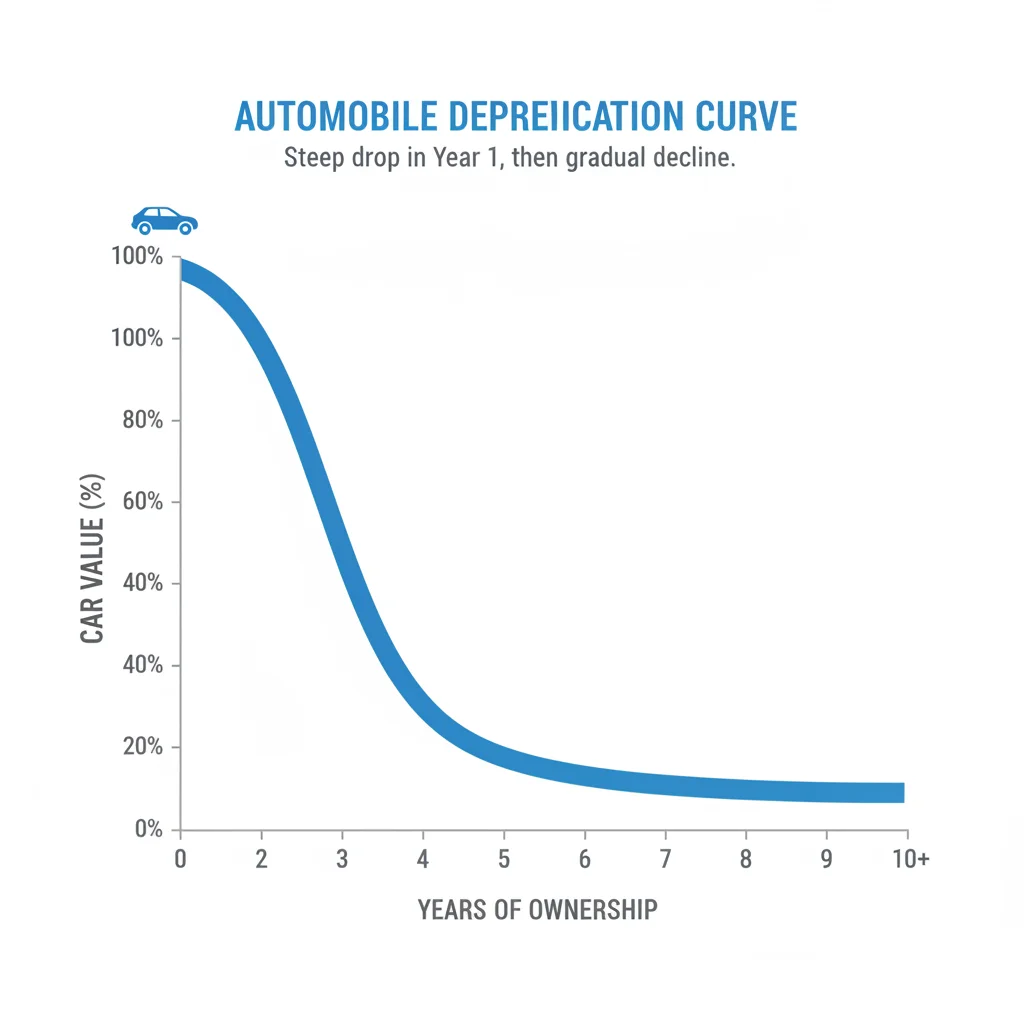
For private sellers, this is where residual value becomes genuinely useful. Instead of relying solely on what a neighbor sold a similar car for, or what a dealer offers as a trade-in, you have access to the same depreciation data that sophisticated finance organizations use to make multi-billion-dollar predictions. Learning to read that data turns pricing from guesswork into strategy.
How Automakers Actually Set Residual Values
Automakers don't set residual values based on optimism or marketing goals — at least not the good ones. Their captive finance arms (Ford Motor Credit, Toyota Financial Services, BMW Financial Services, and so on) employ teams of analysts who track wholesale auction prices on a weekly basis. When three-year-old versions of a particular model start selling consistently at $21,000 at Manheim and similar auctions, that data flows directly into the next month's residual tables.
Here's the practical pipeline:
- Auction data collection: Wholesale prices for off-lease and trade-in vehicles are tracked at major auction houses nationwide, giving finance divisions real-time visibility into what specific makes and models actually fetch.
- Historical trend modeling: Analysts look at how previous model years of the same vehicle depreciated over time, adjusting for refresh cycles, competitive entries, and economic conditions.
- Forward-looking adjustments: If a new model generation is expected to launch in two years, residuals may be lowered to account for the value dip that often accompanies a redesign. Fuel economy shifts, safety rating changes, and technology updates are all factored in.
- Market segmentation: Residuals differ by trim level, region, and sometimes even color. A fully-loaded AWD trim in the Pacific Northwest may carry a higher residual than a base FWD version in a flat, dry market.
Residual Values Change Monthly
Automakers adjust residual percentages month by month in response to current market conditions, inventory levels, and promotional goals. A model's residual in January may differ meaningfully from its residual in July of the same year. If you're using archived residual data as a pricing benchmark, try to match the month and model year as closely as possible to your specific vehicle.
Residuals Vary by Trim and Mileage Allowance
Published residual values aren't one-size-fits-all. A base trim may carry a different residual than a fully loaded version of the same model, and higher mileage allowances (15,000 miles/year vs. 10,000) reduce the residual percentage. When researching, try to match the trim level and mileage tier to your actual vehicle as closely as possible for the most accurate depreciation benchmark.
The result is a published residual percentage that represents the automaker's best actuarial estimate of future value. It is not a guaranteed buyback price — it's a forecast. But it's a forecast built from more data than most private sellers will ever have access to independently.
This is why comparing residual values across competing models is so revealing. When Toyota sets a 57% residual on the Camry and a competing brand sets 44% on a similar sedan, that gap isn't arbitrary. It reflects real differences in projected resale performance — the kind of difference that brand reliability reputations directly drive.
Reading the Residual Percentage as a Seller
If you're preparing to sell a car privately, residual value data gives you a concrete starting point — one that doesn't depend on what a dealer offered or what a neighbor guessed. Here's how to put it to work.
Step 1: Find the Original MSRP
Pull the window sticker from your records, or look up the base price of your exact trim and options at launch using archived automotive pricing sites. This is your starting number.
Step 2: Look Up the Residual That Applied When You Leased (or When Cars Like Yours Were Leased)
Sites like Edmunds, LeaseHackr, and archived manufacturer lease promotions publish or archive monthly residual values. For a car you're selling today after owning for three years, you want to find what the 36-month residual was when that model year launched. This percentage, applied to the original MSRP, gives you a data-backed estimate of current market value.
Step 3: Apply the Percentage and Adjust
Multiply the MSRP by the residual percentage. If your car's MSRP was $35,000 and the 36-month residual was 52%, the implied market value is $18,200. Now adjust for your specific situation:
- Mileage: Most residuals assume 10,000–12,000 miles per year. More miles mean a lower value; fewer miles may support a premium.
- Condition: Residuals assume average wear. Clean, well-maintained vehicles can justify asking 5%–8% above the residual-implied price.
- Local demand: Use valuation tools like KBB and Edmunds to sanity-check your number against recent local transactions.
Use Residuals to Screen Cars Before You Buy
Before purchasing any new or nearly-new vehicle, look up its current lease residual. A 36-month residual above 50% of MSRP is generally a strong signal of value retention. This single number can save you thousands in avoided depreciation over three to five years of ownership — and make the car far easier to sell when the time comes.
Cross-Check Residual Data With Current Listings
Residual percentages give you a theoretical floor for your asking price, but actual transaction prices in your local market may be higher or lower depending on current supply and demand. Always validate your residual-implied price against real sold listings — not just asking prices — on platforms like CarGurus or AutoTrader before finalizing your number.
This method won't give you a perfect number — no single method does. But it gives you a defensible number. When a buyer challenges your asking price, you can explain that it's grounded in the same depreciation data automakers use to set lease terms. That's a far stronger position than "I checked what similar cars are listed for online."

High vs. Low Residuals: What the Gap Tells You
Not all cars depreciate equally, and residual values make those differences concrete. Compare two similarly priced sedans:
| Model | MSRP | 36-Month Residual | Implied Value at 3 Years | Depreciation ($ lost) |
|---|---|---|---|---|
| Toyota Camry LE | $28,000 | 55% | $15,400 | $12,600 |
| Competing Sedan | $28,000 | 43% | $12,040 | $15,960 |
The difference — $3,360 — represents real money that the Toyota owner retains simply because the market values that car more highly at the three-year mark. The residual percentage made that visible before either car left the lot.
49%
Average 3-year residual for mainstream sedans
According to ALG residual value data, mainstream sedans retain roughly 49% of MSRP after 36 months under average conditions.
15–25%
First-year depreciation for new vehicles
Most new cars lose between 15% and 25% of their original sticker price within the first 12 months of ownership, per Edmunds analysis.
$3,000+
Resale premium for top-residual brands
Vehicles from brands like Toyota and Honda can command $3,000 or more at private sale compared to lower-residual competitors in the same segment, based on iSeeCars resale research.
36 months
Most common lease term (and residual benchmark)
The 36-month lease is the most widely used term in U.S. auto leasing, making 3-year residual percentages the most relevant depreciation benchmark for most sellers.
For sellers, the practical lesson is this: if you own a car with historically high residuals, your private sale price should reflect that advantage. Don't let a buyer's offer anchor you to a low number when your car objectively holds its value better than competing models. Conversely, if you own a car with a low residual — say, a luxury brand known for aggressive leasing incentives but poor long-term resale — temper your expectations accordingly.
Understanding this gap also helps you interpret the trade-in offers dealers make. A low trade-in offer on a high-residual vehicle isn't necessarily fair — the dealer is applying their own margin on top of an already conservative valuation. Knowing the residual-implied price gives you the leverage to push back.
“The residual value is really the automaker's public admission of how fast their car depreciates. It's the most honest depreciation data available — and most private sellers never look at it.”
— Brian Moody, Executive Editor, Autotrader
When Residual Predictions Miss — and What That Means for You
Residual values are forecasts, and forecasts are wrong sometimes. The used-car market surge of 2021–2022 is a vivid recent example: auction prices for three-year-old vehicles shot 30%–40% above pre-pandemic norms, making many leases immediately profitable to buy out because the car was worth far more than its stated residual.
The opposite happens too. When an automaker floods the market with a particular model, or when a significant redesign launches, used versions of the prior generation can fall below their projected residuals. Buyers benefit; sellers are caught off guard.
Hidden depreciation triggers — recalls, safety rating downgrades, fuel economy scandals, or even aggressive new competitor launches — can crater a car's actual value below what any residual table projected. If your car has experienced one of these events since it was leased or purchased, adjust your expectations downward from the residual-implied baseline.

The practical takeaway: use residual values as your starting benchmark, then layer in current market reality. Check what similar vehicles are actually selling for — not just listed for — on platforms like CarGurus, AutoTrader, and Facebook Marketplace in your zip code. The residual gives you the floor; current demand tells you how much above (or below) that floor the real market sits today.
Once you've established a realistic price range using this approach, you're ready to move to the next step: using depreciation data to negotiate, whether you're buying or selling.
Residual Value vs. Actual Market Value: Keeping Them Straight
One important distinction every seller should understand: residual value and actual market value are related but not the same thing.
- Residual Value
- Set by the automaker at lease origination. It's a contractual figure used to calculate lease payments. It represents what the finance company predicted the car would be worth — not what it actually is worth today.
- Actual Market Value
- What buyers in your local market will pay for the car right now, based on current supply, demand, condition, and comparable recent sales. This is what appraisal tools like KBB and Edmunds estimate, and what auction results reflect.
In a stable market, these two figures converge closely at the end of a lease term — that's the whole point of a well-calibrated residual. But market disruptions, regional demand shifts, and vehicle-specific events can push them apart significantly in either direction.
Use Residuals to Screen Cars Before You Buy
Before purchasing any new or nearly-new vehicle, look up its current lease residual. A 36-month residual above 50% of MSRP is generally a strong signal of value retention. This single number can save you thousands in avoided depreciation over three to five years of ownership — and make the car far easier to sell when the time comes.
Cross-Check Residual Data With Current Listings
Residual percentages give you a theoretical floor for your asking price, but actual transaction prices in your local market may be higher or lower depending on current supply and demand. Always validate your residual-implied price against real sold listings — not just asking prices — on platforms like CarGurus or AutoTrader before finalizing your number.
For a comprehensive look at the full picture of how and why vehicles lose value, see our depreciation basics hub — it covers everything from first-year drops to long-term curve flattening across vehicle categories.
Also worth a look if you're comparing models before selling or buying: the companion article on how residual value shapes every lease deal digs into the leasing mechanic side of the same concept, giving you a more complete picture of how automakers think about future value.

All claims are backed by peer-reviewed research. Sources on request.