Key Takeaways
Following Too Closely (Tailgating)
Following too closely — commonly called tailgating — is when a driver fails to maintain a safe distance behind the vehicle ahead, leaving insufficient space to stop safely if that vehicle brakes suddenly. Every U.S. state has a specific law prohibiting this behavior, and violations are chargeable offenses that can result in fines, points on your license, and fault assignment in a crash. The legal standard varies by state but generally requires drivers to maintain a "reasonable and prudent" following distance given speed, traffic, and road conditions.
Most states codify following distance under statutes using language like "assured clear distance ahead" or "reasonable and prudent distance," making the offense partially subjective — which gives law enforcement and courts significant discretion in enforcement.
The Legal Reality Most Drivers Don't Know
Most drivers think of tailgating the way they think of jaywalking — technically against the rules, but rarely enforced and seldom serious. That assumption is wrong, and it costs drivers money every day.
Following-distance laws exist in every state. They are moving violations. They appear on your driving record. They trigger insurance surcharges. And when a crash occurs, they virtually guarantee fault assignment against the rear driver. The relaxed attitude most people bring to following distance is completely out of step with how the legal system treats it.
What makes tailgating laws particularly effective as enforcement tools is that they don't require any measuring equipment. A traffic officer who observes what they deem an unsafe following gap has everything they need to issue a citation. There's no radar gun requirement, no minimum distance threshold to dispute. That gives officers and courts broader latitude to act than most drivers realize.
Understanding exactly how these laws are written — and what they're designed to capture — is the first step to taking the risk seriously. See our overview of U.S. traffic laws every driver should know for broader context on commonly misunderstood rules.
How Following Distance Laws Are Actually Written
If you go looking for a specific number — "you must leave at least X feet" — you'll mostly come up empty. Most state statutes are deliberately flexible. The typical language reads something like:
"The driver of a vehicle shall not follow another vehicle more closely than is reasonable and prudent, having due regard for the speed of such vehicle and the traffic upon and the condition of the highway."
That phrase — reasonable and prudent — does the heavy lifting. It means the required distance shifts based on speed, weather, road surface, visibility, and traffic density. There's no fixed number you can memorize and rely on as a legal defense.
A handful of states do specify minimum distances for specific vehicle types. California, for example, requires trucks and vehicles towing trailers to maintain at least 300 feet of following distance on two-lane highways when traffic is moving. Several states have similar rules for commercial vehicles. But for ordinary passenger cars, the standard is almost universally the "reasonable and prudent" formula.
The 3-Second Rule Has No Legal Safe Harbor Status
Many drivers assume that if they're following the 3-second rule, they're legally protected. That's not how the law works. The "reasonable and prudent" standard can require significantly more distance in adverse conditions, and no fixed-interval rule creates immunity from citation or fault assignment. Courts have upheld tailgating citations against drivers who claimed they were following standard guidelines.
State Laws Vary — Know Before You Cross Borders
Following-distance statutes use similar language across states but differ in how aggressively they're enforced, how points are assessed, and whether specific distances apply to certain vehicle classes. If you regularly drive across state lines, it's worth checking the specific statutes in states you frequent. What's treated as a minor infraction in one state may carry heavier penalties in another. See <a href="/maintenance-and-ownership/safety-legal/traffic-laws/traffic-law-differences-across-state-lines-drivers-should-know-before-a-road-trip">traffic law differences across state lines</a> for a practical breakdown.
This structure matters for a practical reason: it means you cannot argue you were within the legal limit simply because you were maintaining the 3-second rule. If conditions required more distance and you didn't provide it, you can still be cited — and still be found at fault in a crash. As stopping distance research shows, 3 seconds is a floor, not a ceiling.
What Officers Look for and How Citations Hold Up
Officers are trained to estimate vehicle gaps using fixed reference points — road markers, bridge abutments, lane stripes. When they see one vehicle pull into a reference zone just as the vehicle ahead clears it, that's documentation enough. Combined with their testimony about speed and traffic conditions, it forms a legally sufficient record for a citation.
23%
Rear-end crashes as share of all U.S. crashes
According to NHTSA data, rear-end collisions consistently represent approximately 23% of all traffic crashes annually — most linked to following distance failures.
~$1,000+
Real 3-year cost of one tailgating ticket
Combining the average fine with typical insurance surcharges sustained over a 3-year lookback period pushes the true cost well beyond the initial citation amount.
2–3 pts
License points added per following-too-closely violation
Most states assign 2 to 3 points for a following-too-closely conviction, which can trigger license review or suspension when combined with other violations.
1.7 sec
Average driver perception-reaction time
Research from the Transportation Research Board indicates the average driver takes 1.5–2 seconds just to perceive and begin responding to a hazard — before braking even starts.
20–30%
Typical insurance premium increase after violation
Rate comparison data from multiple insurers shows following-too-closely convictions commonly produce 20–30% premium increases at the next renewal cycle.
Dashcam footage from patrol vehicles adds corroboration but isn't required. In contested cases, officers describe conditions, estimated gap, and speed. Courts routinely uphold these citations because the "reasonable and prudent" standard was always designed to be assessed case-by-case, not measured with instruments.
Challenging a tailgating ticket is genuinely difficult. Unlike a speed camera citation where you can dispute the calibration of a device, there's no device to challenge. Your word against a trained officer's visual assessment, in a courtroom where the statute explicitly gives that assessment weight, is not a strong position. Most drivers who fight these tickets lose.
Use a Fixed Point, Not Just Time
The 3-second rule works by picking a fixed roadside object — a sign, a shadow line, a bridge — and counting from when the car ahead passes it to when you do. But in heavy traffic or at higher speeds, supplement time with visual space: you should always be able to see the rear tires of the vehicle ahead making contact with the road. If you can't, close that gap.
If You're Being Tailgated, Don't Brake-Check
Brake-checking someone who's following too closely feels satisfying but creates serious legal and physical risk. If the tailgater hits you, the investigation will examine both drivers' conduct. Deliberate brake-checking can shift partial fault to you and may constitute its own moving violation in some states. The safer response is to signal, pull right, and let the aggressive driver pass.
The more useful question isn't "Can I beat this ticket?" but rather "What is the downstream cost if I don't take this seriously?" A single following-too-closely conviction in many states adds 2–3 points to your license. Stack that with other minor violations and you're looking at license suspension reviews — or significantly elevated insurance that compounds over renewal cycles.
The Insurance Impact: More Expensive Than the Fine
Traffic fines for following too closely typically run $100–$250 for a first offense, varying by state and local surcharges. That's annoying but survivable. What most drivers don't account for is what happens at renewal.

Insurers run motor vehicle record checks — typically at every renewal — and moving violations trigger surcharge calculations. A following-too-closely ticket is treated as an at-fault risk indicator. Premium increases of 20–30% per year are common after a single conviction, and those surcharges often persist for three to five years depending on your state's lookback rules.
Do the math: a $150 fine plus a $400/year premium increase held for three years is a $1,350 real cost. For drivers already carrying other violations, the compounding effect can push them into high-risk tier pricing, where the annual increase can be far more severe.
Younger drivers feel this disproportionately. Insurers already apply higher base rates to drivers under 25, and adding a following-too-closely violation on top of that baseline can make premiums borderline unaffordable. The violation also signals to underwriters exactly the kind of risk behavior they price against — inattentiveness and poor hazard spacing.
Rear-End Crashes: Why the Presumption of Fault Is Almost Unbreakable
When a rear-end collision occurs, legal presumption in every U.S. state places fault on the following driver. The reasoning is straightforward: you are responsible for leaving enough distance to stop safely regardless of what the vehicle ahead does. If you can't stop in time, you weren't maintaining adequate following distance — full stop.
This presumption is rebuttable in theory. If the front driver reversed intentionally, if a mechanical failure caused a sudden stop without lights, or if an extreme third-party event pushed a vehicle into your path — these can shift or apportion fault. But these defenses are narrow and difficult to prove. "They stopped suddenly" is not one of them. Sudden stops are a foreseeable event that your following distance is legally required to account for.
“The rear driver's obligation to maintain a safe following distance is absolute in the eyes of the law. 'They stopped short' has never been — and will never be — a complete defense to a rear-end collision.”
— David Cronin, Traffic law attorney and former DMV hearing officer
The practical consequence: if you rear-end someone while tailgating, you are almost certainly paying for both vehicles, both medical claims, and any injury liability — through your insurer, or out of pocket if your limits are insufficient. And your insurer will almost certainly classify it as an at-fault accident, which means another significant premium event layered on top of the citation.
For more on how fault assignment works in traffic incidents and what officers consider, see how failure to signal gets treated in fault determinations — similar legal logic applies across multiple violation types.
When Tailgating Escalates to Reckless Driving
Standard following-too-closely citations are moving violations — serious but manageable. In a subset of cases, the same behavior crosses into reckless driving territory, which is a different category of problem entirely.
Reckless driving is typically defined as operating a vehicle with willful or wanton disregard for safety. Persistent tailgating at highway speeds, particularly after being confronted or in school zones, can meet that threshold in many states. So can tailgating combined with weaving, horn use, or aggressive lane changes — behavior that increasingly overlaps with road rage statutes.
Use a Fixed Point, Not Just Time
The 3-second rule works by picking a fixed roadside object — a sign, a shadow line, a bridge — and counting from when the car ahead passes it to when you do. But in heavy traffic or at higher speeds, supplement time with visual space: you should always be able to see the rear tires of the vehicle ahead making contact with the road. If you can't, close that gap.
If You're Being Tailgated, Don't Brake-Check
Brake-checking someone who's following too closely feels satisfying but creates serious legal and physical risk. If the tailgater hits you, the investigation will examine both drivers' conduct. Deliberate brake-checking can shift partial fault to you and may constitute its own moving violation in some states. The safer response is to signal, pull right, and let the aggressive driver pass.
Reckless driving is often a misdemeanor, not just an infraction. That means criminal court, potential fines of $1,000 or more, possible license suspension, and in some states, up to 90 days in jail for a first offense. Insurance consequences are dramatically more severe — some carriers will non-renew a policy entirely after a reckless driving conviction.
The variation in how states define and penalize reckless driving is significant. A behavior that earns a standard citation in one state may be charged as reckless in a neighboring one. If you drive across state lines regularly, knowing where those thresholds are matters.
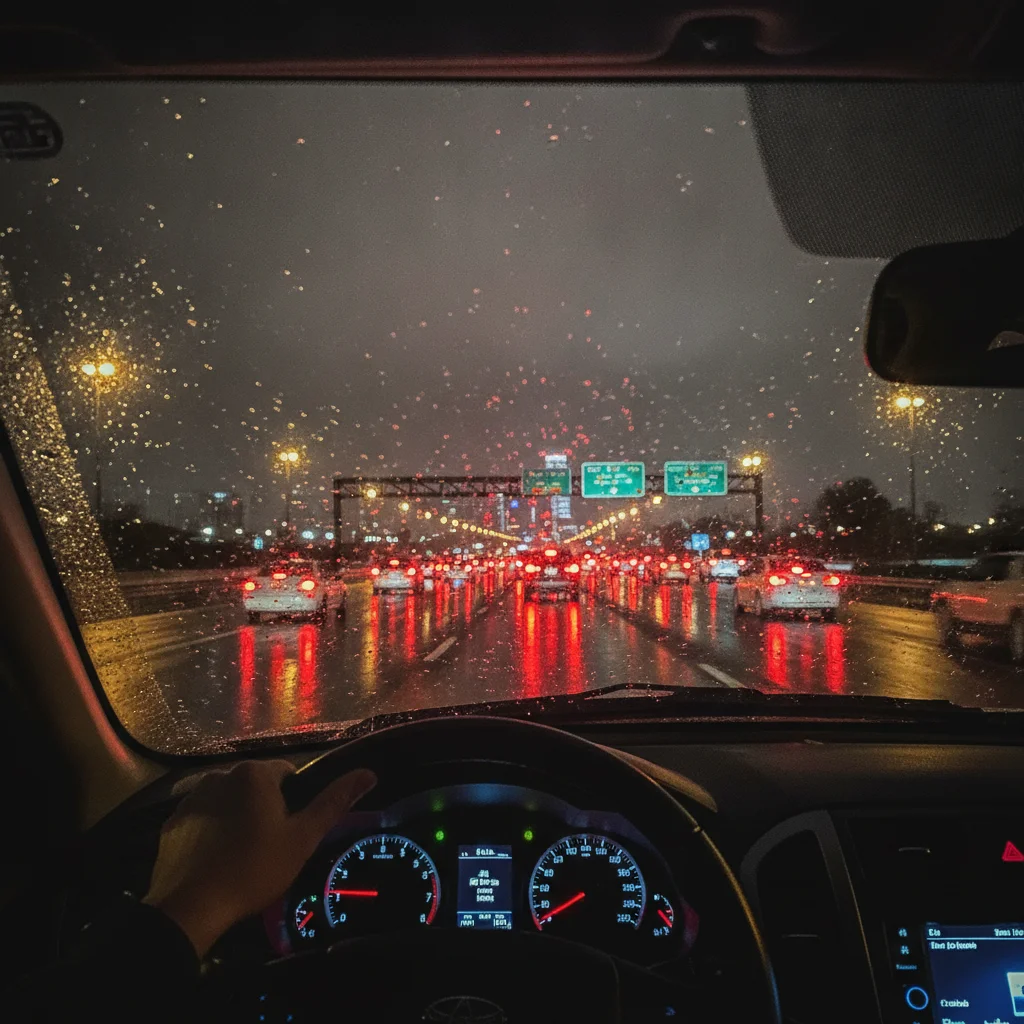
Practical Habits That Keep You on the Right Side of the Law
The 3-second rule — counting from when the car ahead passes a fixed point to when you do — is a reasonable baseline at moderate speeds on dry roads. But it's a starting point, not a legal shield. Here's how to adjust it for real conditions:
- Rain or wet roads: Double your gap to at least 6 seconds. Wet asphalt can more than double stopping distance.
- Highway speeds above 65 mph: 4–5 seconds is a more appropriate baseline. At 70 mph you're covering roughly 100 feet per second.
- Heavy vehicles or trailers: Your stopping distance increases substantially with added weight. Add at least 2 additional seconds.
- Night driving or low visibility: Your perception-reaction time is effectively longer when you can see less. Increase gap accordingly.
- Congested stop-and-go traffic: Use distance rather than time — maintain at least one to two car lengths regardless of speed.
The deeper habit to build is treating following distance as a variable you actively manage rather than a setting you establish and forget. Road conditions change. Traffic density changes. Your alertness changes. The "reasonable and prudent" legal standard accommodates all of that — which means your distance should too.
For a deeper look at the crash research behind these numbers, the science behind following distance recommendations is worth reading. And if you think some common assumptions about tailgating behavior are harmless, the research behind tailgating myths will challenge several of them.
The 3-Second Rule Has No Legal Safe Harbor Status
Many drivers assume that if they're following the 3-second rule, they're legally protected. That's not how the law works. The "reasonable and prudent" standard can require significantly more distance in adverse conditions, and no fixed-interval rule creates immunity from citation or fault assignment. Courts have upheld tailgating citations against drivers who claimed they were following standard guidelines.
State Laws Vary — Know Before You Cross Borders
Following-distance statutes use similar language across states but differ in how aggressively they're enforced, how points are assessed, and whether specific distances apply to certain vehicle classes. If you regularly drive across state lines, it's worth checking the specific statutes in states you frequent. What's treated as a minor infraction in one state may carry heavier penalties in another. See <a href="/maintenance-and-ownership/safety-legal/traffic-laws/traffic-law-differences-across-state-lines-drivers-should-know-before-a-road-trip">traffic law differences across state lines</a> for a practical breakdown.

All claims are backed by peer-reviewed research. Sources on request.