Key Takeaways
Before committing to a merge, pick a specific car in the traffic stream as your target gap — not just a general sense of 'there's space.' Targeting a concrete reference point prevents the hesitation that makes short-ramp merges dangerous.
Research on driver decision-making shows that vague gap assessment leads to last-second aborts or over-aggressive entries; a concrete visual target reduces that ambiguity.
On long highway trips, set a phone timer for 90-minute intervals as a fatigue check-in. If you feel even mildly drowsy at the alarm, commit to stopping — the urge to 'push through' is itself a symptom of impaired judgment.
The AAA Foundation found that the subjective feeling of alertness is a poor predictor of actual driving performance once fatigue sets in; externally imposed check-ins compensate for this blind spot.
When driving in rain, find a truck's wheel tracks and follow them — the tires have already displaced water from that line, reducing your hydroplaning risk compared to driving in the center of the lane.
Commercial truck tires displace significant standing water; following their path (at a safe following distance) reduces the water film depth your tires encounter.
Why Highway Driving Carries Unique Risks
American interstates move more than three trillion vehicle miles of traffic every year. They are, by most engineering measures, the safest road type per mile traveled—but that statistic comes with a significant asterisk. When highway crashes do occur, they are far more likely to be fatal than crashes on lower-speed urban streets. The physics are straightforward: kinetic energy scales with the square of velocity. A vehicle traveling at 70 mph carries nearly four times the crash energy of the same vehicle at 35 mph.
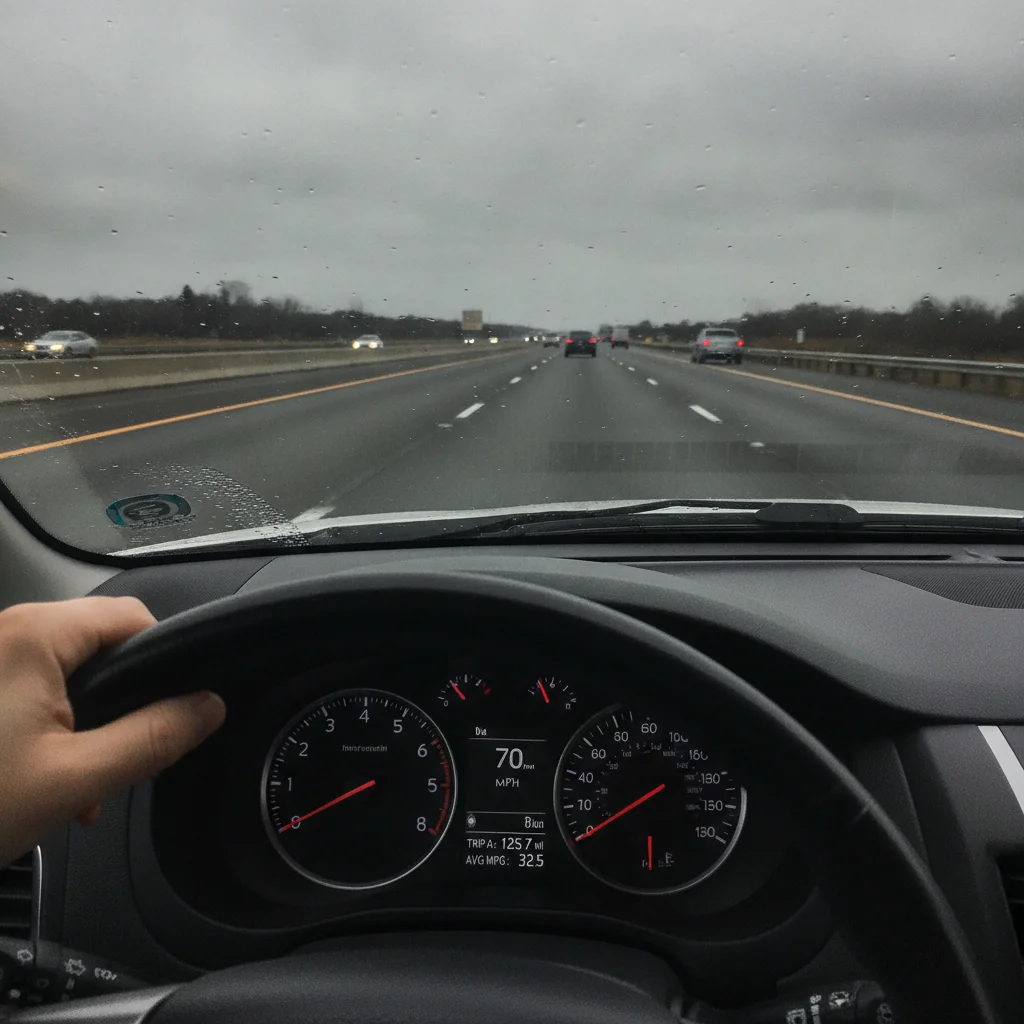
The National Highway Traffic Safety Administration (NHTSA) consistently finds that speeding—defined as driving above the posted limit or too fast for conditions—contributes to roughly one-third of all U.S. traffic fatalities annually, with rural interstates representing a disproportionate share. Wide lanes, long sight lines, and monotonous scenery create what researchers call velocity adaptation: drivers instinctively feel comfortable at speeds higher than they should, and their perception of risk drops.
Highway driving also introduces hazards that simply do not exist on local roads: large commercial trucks generating significant air turbulence and longer stopping distances, debris from cargo or blown tire treads, complex merging sequences at high speed, and the compounding effect of driver fatigue over long distances. Understanding these unique dynamics is the foundation of every safe-driving habit covered in this guide.
~36%
Highway fatalities linked to speeding
NHTSA data consistently attributes roughly one-third of all U.S. traffic deaths to speed-related factors, with rural interstates overrepresented.
800+
Annual work-zone crash deaths
The Federal Highway Administration reports over 800 fatalities in highway construction zones each year, affecting both workers and motorists.
2x
Crash risk increase with under-6-hour sleep
AAA Foundation for Traffic Safety research found drivers sleeping fewer than six hours face crash rates double those of well-rested drivers.
50%+
Wet-road stopping distance increase at 70 mph
Tire safety researchers estimate stopping distances extend by at least half on wet pavement compared to dry conditions at highway speeds.
30–50%
Premium increase after at-fault highway crash
Industry data from insurance rate analysts shows a single at-fault collision commonly raises full-coverage premiums by this range at renewal.
Before You Enter: Pre-Trip and Vehicle Readiness
The most consequential highway safety decisions happen before the ignition turns. A vehicle that is mechanically compromised on a local road is an inconvenience; the same vehicle on an interstate at highway speed is a life-threatening emergency. A brief pre-trip inspection takes under five minutes and addresses the leading causes of highway mechanical failures.
Tire Condition and Pressure
Under-inflated tires generate excess heat at sustained highway speeds, accelerating the risk of a blowout. Check tire pressure cold—before driving more than a mile—against the figure printed on the driver-side door jamb sticker, not the maximum pressure molded into the tire sidewall. Inspect tread depth with a quarter: if Washington's head is fully visible when the coin is inserted tread-down, the tire is below 4/32 of an inch and should be replaced before any long-distance highway driving. Also scan sidewalls for bulges or cracking, which signal structural weakness.
Fluid Levels
Coolant and oil are the two fluids most directly tied to highway breakdowns. Check the coolant reservoir and the oil dipstick. If either is low, address it before departure. A vehicle that overheats on an interstate requires a potentially dangerous emergency stop on the shoulder.
Brakes and Lights
Have a helper walk around the vehicle while you cycle through brake lights, turn signals, and headlights. A non-functioning brake light on a 70-mph highway substantially increases rear-end collision risk. If brakes feel spongy or require more pedal pressure than usual, have them inspected before a highway trip.
Check Tires Cold — Every Long Trip
Tire pressure rises as tires heat up during driving, so readings taken after even a short drive will read higher than the true cold pressure. Always check pressure before driving more than a mile for the most accurate reading. For highway trips, this check takes 90 seconds and eliminates one of the most common causes of interstate blowouts.
If you are considering a used vehicle for frequent highway commuting, the inspection process is a critical opportunity to catch brake, tire, and suspension issues that become safety liabilities at speed.
Mastering the Entry Ramp
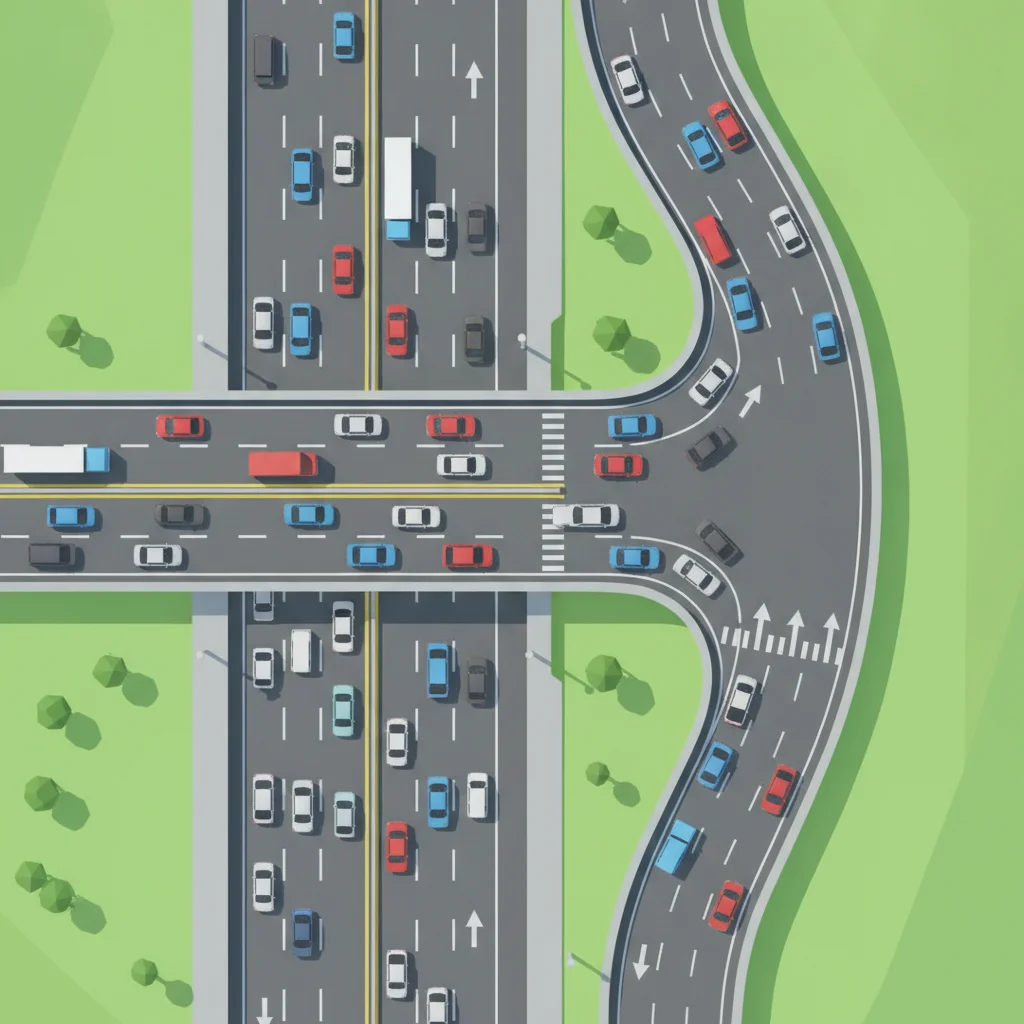
The acceleration lane is where a disproportionate number of highway crashes begin. The physics and psychology of merging are well-documented: improper merging technique is a leading cause of highway rear-end collisions, and the error almost always involves the same two failures — entering traffic too slowly, or failing to identify a gap before committing to the merge.
The Speed-Match Principle
The entry ramp's job is to give you space and time to reach highway speed before you enter the travel lanes. This is not optional courtesy — it is a physical necessity. A vehicle entering a 70-mph traffic stream at 45 mph creates a 25-mph speed differential that approaching drivers have fractions of a second to respond to. Use the full length of the acceleration lane. In most states, you are legally required to yield to traffic already on the highway, but traffic on the main lanes has a concurrent responsibility to move over when it is safe to facilitate your entry.
The Mirror-Signal-Scan Sequence
Begin your mirror check as soon as you enter the on-ramp, not at the last moment before the lane ends. Signal your intent early — three to four seconds of turn-signal use before moving. Identify a gap in traffic of at least four seconds before committing. Do not stop at the end of an acceleration lane unless traffic is completely gridlocked; a stopped vehicle on a highway shoulder or merge lane is extremely vulnerable.
Before committing to a merge, pick a specific car in the traffic stream as your target gap — not just a general sense of 'there's space.' Targeting a concrete reference point prevents the hesitation that makes short-ramp merges dangerous.
Research on driver decision-making shows that vague gap assessment leads to last-second aborts or over-aggressive entries; a concrete visual target reduces that ambiguity.
On long highway trips, set a phone timer for 90-minute intervals as a fatigue check-in. If you feel even mildly drowsy at the alarm, commit to stopping — the urge to 'push through' is itself a symptom of impaired judgment.
The AAA Foundation found that the subjective feeling of alertness is a poor predictor of actual driving performance once fatigue sets in; externally imposed check-ins compensate for this blind spot.
When driving in rain, find a truck's wheel tracks and follow them — the tires have already displaced water from that line, reducing your hydroplaning risk compared to driving in the center of the lane.
Commercial truck tires displace significant standing water; following their path (at a safe following distance) reduces the water film depth your tires encounter.
When the Ramp Is Short
Compressed ramps — common in older urban interchanges — require faster acceleration and earlier gap identification. If you drive a lower-powered vehicle, be particularly alert to this situation. On short ramps, a gap that looks adequate from the ramp entrance can disappear quickly. When in doubt, slow briefly and wait for a larger gap rather than forcing a marginal merge at insufficient speed.
Lane Selection and Positioning
Not all highway lanes carry equal risk. Research published by traffic safety organizations consistently shows that crash rates and crash severity differ by lane position. The data on lane safety points to the middle lanes as the lowest-risk position for most drivers on three-or-more-lane highways.
Understanding Lane Risk Profiles
- Right lane: Higher exposure to merging traffic from on-ramps and slowing vehicles exiting. Also where debris and blown tire pieces tend to accumulate.
- Middle lanes: Insulated from merging conflicts and exit maneuvers. Generally the steadiest traffic flow. Preferred for sustained highway cruising.
- Left lane (passing lane): Fastest speeds, highest energy collisions when they occur, and in most states, legally restricted to passing only. Driving indefinitely in the left lane — a widespread habit — increases risk and is a ticketable offense in states including Florida, Georgia, New Jersey, and others.
Left-Lane Laws Vary by State
More than 40 U.S. states have laws restricting the left lane to passing only, but enforcement intensity and specific wording vary significantly. Some states apply the restriction only above 65 mph; others require moving right whenever someone approaches from behind. Check the rules for any state you plan to drive through on a long trip. <a href="/maintenance-and-ownership/safety-legal/traffic-laws/traffic-law-differences-across-state-lines-drivers-should-know-before-a-road-trip">State traffic law differences</a> can catch unfamiliar drivers off guard.
Telematics Programs Are Opt-In
Usage-based insurance programs that monitor driving behavior are optional with every major carrier that offers them. Drivers who have high-mileage highway commutes with smooth, consistent habits typically see premium discounts of 10–25% through these programs. However, aggressive highway behavior — hard braking, rapid lane changes, late-night driving — can result in surcharges with some carriers. Read the program terms before enrolling.
Maintaining Your Lane Position
Within your chosen lane, keep your vehicle centered. Highway crashes caused by unintentional lane drift are more common than most drivers recognize — a phenomenon tied to distraction, fatigue, and the false sense of security that straight, wide lanes create. Many modern vehicles include lane-departure warning systems for this reason. Use them, but do not rely on them exclusively.
For a deeper understanding of how sustained highway driving affects fuel consumption differently than stop-and-go urban travel, see this comparison: city vs. highway fuel efficiency.
Managing Speed, Following Distance, and Blind Spots
Three behaviors account for a substantial majority of preventable highway crashes: excessive speed, insufficient following distance, and blind-spot failures during lane changes. Each is individually manageable with deliberate habit-building.
Speed Management
Posted speed limits on U.S. interstates range from 55 mph in some urban corridors to 85 mph on a single stretch of Texas highway. The appropriate speed is not always the posted maximum — it is the speed that gives you adequate reaction distance for the conditions. In rain, that might be 10–15 mph below the limit. In heavy traffic, matching the flow of vehicles around you (without exceeding the limit) is generally safer than rigidly holding a speed that makes you an outlier in the traffic stream.
The Three-Second Rule — and When to Extend It
The three-second following distance rule — choosing a fixed point ahead and ensuring at least three seconds pass between when the vehicle in front passes it and when you do — is the recognized minimum at highway speeds. But three seconds provides limited buffer for distracted reactions or wet braking distances. Safety researchers increasingly recommend four to five seconds as a practical target. Double that gap when following a large truck: trucks take significantly longer to stop, and their bulk blocks your forward sight line entirely.
“Drowsy driving is a serious issue that puts everyone on the road at risk. Unlike alcohol, there's no breathalyzer for fatigue, and drivers who are sleep-deprived often don't recognize just how impaired they are.”
— David Yang, Executive Director, AAA Foundation for Traffic Safety
Blind Spots and Lane Changes
Blind spots on modern passenger vehicles can conceal entire motorcycles and compact cars. Before any lane change: check your mirror, signal, then physically turn your head to scan the blind spot — in that order, every time. Relying on mirrors alone misses the roughly 15-degree arc beside and behind each rear pillar. If your vehicle has blind-spot monitoring, treat the warning indicator as a confirmation step, not a substitute for the head check.

When changing lanes, do it one lane at a time. Multi-lane jumps — crossing from the far right to the fast lane in a single move — are associated with a disproportionate number of highway sideswiping crashes.
Navigating Hazards: Weather, Construction, and Fatigue
Highway travel concentrates three categories of elevated hazard: adverse weather that becomes dramatically more dangerous at speed, construction zones with compressed lanes and abrupt speed transitions, and driver fatigue that degrades judgment invisibly over time.
Adverse Weather
Rain reduces tire traction and increases stopping distances. At 70 mph on wet pavement, stopping distances can extend by 50% or more compared to dry conditions. Hydroplaning — where a tire rides on a film of water rather than the road surface — becomes a risk above 35 mph on standing water and can cause sudden complete loss of steering. If you feel the steering go light on a wet highway, ease off the accelerator gradually — do not brake or steer sharply.
In winter conditions, bridges and overpasses freeze before road surfaces because cold air circulates beneath them. Treat every bridge deck as potentially icy even when the preceding pavement feels clear.
Black Ice Has No Visual Warning
Black ice — a thin, nearly transparent glaze of ice on pavement — is responsible for a disproportionate number of winter highway fatalities because it is effectively invisible at speed. Bridge decks, shaded highway segments, and areas near water are highest risk. If outdoor temperatures are below 40°F and the pavement appears wet, treat every surface as potentially icy and reduce speed accordingly.
Do Not Stop on a Highway Shoulder Unnecessarily
The highway shoulder is statistically one of the most dangerous places to be on foot. If you experience a mechanical issue, activate your hazard lights immediately and coast to the nearest exit ramp if at all possible. If you must stop on the shoulder, stay in your vehicle with the seatbelt fastened and call for help — exiting the car on a live highway shoulder dramatically increases your injury risk.
Construction Zones
Work zone crashes kill more than 800 people annually in the United States, including both workers and drivers. Construction zone risk is elevated by compressed lanes, sudden speed reductions, uneven pavement transitions, and workers operating in close proximity to live traffic. Slow down earlier than feels necessary when approaching a work zone — the speed differential as you enter is the most dangerous moment. Fines for speeding in work zones are doubled in most states.
Driver Fatigue
Studies from the AAA Foundation for Traffic Safety have found that a driver who has slept fewer than six hours in the past 24 hours faces crash rates comparable to a driver at the legal alcohol impairment threshold. Unlike alcohol, fatigue has no external indicators — drivers reliably underestimate their own impairment. On long highway drives, plan a 15-minute break every two hours, regardless of how alert you feel. Caffeine helps delay the onset of impairment but does not reverse it once fatigue is advanced. If you find yourself unable to recall the last several miles driven, pull over.
Drowsy Driving Is Impaired Driving
Federal safety research treats drowsy driving as a form of impairment equivalent in crash risk to drunk driving at the legal threshold. If you are experiencing microsleeps — brief, involuntary moments where your eyes close for one to four seconds — you are in immediate danger. Pull off at the next available exit or rest area. Continuing to drive in this state is not a matter of willpower; it is physiologically unsafe.
Exiting Safely: The Last Half-Mile
The exit sequence begins well before the exit ramp — ideally at the one-mile marker sign. The critical errors drivers make when exiting are symmetrical to the errors they make entering: either braking too early (on the highway, before reaching the ramp) or too late (on the ramp, carrying highway speed toward a reduced-speed surface).
Positioning Before the Exit
If you are not already in the right lane, begin moving right at least a mile before your exit when traffic allows. Sudden last-second lane changes to reach an exit — cutting across multiple lanes — are a significant cause of sideswipe and rear-end crashes. Signal early and move smoothly, one lane at a time.
Where to Decelerate
Decelerate after you have moved onto the exit ramp, not before. Braking on the highway to slow for an exit creates a speed differential with traffic behind you. The ramp's purpose is to provide space to decelerate from highway speed to the ramp's posted advisory speed — use it. Advisory speed signs on ramps (typically posted on yellow signs) reflect the maximum safe speed for the curve geometry, not a suggestion.
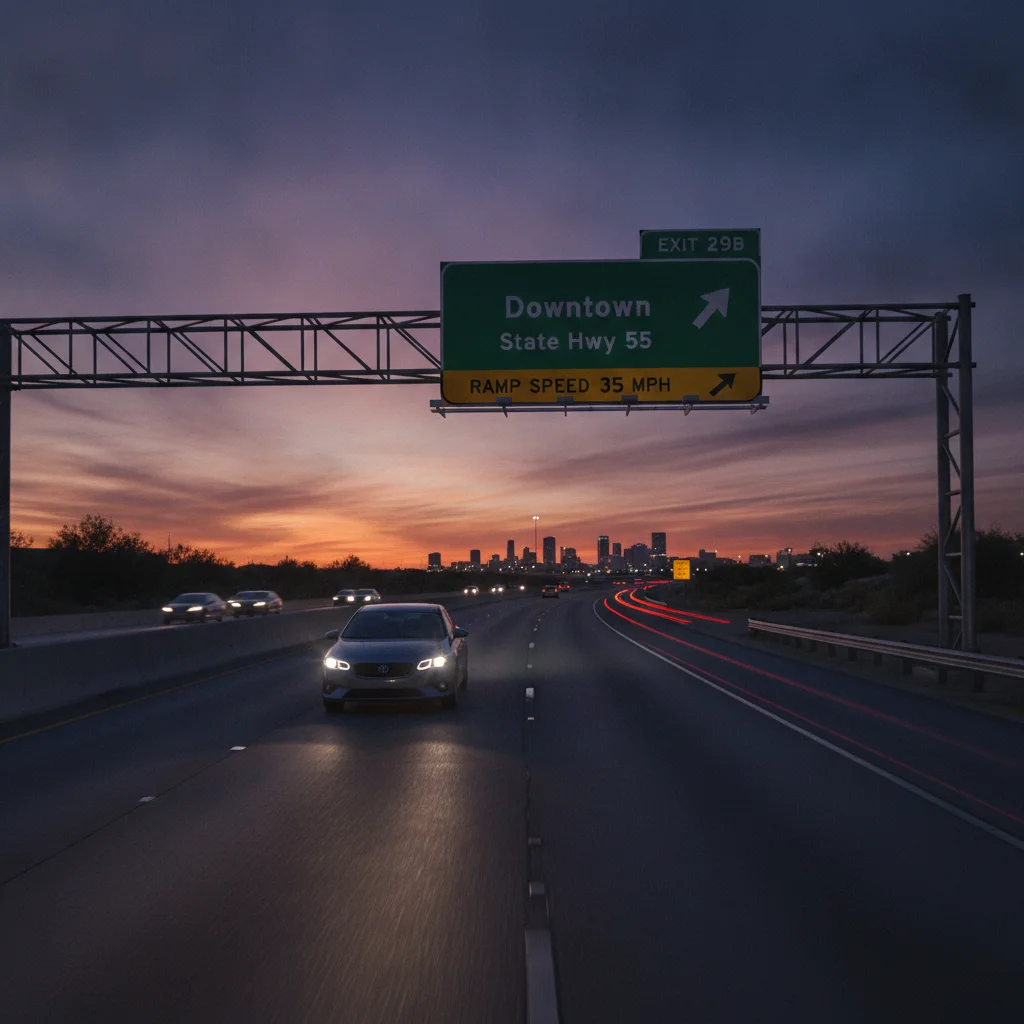
Re-Adaptation to Surface Streets
After sustained highway driving, drivers frequently underestimate their speed on surface streets — a well-documented effect of velocity adaptation. What feels like 35 mph after an hour at 70 mph is often closer to 50 mph. Check your speedometer consciously for the first minute or two after exiting. This is particularly important when the exit leads directly to a traffic signal, roundabout, or school zone.
For context on how intersection types at highway exits compare in safety profile, the data on roundabouts versus four-way stops is worth understanding before you encounter one at speed.
How Highway Habits Affect Your Insurance and Costs
Highway driving behavior has measurable downstream effects on your auto insurance premiums, not just your physical safety. Insurers increasingly use telematics programs — optional plug-in devices or smartphone apps — to track behaviors including hard braking, rapid acceleration, and late-night high-speed driving. Drivers who demonstrate smooth, consistent highway habits often qualify for meaningful discounts.
Beyond telematics, the connection between safe driving and insurance costs runs through your claims history. A single at-fault highway collision — even a minor one — can increase full-coverage premiums by 30–50% at renewal, and that surcharge typically persists for three to five years. The financial incentive for defensive highway driving is substantial.
NHTSA Drowsy Driving Resources
The National Highway Traffic Safety Administration offers research-backed guidance on recognizing and preventing fatigue behind the wheel — directly applicable to long highway trips.
AAA Foundation Tire Safety Guide
Covers proper inflation, tread inspection, load ratings, and blowout response — critical knowledge for any driver making regular interstate trips.
FHWA Work Zone Safety Program
The Federal Highway Administration's work zone safety resources include state-by-state fine schedules and driver behavior research for navigating construction zones on highways.
Insurance Institute for Highway Safety (IIHS) Crash Stats
IIHS maintains publicly searchable crash data by road type, speed, and contributing factor — useful for understanding the real statistical landscape of highway risk.
GasBuddy Trip Cost Calculator
Estimate highway fuel costs by route before you depart. Pairs well with understanding how sustained highway speeds affect fuel economy versus city driving.
Speed violations captured by highway patrol have a parallel effect. A single speeding ticket for exceeding the limit by 15 mph or more can trigger a premium increase at renewal, and repeat violations can make some coverage categories difficult to obtain. For a state-by-state breakdown of how traffic law differences affect both your legal obligations and your insurance exposure, see: traffic law differences across state lines.
The broader takeaway is that highway safety and financial responsibility are deeply linked. The habits described throughout this guide — controlled entry, appropriate following distance, fatigue management, smooth exits — reduce crash probability, but they also build the kind of driving record that keeps your insurance costs manageable over time. Safe driving on the highway is not just a risk-management strategy. It is an economic one.

All claims are backed by peer-reviewed research. Sources on request.