Key Takeaways
Safest Highway Lane
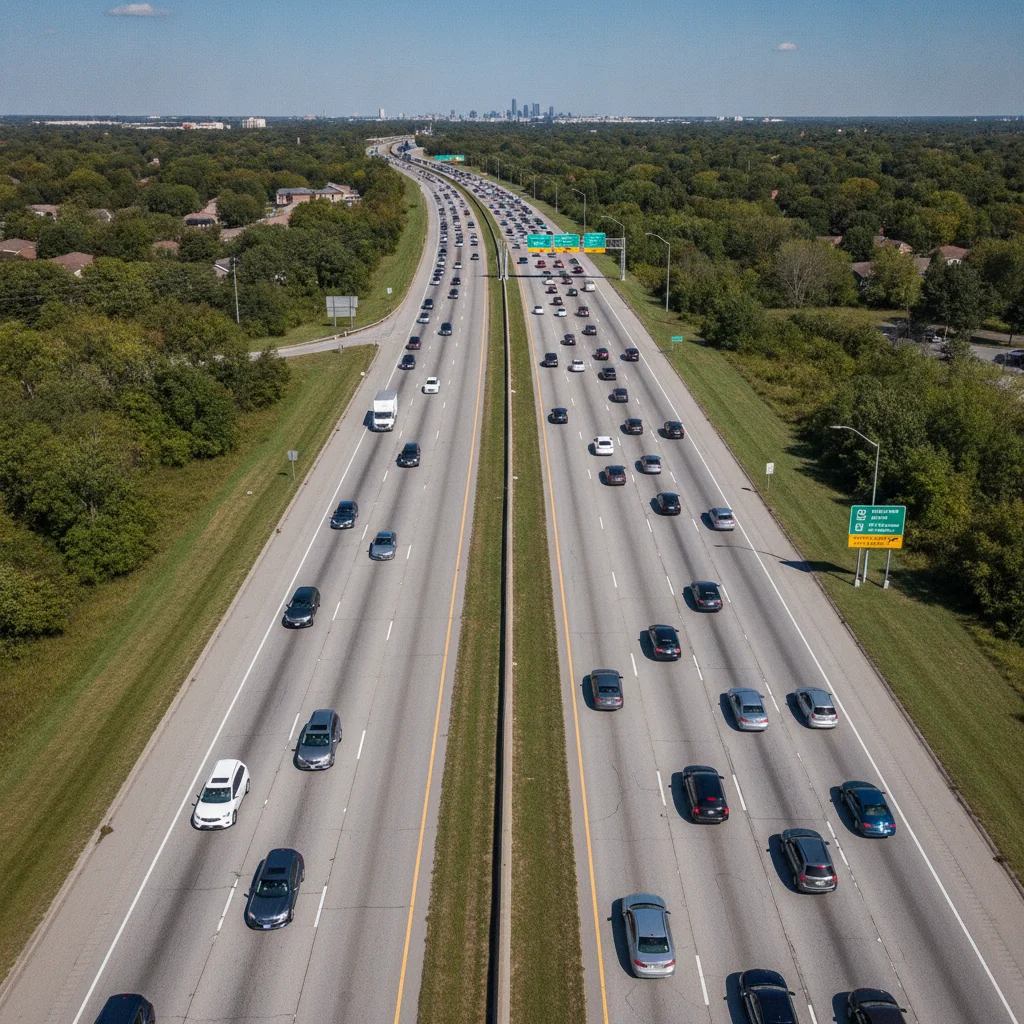
On a multi-lane highway, the "safest lane" refers to the lane position that statistically exposes a driver to the lowest likelihood of being involved in a crash. Research consistently points to the center lane on three-lane highways as offering the best balance of conflict-point reduction and maneuverability. Lane safety is not fixed — it shifts based on traffic conditions, road design, speed, and what a driver is about to do next.
Crash exposure studies use metrics like conflict points per lane-mile, crash frequency ratios, and lane-departure crash rates to compare lane-specific risk. The FHWA and NHTSA maintain lane-coded crash databases that inform these analyses.
Why Lane Position Is a Safety Variable, Not Just a Preference
Most drivers pick a lane out of habit — they settle into the middle, hug the right out of caution, or drift left to avoid trucks. What very few realize is that this choice carries measurable consequences. Lane position on a multi-lane highway is one of the more quietly significant safety variables in everyday driving, and crash data shows consistent patterns across it.
The Federal Highway Administration (FHWA) and the Insurance Institute for Highway Safety (IIHS) have both examined lane-coded crash data, and the results challenge some intuitive assumptions. The right lane doesn't feel as exposed as the left, but it sees more conflict events. The left lane feels fast and efficient, but crashes there are disproportionately severe. The middle lane, often dismissed as indecisive, turns out to have the most favorable risk profile for typical travel speeds.
This doesn't mean driving is a matter of finding the one safe lane and staying in it forever. Road design, speed, traffic density, weather, and your own route all complicate the picture. But understanding the baseline risk profile of each lane gives you a framework for making smarter, more deliberate decisions — especially on the long stretches of interstate most American drivers cover regularly.
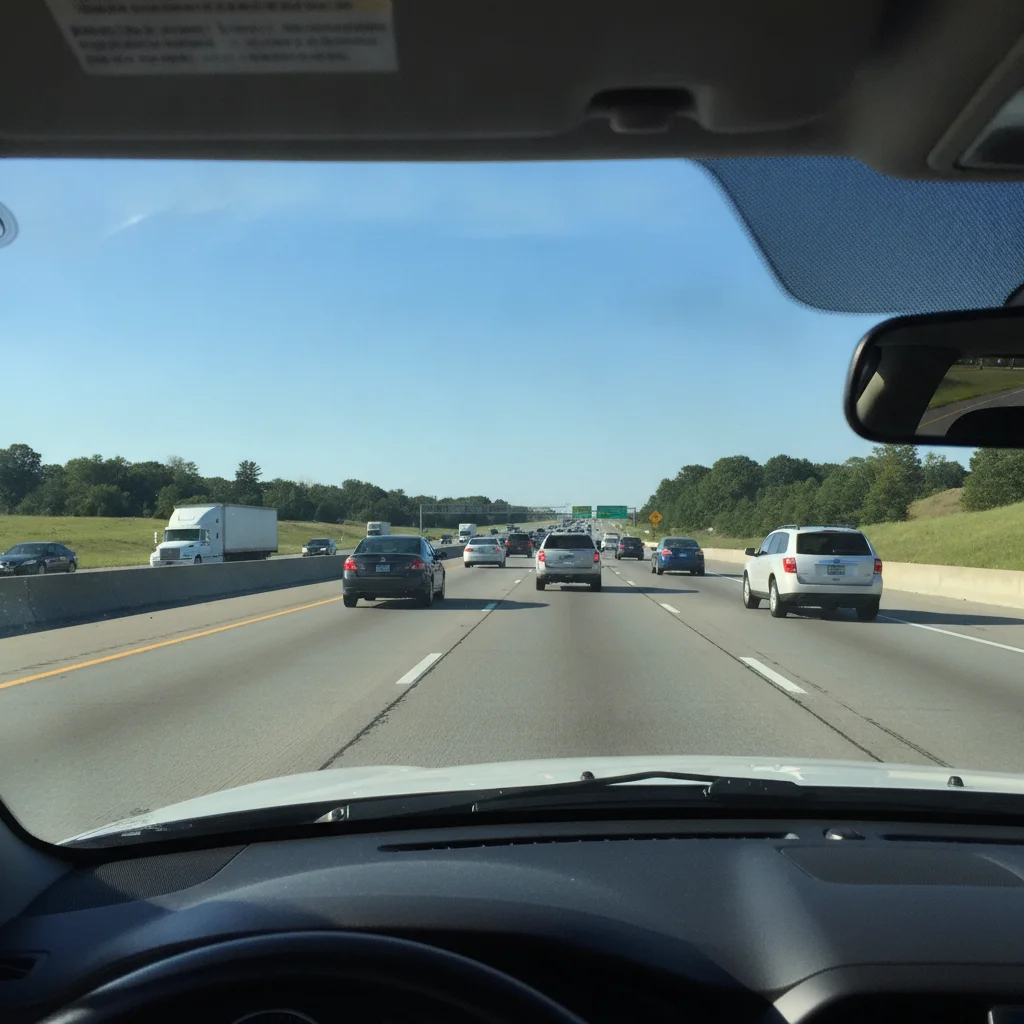
For a broader look at how road environment shapes overall risk, see our comparison of urban vs. rural driving danger. Highway lane risk sits within that larger picture.
Breaking Down the Risk Profile of Each Lane
The Right Lane: High Conflict, Lower Speed
The right lane is where most highway entry and exit activity happens. On-ramp vehicles accelerate to merge right, off-ramp vehicles decelerate as they approach exits, and trucks — legally required in some states to occupy right lanes — create speed disparities. Each of these events is a conflict point: a moment when two vehicles' paths interact with the potential for a crash.
FHWA data on freeway incidents consistently shows elevated crash rates in the right lane near interchange zones. A 2019 analysis of crash patterns on urban interstates found that right-lane crashes clustered within roughly a quarter-mile of on-ramps and off-ramps. Away from interchanges, right-lane crash rates drop considerably — making lane selection a dynamic decision rather than a fixed one.
Two-Lane Interstates Change the Math
Not all American interstates are three lanes wide. On two-lane highways — common in rural states — the center-lane framework doesn't apply because there's no center lane. On these roads, following distance, speed selection, and pass timing become the dominant safety variables. The lane-choice research discussed here applies specifically to standard multi-lane divided highway configurations with three or more lanes in each direction.
Lane Risk Varies by State Road Design
Highway design standards vary meaningfully across states — lane width, shoulder width, median barrier type, and interchange spacing all influence which lane carries the most risk on a given road. The center-lane advantage described here is a general finding across aggregated crash datasets. On a specific stretch of road with unusual geometry, the picture may differ. Local DOT crash maps, increasingly available to the public online, can show where crashes cluster on familiar routes.
Attention Outweighs Lane Position
Research consistently finds that distraction is a more powerful crash predictor than lane position. A driver who is attentive in the right lane is safer than a distracted driver in the center lane. The lane-choice framework in this article is most useful as a tiebreaker when other factors are held equal — which in practice means: get your attention right first, then optimize your lane position.
For drivers who are approaching their exit within the next few miles, shifting right early and with deliberation is still the right move. The elevated risk of the right lane near exits is lower than the risk of a panicked last-second lane change across traffic.
The Left Lane: Lower Frequency, Higher Severity
The left lane — the passing or fast lane — sees fewer total crashes in most datasets, but the crashes it does see are more severe on average. Speed is the primary reason. The left lane typically operates at the highest sustained speeds on a given road, and crash energy scales with the square of velocity. A collision at 80 mph releases roughly 78 percent more kinetic energy than one at 60 mph.
Left-lane crashes are also more likely to be rear-end collisions caused by speed differential — a faster driver closing on a slower one with insufficient reaction time. "Left-lane camping" (driving slowly in the passing lane) is a major contributor to this pattern. More than 40 U.S. states now have statutory "keep right" laws specifically because of this dynamic, and traffic engineers classify it as a significant contributor to highway fatalities.
Additionally, the left lane has less margin for error. A lane departure to the left often means contact with a median barrier rather than a paved shoulder, and median barrier impacts — especially with concrete jersey barriers — tend to involve multiple vehicle interactions and are frequently fatal.
The Center Lane: The Balanced Option
On a three-lane highway, the center lane avoids both primary hazards: it's insulated from merge conflicts by the right lane, and it's buffered from the speed differential and median proximity issues of the left lane. It also offers the most options for responsive maneuvering — a driver in the center can move either direction to avoid a sudden hazard.
Traffic engineering research on lane distribution and crash exposure consistently identifies the center lane as having the lowest crash rate per vehicle-mile traveled on standard urban and suburban interstates. That advantage narrows on roads with heavy lane-switching traffic, but as a baseline, it holds up across multiple datasets.
9%
Highway crashes involving lane-change or merge
NHTSA data estimates lane-change and merge maneuvers contribute to approximately 9% of all highway crashes in the U.S.
800+
Annual U.S. work zone fatalities
According to FHWA statistics, more than 800 people are killed in highway construction zone crashes each year in the United States.
78%
More kinetic energy at 80 mph vs. 60 mph
Because crash energy scales with the square of velocity, a collision at 80 mph releases approximately 78% more energy than one at 60 mph.
40+
U.S. states with keep-right laws
More than 40 states have enacted statutes requiring slower drivers to keep right, directly targeting left-lane camping as a crash risk.
0.25 mi
Right-lane crash cluster radius near on-ramps
A 2019 FHWA-informed analysis of urban interstate crashes found right-lane incidents clustered within roughly a quarter-mile of interchange ramps.
The Role of Lane Changes in Overall Highway Risk
Whatever lane you're in, the act of changing lanes is itself a risk event. Studies from the NHTSA estimate that lane-change and merge maneuvers are involved in approximately 9 percent of all crashes and 4 percent of fatal crashes on highways — a non-trivial share given how routine the maneuver seems.
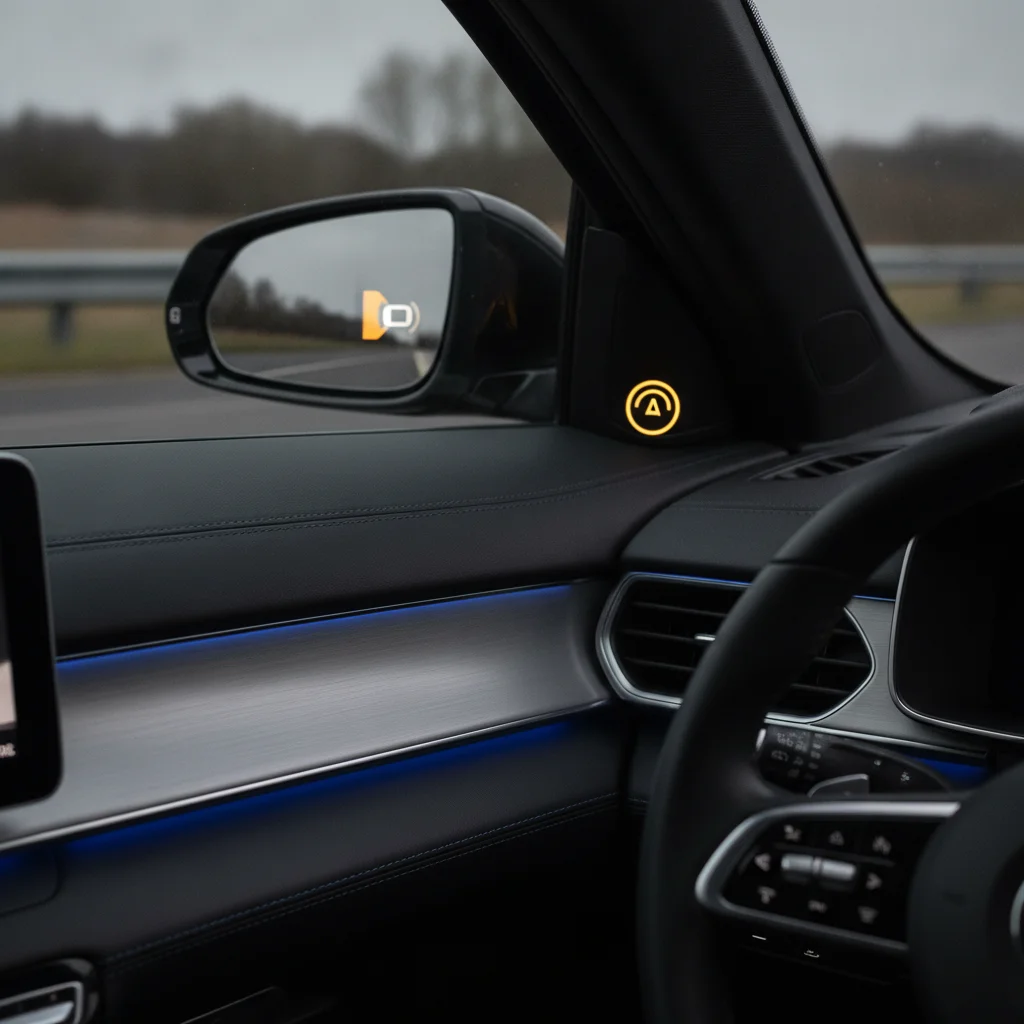
The risk comes from multiple sources: blind spots that mirrors don't fully cover, the need to judge closing speeds in adjacent lanes, and the brief moment of divided attention as a driver scans, signals, and steers simultaneously. Fatigue, distraction, and poor mirror adjustment compound each of these factors.
Minimize Unnecessary Lane Changes
Each lane change is a distinct crash-risk event involving blind spots, speed judgment, and divided attention. Before switching lanes, ask whether you're doing it for a clear reason — clearing a merge zone, approaching an exit, passing a slow vehicle — or simply out of habit. Deliberate, infrequent lane changes are consistently associated with lower highway crash involvement.
Adjust Your Mirrors Before You Drive
Most blind-spot crashes occur because mirrors are set too narrow — showing the driver the side of their own vehicle rather than adjacent lane traffic. Adjust side mirrors so that your car is just barely out of frame. This dramatically expands your lateral field of view and reduces the size of the true blind spot. Do this adjustment every time before a highway trip, not just when you notice a problem.
Plan Your Exit Lane Move Early
Moving from the center to the right lane in the final quarter-mile before an exit is one of the higher-risk maneuvers commuters make regularly. Instead, begin your transition at least a mile out from your exit in moderate traffic, more in heavy traffic. Early, unhurried lane moves eliminate the panicked diagonal cuts that contribute to right-lane merge crashes near interchanges.
This is part of why settling into the center lane and staying there — rather than repeatedly weaving to shave seconds — is the behavior most consistent with the crash data. Each unnecessary lane change is a small gamble. Over a long trip, the cumulative exposure adds up.
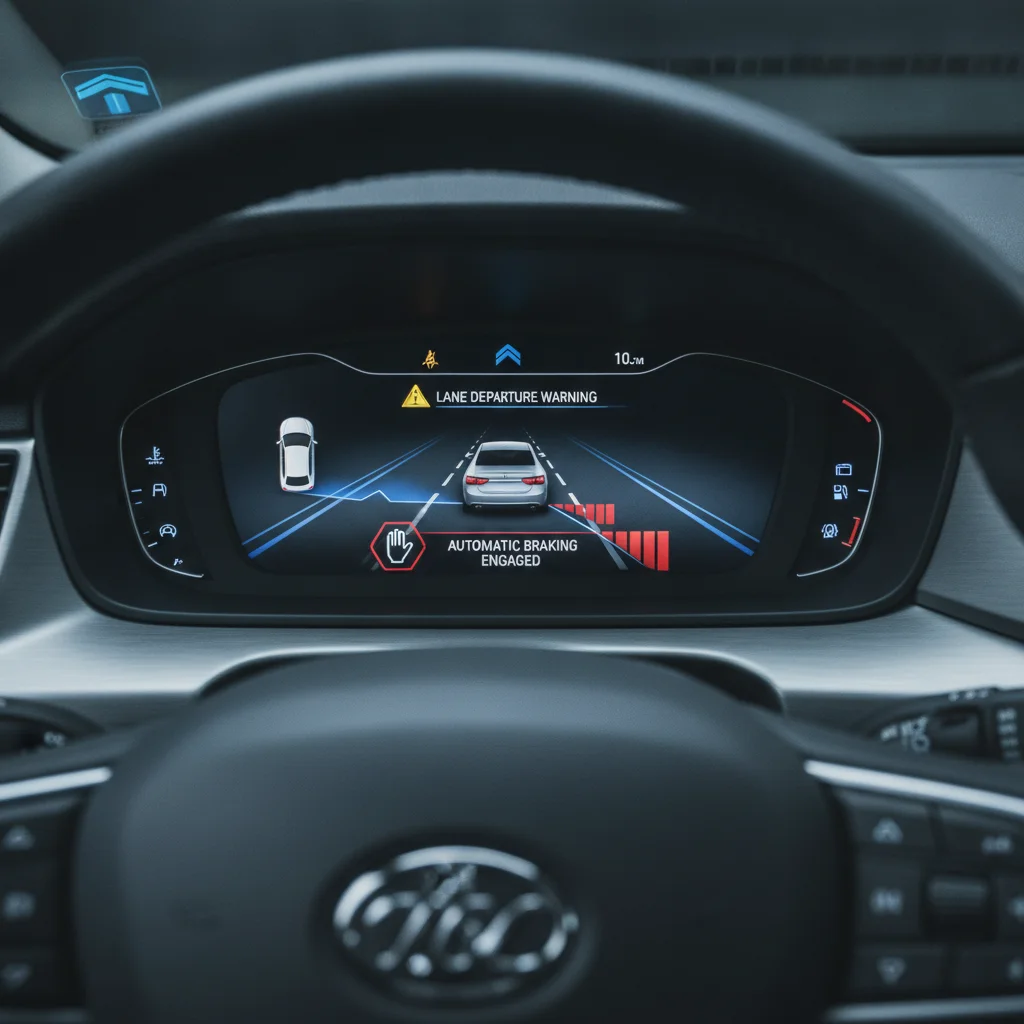
Modern vehicles equipped with blind-spot monitoring and lane-change assist systems measurably reduce lane-change crash risk. Our overview of road safety tech that actually works covers what the IIHS testing shows about these systems in practice.
When the Rules Shift: Conditions That Override the Default
The center-lane baseline breaks down in specific conditions that drivers need to recognize. Understanding when to override the default lane choice is just as important as knowing what the default is.
Construction Zones
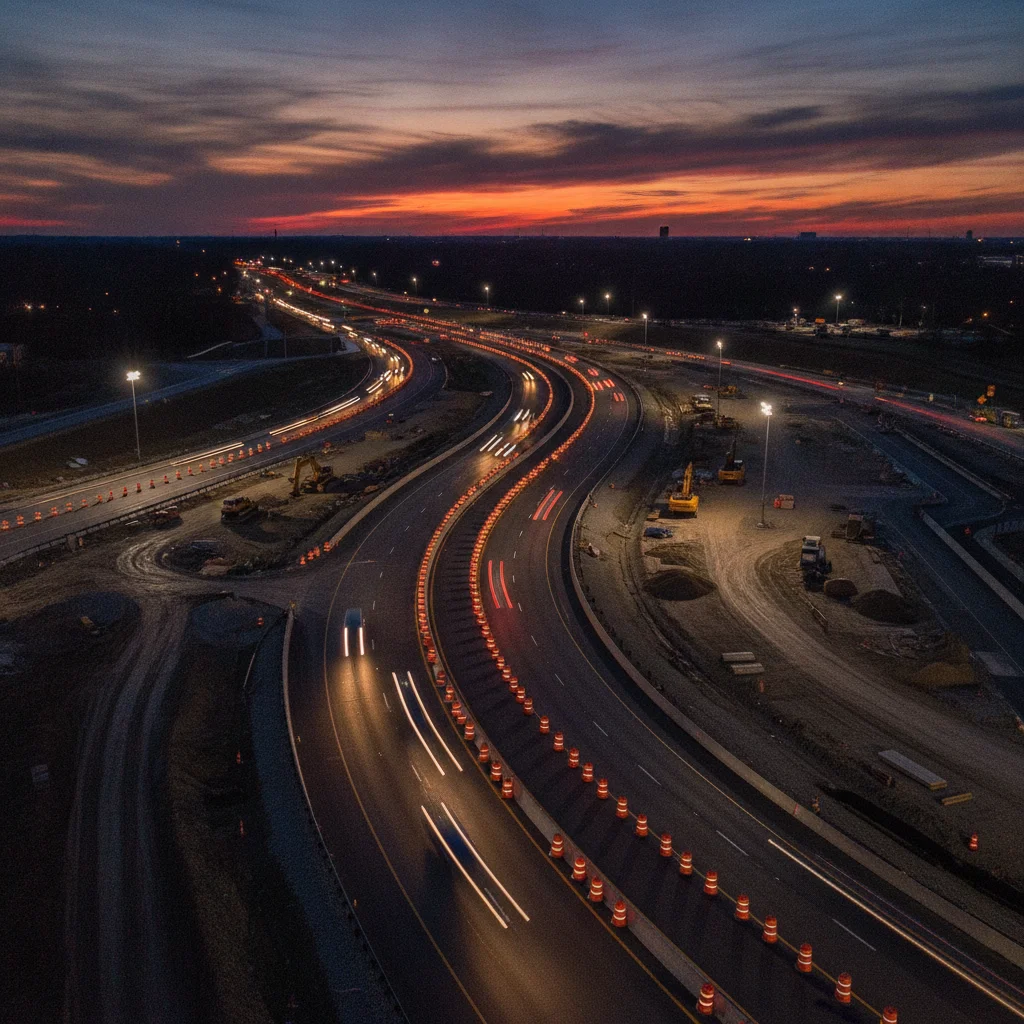
Work zones often compress three lanes into two, eliminate shoulders, and place workers feet from live traffic. In these environments, the left lane can become the de facto shoulder, and right-lane positioning near cone lines introduces new hazards. Traffic engineers recommend the far lane from active construction activity, which varies by zone layout. Speed reduction is more important than lane choice in active work zones. Our dedicated piece on construction zone driving risks covers the specifics in detail.
Heavy Truck Traffic
Large commercial vehicles create turbulence, have extended stopping distances, and generate significant blind spots on all four sides. When truck density is high — particularly on freight corridors — staying out of positions directly beside or just behind a truck is more important than lane designation. If the center lane puts you in sustained proximity to a truck convoy, briefly occupying the left lane with clear sight lines forward may be lower-risk in that moment.
Night and Adverse Weather
At night and in rain, fog, or snow, the crash risk associated with all lanes increases, but the penalties for errors in the left lane — less shoulder margin, no recovery room — become steeper. Reducing speed and increasing following distance matters more than lane position in these conditions, but moving right during severe weather is generally prudent if traffic allows.
HOV and Carpool Lanes
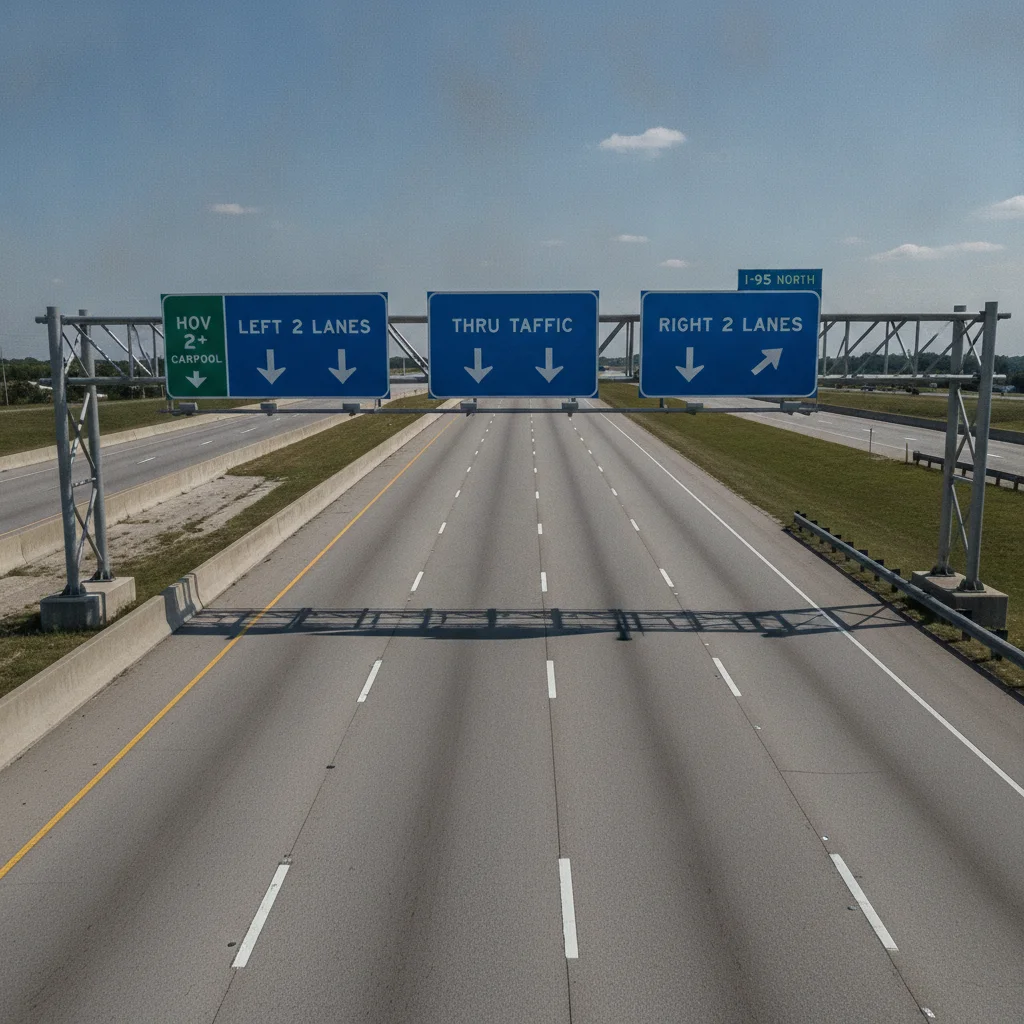
HOV lanes introduce their own risk considerations. They're separated from regular traffic by solid white lines that legally cannot be crossed except at designated points, which means a driver who needs to exit can't simply change lanes at will. If you're using an HOV lane, plan your exit timing early. For the rules governing HOV eligibility, see our explainer on carpool lane rules and qualifications.
Two-Lane Interstates Change the Math
Not all American interstates are three lanes wide. On two-lane highways — common in rural states — the center-lane framework doesn't apply because there's no center lane. On these roads, following distance, speed selection, and pass timing become the dominant safety variables. The lane-choice research discussed here applies specifically to standard multi-lane divided highway configurations with three or more lanes in each direction.
Lane Risk Varies by State Road Design
Highway design standards vary meaningfully across states — lane width, shoulder width, median barrier type, and interchange spacing all influence which lane carries the most risk on a given road. The center-lane advantage described here is a general finding across aggregated crash datasets. On a specific stretch of road with unusual geometry, the picture may differ. Local DOT crash maps, increasingly available to the public online, can show where crashes cluster on familiar routes.
Attention Outweighs Lane Position
Research consistently finds that distraction is a more powerful crash predictor than lane position. A driver who is attentive in the right lane is safer than a distracted driver in the center lane. The lane-choice framework in this article is most useful as a tiebreaker when other factors are held equal — which in practice means: get your attention right first, then optimize your lane position.
Translating Research Into Everyday Habits
Road safety research is useful only if it changes behavior. Here's how the lane-risk data translates into concrete driving habits for typical American highway commuters and long-distance drivers:
- Default to the center lane on three-lane highways during normal conditions. It provides the best balance of merge-conflict avoidance and speed-differential buffering.
- Use the right lane proactively when approaching your exit, but move there gradually and early — not in the final quarter-mile when panic decisions get made.
- Treat the left lane as a passing lane, not a travel lane. Use it to pass, then return center. This is both legally sound in most states and consistent with the crash data on speed-differential collisions.
- Count your lane changes. Each one is a risk event. If you find yourself weaving repeatedly, ask whether the time gained justifies the exposure.
- Adjust your position before hazards, not during them. Seeing an on-ramp cluster approaching? Move left a lane before you reach it. Seeing a slowdown ahead? Increase following distance before you're in it.
“The safest lane is ultimately the one you're in when you're paying full attention. But if you're going to park yourself somewhere for a long stretch of interstate, the data consistently points to the center lane as the lowest-conflict position for average conditions.”
— David Harkey, President, Insurance Institute for Highway Safety (IIHS)
For a comprehensive framework covering the full arc of a highway trip — from entry ramp to exit — see highway driving safety from entry ramp to exit. And if merging specifically is an area you want to sharpen, our piece on where most drivers go wrong when merging addresses the physics and psychology behind that maneuver.
Minimize Unnecessary Lane Changes
Each lane change is a distinct crash-risk event involving blind spots, speed judgment, and divided attention. Before switching lanes, ask whether you're doing it for a clear reason — clearing a merge zone, approaching an exit, passing a slow vehicle — or simply out of habit. Deliberate, infrequent lane changes are consistently associated with lower highway crash involvement.
Adjust Your Mirrors Before You Drive
Most blind-spot crashes occur because mirrors are set too narrow — showing the driver the side of their own vehicle rather than adjacent lane traffic. Adjust side mirrors so that your car is just barely out of frame. This dramatically expands your lateral field of view and reduces the size of the true blind spot. Do this adjustment every time before a highway trip, not just when you notice a problem.
Plan Your Exit Lane Move Early
Moving from the center to the right lane in the final quarter-mile before an exit is one of the higher-risk maneuvers commuters make regularly. Instead, begin your transition at least a mile out from your exit in moderate traffic, more in heavy traffic. Early, unhurried lane moves eliminate the panicked diagonal cuts that contribute to right-lane merge crashes near interchanges.
What the Data Can't Tell You — And Why Attention Still Wins
Crash statistics describe populations, not individual trips. The center lane has a better average risk profile, but no lane protects a distracted driver. Research on attention and driving consistently finds that cognitive distraction — the kind produced by a phone conversation, even hands-free — degrades hazard detection and reaction time regardless of which lane a driver occupies.
A 2021 study published in Accident Analysis and Prevention found that attentive drivers in "higher-risk" lanes outperformed distracted drivers in ostensibly safer positions across simulated hazard scenarios. Lane choice is a structural factor; attention is a behavioral one. Both matter, but attention operates on every second of every mile, while lane choice is a discrete decision made occasionally.
The practical takeaway: use the research to make better default choices, but don't treat lane selection as a substitute for the fundamentals — appropriate speed, maintained following distance, active scanning, and undivided attention. Those variables dwarf lane position in their overall influence on crash outcomes.
Two-Lane Interstates Change the Math
Not all American interstates are three lanes wide. On two-lane highways — common in rural states — the center-lane framework doesn't apply because there's no center lane. On these roads, following distance, speed selection, and pass timing become the dominant safety variables. The lane-choice research discussed here applies specifically to standard multi-lane divided highway configurations with three or more lanes in each direction.
Lane Risk Varies by State Road Design
Highway design standards vary meaningfully across states — lane width, shoulder width, median barrier type, and interchange spacing all influence which lane carries the most risk on a given road. The center-lane advantage described here is a general finding across aggregated crash datasets. On a specific stretch of road with unusual geometry, the picture may differ. Local DOT crash maps, increasingly available to the public online, can show where crashes cluster on familiar routes.
Attention Outweighs Lane Position
Research consistently finds that distraction is a more powerful crash predictor than lane position. A driver who is attentive in the right lane is safer than a distracted driver in the center lane. The lane-choice framework in this article is most useful as a tiebreaker when other factors are held equal — which in practice means: get your attention right first, then optimize your lane position.

All claims are backed by peer-reviewed research. Sources on request.