Key Takeaways
Vehicle Registration Fee
A vehicle registration fee is the annual charge a state or local government collects to legally permit your car to be driven on public roads. It covers the administrative cost of maintaining vehicle records and funds transportation infrastructure, safety programs, and sometimes emissions oversight. The fee appears on your renewal notice each year and must be paid to keep your plates valid.
Registration fees are distinct from title fees (a one-time transfer charge) and vehicle property taxes (assessed in roughly 27 states based on the car's value). All three may appear on the same DMV bill, which is why the total can be surprisingly high.
The Bill That Confuses Everyone
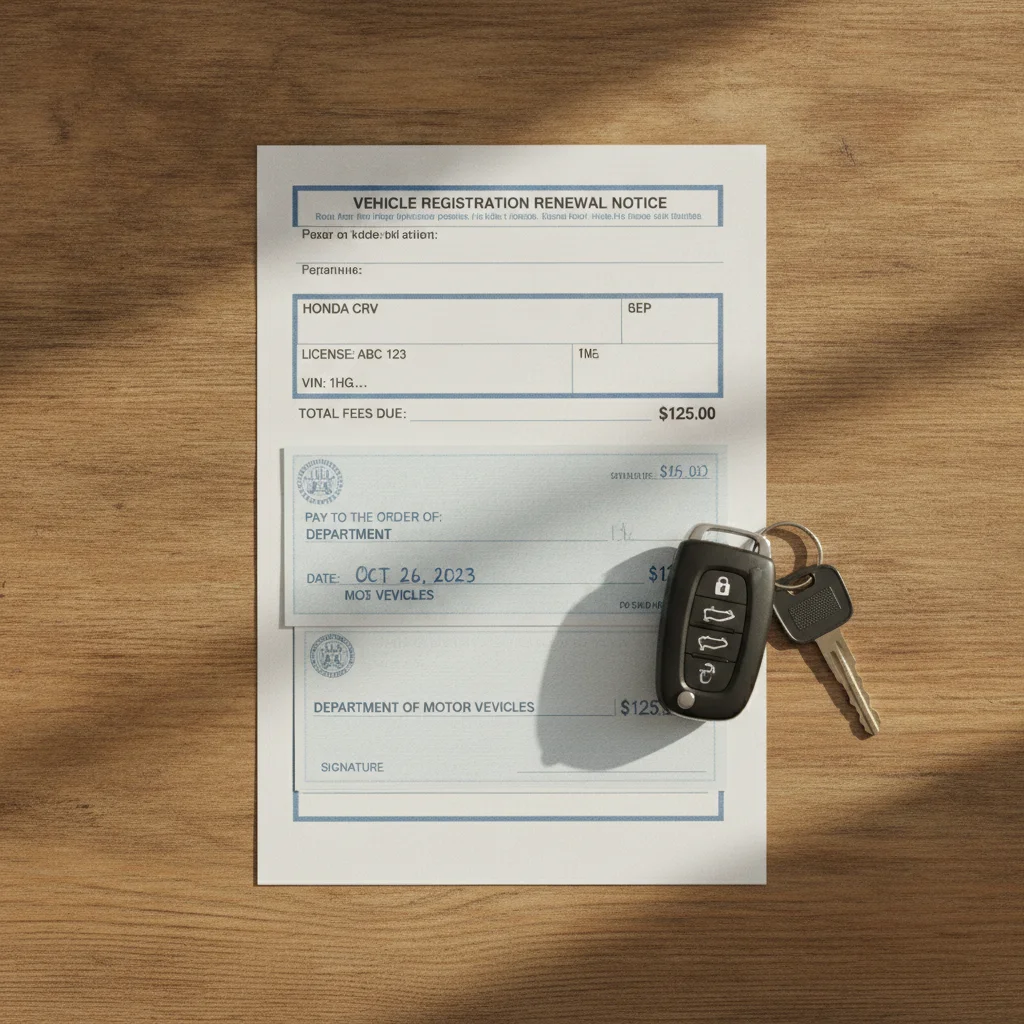
Every year, the registration renewal notice arrives — and every year, a surprising number of drivers just pay it without reading the line items. That's understandable. The notice is dense, the labels are bureaucratic, and the total feels like a black box. But what you're actually looking at is a stack of separate charges, each with its own legislative origin and its own spending destination.
Think of it like a utility bill. When you pay your electric bill, you're not just paying for kilowatt-hours. You're paying a base charge, a fuel adjustment surcharge, a distribution fee, maybe a renewable energy rider. Vehicle registration works the same way. The number at the bottom combines a base registration fee, possibly a value-based excise tax, a local add-on, a fee for your specific plate type, and sometimes an emissions program surcharge — all rolled into one payment.
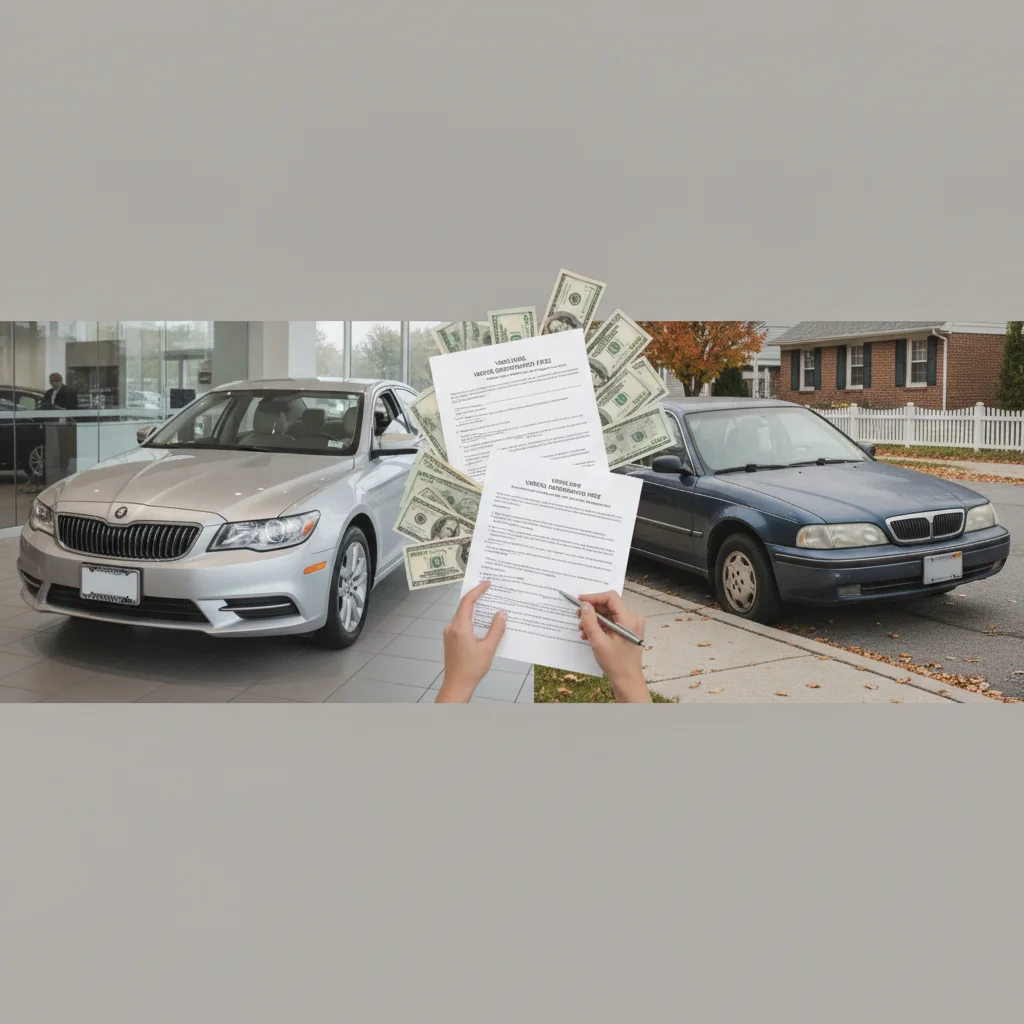
Knowing what each piece funds changes how you think about the cost. It also helps you anticipate how the total will shift year to year, why moving to a different state can dramatically change what you owe, and why a brand-new $55,000 SUV costs so much more to register in the first year than a five-year-old sedan.
For a deeper look at how these line items shift at renewal time, see what changes at annual registration renewal.
The Base Registration Fee: Keeping the Records
Every state charges a base registration fee. This is the administrative cost of putting your vehicle in the state's database, issuing your plates or registration sticker, and maintaining the records that let law enforcement verify ownership and law-abiding status at a traffic stop. It's the most straightforward part of the bill.
Base fees vary widely but are often the smallest line item on the total notice. In many states, the base fee ranges from $20 to $75. It typically does not change from year to year based on your vehicle's age or value — it's a flat charge. What makes registration expensive in high-cost states isn't usually the base fee; it's the other components layered on top of it.
Registration Fees vs. Title Fees: Not the Same
Title fees are a one-time charge paid when ownership of a vehicle is transferred — either at purchase or when you pay off a loan and the lienholder releases the title. Registration fees are annual. Both may appear on your initial purchase paperwork, which is why first-year totals can seem especially high. Don't conflate the two when budgeting for ongoing ownership costs.
Local Add-Ons Vary Even Within One State
Two drivers in the same state can pay meaningfully different registration totals if they live in different counties. Regional transportation districts, air quality management districts, and locally-approved infrastructure bonds can all add surcharges that appear on the state renewal notice but are authorized and collected by local entities. Always check the county-level breakdown for your specific address.
Fee Structures Change With Legislation
State legislatures revise fee schedules periodically — sometimes annually. A fee that applied to your vehicle last year may be calculated differently this year, particularly for EVs, which are subject to active legislative adjustment in many states. Checking your state DMV's current fee schedule each renewal cycle is the only way to know what to expect.
Some states fold administrative costs entirely into a single opaque total, making it hard to identify the base component without requesting an itemized breakdown from the DMV. If you're trying to compare true base fees across states, the National Conference of State Legislatures (NCSL) publishes annual summaries of fee structures.
Value-Based Fees: The Tax That Punishes New Cars
This is the component that surprises most new-car buyers. Roughly half of U.S. states calculate a portion of the registration fee — sometimes called an excise tax, an ad valorem tax, or a motor vehicle privilege tax — based on your vehicle's assessed value. The newer and more expensive the car, the higher this charge.
California, for instance, charges a Vehicle License Fee (VLF) of 0.65% of the vehicle's depreciated value annually. On a $50,000 new car, that's $325 in the first year just for the VLF component. By year five, as the car depreciates, that same vehicle might trigger only $150. By year ten, the charge may fall below $75. This sliding scale means that owners of new vehicles in value-based states pay a dramatically higher registration cost in years one through three than owners of the same vehicle bought used.
~27
States charging vehicle property taxes
According to the Tax Foundation, roughly 27 states levy some form of annual personal property tax on vehicles, often appearing alongside registration fees.
$211.43
Georgia's annual EV surcharge
As of 2024, Georgia charges one of the highest EV-specific registration surcharges in the nation to offset lost gasoline tax revenue.
30+
States with EV registration surcharges
The National Conference of State Legislatures reports that more than 30 states now impose supplemental fees specifically on electric vehicles.
0.65%
California's annual Vehicle License Fee rate
California assesses a VLF equal to 0.65% of the vehicle's depreciated value each year, making it a significant cost driver for new-vehicle owners in the state.
$30–$500+
Annual registration cost range across states
Total annual registration costs vary enormously depending on state fee structures, local add-ons, and vehicle type, ranging from under $30 in some states to over $500 in others.
If you're weighing the total ownership cost of buying new versus used, it's worth running the numbers over the full registration lifecycle. Our guide on registration fees over a car's full ownership period walks through exactly how that math plays out in value-based states.
To see how your state values the vehicle for fee purposes, many DMVs use a depreciation schedule tied to original MSRP — not the current market value or what you actually paid. That distinction matters: if you bought a vehicle below MSRP, you may still owe fees based on the full sticker price in the early years.
“Vehicle registration fees are among the most opaque costs in car ownership — drivers often pay them for decades without knowing what they're actually funding. A little transparency goes a long way toward helping consumers make smarter purchasing and relocation decisions.”
— Mark Robyn, Senior Economist, Tax Foundation, specializing in state transportation and motor vehicle tax policy
Weight-Based Fees: Bigger Vehicles Pay More
A number of states tie registration costs to curb weight or Gross Vehicle Weight Rating (GVWR) rather than value. The logic here is straightforward from an engineering standpoint: heavier vehicles cause more road wear. A 6,000-pound pickup truck does measurably more damage to pavement than a 3,200-pound sedan, so the argument goes that owners of heavier vehicles should contribute more to road repair.
States like Oregon, Washington, and Idaho use weight-based fee schedules. A vehicle weighing under 4,000 pounds might pay a $50 weight fee, while a vehicle over 8,000 pounds could face a fee above $200 — just for that one component. When you stack the weight fee on top of the base fee and any local add-ons, truck and SUV owners can end up paying significantly more than sedan owners even on identically valued vehicles.

This is worth understanding before you buy. A full-size pickup truck carries road-wear fee implications that a midsize crossover doesn't. See our detailed breakdown of how vehicle weight affects your registration fee for state-by-state comparisons.
Factor Registration Costs Before You Buy
Before finalizing a vehicle purchase, look up the estimated first-year registration fee using your state DMV's online fee calculator — most now offer one. On a new $50,000 vehicle in a value-based state, the first-year registration fee can exceed $700. That's money worth including in your upfront budget alongside sales tax and dealer fees.
Request an Itemized Breakdown If Your Bill Looks High
If your renewal total jumped unexpectedly or seems higher than your neighbor's for a similar car, call your DMV and ask for an itemized explanation of each fee component. Errors in vehicle weight classification or assessed value do occur, and they can persist for years if uncorrected. A five-minute call can save you money on every subsequent renewal.
Where the Money Actually Goes
Registration fee revenue doesn't all flow into one pot. Different components are typically earmarked for different purposes by state law. Understanding those spending streams helps explain why states structure their fees differently and why some categories are politically harder to reduce than others.
- Highway and road maintenance: The largest share in most states. Fees fund pavement repaving, bridge inspection, guardrail replacement, and signage. This is the core infrastructure argument for registration fees.
- Department of Motor Vehicles operations: The base fee largely funds DMV staffing, IT systems, record-keeping, and the physical infrastructure of licensing offices.
- Emissions and air quality programs: Several states, particularly California and those following California's emission standards, charge an additional smog abatement fee or clean air fund surcharge. In California, this is currently $20–$25 per vehicle annually.
- Local transportation districts: Many states allow counties or regional transportation authorities to add their own surcharge to state registration fees. These local add-ons fund transit systems, local road projects, or specific infrastructure bonds. They're why two drivers in the same state can pay noticeably different totals depending on their county.
- State general fund: In some states, a portion of registration revenue flows into the general budget, available for broader appropriations. This is the least transparent use and the one most frequently criticized by transportation advocates.
Registration Fees vs. Title Fees: Not the Same
Title fees are a one-time charge paid when ownership of a vehicle is transferred — either at purchase or when you pay off a loan and the lienholder releases the title. Registration fees are annual. Both may appear on your initial purchase paperwork, which is why first-year totals can seem especially high. Don't conflate the two when budgeting for ongoing ownership costs.
Local Add-Ons Vary Even Within One State
Two drivers in the same state can pay meaningfully different registration totals if they live in different counties. Regional transportation districts, air quality management districts, and locally-approved infrastructure bonds can all add surcharges that appear on the state renewal notice but are authorized and collected by local entities. Always check the county-level breakdown for your specific address.
Fee Structures Change With Legislation
State legislatures revise fee schedules periodically — sometimes annually. A fee that applied to your vehicle last year may be calculated differently this year, particularly for EVs, which are subject to active legislative adjustment in many states. Checking your state DMV's current fee schedule each renewal cycle is the only way to know what to expect.
Understanding the spending breakdown also matters when you're comparing states. A state with a low registration fee but a poorly maintained road network may be underfunding infrastructure. A high fee state may be making genuine capital investments in transportation. Neither number alone tells the full story.
Electric Vehicles: A Different Fee Calculation
Electric vehicles don't burn gasoline, which means their owners don't pay gas taxes — the per-gallon levy that has traditionally been the primary way states fund road maintenance. As EVs have become a meaningful share of new car sales, states have responded by adding supplemental EV registration fees to compensate for that lost gas tax revenue.
As of 2024, more than 30 states charge EV-specific registration surcharges ranging from around $50 per year in some states to over $200 per year in others. Georgia currently charges $211.43 annually. The goal is to make EV owners contribute to roads proportionally to the miles they're likely to drive, though the flat-fee approach has critics who argue it doesn't actually track usage the way a mileage-based charge would.
The net effect is that EVs can end up costing more to register annually than equivalent gasoline vehicles — which surprises many first-time EV buyers who were expecting a simpler, cheaper ownership experience. For a full state-by-state comparison, our article on EV registration fees vs. gas car registration fees breaks down the real numbers.
Vehicle Property Taxes: The Registration-Adjacent Charge
Some states don't just charge a registration fee — they also levy an annual vehicle property tax, treating your car similarly to real estate. This is a separate legal mechanism from the registration fee, but it almost always appears on the same renewal bill, which is why many drivers don't realize they're paying two distinct things.
Virginia, North Carolina, and Connecticut are among the states that levy a vehicle personal property tax in addition to standard registration fees. In Virginia, the rate varies by locality — a $35,000 car might generate a property tax bill of $400–$700 depending on the county, assessed on top of the registration fee itself.
If you live in a property-tax state and you're trying to understand your true annual ownership cost, you need to account for both charges. Our companion article, what a vehicle property tax is and which states charge one, explains how these taxes are calculated and what you can expect to owe.

How to Read Your Renewal Notice — and What to Do With It
Once you understand what you're paying for, the renewal notice becomes a much more useful document. Here's how to approach it:
- Identify each line item separately. Don't just look at the total. Most state renewal notices list each fee component with a label. Common ones include: Base Registration, Vehicle License Fee, County/District Add-On, Smog Abatement Fee, Transportation Improvement Fee, and Special Plate Fee.
- Verify the assessed value if applicable. If you're in a value-based state, check what vehicle value the fee was calculated on. If you believe the state's assessment is too high — particularly on an older vehicle — you may be able to request a correction. Use resources like vehicle valuation tools to check current market estimates.
- Check for errors in vehicle classification. Fees are sometimes calculated on incorrect weight classes or the wrong model year. A data entry error can overcharge you for years.
- Compare year-over-year. If the total jumped significantly, identify which line item changed. Sometimes a local transportation district levy has been added or a temporary exemption has expired.
Factor Registration Costs Before You Buy
Before finalizing a vehicle purchase, look up the estimated first-year registration fee using your state DMV's online fee calculator — most now offer one. On a new $50,000 vehicle in a value-based state, the first-year registration fee can exceed $700. That's money worth including in your upfront budget alongside sales tax and dealer fees.
Request an Itemized Breakdown If Your Bill Looks High
If your renewal total jumped unexpectedly or seems higher than your neighbor's for a similar car, call your DMV and ask for an itemized explanation of each fee component. Errors in vehicle weight classification or assessed value do occur, and they can persist for years if uncorrected. A five-minute call can save you money on every subsequent renewal.
The wide variation in registration costs across state lines is worth knowing before you move or when you're deciding where to shop for a vehicle. See which states have the lowest and highest annual registration costs for the full picture of where your state ranks.
Registration Fees vs. Title Fees: Not the Same
Title fees are a one-time charge paid when ownership of a vehicle is transferred — either at purchase or when you pay off a loan and the lienholder releases the title. Registration fees are annual. Both may appear on your initial purchase paperwork, which is why first-year totals can seem especially high. Don't conflate the two when budgeting for ongoing ownership costs.
Local Add-Ons Vary Even Within One State
Two drivers in the same state can pay meaningfully different registration totals if they live in different counties. Regional transportation districts, air quality management districts, and locally-approved infrastructure bonds can all add surcharges that appear on the state renewal notice but are authorized and collected by local entities. Always check the county-level breakdown for your specific address.
Fee Structures Change With Legislation
State legislatures revise fee schedules periodically — sometimes annually. A fee that applied to your vehicle last year may be calculated differently this year, particularly for EVs, which are subject to active legislative adjustment in many states. Checking your state DMV's current fee schedule each renewal cycle is the only way to know what to expect.

All claims are backed by peer-reviewed research. Sources on request.